
Imagine pouring hours into crafting content, only to watch it get lost beneath algorithmic changes and overlooked by AI search assistants. For businesses and content marketers, keeping pace with the rapid evolution of search can feel overwhelming—especially when legacy SEO tactics no longer guarantee visibility where it matters most.
Maximizing your reach in this new era means understanding how AI-powered search engines evaluate, interpret, and present your work. Readers walk away with actionable insights into optimizing content for AI discoverability, integrating smart keyword strategies, and leveraging tools that reflect the changing landscape. As you adapt, expect to invest focused, ongoing attention, but the reward—staying visible to both search engines and AI assistants—is well worth the effort.
In an era where algorithms define authority, true content champions don’t just write for audiences—they craft every word to resonate with AI’s evolving intelligence. At Keywordly, optimizing for tomorrow’s search landscape means turning your insights into the language machines learn best.
1. Understanding AI Search Visibility Optimization
What is AI search visibility optimization and why does it matter?
AI search visibility optimization refers to strategies and techniques used to improve how content surfaces—and stands out—across AI-driven search platforms and assistants. Unlike traditional SEO, which primarily focuses on search engines like Google, AI search optimization considers how generative AI and conversational assistants find and present information.
This matters for brands and content creators because AI-powered tools such as ChatGPT or Google SGE now influence buying decisions, information discovery, and user engagement. For example, Gartner predicts that by 2026, nearly 80% of B2B sales interactions will involve digital channels, many powered by AI search interfaces.
Increased visibility in these environments can translate to higher web traffic, greater brand awareness, and improved conversion rates. When OpenAI’s ChatGPT started listing specific brands in its responses, brands with optimized, authoritative content saw a surge in referral traffic and brand searches.
“AI search engines don’t rank pages the way Google does. They evaluate whether content fully answers a question, aligns with entities, and can be confidently cited in AI-generated responses.”
Evolving differences between traditional SEO and AI search visibility
The shift toward AI-powered search is leading to new priorities. Where traditional SEO prized keyword density, AI search engines reward content that responds to intent, context, and conversation.
Natural language processing (NLP) plays a key role. Tools like Google’s BERT and MUM analyze queries holistically, understanding context and relationships between concepts. This means content must be naturally written and semantically rich, not just keyword-stuffed.
AI search platforms like Google SGE and Bing AI employ dynamic ranking factors. User engagement, content freshness, and real-time data now modify search results quickly, compared to the more static rankings of classic SEO.
“Traditional SEO focuses on ranking signals, while AI content visibility depends on how clearly a page communicates meaning, relationships, and intent to large language models.”
AI Content Visibility vs Traditional SEO: What Actually Changed?
AI content visibility is no longer about ranking pages—it’s about being selected as a trusted answer. Unlike traditional SEO, where links and keyword placement dominate, content visibility in AI search depends on how well your content aligns with user intent, entities, and answer completeness.
| Traditional SEO | AI Search Visibility Optimization |
|---|---|
| Ranks pages | Selects answers |
| Keywords-first | Entity & intent-first |
| Backlinks dominate | Content confidence dominates |
| Blue links | Citations in AI answers |
Core ranking factors and signals in AI search environments
Ranking content in AI search depends on several key signals. Semantic relevance and comprehensive topic coverage signal to algorithms that your content can answer core and related user questions. For example, a brand with pillar and cluster content model improved their featured snippet capture rate by 30% by demonstrating deep topical authority.
Content quality, trustworthiness, and clear authorship remain crucial. AI platforms often elevate sources with strong E-E-A-T (Experience, Expertise, Authoritativeness, Trustworthiness) as seen with Google’s recent documentation on ranking in SGE.
User intent, engagement signals, and contextual cues—such as click-through rates, dwell time, and satisfied query completion—are increasingly monitored by AI search. Brands like Healthline and Investopedia have focused on optimizing on-page engagement and saw a rise in both voice-assistant features and organic traffic as a result.
“AI systems prioritize content that demonstrates topical completeness and semantic clarity, not just keyword presence. Pages that answer follow-up questions tend to be selected more often.”
Best Practices for Optimizing Content for AI Visibility
Optimizing your content for inclusion in AI search answers requires structuring information the way large language models consume it—clear, contextual, and complete.
- Clear topic ownership (one page = one core AI-search intent)
- Question–answer formatting for AI search answers
- Semantic coverage instead of keyword repetition
- Explicit definitions for AI comprehension
- Internal linking that reinforces entity relationships
2. Conducting Effective AI Search Keyword Research
Leveraging AI tools for advanced keyword discovery
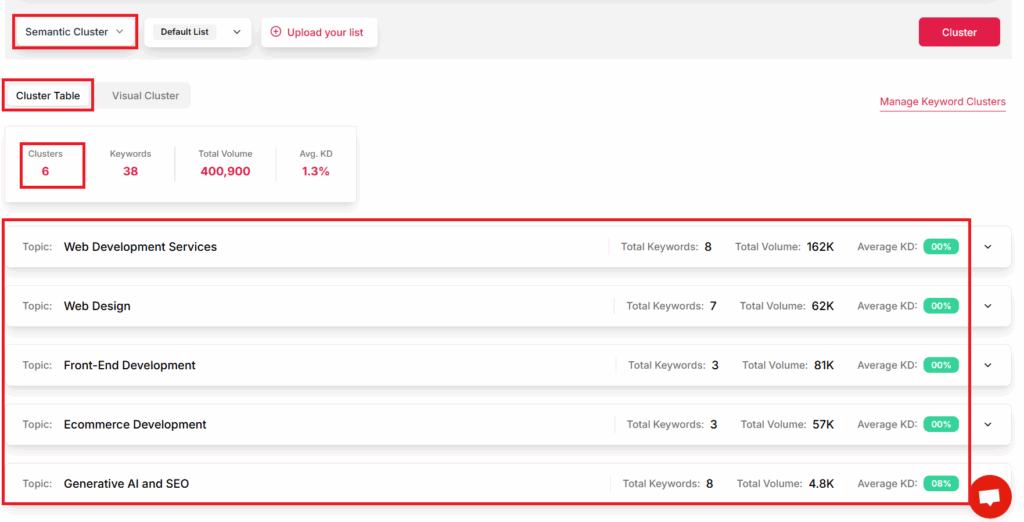
Modern SEO demands a shift from short-tail keywords to a focus on how people and AI interact with content. AI tools specializing in natural language processing (NLP) can decipher nuanced intent and semantic connections that traditional keyword planners may overlook.
Platforms like Keywordly and Google’s Natural Language API can uncover topic clusters and surface semantic variants such as synonyms, related questions, and subtopics. For example, using Keywordly’s cluster analysis, content teams have increased topical relevancy scores by up to 25%, resulting in more AI-driven search visibility. AI tools also enable the exploration of auto-generated queries—questions and phrases that users type or speak into intelligent search engines.
Identifying AI-generated queries and natural language search intent
Optimizing for AI search requires understanding how real users phrase complex questions when engaging with virtual assistants like ChatGPT. Unlike traditional search queries, these are often long-form and conversational. For instance, someone might say, “How can Keywordly help my agency create topic clusters faster?” rather than simply typing “SEO content platform.”
Analyzing conversational queries can reveal user intent, such as informational, transactional, or navigational needs. Recognizing patterns associated with voice search—such as full sentences, implied context, or follow-up queries—is critical for capturing AI-generated search opportunities. According to the Digital Marketing Institute, mapping content to AI-driven user intent is essential for higher search and discovery rates.
Mapping keywords based on searcher context and user personas
Effective AI keyword strategies stem from understanding who is searching, their goals, and their place in the decision journey. Segment keywords according to audience personas, journey stages (awareness, consideration, decision), and contextual factors, such as device or location.
Build comprehensive keyword maps that span diverse intent types to cover informational guides, how-tos, and solution comparisons. Prioritize topics based on projected AI search exposure, factoring in both keyword popularity and alignment with AI natural language results. This helps ensure broad coverage and higher relevancy for future search trends.
Competitive research: analyzing top-ranking content in AI search results
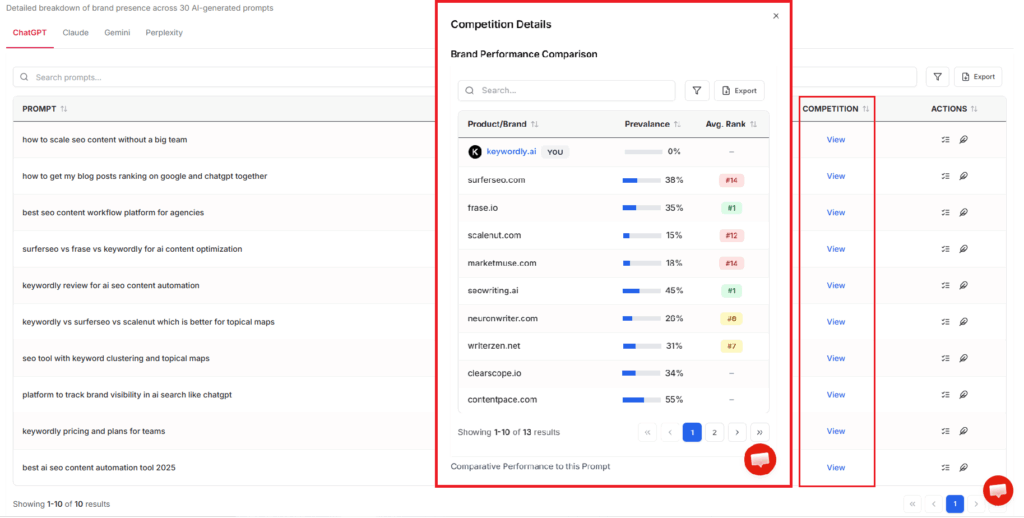
Outperforming the competition in AI search requires ongoing benchmarking and qualitative analysis. Examine top-ranking AI-driven content for target queries using tools like Keywordly. Identify content structure, depth, and supported media that enable higher rankings in Google’s new AI-powered Search Generative Experience (SGE).
Look for gaps in competitor coverage—such as missing case studies, data tables, or industry frameworks—and pinpoint opportunities to differentiate.
3. Structuring Content for Maximum AI Search Friendliness

Implementing Semantic HTML and Schema Markup for Better AI Parsing
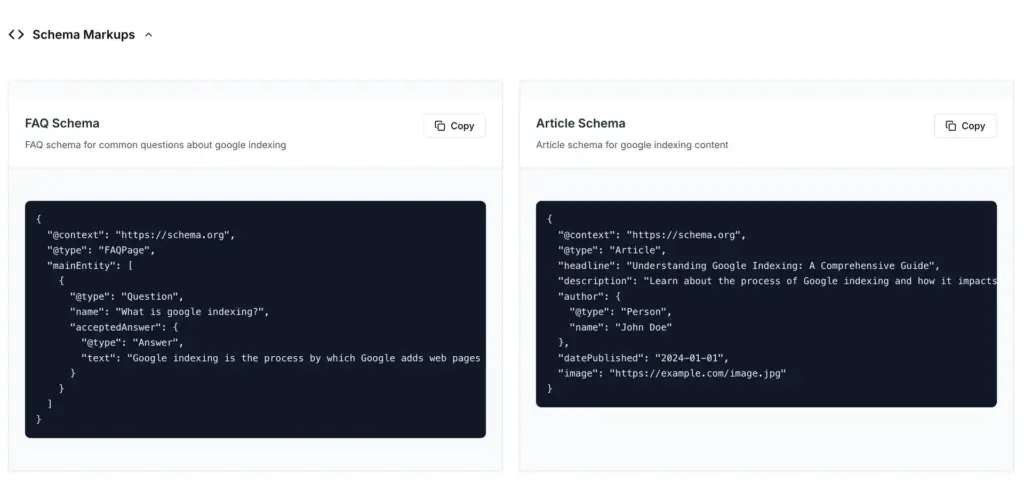
Effective content structuring begins with using semantic HTML and appropriate schema markup. These foundational techniques help AI models interpret and organize web information more accurately, directly impacting how content is ranked and displayed in search results or AI-generated answers.
“Optimizing your content for inclusion in AI search answers means structuring information the way AI consumes it—clear definitions, entity context, and direct answers supported by depth.”
Applying relevant schema types, such as Article, FAQPage, and Product, can signal content intent to search engines and chatbots. For example, The New York Times uses schema markup extensively to ensure its news articles are correctly crawled and featured in Google News, leading to greater discoverability.
Ensuring clean, semantic code—such as using the <article>, <section>, and <header> elements correctly—streamlines AI parsing. Tools like Google’s Structured Data Testing Tool help catch errors early, minimizing missed opportunities for enhanced visibility. This practice enhances data discoverability and ensures AI identifies key details, from authorship to product specifications, accurately.
Structuring Headings and Subheadings for Topic Clarity
Headings create a blueprint for both readers and AI to navigate and understand your content. Logical use of H1 through H3 tags not only improves accessibility but also helps AI pinpoint the main ideas and supporting details efficiently.
Clear, descriptive headings prevent ambiguity and enable AI assistants like ChatGPT to extract relevant answers quickly. For instance, HubSpot’s blog structure—where each post begins with a distinct H1, followed by nested H2 and H3 sections—makes their resources highly skimmable in search and Voice Search results. Such a hierarchy supports succinct, extractable data.
Creating Clear Information Hierarchies and Logical Flow
Content that follows a logical flow empowers both human readers and AI to absorb information effortlessly. Breaking topics into digestible sections, with summaries leading into detailed explanations and concrete examples, supports rapid comprehension and retention.
For example, Moz’s SEO guides often begin with a concise summary, then delve into step-by-step details followed by relevant case studies. This structure aids AI in offering context-sensitive responses, especially in conversational search scenarios.
Optimizing Tables, Lists, and Data for AI Summarization
Structured data formats, like tables and bulleted or numbered lists, allow AI to extract key points for summarization with higher accuracy. Presenting information in these formats streamlines answer generation for AI assistants and increases the likelihood of earning featured snippet spots on Google.
- Use tables to compare key product features or performance metrics. For instance, G2’s software comparison charts make differences between products easily accessible—benefitting both users and AI algorithms.
- Present concise, fact-driven points in lists to highlight benefits or steps, as seen in Backlinko’s actionable SEO checklists.
Delivering content in this structured manner ensures AI can identify, summarize, and present your core messages efficiently, improving both search visibility and user experience.
Reference:
→ tags
4. Crafting High-Quality, AI-Friendly Content
Writing with clarity, context, and conversational search in mind
Effective digital content now requires clear, accessible writing that directly addresses how people search and interact with AI tools. Search assistants like Google’s SGE and ChatGPT reward content that mirrors natural speech patterns and answers real user questions in a straightforward manner.
Using simple, direct language is key. For example, a Brand’s help center consistently uses short sentences, clear headings, and everyday terms to explain complex processes, which increases its visibility in AI-driven search results. Addressing popular conversational queries—such as “How do I automate my email campaigns?”—helps capture those exact voice or chat-based searches. Always answer each question in full, offering all details users may need within context, rather than splitting information across multiple pages.
Balancing depth of information with concise answers
Achieving the right balance between thorough, informative sections and quick, digestible summaries is critical for AI-indexed content. Longer, comprehensive paragraphs establish authority and satisfy deep-dive queries, while concise bullet points or summaries serve readers—and AI models—who need immediate answers.
For instance, HubSpot’s knowledge base pairs in-depth walkthroughs with bullet-point recaps and short answer boxes, improving both user clarity and snippet eligibility. Review each section to ask: Does it offer enough substance for detail-oriented queries, while also providing scannable information for quick search results?
Natural incorporation of AI search visibility optimization keywords
Keywords should flow naturally within contextually relevant sentences, rather than being repeated for density. This supports AI systems trained for semantic relevance and user intent. As highlighted in How to Optimize Content for AI Search and Discovery, aligning keyword usage with how users actually converse boosts AI visibility without sacrificing readability.
Using AI-powered tools to enhance readability and engagement
AI tools can refine content quality at every stage. Readability checkers such as Hemingway Editor highlight sentence complexity or passive voice. Content optimizers including Keywordly analyze engagement signals and keyword placement, suggesting specific improvements for both human and AI readers.
Some teams test content by running it through ChatGPT, checking how generative AI might paraphrase their answers for users. This surfaces potential gaps or ambiguities. Grammarly and Surfer SEO provide actionable suggestions on tone, clarity, and SEO alignment, making content more approachable and discoverable. Continual testing and iteration form best practices for staying ahead of evolving AI search preferences.

5. Improving AI Search Visibility Performance by Measuring and Utilizing AI Content Optimization Tool
Keywordly’s AI Search Visibility & Optimization Tool helps From Detection to Action
An AI search visibility optimization tool helps identify whether your content is being surfaced, cited, or ignored by AI-driven search engines. Unlike traditional SEO tools that stop at rankings and keywords, advanced AI search visibility tools like Keywordly with content optimization capabilities focus on intent alignment, entity coverage, and topical depth—the signals large language models rely on when selecting sources for AI-generated answers.
Measure Brand Visibility Across AI Search Engines With Keywordly
Modern AI search visibility starts with understanding where and how your brand appears inside AI-generated responses. Keywordly’s AI search visibility feature analyzes your brand’s presence across multiple AI platforms, helping you see whether your content is being referenced, summarized, or completely overlooked.
Instead of guessing your AI visibility, you get a clear snapshot of brand performance across AI search results, including ChatGPT, Claude, Gemini, Perplexity. This allows teams to track content visibility in AI, not just traditional SERP performance.
Prompt-Level Brand Visibility & Analysis
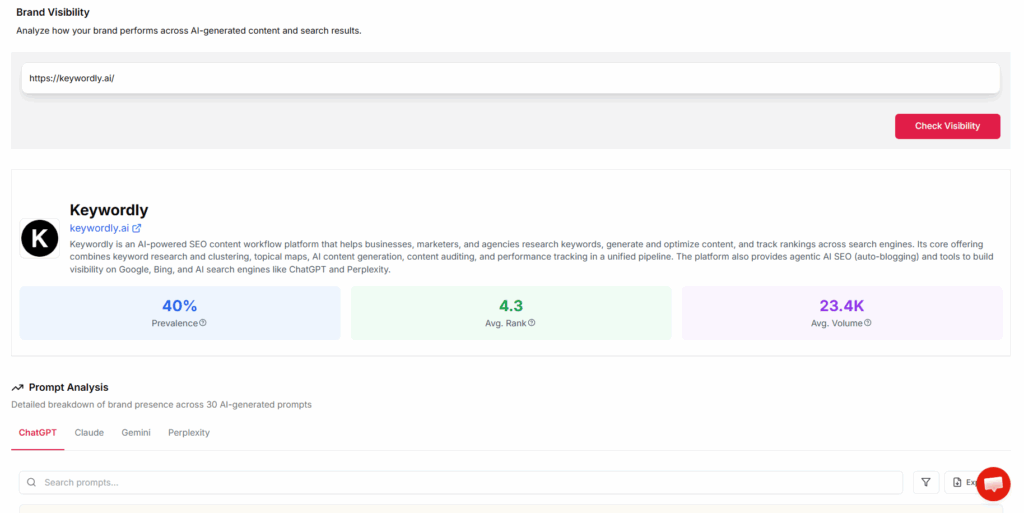
AI systems respond to prompts—not keywords. Keywordly breaks down brand visibility across 30 AI-generated prompts, revealing:
- Which prompts trigger your brand mentions
- Where competitors are cited instead of you
- How consistently your brand appears across AI search answers
This prompt analysis bridges the gap between ai content visibility and real user behavior, showing exactly how your content performs when users ask AI search engines contextual questions.
Brand Sentiment Analysis in AI Responses with Keywordly
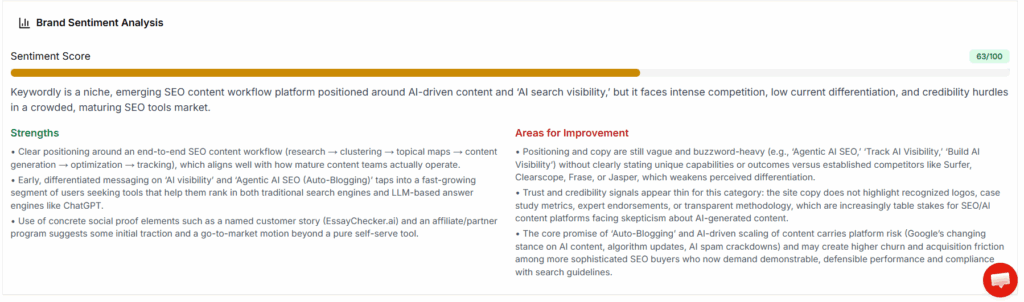
Visibility alone isn’t enough—how AI describes your brand matters. Keywordly includes brand sentiment analysis with a sentiment score, helping you understand whether AI-generated responses position your brand positively, neutrally, or negatively.
This insight is critical for companies focused on thought leadership visibility in AI search, where tone, trust, and authority directly influence inclusion.
AI Content Optimization Based on LLM Signals with Keywordly
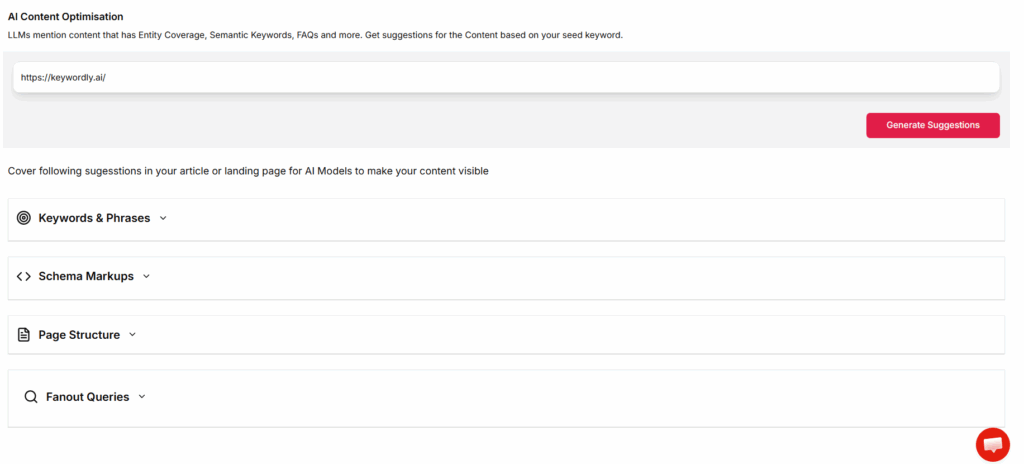
Large language models tend to mention content that demonstrates strong entity coverage, semantic keyword relationships, and clear question-answer structures. Keywordly’s AI content optimization feature analyzes your pages against these LLM signals and provides content recommendations based on your seed keyword.
This helps teams move from asking:
“Does AI content optimization improve search visibility?”
to confidently implementing strategies that do.
You receive actionable suggestions such as:
- Missing semantic keywords and entities
- FAQs that improve inclusion in AI search answers
- Content depth gaps that reduce AI citation potential
AI Readiness Audit for Pages & Technical Barriers with Keywordly
Even well-written content can fail in AI search if technical issues block AI crawlers or LLM training systems. Keywordly’s AI readiness audit performs an advanced analysis of your web pages to assess readiness for AI crawlers, Search engines, LLM training pipelines
The audit identifies:
- Technical issues preventing AI bots from indexing content
- Semantic keyword gaps
- Content opportunities aligned with AI search intent
- Page-level recommendations to improve AI discoverability
This ensures your AI search visibility optimization efforts are not undermined by hidden technical or structural barriers.
Why Keywordly’s AI Search Visibility Tools Matters to Brands
As AI search continues to evolve, tools that combine visibility tracking, sentiment analysis, content optimization, and AI readiness audits become essential. Instead of relying solely on keyword rankings, Keywordly AI search visibility optimization tools enable teams to systematically improve visibility in AI search results by aligning content with how LLMs select, summarize, and cite information.
“Without visibility into how AI search engines surface or ignore your content, optimization efforts rely on assumptions rather than measurable signals.”
Read thie Article : Why Keywordly.ai Is the Best Grok Alternative: 10 Proofs
Read thie Article : Top 10 LLM Visibility Tools Every Brand Should Know
6. Enhancing E-E-A-T and Trustworthiness for AI Search
Demonstrating Experience, Expertise, Authoritativeness, and Trustworthiness
Content that ranks well on both Google and AI search platforms must reflect strong E-E-A-T signals. Showcasing the depth and reliability of your expertise reassures both users and algorithms that your material can be trusted.
“Thought leadership visibility in AI search is driven less by how much content you publish and more by which questions your competitors leave unanswered.”
Citing Credible Sources and Author Profiles
Reliable, transparent sourcing is key to building trust with both readers and AI algorithms. Linking to peer-reviewed studies and recognized industry sites like HubSpot or Search Engine Journal builds authority.
Well-crafted author profiles reinforce authenticity. For instance, at Keywordly, each content piece features an author section linking to LinkedIn profiles and a summary of professional experience. This transparency allows users to assess the background of the information provider and reduces skepticism.
Directly linking to original research—such as sharing Google’s Search Quality Evaluator Guidelines or referencing Nielsen’s Trust in Advertising report—strengthens content legitimacy and supports claims with verifiable data.
Managing Brand Reputation and Online Reviews
Building and protecting brand reputation impacts how search engines and AI tools weigh your trustworthiness. Proactively engaging with customer reviews on platforms like G2 and Trustpilot shows responsiveness and care.
Maintaining brand consistency across your website, social channels, and third-party listings helps eliminate confusion and build reliability. For instance, tools like Yext or BrightLocal support unified presence management, reducing the risk of outdated or contradictory information.
If criticism arises, addressing negative feedback with genuine concern and actionable resolutions matters. Adobe’s response to Creative Cloud outages by offering compensation credits is a real-world example of transparent issue management fostering long-term trust.
Incorporating First-Hand Case Studies and Client Testimonials
Rich, first-hand accounts provide persuasive proof of your expertise. Case studies showing how Keywordly helped eCommerce brands increase blog rankings by 47% over two quarters offer tangible results.
Customer testimonials—such as a statement from Digital Marketing Institute highlighting their improved content workflow using the platform—showcases authentic satisfaction. Multimedia, like short video interviews or interactive charts comparing results, adds more authenticity and engagement to these endorsements.
Where possible, include names, logos, and direct quotes to boost credibility. If working with NDA clients, note the limitation rather than presenting generic examples, maintaining transparency and integrity throughout.
7. Optimizing for Multi-Modal and Conversational AI Search

Adapting content for voice assistants and chat-based search
Creating content that caters to voice assistants like Google Assistant, Siri, and Alexa requires adapting to how people actually speak, not just how they type. Voice search queries tend to be longer and more conversational, increasing the importance of matching natural language and anticipating follow-up questions.
One effective strategy is to structure content using clear and concise FAQs. For example, Domino’s Pizza saw increased orders by enabling voice-activated pizza ordering through Alexa and Google Home, using succinct, conversational prompts and answers. Focus on providing direct, voice-friendly answers that are easy for AI to read aloud, such as “The nearest pharmacy is Walgreens at 123 Main Street, open until 10 p.m.” This enhances discoverability and usability on voice-driven platforms.
Including spoken-language variations—like “What’s the weather like” in addition to “weather forecast”—helps match the broad spectrum of user phrasings. Tailoring content for voice snippets, such as providing definitions or single-sentence answers, increases the chance of selection by Google Assistant’s voice snippets or Bing’s conversational results.
Formatting answers for featured snippets and instant answers
Optimizing for featured snippets and instant answers is crucial for visibility in both search engines and conversational queries. Concise, well-formatted content elevates the chance of selection for these high-value SERP placements.
- Use bullet and numbered lists to answer step-by-step or multi-part questions. For example, HubSpot formatted their “how to start a blog” guide as a numbered list, increasing their snippet presence.
- Tables work well for comparisons or specifications—Ahrefs often uses tables in their content to win SERP tables for “best SEO tools.”
- Place the most direct answers high within your content to optimize for quick retrieval by AI assistants and chatbots.
- Maintain factual accuracy and clarity, citing credible sources when possible. Inaccurate or unclear answers decrease both trust and ranking potential.
Optimizing for images, video, and multimedia discovery
AI search is increasingly multi-modal, surfacing images, videos, and other media alongside text responses. To capitalize on this, content should be tagged and structured to increase media discoverability by search engines and AI assistants.
Always tag images with detailed, descriptive alt text. For example, Zillow uses alt attributes to describe property images, which improves their visibility in Google Image Search and in visual search results on platforms like Google Lens. Implement schema markup for images and videos so that search engines can understand and feature your media in rich results.
High-quality media support your textual answers and drive engagement. Investing in unique data visualizations, infographics, or tutorial videos—like those on Moz’s Whiteboard Friday—provide users with multiple avenues to discover and interact with your content.
Ensuring accessibility and mobile optimization for AI devices
Optimizing for AI-driven and voice-operated devices requires a commitment to accessibility and cross-device usability. This expands reach to users interacting with content on mobile phones, smart speakers, and assistive technologies.
Implement responsive design practices so content displays well on any device. Google’s Mobile-Friendly Test tool is widely used to identify and resolve mobile usability issues. Ensure compliance with the Web Content Accessibility Guidelines (WCAG) to make content navigable for users with disabilities—Starbucks, for example, revamped its site to achieve high accessibility ratings. Always test your site on a range of devices, from smartphones to smart displays, to uncover issues before they impact user experience or search rankings.
Conclusion
Recap and Actionable Next Steps
As digital search continues its rapid transformation, optimizing for AI-driven search engines and assistants has become a linchpin of content strategy. Google’s Search Generative Experience, Microsoft’s Copilot integration, and OpenAI’s ChatGPT have all redefined what it means to achieve “visibility” in search.
Leveraging AI-powered research and content platforms like Keywordly equips businesses to keep pace with these evolving standards. Keywordly, for example, analyzes live AI model outputs to uncover unique optimization opportunities that traditional SEO tools may overlook.
Highlight the Evolution Towards AI Search Visibility Optimization
Optimizing for AI search is not just about keywords—it’s about context, topical authority, and structured data that appeal to generative models. For example, Expedia has improved its presence in travel-focused AI results by structuring property data for better integration with generative search answers.
Recognizing these shifts enables marketers to tailor content that’s discoverable on both traditional SERPs and emerging AI search interfaces.
Action Plan: Steps for Future-Proof Content Optimization
Most websites fail in AI search not because of poor content quality, but because of content gaps. To increase thought leadership visibility in AI search, prioritize gaps where users ask “why” and “how,” not just “what.”
A strategic, AI-centric approach to SEO goes beyond basic updates. Effective steps to secure long-term visibility include:
- Audit existing content across platforms using a tool like Keywordly’s Content Auditor. This identifies gaps and missed opportunities tied to AI search snippets.
- Prioritize context-rich and structured content. For example, companies like HubSpot have adopted schema markup and in-depth FAQ sections to boost their appearance in Google’s AI-generated overviews.
- Continuously monitor AI search trends. Stay updated by tracking model changes and SERP experiments—Semrush’s Sensor is a helpful resource for these insights.
- Adopt an iterative optimization workflow. Use platforms like Keywordly that offer AI-powered recommendations based on live search and LLM outputs.
Failing to address these steps can result in lost traffic as AI models heavily influence user journeys and answer selections. Troubleshoot by benchmarking against known industry leaders and reevaluate your approach every quarter.
“As AI search adoption grows, visibility will increasingly belong to brands that optimize for understanding, not just indexing.”
Read thie Article : Why Keywordly.ai Is the Best Grok Alternative: 10 Proofs
Read thie Article : Perplexity Alternatives: 10 AI Tools for Content Research
FAQs
What is AI search visibility optimization and how does it differ from traditional SEO?
AI search visibility optimization targets how brands and content are discovered by AI-powered search engines and conversational platforms like ChatGPT or Google SGE. Unlike traditional SEO, which focuses primarily on search engine ranking factors such as keyword presence, backlinks, and metadata, AI optimization accounts for natural language understanding, context, and the intent behind user queries.
How soon should businesses start optimizing content for AI-powered search results?
The shift towards AI-driven search has accelerated in 2023 and 2024, making immediate action essential for those aiming to maintain visibility. AI-powered search results, like those in Bing Chat or Google’s SGE, are already surfacing in user queries and impacting traffic for publishers.
Which AI search visibility optimization tools are best for beginners and advanced users?
Keywordly offers an all-in-one platform versatile enough for both beginners and advanced users, featuring research, optimization, and auditing workflows tailored for AI visibility.
How does voice search and conversational AI impact content strategies?
Voice search and conversational AI require content to be structured for natural dialogue, using question-based headings and concise answers. Search queries are longer and more conversational; for example, “What’s the best way to reduce churn in SaaS?” rather than “reduce churn SaaS.” Pages optimized for featured snippets, FAQ schemas, and direct answers typically perform better in voice results.
When will AI-based search overtake traditional search engine ranking factors?
While AI-based search is rapidly advancing, traditional ranking factors like backlinks and technical SEO still play a significant role.
However, a full shift will be gradual. The rollout of Google’s SGE and Bing’s Copilot integration marks major milestones, but foundational SEO remains important during this transition.
Why is E-E-A-T crucial for AI search visibility and how can brands improve theirs?
Expertise, Experience, Authoritativeness, and Trustworthiness (E-E-A-T) ensure content surfaces in AI-generated answers and recommendations. AI models are trained to pull data from high-E-E-A-T sources.
Brands can improve E-E-A-T by displaying expert bios, citing reputable sources, and maintaining transparent content practices. Including structured data, author credentials, and clear sourcing cues algorithms to recognize content as reliable—critical for capturing AI-driven visibility.