Tag: AI Content Creation

  • How to Build an SEO Content Workflow from Scratch

    How to Build an SEO Content Workflow from Scratch

    how to build an SEO content workflow from scratch step by step | Updated September 2026 | By the Keywordly Editorial Team | 3-4 weeks to first full cycle | Beginner

    What You’ll Learn: How to Build an SEO Content Workflow from Scratch Step by Step

    This guide walks you through a proven five-phase system for building an SEO content workflow from scratch. By the end, you’ll know how to execute the exact sequence, audit content and set measurable goals, build keyword research foundations, turn research into actionable briefs, write and optimize content that ranks, and track performance to keep pages competitive.

    Prerequisites: Access to Google Search Console, a spreadsheet or project management tool, and at least one person responsible for writing or editing content.


    Why Building an SEO Content Workflow Matters in 2026

    Search is no longer one thing. Google, AI Overviews, and chat-based engines all compete for attention now. Content without a system behind it dies quietly because pages published in isolation are never refreshed or linked internally. Median SEO ROI sits at 748% for teams that treat content as a process, while 96.55% of pages get zero Google traffic because ranking requires research, intent-matching, and follow-up refreshes.

    Companies that blog consistently see 67% more leads per month, and organizations that publish 6 to 8 SEO-optimized posts per month build effective topic clusters within 6 to 12 months. A workflow is what makes that consistency possible.

    With 88% of digital marketers now using AI daily and 96% of content marketers having adopted AI tools, a modern SEO content workflow must account for AI-assisted research, drafting, and auditing from day one. For supporting data, see SEO Workflow: How To Build A System That Drives Results ….


    The Process at a Glance

    Step Action Time Outcome
    1 Audit existing content and set clear goals 2-3 days Baseline metrics and documented objectives
    2 Research keywords and build topic clusters 3-5 days Prioritized keyword map organized by intent
    3 Create content briefs and editorial calendar 2-4 days Repeatable brief template and publishing schedule
    4 Write, optimize, and publish content 3-7 days per piece Published pages matching search intent and E-E-A-T
    5 Track performance and refresh content Ongoing, monthly review Data-driven refresh and repurposing schedule

    Total time to first full cycle: roughly 3-4 weeks from audit to first published, optimized article.


    Step 1: Audit Your Current Content and Set Clear Goals

    What You’re Doing

    Before creating anything new, you need to know what already exists and how it’s performing. Skipping this step is the single most common reason SEO content workflows stall within the first month — teams start publishing without knowing what success looks like.

    How to Do It

    1. Export a full list of existing URLs from Google Search Console, including impressions, clicks, and average position for the last 12 months.
    2. Tag each page by topic, funnel stage, and performance tier (top performer, mid, underperforming, zero traffic).
    3. Define 2-3 measurable goals for the workflow — organic traffic growth, keyword rankings in a specific cluster, or qualified lead volume.
    4. Document your findings in a shared spreadsheet or platform like Keywordly, which centralizes content auditing alongside research and optimization.

    Best Practices

    What Done Looks Like

    You have a documented spreadsheet of existing content tagged by performance and topic, plus 2-3 written goals the entire team agrees on before any new content is planned. For a more detailed walkthrough, see How to Do a Content Audit: Step-by-Step Checklist.


    Step 2: Research Keywords and Build Topic Clusters

    What You’re Doing

    You’re taking raw keyword data and organizing it by search intent and business value. Skip this, and your briefs will be vague, writers will guess, and content won’t rank.

    How to Do It

    1. Identify 3-5 core topics (“pillars”) relevant to your business, then use a research tool such as Keywordly’s AI-powered research features or Ahrefs to pull related keywords for each pillar.
    2. Categorize every keyword by funnel stage (awareness, consideration, decision) and business value (high, medium, low).
    3. Group keywords into topic clusters — a group of interlinked content pieces centered around a broad “pillar” topic, with supporting subtopic pages that all link back to it.
    4. Route high-value, commercial-intent keywords to your most experienced writers and place them through stricter review.

    Example

    Cluster Funnel Stage Business Value Content Type
    “SEO content workflow” Consideration High Pillar guide + template
    “content brief template” Consideration Medium Supporting how-to article
    “how often to publish blog posts” Awareness Low Short FAQ-style post

    Best Practices

    What Done Looks Like

    You have a keyword map with every keyword assigned to a cluster, a funnel stage, and a priority level, ready to be turned into content briefs.

    To help you navigate the process of researching keywords and building effective topic clusters, here’s a video that provides practical insights and tips.


    Step 3: Create Content Briefs and an Editorial Calendar

    What You’re Doing

    You’re translating keyword research into clear briefs and establishing a realistic publishing cadence that your team can sustain.

    How to Do It

    1. For each planned article, document the target keyword, search intent, competitor pages currently ranking, required subtopics, and word count target.
    2. Add an “information gain” requirement — one specific thing your page will cover that competitors don’t.
    3. Assign each brief to a writer with a due date using a shared calendar. Keywordly can generate briefs automatically from your clustered keyword data, cutting manual research time.
    4. Schedule publishing at a sustainable cadence. Most teams find 6-8 optimized posts per month realistic for building cluster authority within 6-12 months.

    Best Practices

    • Keep briefs to one page or less so writers don’t skip them.
    • Build in a review checkpoint before writing begins to catch scope or intent mismatches early.

    What Done Looks Like

    Every upcoming article has a completed brief and an assigned publish date at least two weeks before it’s due.


    Step 4: Write, Optimize, and Publish Content

    What You’re Doing

    You’re taking the brief and turning it into a finished page that satisfies search intent, is easy to read, and optimizes for both traditional rankings and AI Overview citation.

    How to Do It

    1. Draft the article following the brief’s structure. Lead with a direct answer to the primary query in the first paragraph or section.
    2. Apply on-page optimization: title tag, meta description, header hierarchy, internal links to related cluster content, and schema markup where relevant.
    3. Run an E-E-A-T check. E-E-A-T stands for Experience, Expertise, Authoritativeness, and Trustworthiness.
    4. Use an optimization tool such as Keywordly’s content optimization workflow to compare your draft against top-ranking competitors before publishing.

    Best Practices

    Common Mistakes

    Publishing AI-drafted content without human review is risky. 59% of digital media professionals worry about AI content inaccuracies and hallucinations harming brand quality, so every draft needs a fact-check pass before publication.

    What Done Looks Like

    The article is live, internally linked to its cluster, passes an on-page SEO checklist, and reads as though a subject-matter expert wrote it.


    Step 5: Track Performance and Refresh Content

    What You’re Doing

    This ongoing step is where most teams drop the ball. You’re establishing a monthly review cycle to make data-driven decisions on refreshes, consolidations, or retirements.

    How to Do It

    1. Connect Google Search Console and Google Analytics 4 data to your content calendar so each article’s rankings and traffic are visible in one place.
    2. Set alerts or a monthly review to flag pages with declining rankings or traffic drops, turning them into refresh candidates automatically.
    3. Use Keywordly’s performance tracking and AI visibility monitoring to see how content performs across AI-driven platforms like ChatGPT.
    4. Prioritize refreshes for pages ranking on page two (positions 11-20), which often need only modest updates to move to page one.

    Example

    Signal Likely Action
    Traffic dropped 20%+ month over month Refresh content and check for new competitor pages
    Ranking stuck at position 12-18 Add missing subtopics, update internal links
    Zero clicks after 6 months Consolidate into a stronger cluster page or retire

    What Done Looks Like

    You have a recurring monthly cadence where every underperforming page gets reviewed, and refresh decisions are based on data rather than instinct.


    What to Do After Building the Workflow

    Phase 1 — Stabilize (Months 1-2): Run the five-step cycle consistently, refining brief templates and review checkpoints based on what slows the team down.

    Phase 2 — Scale (Months 3-6): Add more writers or automate repetitive research and optimization tasks using AI-assisted tools. 65% of marketers say AI tools improved their SEO performance when applied within a structured workflow.

    Phase 3 — Expand into AI Search (Months 6+): Extend the workflow to track and improve visibility inside AI Overviews and chat-based answer engines. 44% of consumers now call AI their primary search source.


    Resources You’ll Need

    Resource Role Requirement Price
    Keywordly All-in-one workflow platform for research, briefs, optimization, and AI visibility tracking Recommended Paid plans
    Google Search Console Baseline performance data and indexing checks Required Free
    Google Analytics 4 Traffic and conversion tracking Required Free
    Ahrefs Keyword research and backlink analysis Optional Paid
    monday.com or similar project tool Editorial calendar and task assignment Optional Free tier available

    See also, see SEO Process: 7 steps of succesful Search Engine ….


    Common Plateaus & How to Break Through

    Content is published but rankings stay flat

    Likely cause: The content matches search intent poorly or lacks information gain compared to competitors. Fix: Revisit the brief, add original data, expert insight, or a clearer framework the top-ranking pages don’t have.

    The team can’t keep up with the publishing calendar

    Likely cause: Briefs are too vague, forcing writers to spend hours on research that should have happened in Step 2. Fix: Tighten brief templates and shift keyword research and outlining into an automated workflow tool.

    Traffic is growing but leads or conversions aren’t

    Likely cause: Content is skewed toward top-of-funnel, awareness-stage keywords with low business value. Fix: Rebalance the keyword map toward consideration and decision-stage clusters.

    Older articles are quietly losing traffic

    Likely cause: No refresh cadence exists, so pages age against increasingly aggressive competitor updates. Fix: Implement the monthly review from Step 5 and treat refreshes as equally important as new publishing. For more troubleshooting advice, see A creator’s guide to SEO content strategy.


    Conclusion

    Building an SEO content workflow from scratch comes down to five connected phases: audit and set goals, research and cluster keywords, brief and schedule content, write and optimize for publication, then track and refresh based on real data. Skipping any single phase — especially tracking — is why so much content quietly fails to compound.

    Key Takeaways

    • A documented, five-step workflow turns inconsistent publishing into a repeatable system that compounds traffic and leads over time.
    • Prioritizing keywords by business value and intent, not just volume, is what separates workflows that convert from ones that just generate traffic.
    • Audit your existing content this week and write down two measurable goals before creating anything new.

    FAQ

    How do you build an SEO content workflow from scratch step by step?

    You build an SEO content workflow from scratch by first auditing existing content and setting measurable goals, then researching keywords and organizing them into topic clusters, creating standardized content briefs and an editorial calendar, writing and optimizing content against those briefs, and finally tracking performance monthly to decide what gets refreshed. This five-phase sequence typically takes 3-4 weeks to complete once and then becomes an ongoing monthly cycle.

    How long does it take to see results from a new SEO content workflow?

    Most teams see initial ranking movement within 3-6 months, with meaningful content marketing results typically taking 3-6 months to materialize, and full topic cluster authority building over 6-12 months of consistent publishing.

    How many articles should I publish per month to build an SEO content workflow?

    Publishing 6 to 8 SEO-optimized posts per month builds effective topic clusters within 6 to 12 months, though smaller teams can start with 2-4 per month and scale once the workflow is stable.

    What tools do I need to start an SEO content workflow from scratch?

    At minimum you need Google Search Console and Google Analytics 4, plus a keyword research source and a shared calendar. An all-in-one platform like Keywordly can consolidate research, briefing, optimization, and performance tracking into a single workflow.

    What is the difference between an SEO content workflow and an editorial calendar?

    An editorial calendar is just the scheduling layer showing what publishes when, while a full SEO content workflow includes the upstream research, clustering, and brief creation plus downstream performance tracking and refresh decisions.

    How do I keep an SEO content workflow consistent with a small team?

    Standardize your brief template so research and structure decisions happen once per topic cluster rather than per article, and use automation for repetitive tasks like keyword clustering and on-page checks so a small team can maintain a steady publishing cadence.

    Should AI be part of an SEO content workflow in 2026?

    Yes — 96% of content marketers have adopted AI tools in some part of their workflow, but success depends on having a structured process around the AI output, not the tool itself.

    How do you measure whether an SEO content workflow is working?

    Track organic traffic, keyword rankings by cluster, and conversion or lead data monthly. Only 36% of leaders can currently measure content ROI accurately, making consistent measurement itself a competitive advantage.


    This guide was compiled using publicly available 2026 industry research on SEO and content marketing performance, combined with established SEO workflow frameworks. Individual results vary based on niche competitiveness, publishing consistency, and team resources; treat all timeframes as directional estimates rather than guarantees.

  • How to Automate SEO Content Creation with AI Agents in 2026

    How to Automate SEO Content Creation with AI Agents in 2026


    How to Automate SEO Content Creation with AI Agents in 2026 | Updated August 2026 | Keywordly Editorial Team | 2–4 hours to implement | Beginner

    What You’ll Learn

    By the end of this guide, you’ll understand how to automate SEO content creation with AI agents in 2026 by building a five-stage pipeline that handles keyword research, content briefing, AI drafting, on-page optimization, and performance monitoring. Here’s what you’ll be able to do:

    • Set up an end-to-end AI content pipeline from keyword to published article.
    • Reduce manual production time while maintaining E-E-A-T quality standards.
    • Structure content for both traditional Google rankings and AI-driven answer engines.
    • Monitor and refresh published content automatically so it never goes stale.

    Prerequisites: Basic familiarity with SEO concepts; access to at least one AI content platform; a CMS such as WordPress or Webflow.


    Why Automating SEO Content Creation Matters in 2026

    In 2026, the most effective AI SEO software acts as an autonomous digital employee that executes end-to-end workflows rather than just suggesting text. SEO professionals who historically spent hours on repetitive tasks can now move that work to agents and get it done in minutes.

    According to BCG research, teams using agentic AI reduce low-value SEO work by 25–40% and accelerate content production cycles by 30–50%. Companies utilizing AI for SEO have reported up to a 70% increase in organic traffic. AI can automate roughly 40% of SEO tasks, freeing up your team for work that requires human judgment.

    The bigger shift: traditional strategies centered on rankings are giving way to Generative Engine Optimization (GEO) and Answer Engine Optimization (AEO). These approaches focus on structuring content so AI agents can parse it, understand it, and cite it directly. Building an automated content pipeline is no longer just an efficiency play — it’s a competitive necessity. For supporting data, see How to Use AI Agents for Content Marketing.


    The Process at a Glance

    Step Action Time Outcome
    1 Automate keyword research and clustering 30–60 min setup Prioritized topic cluster ready
    2 Generate data-driven content briefs 5–10 min per brief Structured brief with headings and intent
    3 Draft and optimize content with AI agents 15–30 min per article SEO-ready draft requiring light editing
    4 Apply on-page and GEO optimization 15–20 min per article Article structured for Google and AI engines
    5 Automate publishing and performance monitoring 1–2 hours setup; ongoing Continuous ranking data and refresh triggers

    Total estimated time: 2–4 hours of setup; ongoing workflow runs largely on auto-pilot after configuration.


    Step 1: Automate Keyword Research and Topic Clustering

    What You’re Doing

    You’re replacing manual keyword spreadsheets with an automated discovery and clustering process that surfaces ranked, intent-tagged keyword opportunities organized into topic clusters your content pipeline can act on directly.

    How to Do It

    1. Connect a keyword data source — Ahrefs, Semrush, or Google Search Console — to your workflow platform. These tools provide live search volume and difficulty figures that raw AI models cannot produce. Confirm each figure in these tools before building a content plan around it.
    2. Feed your seed keywords and competitor URLs into the platform and let the AI agent expand them into 50–100 raw ideas, then group by search intent automatically.
    3. Flag clusters with AI Overview coverage. AI Overview is a generative AI feature in Google Search that provides summarized answers at the top of the SERP. Clusters with high AI Overview presence should be treated as citation-priority targets — they require answer blocks, FAQPage schema, and question-based heading structure.
    4. Prioritize clusters by traffic potential, competition level, and topical authority gaps on your domain. Export the priority list as a trigger for Step 2.

    Example: Keyword Cluster Priority Table

    Cluster Intent Est. Monthly Volume AI Overview Present? Priority
    AI SEO automation tools Commercial 4,400 Yes High
    How to automate content publishing Informational 1,600 Yes High
    Best AI writing tools for SEO Commercial 3,200 No Medium
    SEO content audit checklist Informational 880 No Medium

    Best Practices

    • Teams publishing at scale in 2026 automate keyword research — they’ve built repeatable workflows that handle the volume work and reserve human judgment for prioritization, angle selection, and positioning.
    • Run discovery-to-clustering quarterly minimum, and trigger a partial refresh whenever a competitor publishes against one of your priority clusters.

    What Done Looks Like

    You have a prioritized keyword cluster list, tagged by intent and AI Overview presence, feeding automatically into your content briefing queue. For a more detailed walkthrough, see AI Agents in SEO: Keyword Research Automation.


    Step 2: Generate Data-Driven Content Briefs Automatically

    What You’re Doing

    You’re turning a prioritized keyword cluster into a structured content brief — complete with target keywords, recommended word count, heading structure, and internal linking strategy — without opening a single competitor URL manually.

    How to Do It

    1. Connect your keyword pipeline output to an AI briefing tool. Keywordly handles this step, pulling SERP data and generating a structured brief for each cluster in the queue.
    2. Configure the agent to analyze top-ranking pages for your target keyword. A well-configured agent analyzes the top 20 SERP results, identifies content gaps, clusters related keywords, and maps entities that top-ranking content covers — delivering competitive landscape analysis in minutes instead of hours.
    3. Review the auto-generated brief for accuracy of intent match. Confirm that the heading structure answers the searcher’s real question.
    4. Add brand-specific angle, proprietary data, or expert quote placeholders the agent cannot produce. This is where human editorial judgment adds irreplaceable value.

    Best Practices

    • Keep briefs modular — one brief per article — so the pipeline can generate multiple articles in parallel.
    • Start every brief with search intent and page goal, then build around audience, angle, tone, and required proof points.

    Common Mistakes

    • Skipping intent verification: One of the largest AI SEO mistakes is creating content without mapping search intent. An AI agent can match your keyword, but you must confirm the brief reflects what the searcher actually wants to accomplish.

    What Done Looks Like

    Each article in your queue has a complete brief — keyword targets, heading skeleton, recommended word count, and internal link anchors — ready to feed into the drafting agent.


    Step 3: Draft and Refine Content with AI Agents

    What You’re Doing

    You’re using an AI drafting agent to turn the structured brief into a full article, then applying a human editorial pass that adds experience, accuracy, and brand voice before publication.

    How to Do It

    1. Real SEO content production is a chain — keyword research, SERP analysis, gap analysis, outline, drafting, internal linking, citations, and formatting. You can use AI agents to run the full chain. Pass the brief into your AI drafting agent and let it work.
    2. Use Keywordly’s automated content workflow to generate the draft with your brand’s voice guidelines built in, keeping the output consistent across every article.
    3. Perform mandatory human editorial review. Relying on AI to create content without review can lead to generic, inaccurate, or misleading material that undermines trust with both search engines and readers. Treat AI as an assistant, not a replacement.
    4. Inject first-hand experience, expert perspectives, or proprietary data points that AI cannot generate. AI-generated content may lack E-E-A-T signals — Experience, Expertise, Authoritativeness, and Trustworthiness — which search engines increasingly value.

    Best Practices

    • AI tools accelerate research and automate repetitive tasks; successful SEO teams combine AI-driven tools with human expertise.
    • Set a maximum revision budget: aim for 20–30 minutes of human editing per article. If a draft consistently needs more, revisit the brief quality or agent prompt configuration.

    Common Mistakes

    • Publishing raw AI output: Raw AI content consistently lacks E-E-A-T signals. It contains no first-hand experience, no unique perspective, and often includes subtle factual errors. Always fact-check before publishing.

    What Done Looks Like

    You have a human-reviewed, brand-consistent draft that includes original insight, verified statistics, and a natural internal linking structure — ready for on-page optimization.


    Step 4: Apply On-Page and GEO Optimization Automatically

    What You’re Doing

    You’re running each reviewed draft through an optimization layer that ensures proper meta tags, heading hierarchy, schema markup, and internal links — all automatically applied before the article reaches your CMS.

    How to Do It

    1. Auto-generate meta titles, meta descriptions, and Open Graph tags from the draft content. These fields follow consistent, rule-based patterns ideal for automation.
    2. Apply schema markup automatically. Automatically adding schema markup — FAQs, HowTos, and rich snippets — to pages helps them qualify for rich results without manual coding.
    3. Structure content for GEO. Generative Engine Optimization (GEO) is the practice of optimizing content for AI-driven search engines and answer engines like ChatGPT and Perplexity. AI agents structure content with high information gain and factual density that AI models prefer.
    4. Run an automated internal link check. The agent should scan your existing content library and suggest or insert relevant internal links based on topical relevance and anchor text diversity.
    5. Push the optimized article to your CMS staging environment via API. Keywordly connects to common CMS platforms so the handoff from optimization to staging is handled without manual copy-pasting.

    Example: On-Page Optimization Checklist (Auto vs. Manual)

    Task Handled By Human Review Needed?
    Meta title and description generation AI agent Quick spot-check
    FAQ and HowTo schema markup AI agent No
    Internal link insertion AI agent Yes — verify anchor relevance
    Expert quote / E-E-A-T signals Human editor Yes — always
    CMS upload and formatting AI agent via API Final visual check

    What Done Looks Like

    The article is staged in your CMS with correct meta tags, structured data, internal links, and GEO-optimized formatting — requiring only a final visual check before publishing.


    Step 5: Automate Publishing, Monitoring, and Content Refresh

    What You’re Doing

    You’re closing the loop by connecting your publishing workflow to a monitoring layer that tracks ranking movements, flags underperforming content, and triggers automated refresh cycles — so every published article continues to earn traffic over time.

    How to Do It

    1. Schedule publishing through your CMS API or a workflow automation tool such as n8n or Make.
    2. Connect your published URLs to a rank-tracking dashboard. By 2026, you can pull keyword rankings, AI visibility stats, and engagement data from different CMS tools into one clean dashboard — no more jumping between tabs.
    3. Set automated refresh triggers. Agents monitor published content and update it automatically when rankings drop. Configure a threshold — for example, a drop of five or more positions — that triggers an automatic content audit and re-optimization task back into the pipeline.
    4. Track AI engine visibility alongside traditional rankings. Monitor whether your articles are being cited in Google AI Overviews, ChatGPT, Perplexity, or Gemini. Tools like Ahrefs Brand Radar track AI citations across multiple AI engines, monitoring 343 million+ prompts monthly.

    Best Practices

    • Define KPIs beyond simple rankings. Include AI answer engine visibility and click-through trends so you can see how people interact with your content.
    • Scale from 5 to 50 articles a month without adding headcount by ensuring the monitoring layer feeds back into your pipeline, creating a self-sustaining content engine.

    What Done Looks Like

    Your pipeline publishes on schedule, reports ranking and AI visibility data to a single dashboard, and automatically queues underperforming articles for re-optimization — without your intervention.


    What to Do After Completing the Pipeline Setup

    Phase 1 — Validate and calibrate (weeks 1–4): Monitor your first 10 published articles closely. Compare actual performance against brief-level traffic estimates. Adjust your keyword prioritization criteria and brief template based on what the data shows.

    Phase 2 — Scale production (months 2–3): Treat keyword outputs as triggers for downstream automation — a prioritized keyword cluster enters the system, and the pipeline generates a brief, drafts the article, and routes it for review and publication. Once individual steps are stable, increase volume incrementally — add 5–10 additional articles per month and watch for quality degradation signals.

    Phase 3 — Optimize for GEO and AI citation (month 3+): Shift focus from pure ranking metrics to AI citation share. Audit which articles are being cited in AI Overviews, identify the structural patterns they share (FAQ blocks, direct definitions, named entities), and systematically apply those patterns to your briefing template.


    Resources You’ll Need

    Resource Role in This Workflow Status Price
    Keywordly All-in-one SEO content automation platform: briefing, drafting, optimization, and publishing pipeline Recommended See website
    Ahrefs Keyword data validation and AI citation tracking via Brand Radar Required From $129/mo
    Semrush Keyword research and AI Overview coverage flagging Recommended From $139.95/mo
    Frase SERP-based content brief generation and optimization scoring Recommended From $45/mo
    n8n or Make Workflow automation: connecting pipeline steps and scheduling publishing Optional Free tier available; paid from $20/mo

    See also, see How I built an AI SEO Automation to Rank #1 on Google and ….


    Troubleshooting Common Issues

    AI Drafts Feel Generic and Fail Editorial Review

    Likely cause: The content brief is too shallow — it describes the keyword but not the angle, audience, or required proof points.

    Fix: Enrich your brief template to include a one-sentence article angle, the primary objection the reader has, and at least one required data point or expert reference. If you want content that performs in search and sounds like your brand, you need a process that combines automation with editorial judgment. A stronger brief input always produces a stronger draft output.

    Published Articles Are Not Appearing in AI Overviews

    Likely cause: Content structure lacks the citation-friendly formatting that AI engines prefer.

    Fix: Structure content for citation: clear definitions, named entities with explicit relationships, authoritative sources, and citation-friendly formatting. Add direct answer blocks at the top of articles, use FAQPage schema, and cite verifiable sources. According to Frase’s analysis, 38% of AI Overview citations come from pages already ranking in the top 10 Google organic results — the foundation is still traditional SEO ranking.

    Content Volume Is Scaling but Rankings Are Dropping

    Likely cause: The biggest AI content creation mistakes happen when teams publish raw output too quickly or optimize for volume instead of usefulness.

    Fix: Introduce a mandatory editorial quality gate before every publish. Check for factual accuracy, remove unsupported claims, and ensure each article adds a perspective not already in the top 10 results. Reduce publishing cadence if editorial capacity cannot keep pace with output speed.

    The Automation Pipeline Breaks When One Tool Changes Its API

    Likely cause: You built a rigid pipeline where every step depends on the previous one with no error handling.

    Fix: Build separate bots for keyword research, content structuring, and writing style. Only move to full automation via n8n or Make after individual processes work reliably. Add error-notification alerts so a broken step surfaces immediately. For more troubleshooting advice, see HOME – Auto/Mate | Auto/Mate.


    Conclusion

    Key Takeaways

    • Outcome recap: A five-stage AI content pipeline lets you automate SEO content creation with AI agents in 2026 while keeping human editorial judgment at the quality gate before publication.
    • Key insight: In 2026, ranking number one on Google is no longer the only goal — you must also be the cited answer in a generative response. Your automation pipeline should optimize for both surfaces from day one.
    • Next action: Audit your current content production workflow and identify the single most time-consuming step. Automate that step first using Keywordly or the tool stack above, validate the output quality, and build outward from there.

    FAQ

    How to Automate SEO Content Creation with AI Agents in 2026?

    Build a five-stage pipeline: (1) automate keyword research and clustering using Ahrefs or Semrush to produce a prioritized, intent-tagged topic list; (2) use an AI briefing agent to analyze top-ranking SERP results and generate structured content briefs automatically; (3) pass each brief to an AI drafting agent, then have a human editor review for accuracy and E-E-A-T signals; (4) run the reviewed draft through an on-page and GEO optimization layer that applies meta tags, schema markup, and citation-friendly formatting; and (5) publish via CMS API and connect to a monitoring agent that tracks rankings and AI citation share, triggering automatic refresh cycles when performance drops. Platforms like Keywordly unify these stages into a single workflow.

    What is the difference between an AI writing tool and an AI SEO agent?

    Most “AI SEO tools” are AI writers with a keyword field. Real AI SEO agents operate autonomously across multiple stages of content production. An AI writing tool generates text when you prompt it; an AI SEO agent plans, executes, monitors, and adapts across the full content lifecycle without requiring a new prompt for each task.

    How long does it take to see SEO results from an automated pipeline?

    AI agent workflows cut the traditional SEO results timeline in half, shortening 6-month waits into 6-week sprints by automating repetitive work that used to bottleneck campaigns. Real-world implementations show technical fixes taking effect in 24–48 hours, initial ranking movements in 1–4 weeks, and sustained gains over 2–3 months.

    Will automated AI content hurt my Google rankings?

    AI-generated content is not bad for SEO by default. However, publishing unedited drafts or ignoring E-E-A-T signals can harm rankings. Well-edited, helpful AI content performs very well. Treat the AI agent as a production accelerator, not a replacement for human editorial judgment. Every article should pass human review before publication.

    What is GEO and why does it matter for an AI content pipeline?

    Generative Engine Optimization (GEO) is the practice of optimizing content for AI-driven search engines and answer engines — like ChatGPT and Perplexity — to ensure your brand is cited as a primary source. In 2026, a content pipeline that only targets traditional Google rankings leaves a growing share of search impressions on the table. Structure articles with direct answer blocks, FAQPage schema, named entities, and cited sources to increase the probability your content is referenced in AI-generated answers.

    How many articles per month can an automated pipeline realistically produce?

    AI-powered pipelines can scale from 5 to 50 articles a month without adding headcount. The practical ceiling is set by your editorial review capacity. A solo marketer with 30–45 minutes per article for editorial review can realistically publish 15–20 quality articles per month.

    Do I need coding skills to set up an AI SEO content automation pipeline?

    No coding skills are required if you use an all-in-one platform like Keywordly. If you connect separate specialist tools using n8n or Make, basic familiarity with no-code workflow builders is helpful but not mandatory — both platforms offer visual drag-and-drop editors designed for non-developers.

    How do I keep automated content from sounding generic?

    The brief quality determines the draft quality. Enrich every brief with a specific article angle, the reader’s primary objection, at least one required proprietary data point or expert reference, and your brand voice guidelines. Always plan for a human editorial pass to inject first-hand experience and original perspective.


    Methodology: This guide was researched using current industry sources, practitioner case studies, and platform documentation published between late 2025 and August 2026. Statistics are attributed to their original publishing sources and linked inline. Tool pricing was accurate at time of publication and is subject to change — verify current pricing on each vendor’s website before purchasing.


  • How AI SEO Writers Will Shape Topical Authority in 2026

    How AI SEO Writers Will Shape Topical Authority in 2026

    Picture this: your website sits among millions, all vying for attention, but only those with undeniable expertise rise above the noise. As algorithms evolve and user expectations shift, achieving and maintaining topical authority is no longer about keyword stuffing or churning out endless articles. Instead, AI-powered SEO writers are transforming how content is created, optimized, and trusted.

    Facing the reality that outdated strategies quickly lose their edge, digital marketers and website owners grapple with how to demonstrate deep subject matter expertise. The rise of AI-driven writing tools brings both unparalleled opportunities and nuanced challenges. Understanding what sets successful websites apart—how they build credibility, anticipate search intent, and earn trust—is what you’ll uncover here. Expect practical insights, forward-looking strategies, and a clear sense of what it actually takes to stay ahead, knowing that true authority doesn’t develop overnight, but with consistent effort and smart adaptation.

    In 2026, AI SEO writers won’t just follow the conversation—they’ll define what matters most, setting the new standard for topical authority and transforming how brands capture attention in the digital marketplace.

    1. Understanding Topical Authority and the Influence of AI SEO Content Writing

    Defining and Evolving Topical Authority

    Topical authority represents a website’s recognized depth and breadth of expertise on a specific subject, as measured by search engines. By 2026, search algorithms have become more advanced, assessing not just keyword density but also a site’s ability to provide comprehensive, connected, and trustworthy information within a topic cluster.

    The importance of topical authority is clear when you look at brands like WebMD. Through extensive, medically-reviewed libraries and interconnected articles on health topics, WebMD consistently ranks for thousands of health-related queries, demonstrating how topical depth leads to trusted visibility in search results.

    The Evolution from Traditional to AI-Driven SEO Strategies

    Traditional SEO favored keyword targeting and isolated content silos. In contrast, AI-driven SEO strategies focus on understanding entities, context, and relationships between topics. By leveraging AI tools like SurferSEO or MarketMuse, companies create connected content networks that satisfy both user intent and search engine algorithms.

    For instance, NerdWallet used MarketMuse to analyze gaps and expand their personal finance content, ultimately seeing a measurable boost in both organic reach and topical authority.

    How AI SEO Content Writing Transforms the Search Landscape

    AI content generators, like Jasper, enable rapid scaling of expert-like articles by synthesizing massive datasets, FAQs, and trending queries. These tools help brands maintain topical freshness by updating existing material in response to real-time search demand.

    According to a 2023 SEMrush study, brands that adopted AI-driven topic expansion achieved a 42% increase in keyword rankings across their topical clusters within six months.

    Key Differences Between Human and AI SEO Writer Approaches

    Human writers excel at nuanced storytelling, personal anecdotes, and adapting to shifting audience emotions. They often add context and credibility through original research, interviews, or firsthand experience. AI writers, on the other hand, provide speed, consistency, and data-driven insights—often surfacing long-tail keyword opportunities traditional methods might miss.

    For example, The New York Times has embraced a hybrid approach: using AI to outline and suggest topics, but having journalists inject analysis, quotes, and original perspectives before publication. This combination maximizes the strengths of both approaches.

    2. Building Topic Clusters with AI SEO Writers

    2. Building Topic Clusters with AI SEO Writers

    AI-Driven Topic Cluster Development

    Topic clusters help websites dominate search rankings by grouping related content around a core theme, reinforcing authority and breadth. Artificial intelligence is transforming how these clusters are researched, implemented, and optimized by automating key steps and surfacing gaps traditional methods miss. For instance, AI-powered platforms like Clearscope and MarketMuse instantly detect topic relevancy, helping teams build more interconnected content structures.

    Leveraging AI to Identify and Map Related Topics

    AI tools can quickly scan large volumes of competitor content, SERPs, and forums to map out a web of related search intents. This reduces the manual time required for keyword research and ensures that secondary topics aren’t overlooked. HubSpot, for example, uses its own AI algorithms to recommend internal links and adjacent content clusters for users planning pillar pages.

    Speeding Up Content Ideation and Pillar Creation

    Where once brainstorming content opportunities could take days, AI-powered ideation tools now analyze search data and user intent in seconds. Jasper and SurferSEO provide actionable suggestions for new cluster articles, pillar page updates, and FAQ expansion—speeding up the process significantly. One content agency reported a 40% reduction in research time after integrating these AI recommendations.

    Overcoming Internal Linking Challenges with AI Automation

    Proper internal linking solidifies the connections among cluster content, but auditing and updating links across dozens of articles is time-consuming. AI solutions like Link Whisper automate the identification and addition of contextually relevant links, even as content libraries grow. Zyro has leveraged AI-driven linking tools to increase average session duration by more than 15% across its knowledge base.

    Monitoring Topical Coverage for Optimization Gaps

    Continuous cluster optimization ensures no topic gaps persist as search intent evolves. AI-driven dashboards monitor a site’s existing coverage and highlight missing subtopics or underperforming areas. Experts at Globe Runner emphasize that organizing content into strategic clusters with AI signals
    topical authority and comprehensive coverage, as explained in their analysis on SEO Topic Clusters in the Age of AI. This approach yields broader search visibility, especially when clusters are consistently maintained and updated.

    3. Enhancing Content Depth and Relevance Through AI SEO Content

    3. Enhancing Content Depth and Relevance Through AI SEO Content

    3. Enhancing Content Depth and Relevance Through AI SEO Content

    Scaling Quality and Relevance with AI

    Creating high-quality, relevant content consistently is a major challenge for many businesses. Integrating AI-powered tools into your content strategy allows teams to efficiently produce detailed articles that cover key topics comprehensively. This means businesses can expand their content libraries without sacrificing accuracy or engagement.

    For instance, The Washington Post employs its in-house AI tool “Heliograf” to quickly generate thousands of news briefs and event summaries. During the 2016 Rio Olympics, Heliograf produced 300 short reports, enabling the newsroom to stay timely without compromising quality. This demonstrated how automation can help cover more ground while freeing human writers to focus on in-depth analysis.

    Crafting comprehensive, up-to-date articles at scale

    AI systems like Jasper and Clearscope scan vast amounts of data to create content that is not only thorough but also current. By drawing information from recent studies, press releases, and trending topics, these tools help brands stay ahead of competitors.

    For example, HubSpot uses AI to frequently update its marketing guides based on evolving best practices and Google algorithm shifts. This ensures readers have access to the latest knowledge, strengthening the site’s authority in marketing circles.

    Using AI to analyze SERP intent and enrich content

    AI can assess the intent behind top-ranking search results and recommend enhancements to better match user expectations. SurferSEO, for example, analyzes SERP patterns and suggests specific subtopics, questions, and content structures that align with what users want.

    This level of SERP-aware optimization is why SaaS companies like Monday.com maintain high visibility for competitive keywords. By aligning content to user intent, businesses improve engagement and lower bounce rates.

    Contextual keyword integration for increased topical relevance

    Effective SEO content goes beyond stuffing keywords; it requires integrating keywords in a way that reflects how users actually search and consume information. AI tools such as MarketMuse use semantic analysis to recommend related keywords and concepts, making content more relevant for a broader set of queries.

    A study by Search Engine Journal found that content optimized with contextual keywords saw a 30% increase in organic visibility over articles using traditional keyword techniques. This demonstrates how AI can drive more nuanced and effective keyword strategies.

    Real-time updates as new information emerges

    Staying on top of industry developments is essential, especially for sectors like finance and health where data changes rapidly. AI-driven content systems can monitor news feeds, research databases, and social channels, prompting timely content updates as soon as new developments surface.

    For example, WebMD utilizes AI-enhanced workflows to automatically update articles when new medical guidelines are published, helping to maintain accuracy and trust with its audience.

    4. Personalization and User Intent: AI SEO Content’s Competitive Edge

    AI-Powered Personalization Strategies

    How AI detects and adapts to shifting user search behaviors

    Understanding the nuances of user intent is pivotal for ranking in search. AI models leverage real-time data from analytics platforms to spot trends, such as rising search queries or shifts in wording. For example, Google’s BERT and MUM algorithms help interpret conversational queries, adjusting content delivery for user-specific questions.

    Spotify’s AI engine is a standout example: it monitors listening habits and dynamically tailors playlists, resulting in over 60% of users discovering new music through its algorithms. Content teams can tap similar insights, using AI platforms like Clearscope to update content around high-demand, intent-driven topics.

    Delivering content variety for diverse audiences through AI

    AI allows brands to customize formats and messaging styles for distinct audience segments. For instance, The New York Times uses AI to recommend articles based on reading history, surfacing tailored newsletters or multimedia stories. This level of personalization keeps a broader set of users engaged, from beginners to experts.

    AI-driven SEO not only increases clicks, but also fosters loyalty by recognizing and responding to individual preferences, as highlighted in the Complete Guide to AI-Powered SEO.

    AI-driven A/B testing to refine content personalization

    A/B testing powered by AI helps marketers determine which headlines, images, or calls-to-action resonate best with segments. Platforms like Optimizely automate multivariate testing, optimizing landing pages based on user response data. In one case, HubSpot reports that implementing AI-backed A/B testing improved conversion rates by up to 30% for certain B2B campaigns.

    Increasing engagement by matching content to user journeys

    Mapping content to user behavior is essential for sustained engagement. AI can identify where users drop off or need more information, allowing content teams at companies like Amazon to insert timely recommendations or explainer videos. This fosters a seamless, tailored experience from first visit to conversion.

    By leveraging these AI-powered strategies, brands can not only meet but anticipate user needs, differentiating themselves in a competitive digital landscape.

    5. Automating On-Page SEO Optimization with AI SEO Writers

    5. Automating On-Page SEO Optimization with AI SEO Writers

    5. Automating On-Page SEO Optimization with AI SEO Writers

    AI Automation for Better Optimization

    On-page SEO is key to improving search engine visibility, impacting everything from organic rankings to click-through rates. The process, traditionally manual and time-consuming, can now be largely automated thanks to specialized AI SEO writing tools. These platforms streamline repetitive optimization tasks while ensuring your content aligns with evolving best practices.

    AI-driven automation focuses on several core tasks that directly boost page performance. Here’s a closer look at how these smart systems work, with examples from leading platforms and real-world scenarios.

    Dynamic Meta Tags and Schema Generation Powered by AI

    Creating optimized meta titles, descriptions, and schema markup can be tedious for large websites. AI tools like Surfer SEO and Clearscope automate these elements by analyzing top-performing pages and generating tailored suggestions. For example, HubSpot trimmed its on-page meta content production time by nearly 40% after integrating AI-assisted workflows, resulting in more consistent metadata and improved SERP visibility.

    Schema markup helps search engines better understand your content. Tools such as Rank Math’s AI module can automatically insert structured data for articles, products, and FAQs, giving pages a richer presence in Google Search results.

    Automated Internal and External Link Suggestions

    Identifying opportunities for both internal and outbound links is critical but often overlooked. Jasper AI and MarketMuse analyze page content and propose relevant connections to authoritative internal resources or reputable external domains. For instance, Neil Patel’s content team reduced manual linking time by half using MarketMuse’s automatic suggestions, boosting average session duration on their site.

    Automated link recommendations not only save time but also strengthen topical relevance and distribute authority more effectively throughout the site.

    Improving Site Structure for Enhanced Crawlability

    Well-organized site architecture ensures search engines can discover and index content efficiently. AI platforms can identify structural issues such as orphan pages or deep content buried under multiple clicks. Screaming Frog SEO Spider, when paired with AI insights, flagged and resolved over 120 orphaned product pages on REI’s site, improving overall crawl rate and discoverability.

    These technologies provide actionable recommendations to reorganize navigation menus or flatten site hierarchies, which has been linked to higher crawl budgets, especially on enterprise-scale sites.

    Ensuring Consistent Use of Target Keywords Across Content

    Maintaining consistent and natural keyword usage is crucial for on-page relevancy. AI tools such as Writesonic and Frase track target keywords and related phrases, auditing draft content for underutilized terms. HubSpot reports saw a 22% increase in first-page keyword rankings after deploying AI-driven keyword consistency checks for their blogs.

    The result is a more cohesive content experience that satisfies both algorithmic and human audiences, while freeing up valuable time for strategic planning and analysis.

    6. Measuring Topical Authority: Metrics and Tools in the Era of AI SEO Content

    6. Measuring Topical Authority: Metrics and Tools in the Era of AI SEO Content

    Tools and Techniques for AI-Era Authority Tracking

    Evaluating topical authority has grown substantially more sophisticated with the introduction of AI-driven tools. Rather than simply tracking keyword rankings, organizations are utilizing advanced metrics to monitor breadth, credibility, and influence across topics. This shift enables marketers to better understand how well their content ecosystem supports E-A-T (Expertise, Authoritativeness, Trustworthiness) signals.

    AI-powered Tracking of Subject Matter Coverage

    Modern platforms like SEMrush Content Audit and MarketMuse use AI to analyze a site’s content footprint against competing domains. These tools assess how comprehensively key subjects are addressed, identifying gaps and opportunities for deeper topical coverage.

    For instance, Neil Patel’s agency used MarketMuse to map out 53 core content topics in the “digital marketing” space, revealing that competitor Moz.com excelled at cluster development for SEO strategy. This insight informed their content planning and led to a 23% increase in organic traffic within six months.

    Analyzing Expertise, Authority, and Trust Signals Using AI Tools

    AI-based platforms such as ClearVoice and SEMrush SEO Writing Assistant evaluate author credentials, citation quality, and user engagement. These tools use natural language processing to assess E-A-T factors at both the page and domain level.

    A well-documented example is Healthline. By systematically building author profiles and fact-checking signals into content, and using ClearVoice for expertise validation, Healthline secured top-3 Google rankings for hundreds of high-demand medical queries as confirmed by Ahrefs data in 2023.

    Leveraging Predictive Analytics for Better SEO Outcomes

    AI-driven predictive analytics forecast content trends and help optimize publishing calendars for topical authority growth. Companies like BuzzSumo integrate machine learning to alert teams to rising topics and expected shifts in searcher intent.

    BuzzSumo’s 2022 trend alert report guided the New York Times cooking section to prioritize less-covered topics like “air fryer dessert recipes,” resulting in a 33% spike in traffic for those recipes over three months.

    Integrating AI Insights with Traditional SEO Reporting

    Combining AI insights with traditional tools such as Google Search Console or Ahrefs provides a well-rounded picture of topical authority. AI can automate competitor analysis and surface emerging authority signals, while established SEO platforms track organic visibility and link growth.

    For example, an e-commerce retailer might use MarketMuse for gap analysis, feed the data into Data Studio alongside Google Analytics, and document measurable improvements in keyword reach and session duration. This synthesis helps stakeholders see the strategic impact of content decisions at a glance.

    7. Overcoming Challenges and Ethical Concerns with AI SEO Writers

    7. Overcoming Challenges and Ethical Concerns with AI SEO Writers

    7. Overcoming Challenges and Ethical Concerns with AI SEO Writers

    Addressing AI SEO Content Risks

    Adopting AI-powered SEO writing tools presents several challenges and ethical dilemmas for businesses seeking high-quality content. While these platforms can drastically increase efficiency, they also introduce risks related to content quality, originality, and accuracy. Companies have to manage these factors proactively to maintain trust and drive long-term results.

    Avoiding Content Duplication and Ensuring Originality

    Content duplication can damage a website’s SEO ranking and credibility. For example, in 2023, the online publisher CNET was found to have published several AI-generated articles with similar phrasing and structure, which led to backlash and slightly lower trust ratings from readers and Google’s algorithms. To address this, brands should leverage plagiarism detection tools like Copyscape and invest in editorial oversight before publishing AI-generated text.

    Maintaining Human Voice and Editorial Standards

    Readers can easily sense when content feels artificial or lacks a unique brand voice. Airbnb, for instance, uses a hybrid approach where AI drafts content, but human editors refine copy to meet the brand’s friendly, welcoming tone. Maintaining strict editorial review not only preserves brand identity but also ensures content resonates authentically with target audiences.

    Addressing Misinformation and Bias in AI-Generated Content

    AI tools can inadvertently generate incorrect or biased information, especially when drawing on flawed or dated training data. A notable case occurred when OpenAI’s GPT models produced outdated COVID-19 advice during rapid news cycles. To counter these risks, businesses often establish fact-checking protocols and instruct AI platforms to use trustworthy sources where possible.

    Preparing for Future Regulatory and Compliance Changes

    AI content regulations are rapidly evolving. The European Union’s AI Act and California’s proposed AI transparency laws are setting new standards for transparency and accountability. Companies working with AI-driven SEO need to monitor such changes and build agile content processes, ensuring their practices remain compliant as rules develop.

    Conclusion

    Strategic Takeaways for 2026

    As we look ahead to 2026, the intersection of artificial intelligence and SEO content writing will become even more crucial for establishing and maintaining topical authority online. With Google’s algorithms increasingly favoring depth, context, and semantic relevance, brands leveraging advanced AI tools like Jasper and SurferSEO are already outpacing competitors in search visibility.

    How AI SEO Content Writing Will Shape Topical Authority

    AI-driven platforms generate content clusters and topic maps that ensure comprehensive coverage. For instance, HubSpot has scaled its pillar-content strategy using AI, resulting in over 50% organic growth year-over-year. This kind of topical dominance isn’t just about keywords; it’s about providing genuine value on every subtopic.

    Key Benefits and Actionable Strategies

    Businesses will benefit from efficiency gains, consistency, and data-driven decision-making. One practical approach is integrating Clearscope or MarketMuse into your workflow to uncover content gaps and deploy high-ranking assets. A/B testing landing pages, as Shopify did, revealed that AI-assisted copy led to a 21% increase in conversion rates in trials.

    The Necessity of Human Oversight

    Despite these advancements, human insight remains vital for upholding brand authenticity and avoiding shallow, robotic prose. Editors at The Washington Post, who supplement their Heliograf AI system with human review, show that credibility relies on a balanced collaboration.

    Proactive Adaptation and Experimentation

    To stay ahead, teams should regularly pilot AI-powered tools and measure impacts. Consider experimenting with content optimization plugins or even custom GPTs to find the best fit for your market and workflows.

    Next Steps: Evaluate and Pilot

    Begin by mapping current SEO processes and identifying automation bottlenecks. Piloting tools like Frase for one content cluster can surface new efficiencies and growth opportunities—which, as in the case of Credit Karma, led to a 30% boost in targeted traffic from refined content strategy.

    Frequently Asked Questions

    Common Queries About AI SEO Writers and Topical Authority

    Organizations exploring AI SEO writers often have practical concerns about how these tools compare to human writers, their reliability, and their adaptability. Here’s a closer look at some of the most pressing questions—and real-world examples—shaping this rapidly evolving space.

    What is the difference between an AI SEO writer and a traditional SEO content writer?

    AI SEO writers use machine learning algorithms to generate text optimized for search engines. Tools like Jasper and Copy.ai analyze ranking factors and generate content at scale using natural language processing. Traditional SEO writers, on the other hand, combine industry expertise and creativity with keyword research, typically resulting in more nuanced, tailored content aligned to business goals.

    For example, NerdWallet relies on a hybrid model—human experts lead content strategy, but AI tools accelerate keyword research and basic drafts. This blend ensures content meets both search and user intent.

    How can businesses ensure quality and accuracy in AI-generated SEO content?

    Quality assurance remains essential. Manual review by subject matter experts is still the gold standard. G2, a software review platform, reports that they use SurferSEO’s AI writer to draft articles, but all content is fact-checked by their editorial team. This helps minimize potential errors or misstatements produced by AI.

    Implementing plagiarism checkers and factual verification tools like Copyscape and Grammarly also reduces the risk of inaccurate or duplicate content making its way online.

    Is AI SEO content writing suitable for all industries in 2026?

    While AI content writing has advanced, it isn’t universally effective. Regulated sectors—such as healthcare and finance—require strict compliance and specialized expertise, often best handled by certified professionals. For example, the Mayo Clinic restricts all medical content creation to board-certified staff, regardless of AI advancements.

    Conversely, e-commerce brands like Shopify embrace AI-generated product descriptions to rapidly scale their catalog content, leveraging automation where risk is lower.

    When should human editors intervene in the AI SEO content process?

    Editorial oversight is vital during fact-checking, adding brand voice, and ensuring context relevance. For instance, Forbes uses AI to identify trending topics, but professional editors review and refine every piece before publication to align with their editorial standards.

    Whenever a topic involves complex analysis, policy guidance, or unique storytelling, editorial review becomes non-negotiable for credibility and trust.

    Why is topical authority critical for long-term SEO success?

    Search engines increasingly reward websites with deep expertise on a subject. Building topical authority means consistently producing high-quality, interlinked content that addresses every aspect of a topic. HubSpot’s marketing blog is frequently cited for its ability to dominate search rankings through extensive clusters of authoritative content around lead generation, inbound marketing, and SEO.

    This approach not only drives more organic traffic but also builds reader trust over time.

    How do AI SEO writers adapt to evolving search engine algorithms?

    Leading AI platforms—like Clearscope and MarketMuse—update their underlying models to reflect the latest Google algorithm changes, often within weeks of major updates. These tools analyze SERP shifts and adjust keyword recommendations to remain competitive.

    However, algorithmic changes such as Google’s Helpful Content Update in 2023 showed that human input remains vital, as algorithmic shifts often prioritize user experience and expertise over mere keyword presence.

  • AI Content Creation: A Practical Guide to Generate Better Content Faster

    AI Content Creation: A Practical Guide to Generate Better Content Faster

    Boost traffic with AI content creation for SEO. Learn how Keywordly increased organic traffic by 110% with end-to-end AI workflows.

    Introduction

    Publishing more content isn’t the bottleneck anymore—ranking is. If you’re shipping blog posts, landing pages, and guides but organic traffic keeps flatlining, you don’t have a writing problem. You have a search intent + optimization problem.

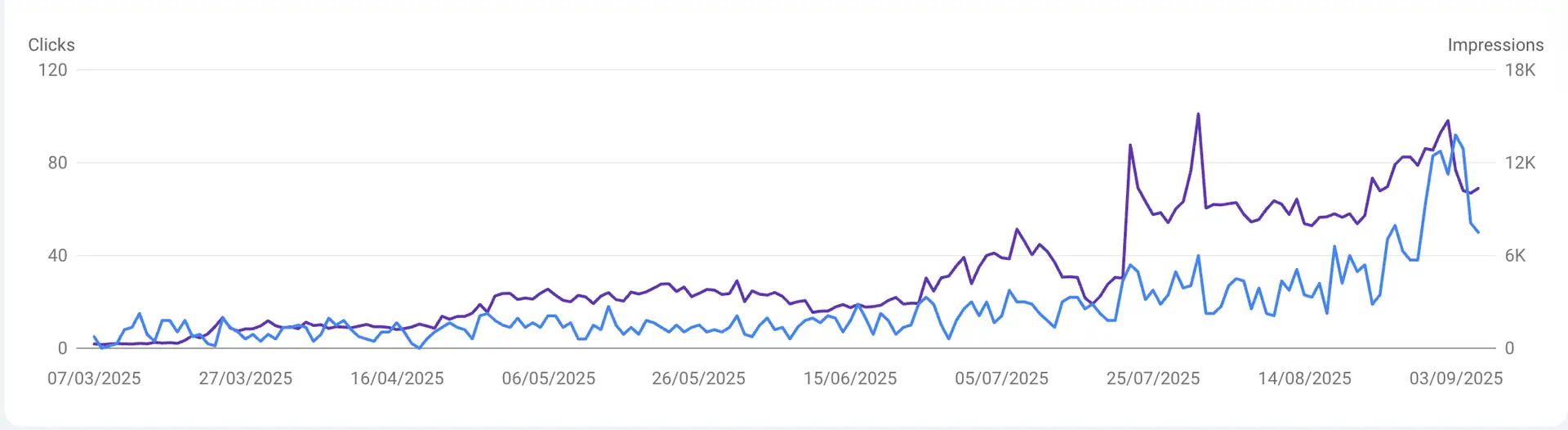
    That’s exactly where AI content creation for SEO comes in. Over the last quarter we rebuilt our publishing workflow around Keywordly—from keyword discovery and clustering to SEO-first briefs, AI-assisted drafting, optimization scoring, and rank tracking. The result: +110% organic traffic in 90 days, with fewer hours per article and a tighter feedback loop.

    This blog shows you precisely how we did it, where most “AI writers” fall short for SEO, and the exact checklist you can use to reproduce our results. 

    “Teams that systemize AI content creation don’t just publish faster — they compound organic growth month after month.”

    What is “AI Content Creation for SEO”?

    Most AI writers are great at text generation but stop short of what actually drives rankings: choosing the right topics, structuring around search intent, covering entities and subtopics comprehensively, optimizing on-page signals, and iterating based on performance.

    When we say AI content creation for SEO, we don’t mean pressing a button and letting an AI spit out a blog post. True SEO-focused AI writing is an end-to-end workflow that blends machine efficiency with search engine strategy.

    Here’s how the process actually works:

    • Research: Expand seed keywords into topical clusters; map intent and difficulty. Clustering helps you cover a topic comprehensively, improve internal linking, and signal authority—key for both classic SEO and GEO.
    • Plan: Turn SERP analysis into briefs with required H2s/H3s, entities, and internal links. Google’s core systems reward helpfulness and depth. Briefs anchor the draft to what real searchers expect to find. Google for Developers
    • Draft: Generate copy aligned to the brief—not generic “thought leadership.”
    • Optimize: Score against competitors; tighten meta, headings, internal links, and schema. Average winning blog posts are longer and more structured than they were a decade ago; process—not just prose—wins
    • Publish & Iterate: Track rankings and rewrite with data.

    It’s not “let the model write an article.” It’s AI-assisted SEO operations. And in 2025, this approach isn’t optional; most marketing teams already use AI in their roles, with adoption continuing to climb.

    “A structured AI workflow reduces content production time by up to 50% — without sacrificing SEO performance.”

    Why AI Now? The Search Landscape Changed

    The Gap Most “AI Writers” Don’t Solve

    Plenty of tools generate copy. Far fewer help you rank:

    • Keyword discovery is shallow. Many tools ideate titles but don’t build clusters or map intent.
    • Briefs are optional. Without SERP-driven outlines, drafts miss subtopics and query refinements that Google (and AI answer engines) expect.
    • No competitive optimization loop. If you’re not scoring against the live SERP and iterating, you’ll trail whoever is.
    • Zero governance. Brand voice, compliance, and factual checks still need a controlled workflow.

    Keywordly closes this gap by combining research → briefs → AI drafting → optimization scoring → publish/track in one flow. That end-to-end design is what turned our content team into a proper revenue function.

    “Content creation drives traffic — but optimized AI workflows drive predictable growth.”

    Read this Article : 5 Proven AI Content Writing Steps to Create High-Quality Content

    Case Study: How We Increased Organic Traffic by 110% in 90 Days with Keywordly

    Context: We were publishing 6–8 posts/month. Average position hovered in the 20s–30s. Impressions were fine; clicks lagged. Our goals:

    1. Win more transactional and high-intent informational queries;
    2. Reduce hours per article;
    3. Build topical authority in 3 sub-niches.

    Step 1 — Seed to Clusters (Research)

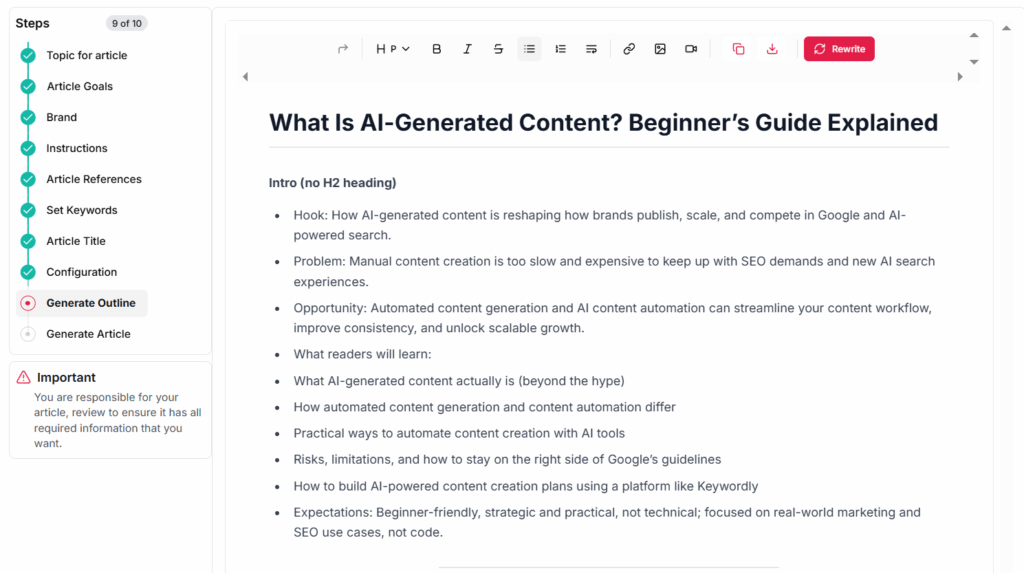
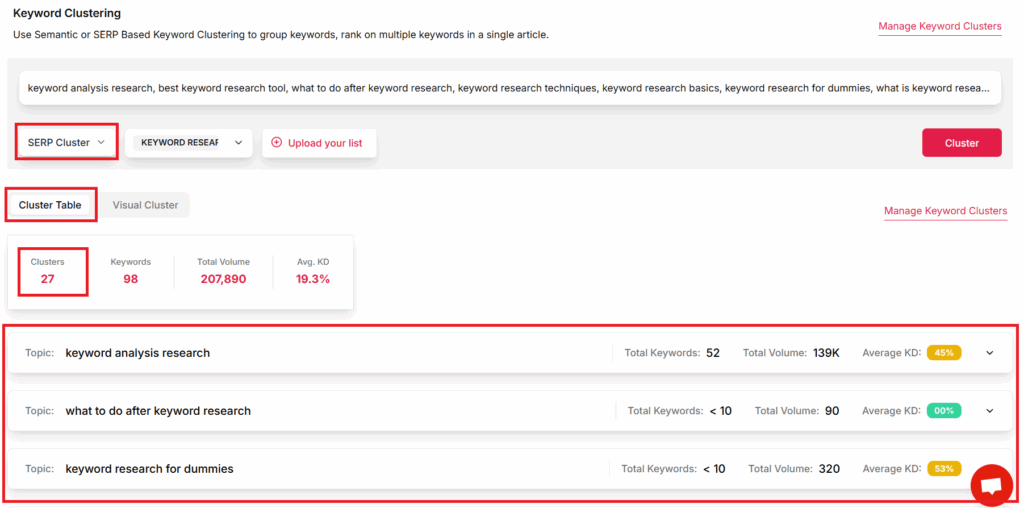
    SERP cluster table
    Keywordly SERP Keyword Clustering
    • Started with 8 seed topics tied to product value props.
    • In Keywordly, we expanded each seed into topic clusters with long-tails, questions, and related entities.
    • We filtered keywords by SERP intent (informational vs. commercial), difficulty, and opportunity score (gaps vs. competitors).
    • Output: 42 prioritized keywords grouped into 10 clusters, each with a pillar + 2–4 support articles.

    Step 2 — SERP-Backed Briefs

    content brief generation
    Keywordly Content Brief Genration
    • For every target keyword, Keywordly generated a brief with H2/H3 recommendations mapped to the top 10 results, entities to include, and People Also Ask coverage.
    • We added internal link targets (pillar ↔ cluster) and calls-to-action tailored to BOFU (free trial, demo, checklist).

    Step 3 — AI-Assisted Drafting

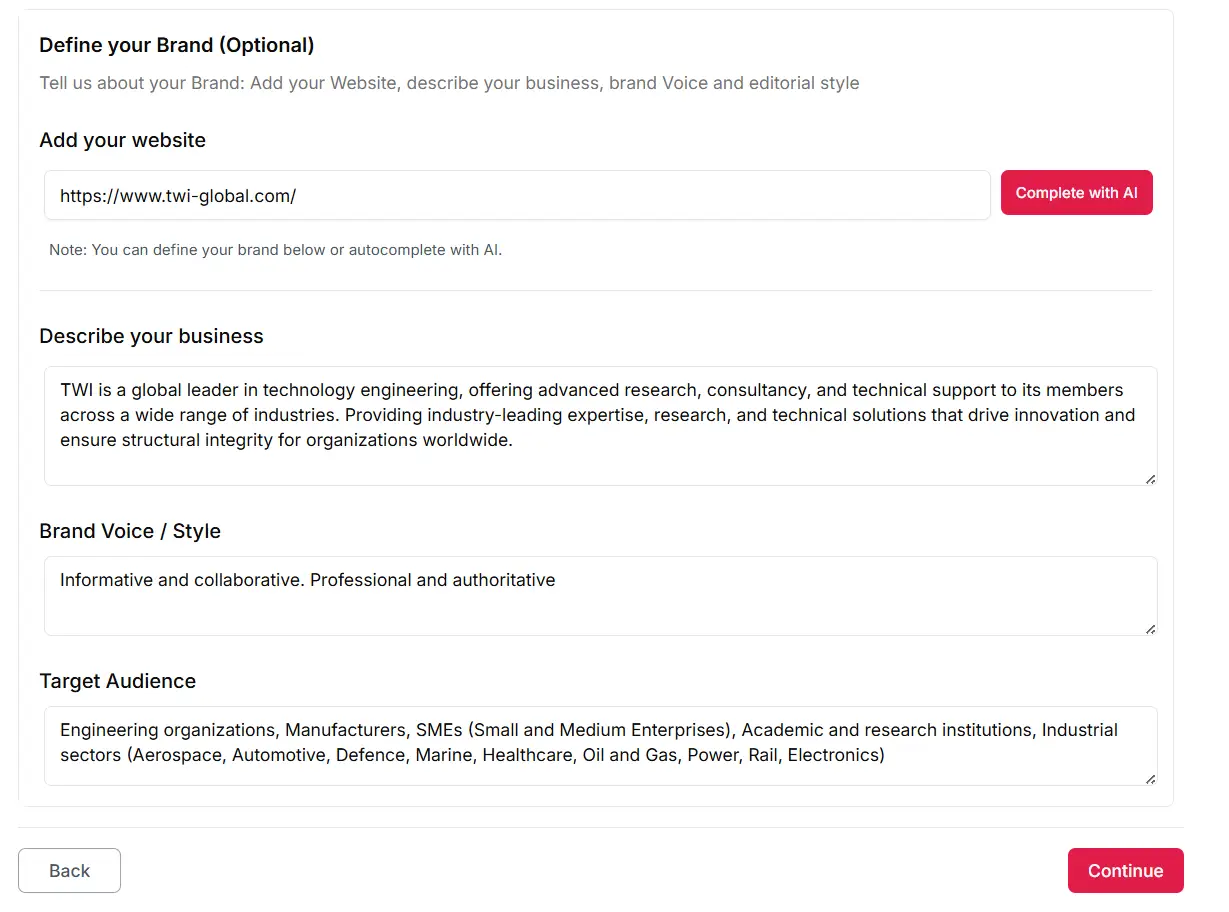
    brand voice keywordly.ai
    Keywordly Brand voice & Target Audience workflow
    • Writers used Keywordly’s guided drafting to fill sections against the brief.
    • We enforced a brand voice block (tone, banned phrases), facts to include, and data placeholders (we add citations manually).
    • Every draft passed a factual spot-check and originality pass before optimization.

    Time saved: ~45–60% vs. writing from scratch, mostly in outline creation and first-draft generation.

    Step 4 — On-Page Optimization 

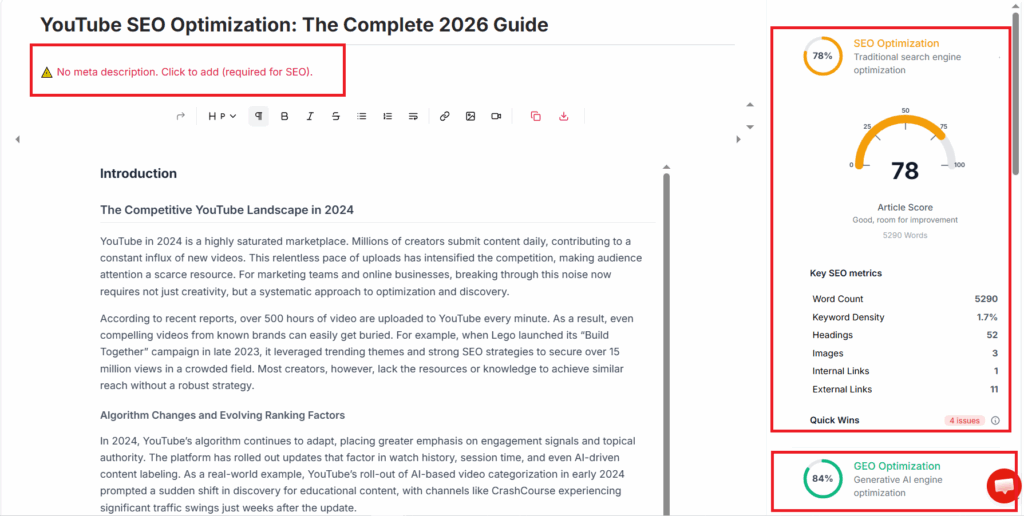
    keywordly - seo optimization
    Keywordly On page SEO/ GEO Optimization
    • Keywordly’s optimizer flagged missing entities, weak sections, and thin H2s relative to the live SERP.
    • We tightened title tags, meta descriptions, H1/H2 semantics, internal links, and added FAQ schema when appropriate.
    • Editorial checklist ensured:
      • Answer snippet-worthy subqueries early
      • Cite 4–5 credible external sources per article
      • Include comparison blocks and tables for BOFU posts

    “Most brands fail with AI not because of the tools — but because they lack a structured optimization system.”

    Read this Article : 10 Best AI Content Writing Tools in 2026

    Step 5 — Publish, Interlink, and Iterate

    • We published in clusters (pillar + 2–3 supports/week) to consolidate signals.
    • After 14–21 days, we pulled GSC data, found underperforming sections, and ran content relaunches (tighten intros, add missing subtopics, refresh stats). This “relaunch” pattern is a proven traffic lever.

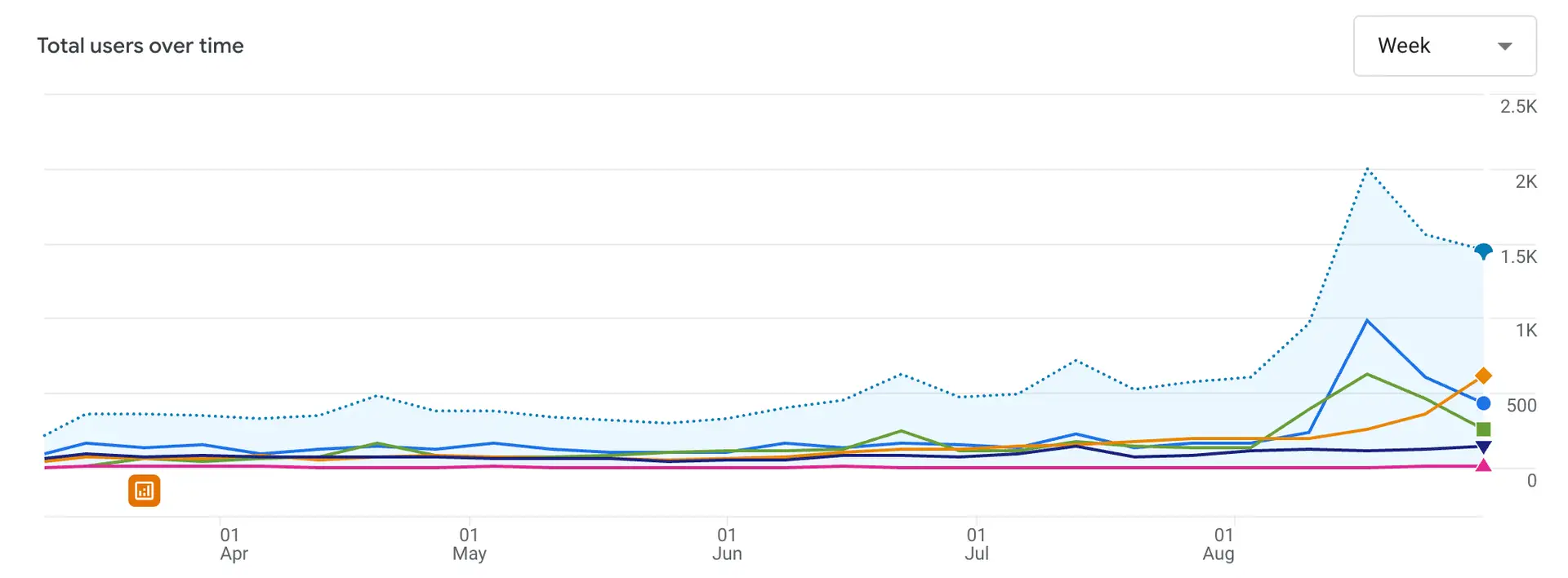
    Results (90 Days)

    • Organic traffic: +110% (sitewide)
    • Average position: 32 → 12 (median across new/updated URLs)
    • Impressions: +150%

    When NOT to Use AI for SEO

    • You don’t have a point of view or subject-matter input.
    • Your industry is heavily regulated and requires legal review on every line.
    • You publish news where freshness + original reporting beats depth.
    • You can’t commit to iteration (publish → measure → relaunch).

    AI won’t save a weak process. It accelerates whatever process you already run.

    “The smartest teams don’t automate everything — they automate strategically.”

    Conclusion

    CTA

    “AI content creation becomes a competitive advantage when paired with performance tracking, optimization insights, and repeatable systems.”

    AI has changed the game for marketers, but the real breakthrough comes when you use it strategically for SEO. It’s not just about producing more words — it’s about creating optimized, search-ready content that ranks, attracts the right audience, and drives measurable business growth.

    By following an end-to-end workflow — from keyword research and SERP-driven briefs to SEO scoring, optimization, and iteration — AI enables you to scale content while maintaining quality. Our own experience with Keywordly proves the impact: a 110% traffic increase in just 90 days by replacing guesswork with a structured, AI-driven content engine.

    If your content is struggling to rank, now is the time to adopt AI tools that are built for SEO performance, not just writing convenience.

    “If your team is still treating AI as a drafting tool instead of a growth engine, you’re leaving visibility on the table.”

    Read this Article : What Is AI-Generated Content?A Beginners Guide to Ai Content Creation

    Read this Article : Proven SEO Content Writing Examples That Boost Engagement and Rankings

    FAQs

    Is AI-generated content safe for SEO?
    Yes—quality and helpfulness matter more than the method. Google’s core update targets low-quality, unoriginal content, not “AI content” per se. Align with intent, cite sources, and add original value (examples, data, frameworks).

    How many words should we aim for?
    There’s no magic number, but successful posts tend to be longer than a decade ago because they cover more subtopics. Focus on coverage, not padding. 

    Do we still need human editors?
    Absolutely. Use editors for fact-checking, brand voice, and claims. AI assists; humans ensure accuracy, nuance, and trust