Tag: AI Content Creation for SEO

  • How to Optimize content for AI search engines and LLM citations in 2026

    How to Optimize content for AI search engines and LLM citations in 2026


    How to Optimize Content for AI Search Engines and LLM Citations – Step-by-Step Guide (2026)

    how to optimize content for AI search engines and LLM citations in 2026 | August 24, 2026 | Keywordly Editorial Team | 3–5 hours of implementation per content piece | Beginner

    What You’ll Learn

    This guide teaches how to optimize content for AI search engines and LLM citations in 2026 using Generative Engine Optimization (GEO). Instead of just ranking on Google, you earn named citations inside AI-generated answers on ChatGPT, Perplexity, Gemini, Google AI Overviews, and Claude.

    By the end, you’ll be able to:

    • Structure each page so AI engines can extract and cite clean, self-contained answers.
    • Implement essential schema markup types (Article, FAQPage, HowTo, Organization) that serve as machine-readable trust signals.
    • Build E-E-A-T and topical authority signals that determine whether an LLM trusts your content enough to quote it.
    • Track your AI Share of Voice across major platforms and turn metrics into a repeatable optimization loop.

    Prerequisites: Basic CMS familiarity, Google Search Console access, and an editable content workflow.


    Why Optimizing for AI Search Engines and LLM Citations Matters in 2026

    ChatGPT crossed 900 million weekly active users in February 2026. Perplexity processes 780 million queries per month. These are primary discovery channels now. According to Similarweb‘s July 2025 analysis, zero-click searches jumped from 56% to 69% in a single year after Google rolled out AI Overviews.

    Adobe Analytics tracked one trillion visits during the 2025 holiday season and found AI-driven traffic to U.S. retail websites grew 693% year-over-year. Shoppers arriving via AI recommendations convert 31% higher and bounce 27% less than those from other organic sources.

    Yet only 23% of marketers actively measure and optimize for AI citations. The U.S. GEO market is projected to reach USD 365.4 million in 2026 with a 42.9% compound annual growth rate. Early movers will own their category’s AI presence for years. For supporting data, see Google’s Guide to Optimizing for Generative AI Features on ….


    The Process at a Glance

    Step Action Time Outcome
    1 Structure content for AI extractability 1–2 hrs per page Clean, citable answer blocks created
    2 Implement schema markup for LLMs 30–60 min per template Machine-readable trust signals in place
    3 Build E-E-A-T and topical authority Ongoing; 4–8 weeks for cluster LLMs treat your domain as cite-worthy
    4 Expand off-page and earned-media presence Ongoing; 1–2 hrs/week Third-party mentions feed LLM training
    5 Track AI Share of Voice and iterate 1–2 hrs/week ongoing Closed optimization loop, growing citation share

    Total setup time: 3–5 hours per priority content piece, plus an ongoing weekly monitoring cadence.


    Step 1: Structure Content for AI Extractability

    What You’re Doing

    You’re formatting pages so AI engines can spot a quotable answer in under one second. Your content must be easy to understand, verify, and quote.

    How to Do It

    1. Lead every section with a definition sentence. Every major section opens with a single, self-contained sentence that defines the topic in a format AI models can extract as a standalone quote. Instead of “In recent years, marketers have debated GEO,” write: “Generative Engine Optimization (GEO) is the practice of structuring content so AI engines cite it in synthesized answers.”
    2. Use direct answers before explanation. State the answer in the first one or two sentences of each section, then expand with evidence. Direct answers at the start of sections, short paragraphs, scannable headings, and comparison tables maximize extractability.
    3. Add statistics with named sources. Adding statistics improves AI visibility by 41% (Princeton, Georgia Tech, and IIT Delhi research). Every stat needs a source name inline so the AI can verify and repeat attribution. “According to Forrester’s 2026 State of AI” is gold.
    4. Include comparison tables and FAQ blocks. Comparison content, “best of” product reviews, and tools with calculators get cited more frequently by AI platforms.
    5. Write in logically complete chunks. Create short, logically complete ideas that stand alone without needing the next paragraph to make sense.
    6. Keep key content in crawlable HTML. Avoid hiding answers inside JavaScript-rendered components or accordion elements that block crawlers.

    Example: Extractable vs. Non-Extractable Opening

    Format Opening Sentence LLM Outcome
    Non-extractable “In today’s rapidly evolving landscape, many marketers are wondering about GEO…” Skipped — no citable claim
    Extractable “Generative Engine Optimization (GEO) is the practice of structuring content so AI engines cite it in synthesized answers.” High citation probability — definition-forward, entity-named

    Best Practices

    • Include a “TL;DR” or “Key Takeaway” summary block at the top of long guides. Summary blocks mirror how AI presents generative answers.
    • Use proper semantic HTML heading hierarchy (H2 → H3 → H4) consistently. Proper heading hierarchy significantly improves an LLM’s ability to extract relevant information.
    • Refresh statistics at least quarterly. Content freshness contributes approximately 18–22% weight in AI citation decisions.

    What Done Looks Like

    Every H2 section opens with a definition or direct-answer sentence, contains at least one named statistic, and reads as a complete, self-contained answer.

    Key Takeaway: Lead with definitions and direct answers. Add named statistics. Structure content in logically complete chunks. For a more detailed walkthrough, see AI Search Optimization Strategies: How to Rank in AI- ….


    Step 2: Implement Schema Markup for LLM Trust Signals

    What You’re Doing

    You’re adding JSON-LD structured data so AI systems can parse your page’s purpose, authorship, publication date, and content structure. The goal is machine clarity — when your schema accurately reflects your content, AI systems can confidently assess whether your content is worth citing.

    How to Do It

    1. Implement Organization schema site-wide. Organization schema establishes your brand’s identity, providing AI systems with your name, URL, logo, contact details, and connections to other entities. Without it, AI systems have to guess your identity.
    2. Add Article schema to every content page. Article schema tells LLMs the publication date, modification date, author, and publisher, ensuring AI correctly categorizes and dates your information.
    3. Add FAQPage schema to every page with a Q&A section. FAQPage schema produces the highest AI citation lift because it structures content as standalone Q&A pairs that LLMs can extract and cite independently.
    4. Stack schema types using JSON-LD @graph format. Combining FAQPage with Article and HowTo schema using @graph stacking produces 1.8x more citations than Article schema alone.
    5. Validate before publishing. Use Google’s Rich Results Test and the Schema Markup Validator. Most production failures are @id drift or property values that diverge from rendered text.
    6. Add an llms.txt file. LLMS.txt files provide AI systems explicit guidance on content access and citation preferences.

    Schema Priority Table

    Schema Type Pages to Apply Primary LLM Benefit Priority
    Organization Homepage, About Brand entity resolution Required
    Article / BlogPosting All blog and guide pages Author + date attribution Required
    FAQPage Any page with Q&A blocks Pre-formatted citation pairs High
    HowTo Step-by-step guides Structured procedure extraction High
    BreadcrumbList All pages Site topology clarity Recommended

    What Done Looks Like

    Google’s Rich Results Test returns zero errors, the Schema Markup Validator confirms correct @graph nesting, and your Article schema includes a named author linked to a Person entity with credentials.

    Key Takeaway: Implement Organization, Article, FAQPage, and HowTo schema using JSON-LD @graph stacking, validating all implementations before publishing.


    Step 3: Build E-E-A-T Signals and Topical Authority

    What You’re Doing

    E-E-A-T (Experience, Expertise, Authoritativeness, Trustworthiness) is now the foundation for visibility across traditional SEO, GEO, and AI mentions. When an AI engine chooses between five retrieved sources, E-E-A-T becomes the deciding factor.

    How to Do It

    1. Add named author bylines with credentials. Named authors with real expertise help your content survive the citation filter inside ChatGPT, Perplexity, and Google AI Overviews. Include a linked author bio page, social profiles, and relevant credentials.
    2. Cite all data and claims to primary sources inline. Citations to primary sources help AI systems verify claims. Link to original research, not summaries.
    3. Build topical clusters, not isolated pages. Domains with 10 or more interlinked pages on a topic cluster earn AI citations at 2 to 3 times the rate of single-page competitors (Slate’s 2026 AI SEO benchmark). Build pillar pages with 8–15 supporting cluster articles, linked with descriptive anchor text.
    4. Demonstrate firsthand experience. Humanize content with specific outcomes, case studies, and real data. Strengthen Experience signals by sharing what you’ve actually done.
    5. Maintain content freshness. Content published or updated within the last 13 weeks is significantly more likely to be cited. Establish a quarterly review workflow for all pillar pages.

    Platforms like Keywordly automate this workflow at scale, combining keyword research, content clustering, optimization, and AI citation tracking into one system that treats SEO and GEO as a continuous process.

    What Done Looks Like

    Your site has a linked cluster of at least 8–10 pages on your primary topic, each authored under a verified byline, each citing primary sources inline, and each updated within the past 90 days.

    Key Takeaway: Named authors, primary source citations, comprehensive topical clusters, and consistent freshness — these four signals tell LLMs your content deserves to be quoted.


    Step 4: Expand Off-Page and Earned-Media Presence

    What You’re Doing

    Brand mentions correlate 3x more strongly with AI visibility than backlinks (0.664 vs. 0.218 correlation coefficient). A mention on a trusted industry site matters more than a link from a low-authority source.

    How to Do It

    1. Earn coverage in high-trust industry publications. High-trust, niche industry publications demonstrate accelerated LLM inclusion — content can appear in AI responses within hours rather than days.
    2. Contribute genuine expertise to community platforms. Contribute expertise in relevant Reddit communities, Quora, and forums. Get featured in comparison articles, roundups, and “best of” lists.
    3. Distribute original data and research. Distributing content to multiple publications increases AI citations by up to 325% compared to publishing on a single domain.
    4. Maintain consistent brand entity signals. LLMs depend on consistent brand signals — your name, leadership, and messaging should align across every digital touchpoint.
    5. Monitor unlinked brand mentions and convert them. Track where authoritative sources reference your brand without a link, then reach out to convert those into backlinks. Digital PR generates branded mentions on high-authority news sites, which LLMs treat as citation evidence even without a dofollow link.

    What Done Looks Like

    Your brand appears in at least three or four third-party, category-relevant sources that LLMs actively retrieve, and your brand name, description, and URLs are consistent across all of them.

    Key Takeaway: Actively pursue earned media and community engagement to build the citation trail that AI systems use to assess credibility.


    Step 5: Track AI Share of Voice and Iterate

    What You’re Doing

    You’re replacing guesswork with data: querying AI platforms regularly for target prompts, measuring how often and how prominently your brand appears, and using those results to prioritize content and technical updates.

    How to Do It

    1. Define your target prompts. List 20–40 queries your buyers type into AI engines, organized by funnel stage: awareness, consideration, and decision.
    2. Run prompts across all six major platforms. The six primary AI platforms to monitor in 2026 are ChatGPT, Google Gemini, Perplexity, Claude, Grok, and Google AI Overviews — each behaves differently. Do not assume performance on one platform reflects performance on another.
    3. Measure Share of Voice (SOV). Share of voice measures the percentage of AI answers mentioning your brand versus total answers for target queries. Top-performing brands capture 15% or more share across core query sets, with enterprise leaders reaching 25–30% in specialized verticals.
    4. Track citations and mentions separately. AI citation tracking tools return four core data types: whether you were cited, which URL was cited, the sentiment around your mention, and a share-of-voice benchmark against competitors.
    5. Use the data to prioritize content updates. Pages earning mentions but not citations usually need clearer answer structure or schema. Pages earning neither need authority investment.
    6. Establish a weekly cadence. Frequency across many runs matters more than any single result — one mention is noise; a mention in 60% of runs is a signal.

    Example: Prompt-Level SOV Tracking Spreadsheet

    Prompt ChatGPT Mention? Perplexity Citation? Gemini Mention? Action Required
    “Best SEO tools 2026” Yes No Yes Add FAQPage schema; earn Perplexity-indexed coverage
    “How to do keyword clustering” No No No Publish pillar + cluster; earn third-party roundup inclusion
    “AI content optimization tools” Yes Yes No Update Gemini-visible content; refresh schema dateModified

    What Done Looks Like

    You have a weekly SOV dashboard covering at least four AI platforms, a baseline citation rate recorded, and a content update queue driven directly by which prompts your brand is missing from.

    Key Takeaway: Measure weekly, act on gaps. Your data becomes your roadmap for the next round of optimization.


    What to Do After Completing the Process

    Phase 1 — Consolidate (Weeks 1–4 After Setup)

    Validate all schema using both Google’s Rich Results Test and the Schema Markup Validator. Confirm your AI crawl access by reviewing robots.txt. Run your first full prompt sweep across all six platforms and record your baseline SOV numbers.

    Phase 2 — Scale Authority (Months 2–3)

    Expand your topical cluster to cover all subtopics and related queries. Pitch original research or data reports to two or three industry publications for earned-media coverage. Refreshing high-performing content is 3–10x more cost-effective than creating new content — prioritize updating existing top pages before building new ones.

    Phase 3 — Compound and Defend (Month 4 Onward)

    Treat your SOV data as competitive intelligence. Comprehensive strategies typically show measurable improvements in 60–90 days, with substantial results requiring 6–12 months of consistent effort. Quarterly freshness audits keep pages active in AI citation pools as training data evolves.


    Resources You’ll Need

    Resource Role Required / Recommended / Optional Price
    Keywordly All-in-one SEO and AI content workflow: keyword research, clustering, content optimization, and AI visibility tracking across traditional and AI search platforms Recommended Paid plans (see site for current pricing)
    Google Search Console Monitor indexing, schema eligibility, and organic baseline performance Required Free
    Google Rich Results Test Validate schema markup before publishing Required Free
    Schema Markup Validator Deep syntactic check of JSON-LD against Schema.org standards Required Free
    Nightwatch LLM brand monitoring and AI Share of Voice tracking across ChatGPT, Claude, Gemini, and Perplexity Recommended Paid plans available

    See also, see How to Optimize Content for AI Search Engines in 2026.


    Troubleshooting Common Issues

    Problem: Content Is Being Retrieved by LLMs but Never Cited

    Likely cause: Your content passes retrieval but fails generation. A brand that excels at retrieval (great technical structure) but fails at generation (no trust) will be ingested but ultimately ignored.

    Fix: Audit your E-E-A-T layer. Add named author bylines with verifiable credentials, cite all statistics to primary sources inline, and confirm your Organization schema is live and error-free. Ask yourself: if the AI misses your main point, restructure the opening paragraph as a definition-forward answer.

    Problem: Schema Is Implemented but AI Citations Have Not Improved

    Likely cause: Schema is infrastructure, not a citation growth lever. AI-cited pages are almost three times more likely to carry JSON-LD schema than non-cited pages — but that’s correlation, not causation.

    Fix: Pair schema implementation with topical cluster expansion, off-page earned media, and a freshness audit on any page older than 90 days.

    Problem: Strong Google Rankings but Zero Presence in AI Answers

    Likely cause: Your pages rank well but are structured for click-based discovery, not AI extractability. Content that buries the answer or lacks named statistics is skipped by LLMs even when Google ranks it in position one.

    Fix: Rewrite the first paragraph using definition-forward structure. Add a “Key Takeaways” summary block above the fold, add FAQPage schema, and include at least two named statistics per major section. Re-run your prompt sweep one week after publishing.

    Problem: AI Share of Voice Is Flat Despite Consistent Content Publishing

    Likely cause: Publishing isolated articles without a topical cluster strategy. Coverage depth on a subject is the dominant variable in AI visibility.

    Fix: Group existing pages into a pillar-cluster model, create 8–10 supporting articles for each pillar, and link them with descriptive anchor text. Track SOV at the cluster level, not the individual page level. For more troubleshooting advice, see Common Google AI Overviews Optimization Mistakes.


    Conclusion

    Key Takeaways

    • The core insight: Optimizing for AI requires mastering two parallel tracks — technical retrievability (structure, schema, crawlability) and generative trustworthiness (E-E-A-T, topical depth, off-page authority). Both are essential.
    • The highest-ROI move: Restructure your highest-traffic pages to lead with definition-forward answers and named statistics. Deliberately structuring content for generative engines can raise a source’s visibility in AI answers by roughly 30% to 40%.
    • Your next action: Choose your three most commercially important pages, apply the extractable structure and schema markup from Steps 1 and 2 this week, then run a prompt sweep across ChatGPT and Perplexity to establish your baseline AI Share of Voice.

    FAQ

    How do you optimize content for AI search engines and LLM citations?

    Follow five core steps: (1) Structure each page so every major section opens with a definition-forward, self-contained answer and includes at least one named statistic. (2) Implement JSON-LD schema markup — Organization, Article, FAQPage, and HowTo — so AI engines can resolve your brand identity and content structure. (3) Build E-E-A-T signals: named author bylines with credentials, inline citations to primary sources, and a topical cluster of 8–15 interlinked pages on each core subject. (4) Expand off-page presence through earned media, industry roundups, and community platforms that LLMs actively retrieve. (5) Track your AI Share of Voice weekly across ChatGPT, Perplexity, Gemini, Claude, Grok, and Google AI Overviews, and use gaps in that data to prioritize content updates.

    What is Generative Engine Optimization (GEO) and how is it different from traditional SEO?

    GEO is the holistic practice of adapting your digital content, technical structure, and brand signals to be cited, mentioned, and represented accurately within AI-generated, synthesized answers — the next step after traditional SEO. Traditional SEO targets a ranked link position; GEO targets a named citation inside an AI-generated paragraph. The mechanics overlap significantly — strong traditional rankings are still required — but GEO adds layers around content extractability, schema machine-readability, and off-page brand authority that classic SEO does not address.

    How long does it take to see results from AI citation optimization?

    Schema markup and content restructuring can influence AI citation eligibility within days of indexing. However, comprehensive strategies typically show measurable improvements in 60–90 days, with substantial results requiring 6–12 months of consistent effort. Topical cluster authority and off-page earned media take the longest to compound. The fastest wins come from restructuring existing high-traffic pages with definition-forward openings and named statistics.

    Which schema types matter most for LLM citations?

    The four highest-priority schema types are Organization (brand entity resolution), Article or BlogPosting (author and date attribution), FAQPage (pre-formatted Q&A pairs), and HowTo (structured procedure extraction). Combining FAQPage with Article and HowTo schema using JSON-LD @graph stacking produces 1.8x more citations than Article schema alone. Validate every implementation using Google’s Rich Results Test and the Schema Markup Validator before publishing.

    What is AI Share of Voice and how do you measure it?

    Share of voice measures the percentage of AI answers mentioning your brand versus total answers for target queries. Define a prompt set of 20–40 queries your buyers type into AI engines, run those prompts weekly across ChatGPT, Perplexity, Gemini, Claude, Grok, and Google AI Overviews, and log whether your brand is cited, mentioned, or absent for each. Because LLMs are non-deterministic, frequency across many runs matters more than any single result. Tools like Nightwatch automate this process at scale.

    Does traditional SEO still matter for AI search visibility?

    Yes — traditional SEO is the prerequisite layer. Pages cited in AI Overviews are almost always already ranking in Google’s top 10. You cannot skip traditional SEO and go straight to AI Overviews. Think of it this way: strong Google rankings make your content eligible for AI retrieval; GEO techniques determine whether it gets selected and cited once retrieved.

    What are the most common mistakes that prevent LLM citations?

    The most frequent mistakes are: burying the answer instead of leading with a definition-forward sentence; publishing vague statistical claims without naming the source; launching isolated articles instead of interlinked topical clusters; ignoring off-page presence on community platforms that LLMs actively retrieve; and failing to refresh content past the 90-day mark. If a page hasn’t been updated in six months, it is three times more likely to lose its citation to a fresher competitor.

    How does content freshness affect AI citation rates?

    Content freshness contributes approximately 18–22% weight in AI citation decisions, with higher importance for rapidly evolving topics. AI citations drop sharply when content ages past 90 days, especially on ChatGPT and Perplexity. Update statistics, add one new paragraph covering a recent development, and refresh the dateModified field in your Article schema — this signals to AI crawlers that the content is current.


    Methodology: This guide is based on primary GEO and LLM visibility research published between January and August 2026, including data from Princeton/Georgia Tech/IIT Delhi (GEO-bench), Adobe Analytics, Similarweb, and Ahrefs. Statistics are cited inline with source attribution. Results depend on domain authority, content quality, competitive landscape, and consistent execution. Last reviewed: August 24, 2026.

  • AI Content Creation: A Practical Guide to Generate Better Content Faster

    AI Content Creation: A Practical Guide to Generate Better Content Faster

    Boost traffic with AI content creation for SEO. Learn how Keywordly increased organic traffic by 110% with end-to-end AI workflows.

    Introduction

    Publishing more content isn’t the bottleneck anymore—ranking is. If you’re shipping blog posts, landing pages, and guides but organic traffic keeps flatlining, you don’t have a writing problem. You have a search intent + optimization problem.

    That’s exactly where AI content creation for SEO comes in. Over the last quarter we rebuilt our publishing workflow around Keywordly—from keyword discovery and clustering to SEO-first briefs, AI-assisted drafting, optimization scoring, and rank tracking. The result: +110% organic traffic in 90 days, with fewer hours per article and a tighter feedback loop.

    This blog shows you precisely how we did it, where most “AI writers” fall short for SEO, and the exact checklist you can use to reproduce our results. 

    “Teams that systemize AI content creation don’t just publish faster — they compound organic growth month after month.”

    What is “AI Content Creation for SEO”?

    Most AI writers are great at text generation but stop short of what actually drives rankings: choosing the right topics, structuring around search intent, covering entities and subtopics comprehensively, optimizing on-page signals, and iterating based on performance.

    When we say AI content creation for SEO, we don’t mean pressing a button and letting an AI spit out a blog post. True SEO-focused AI writing is an end-to-end workflow that blends machine efficiency with search engine strategy.

    Here’s how the process actually works:

    • Research: Expand seed keywords into topical clusters; map intent and difficulty. Clustering helps you cover a topic comprehensively, improve internal linking, and signal authority—key for both classic SEO and GEO.
    • Plan: Turn SERP analysis into briefs with required H2s/H3s, entities, and internal links. Google’s core systems reward helpfulness and depth. Briefs anchor the draft to what real searchers expect to find. Google for Developers
    • Draft: Generate copy aligned to the brief—not generic “thought leadership.”
    • Optimize: Score against competitors; tighten meta, headings, internal links, and schema. Average winning blog posts are longer and more structured than they were a decade ago; process—not just prose—wins
    • Publish & Iterate: Track rankings and rewrite with data.

    It’s not “let the model write an article.” It’s AI-assisted SEO operations. And in 2025, this approach isn’t optional; most marketing teams already use AI in their roles, with adoption continuing to climb.

    “A structured AI workflow reduces content production time by up to 50% — without sacrificing SEO performance.”

    Why AI Now? The Search Landscape Changed

    The Gap Most “AI Writers” Don’t Solve

    Plenty of tools generate copy. Far fewer help you rank:

    • Keyword discovery is shallow. Many tools ideate titles but don’t build clusters or map intent.
    • Briefs are optional. Without SERP-driven outlines, drafts miss subtopics and query refinements that Google (and AI answer engines) expect.
    • No competitive optimization loop. If you’re not scoring against the live SERP and iterating, you’ll trail whoever is.
    • Zero governance. Brand voice, compliance, and factual checks still need a controlled workflow.

    Keywordly closes this gap by combining research → briefs → AI drafting → optimization scoring → publish/track in one flow. That end-to-end design is what turned our content team into a proper revenue function.

    “Content creation drives traffic — but optimized AI workflows drive predictable growth.”

    Read this Article : 5 Proven AI Content Writing Steps to Create High-Quality Content

    Case Study: How We Increased Organic Traffic by 110% in 90 Days with Keywordly

    Context: We were publishing 6–8 posts/month. Average position hovered in the 20s–30s. Impressions were fine; clicks lagged. Our goals:

    1. Win more transactional and high-intent informational queries;
    2. Reduce hours per article;
    3. Build topical authority in 3 sub-niches.

    Step 1 — Seed to Clusters (Research)
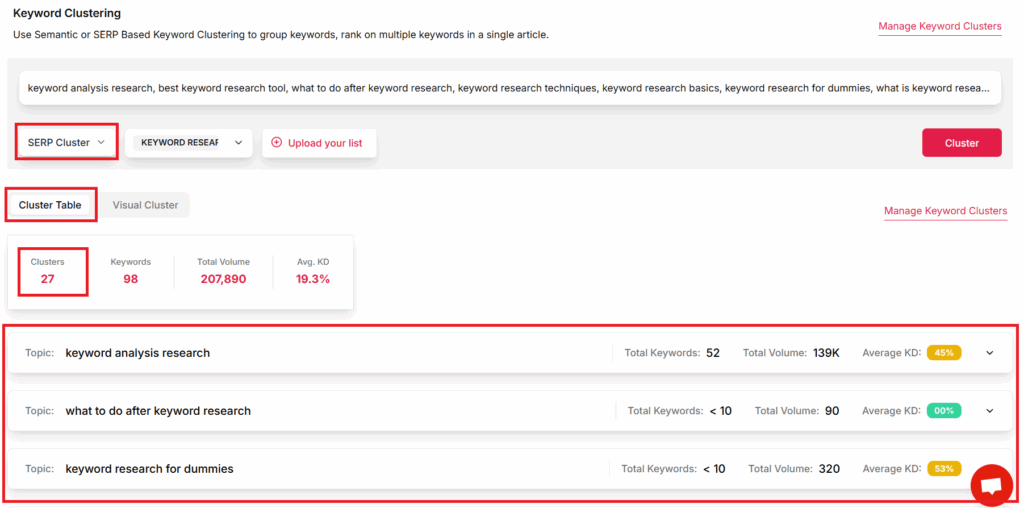
    SERP cluster table
    Keywordly SERP Keyword Clustering
    • Started with 8 seed topics tied to product value props.
    • In Keywordly, we expanded each seed into topic clusters with long-tails, questions, and related entities.
    • We filtered keywords by SERP intent (informational vs. commercial), difficulty, and opportunity score (gaps vs. competitors).
    • Output: 42 prioritized keywords grouped into 10 clusters, each with a pillar + 2–4 support articles.

    Step 2 — SERP-Backed Briefs
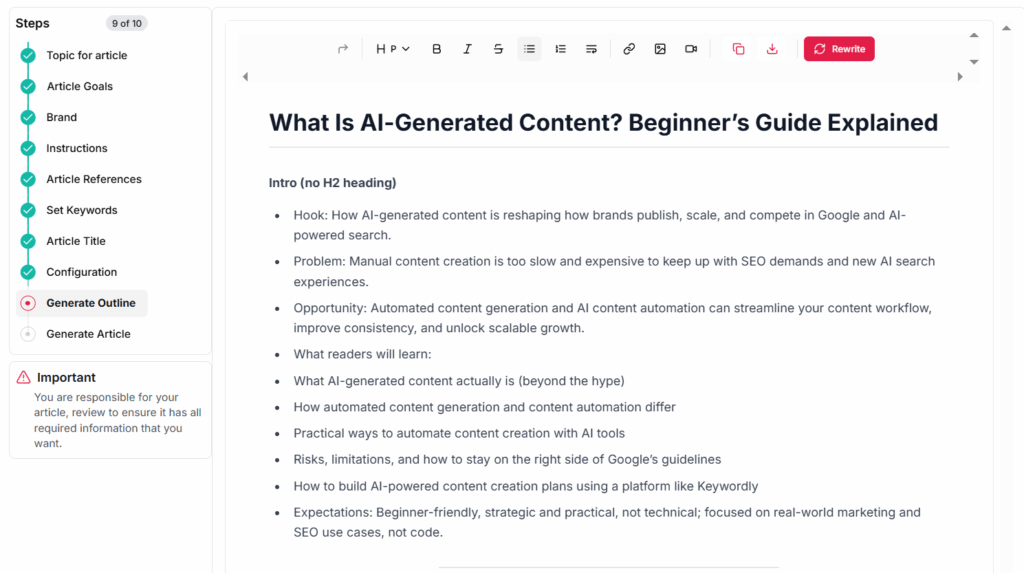
    content brief generation
    Keywordly Content Brief Genration
    • For every target keyword, Keywordly generated a brief with H2/H3 recommendations mapped to the top 10 results, entities to include, and People Also Ask coverage.
    • We added internal link targets (pillar ↔ cluster) and calls-to-action tailored to BOFU (free trial, demo, checklist).

    Step 3 — AI-Assisted Drafting
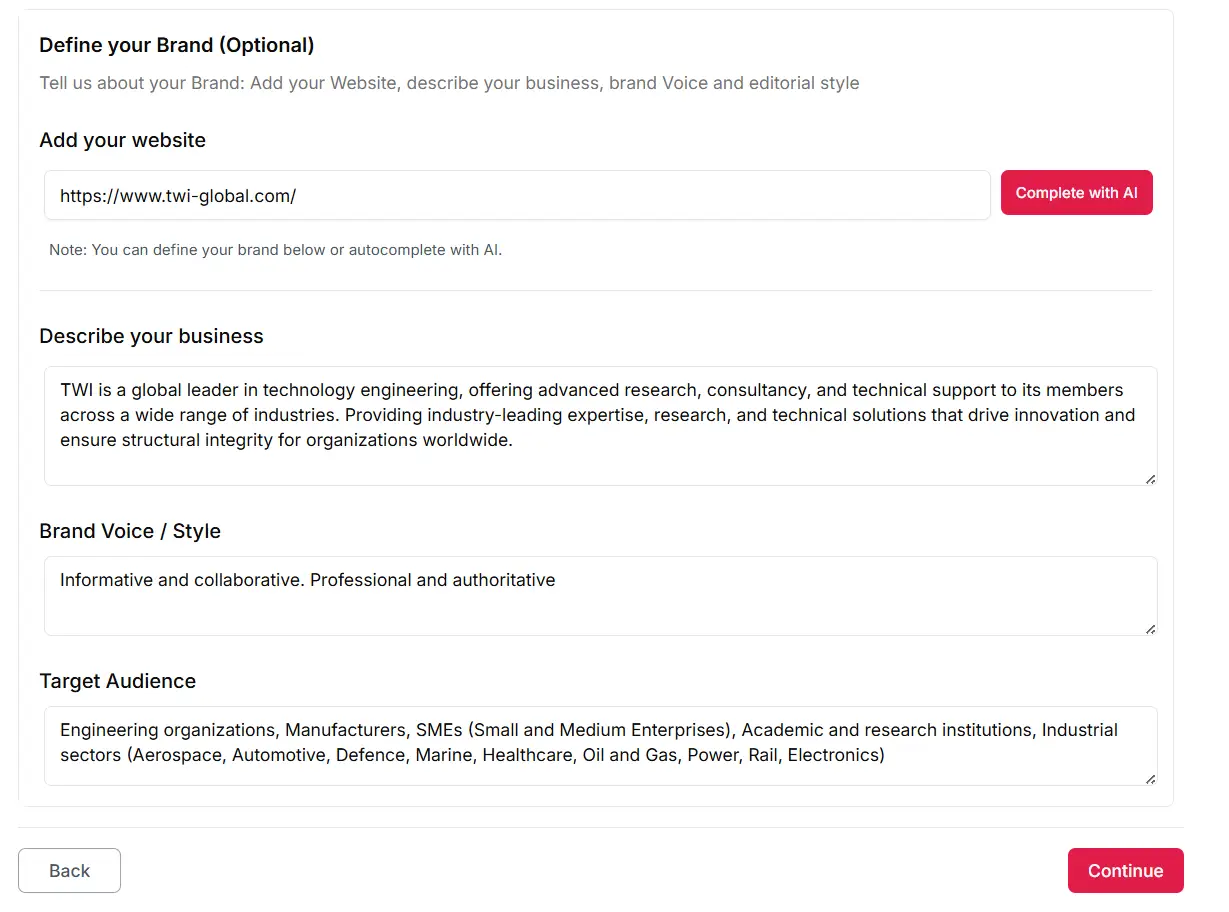
    brand voice keywordly.ai
    Keywordly Brand voice & Target Audience workflow
    • Writers used Keywordly’s guided drafting to fill sections against the brief.
    • We enforced a brand voice block (tone, banned phrases), facts to include, and data placeholders (we add citations manually).
    • Every draft passed a factual spot-check and originality pass before optimization.

    Time saved: ~45–60% vs. writing from scratch, mostly in outline creation and first-draft generation.

    Step 4 — On-Page Optimization 
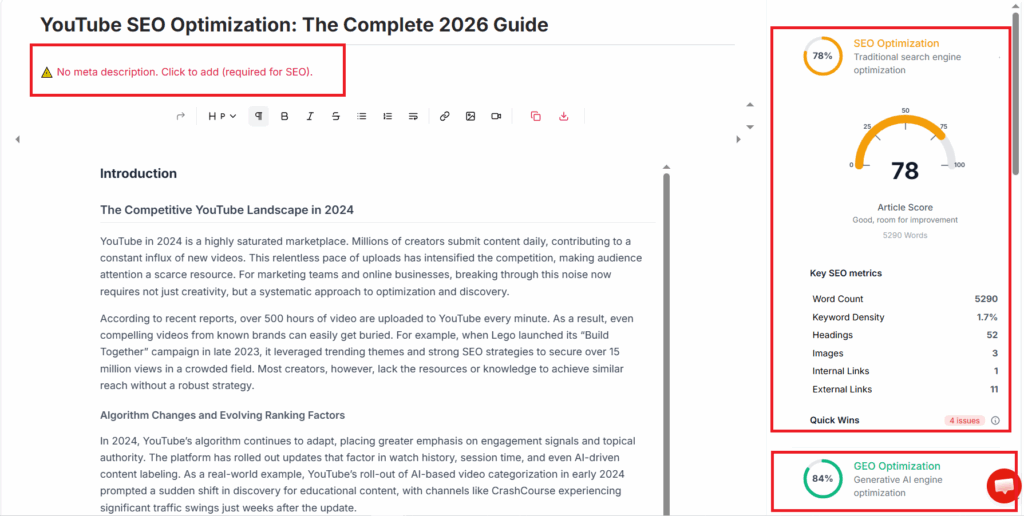
    keywordly - seo optimization
    Keywordly On page SEO/ GEO Optimization
    • Keywordly’s optimizer flagged missing entities, weak sections, and thin H2s relative to the live SERP.
    • We tightened title tags, meta descriptions, H1/H2 semantics, internal links, and added FAQ schema when appropriate.
    • Editorial checklist ensured:
      • Answer snippet-worthy subqueries early
      • Cite 4–5 credible external sources per article
      • Include comparison blocks and tables for BOFU posts

    “Most brands fail with AI not because of the tools — but because they lack a structured optimization system.”

    Read this Article : 10 Best AI Content Writing Tools in 2026

    Step 5 — Publish, Interlink, and Iterate

    • We published in clusters (pillar + 2–3 supports/week) to consolidate signals.
    • After 14–21 days, we pulled GSC data, found underperforming sections, and ran content relaunches (tighten intros, add missing subtopics, refresh stats). This “relaunch” pattern is a proven traffic lever.

    Results (90 Days)
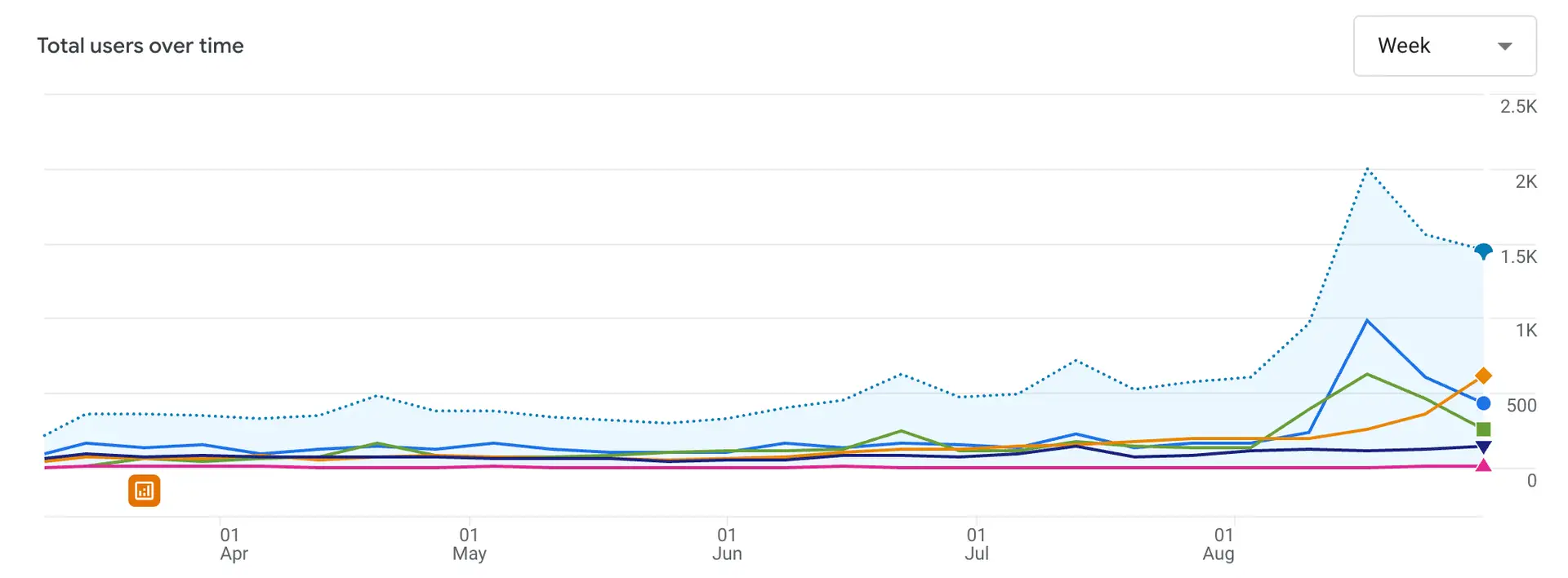
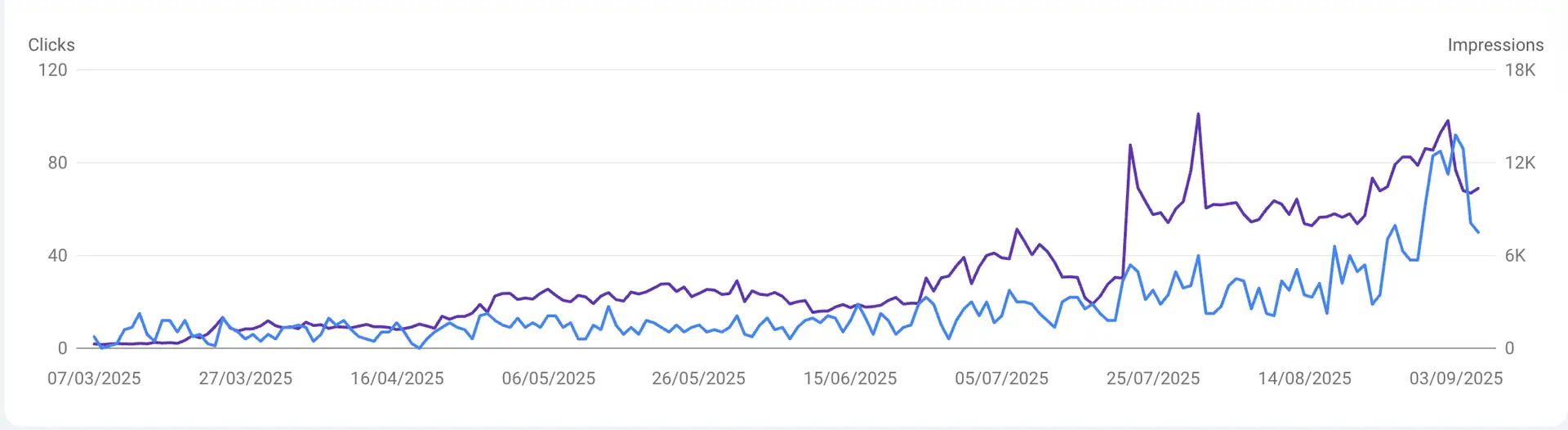
    • Organic traffic: +110% (sitewide)
    • Average position: 32 → 12 (median across new/updated URLs)
    • Impressions: +150%

    When NOT to Use AI for SEO

    • You don’t have a point of view or subject-matter input.
    • Your industry is heavily regulated and requires legal review on every line.
    • You publish news where freshness + original reporting beats depth.
    • You can’t commit to iteration (publish → measure → relaunch).

    AI won’t save a weak process. It accelerates whatever process you already run.

    “The smartest teams don’t automate everything — they automate strategically.”

    Conclusion
    CTA

    “AI content creation becomes a competitive advantage when paired with performance tracking, optimization insights, and repeatable systems.”

    AI has changed the game for marketers, but the real breakthrough comes when you use it strategically for SEO. It’s not just about producing more words — it’s about creating optimized, search-ready content that ranks, attracts the right audience, and drives measurable business growth.

    By following an end-to-end workflow — from keyword research and SERP-driven briefs to SEO scoring, optimization, and iteration — AI enables you to scale content while maintaining quality. Our own experience with Keywordly proves the impact: a 110% traffic increase in just 90 days by replacing guesswork with a structured, AI-driven content engine.

    If your content is struggling to rank, now is the time to adopt AI tools that are built for SEO performance, not just writing convenience.

    “If your team is still treating AI as a drafting tool instead of a growth engine, you’re leaving visibility on the table.”

    Read this Article : What Is AI-Generated Content?A Beginners Guide to Ai Content Creation

    Read this Article : Proven SEO Content Writing Examples That Boost Engagement and Rankings

    FAQs

    Is AI-generated content safe for SEO?
    Yes—quality and helpfulness matter more than the method. Google’s core update targets low-quality, unoriginal content, not “AI content” per se. Align with intent, cite sources, and add original value (examples, data, frameworks).

    How many words should we aim for?
    There’s no magic number, but successful posts tend to be longer than a decade ago because they cover more subtopics. Focus on coverage, not padding. 

    Do we still need human editors?
    Absolutely. Use editors for fact-checking, brand voice, and claims. AI assists; humans ensure accuracy, nuance, and trust