
You’ve gathered hundreds of keywords, but turning that messy spreadsheet into focused, high-performing topic clusters feels like a full-time job. Manually grouping terms by intent and relevance can work for small projects, yet it quickly breaks down when you’re scaling content across dozens of pages and markets. That’s where AI keyword clustering—and platforms like Keywordly—start to look appealing.
This article unpacks how manual clustering actually works, how AI automates the process using semantic relationships, and how Keywordly combines both structure and automation into a scalable workflow. You’ll see where human judgment is still essential, what AI does better and faster, and what level of effort to expect when building reliable, long-term SEO clusters across Google, Bing, and AI-driven search experiences.
In an era where algorithms can cluster thousands of keywords in seconds, the real SEO advantage isn’t choosing between manual vs AI keyword clustering—it’s knowing how to combine human strategy with machine-scale intelligence across platforms like Keywordly.
Reference:
Manual vs Automated Keyword Clustering
Introduction
Hook and Context
Manual keyword clustering used to mean wrestling with spreadsheets, color codes, and endless copy‑pasting. An SEO might spend hours sorting 1,000 keywords from Ahrefs or Semrush into themes, line by line, just to build one content roadmap. That effort often had to be repeated every quarter as search behavior and competitors shifted.
AI keyword clustering flips that workflow. With tools powered by large language models—like ChatGPT, Perplexity, and Gemini—you can upload the same 1,000-keyword list and get structured groups in minutes. Instead of spending time dragging cells in Google Sheets, strategists can focus on search intent, content angles, and monetization opportunities.
As users rely more on AI search tools for answers, content is discovered through conversational queries, follow‑up questions, and topic exploration. Someone might start with “best project management tools” on Google, then refine their research through Perplexity to compare Asana, Monday.com, and ClickUp by feature and price.
This shift means brands need smarter, scalable keyword organization to cover topics comprehensively, not just rank for one or two head terms. If your clustering is shallow or scattered, AI search systems are more likely to surface competitors with better structured topical coverage, richer internal linking, and clearer semantic relationships.
Definition and Importance of Keyword Clustering
Keyword clustering is the process of grouping related search terms—like “best CRM for small business,” “small business CRM software,” and “affordable CRM tools”—into a unified theme. That theme then guides a page or content hub so you address all major questions users have around that topic.
This approach is critical for building topical authority. For example, HubSpot does not just target “CRM software”; it maintains clusters around sales CRM, marketing automation, customer support, and integrations, each with supporting articles capturing long‑tail variations. That depth helps search engines trust them as a leading CRM resource.
Effective clustering also reduces keyword cannibalization, where multiple pages compete for the same query. Instead of publishing five thin posts about “email marketing tips,” a cluster strategy consolidates them into one strong guide plus focused supporting articles on deliverability, subject lines, and automation workflows.
From an operations perspective, keyword clustering enables scalable content production. Teams can turn a 2,000‑keyword list into clear topic clusters, assign them as “hubs and spokes,” and plan content sprints. SaaS brands like Notion and Shopify use topic cluster architectures to organize educational content around use cases, industries, and product features.
Manual vs AI vs Platforms Like Keywordly
There are three main ways teams approach keyword clustering: fully manual spreadsheets, general AI tools, and specialized platforms like Keywordly. Each path changes how much time you spend sorting data versus interpreting it. The right choice depends on your budget, volume of keywords, and need for workflow automation.
Manual clustering offers precise control. An SEO strategist might manually group keywords based on SERP analysis from Google, checking whether pages from Zapier, HubSpot, or NerdWallet rank together. This yields accurate clusters but does not scale well when you are dealing with 10,000+ keywords across multiple markets.
AI‑assisted clustering with tools like ChatGPT or Gemini accelerates pattern recognition. You can paste exports and ask the model to group terms by intent, funnel stage, or product line. However, you still need to manage formatting, deduplication, and mapping to URLs, and results can be inconsistent without clear prompts or SEO expertise.
Platforms like Keywordly combine automation with SEO‑specific logic. Instead of juggling prompts and spreadsheets, you import keywords, let the system cluster them using search and semantic signals, and then tie clusters directly to briefs, content audits, and optimization workflows. Many teams adopt a hybrid model—using Keywordly for structure and speed, while keeping human oversight to refine priority clusters and align them with revenue goals.
“Keyword clustering turns scattered keywords into structured SEO opportunities.”
1. Understanding Keyword Clustering and Why It Matters for Modern SEO
What Is Keyword Clustering in SEO?
Keyword clustering is the practice of grouping closely related search terms so they can be targeted together on one URL or within a tightly connected content hub. Instead of writing separate pages for “best CRM for small business,” “small business CRM tools,” and “CRM software for startups,” you cluster them into a single, stronger resource.
This goes beyond building a flat keyword list. You look at themes, shared search intent, and SERP overlap—i.e., whether Google shows similar pages for different queries. Those clusters then drive URL structure, content briefs, and on-page optimization, so every piece of content has a clear role in the site.
Manually, SEOs often copy keywords into spreadsheets, tag by intent, then group by overlapping SERP results. Automated tools like manual vs automated keyword clustering guides show how algorithms speed this work, while platforms like Keywordly apply AI to cluster thousands of terms in minutes instead of hours.
How Keyword Clustering Supports Topical Authority and Semantic Relevance
Strong clusters help you cover a topic comprehensively rather than publishing dozens of thin, overlapping pages. HubSpot’s sales hub, for example, organizes content around clusters like “sales enablement” and “sales automation,” then builds guides, templates, and FAQs under each.
By targeting clusters, you increase semantic relevance: a pillar page can answer primary queries while sub-sections and internal links address modifiers like “pricing,” “implementation,” or “for nonprofits.” Google sees a coherent experience instead of scattered answers.
This structure feeds topical authority signals—depth of coverage, consistent internal linking, and a logical content architecture. Keywordly turns clusters directly into hub-and-spoke content plans, so your writers know which questions, variations, and intents must live together on a single page or content hub.
Why Keyword Clustering Is Critical for Both Google and AI Search Engines
Google’s systems (like RankBrain and its entity-based algorithms) evaluate topics, entities, and relationships, not isolated keywords. When your site is organized around clusters such as “local SEO for dentists” with guides, checklists, and case studies, Google can understand that you’re an expert in that niche.
AI search engines and assistants synthesize answers from multiple sources and favor brands with clear topical depth and structured content. If your “B2B SEO strategy” cluster includes definitions, frameworks, examples, and benchmarks, you’re more likely to be cited in AI answer boxes or summaries.
Keywordly supports this by mapping clusters to pillar pages, related FAQs, and supporting articles, ensuring your content is structured in a way AI systems can easily interpret, reference, and surface across conversational searches.
Where AI Keyword Clustering Fits in the Modern SEO Workflow
Keyword clustering sits between raw keyword research and tactical content planning or information architecture. After you export keyword data from tools like Google Keyword Planner or Semrush, you can use AI clustering in Keywordly to group thousands of terms by intent, topic, and SERP similarity.
This process plugs into multiple workflows: large site audits, new site builds, content expansion roadmaps, and refreshes for underperforming URLs. For example, an agency auditing a 500-page ecommerce site can quickly see overlapping clusters around “running shoes for women” and consolidate cannibalizing pages.
AI-driven clustering is most effective when paired with human review, SERP analysis, and strategic judgment. Keywordly surfaces draft clusters and suggested content hubs, while your SEO team validates intent, prioritizes opportunities, and shapes briefs that align with brand goals and revenue potential.
“Search engines don’t rank isolated keywords — they rank topical relevance.”
2. How Manual Keyword Clustering Works (and Where It Still Wins)
Core Steps in Manual Keyword Clustering
Manual keyword clustering usually starts inside tools marketers already know: Google Keyword Planner, Google Search Console, or SEO suites like Ahrefs and Semrush. You export large keyword lists into a spreadsheet, then begin cleaning, sorting, and tagging them by modifiers such as “best,” “pricing,” or “software.”
An ecommerce team at REI, for instance, might pull thousands of terms around “hiking boots,” then manually separate informational queries like “how to choose hiking boots” from commercial ones like “waterproof hiking boots men’s size 11.” This early structure sets the stage for accurate clusters and avoids content cannibalization.
Once the list is cleaned, marketers group keywords by similarity and perceived intent in spreadsheets or mind-mapping tools like Miro or Xmind. Each tentative cluster is then validated by checking live SERPs for a few representative terms.
If Google shows buying guides for “best CRM for startups” but mainly product pages for “CRM software pricing,” a B2B SaaS team knows those belong in separate clusters and separate URLs. These checks avoid mixing research-focused and bottom-of-funnel queries on a single page.
After validation, clusters are refined into final groups and mapped to URLs. You assign a primary keyword (for example, “email marketing software” for a Mailchimp-style page) and several secondary keywords that support the same intent.
This is where a platform like Keywordly can import your manual clusters, tie them to existing URLs, and track performance across Google and AI-powered surfaces like ChatGPT, making sure each cluster becomes a focused, measurable content asset.
Pros of Manual Clustering: Control, Nuance, and Strategic Insight
Manual clustering shines when control and nuance matter. Teams in regulated niches—such as healthcare providers writing around “telehealth depression treatment” or financial firms targeting “Roth IRA contribution limits”—often need a human eye to ensure compliance, accuracy, and brand-safe phrasing.
A strategist can decide that “cheap depression therapy online” is inappropriate for a mental health brand, even if it has volume, and instead reshape the cluster around “affordable online therapy” to align with brand values and legal constraints.
Human review also picks up subtle differences in intent that generic AI models may miss. A cybersecurity vendor like CrowdStrike must distinguish between “endpoint protection software” (product-focused) and “what is endpoint security” (education-focused), even though the phrases seem close.
While clustering, teams often uncover strategic insights: obvious content gaps, overlapping blog posts, or product terms users search for that the site never mentions. Keywordly can then log these gaps, prioritize new content briefs, and route them into your production workflow.
Cons of Manual Clustering: Time, Scalability, and Human Error
The drawback is scale. Manually clustering 500 keywords is realistic; clustering 50,000 from Ahrefs or Google Search Console quickly becomes a multi-week project for an in-house SEO team or agency. Fatigue sets in, and quality declines over time.
For large publishers like HubSpot or Shopify, manual-only workflows make it difficult to keep clusters updated as SERPs shift and new intents emerge. Re-clustering entire categories every quarter is almost impossible without automation.
Consistency is another challenge. Two specialists might cluster “SEO content strategy,” “content SEO plan,” and “SEO editorial calendar” differently, creating internal conflict about what belongs on which URL.
Keywordly addresses this by using AI-assisted clustering to handle the heavy lifting, then allowing experts to review, merge, or split groups. This hybrid approach reduces human error while still preserving judgment where it matters most.
When Manual Keyword Clustering Is the Better Choice
Manual clustering is still the best choice for small to mid-sized sets where strategic nuance outweighs speed—say, a 300-keyword list for a B2B SaaS pricing hub or a new service line for a local law firm. You can deeply analyze each term, search intent, and SERP layout.
In technical niches like medical devices, cloud infrastructure, or tax law, AI models sometimes misread jargon, so human-led clustering remains safer. For example, distinguishing between “HIPAA compliant chat” and general “healthcare live chat” demands domain expertise.
A powerful workflow is to let AI—inside Keywordly—generate initial clusters from thousands of terms, then have strategists manually refine the critical ones. You review clusters for your highest-value categories, validate SERPs, and adjust mappings before committing to big content investments.
This blend of AI speed and manual oversight lets teams ship more content, more accurately, across both search engines and AI-driven platforms, while still preserving control where mistakes would be costly.
“Manually grouping hundreds of keywords isn’t scalable — and that’s where AI changes the game.”
Reference:
How to Do Keyword Clustering & Why It Helps SEO
3. How AI Keyword Clustering Works: Speed, Scale, and Smart Grouping
What AI Keyword Clustering Is and How It Uses Semantics and Search Intent
Keyword clustering means grouping related queries by topic, semantic similarity, and intent rather than treating every keyword as a separate page. As Majid Basharat explains in AI-powered clustering for keyword grouping in SEO campaigns, the goal is to organize large keyword sets by relevance and search intent so you can plan content around themes instead of isolated phrases.
Manual clustering relies on spreadsheets and visual scanning for shared words like “best,” “near me,” or brand names. AI clustering, by contrast, uses machine learning and NLP embeddings to understand context. That’s how it knows “project management software” and “tools to manage team tasks” belong together, even though they share no exact keywords.
High-quality AI systems also look at SERP similarity, entities, and user intent patterns. For example, if Google returns the same top results for “how to start a podcast” and “podcast setup guide,” AI will likely group these into a single informational cluster because real users see them as interchangeable.
Typical AI Keyword Clustering Workflow
Whether you work in-house or at an agency, the workflow usually starts the same way: exporting a big keyword list from tools like Semrush, Ahrefs, or Google Search Console. With manual clustering, you’d then sort, color-code, and filter in Excel for hours. With AI, you upload that list into a platform that handles the heavy lifting automatically.
In Keywordly, you import your dataset, and the AI computes semantic relationships, SERP overlap, and shared entities to detect intent-based clusters. It then generates a cluster map where each group has a clear primary keyword and supporting variations, ready for content briefs or content hubs.
From there, clusters can be synced into your content calendar, brief generator, or project management tools like Asana and Trello. Agencies often route Keywordly clusters directly into production so writers get pre-grouped topics such as “B2B SaaS SEO strategy,” “SaaS keyword research,” and “SaaS content marketing plan” in one coherent package.
Key Benefits of AI Keyword Clustering: Efficiency, Scale, and Consistency
Manual keyword clustering for 5,000+ phrases can take a strategist several days. AI reduces that to minutes while preserving, and often improving, quality. One mid-size ecommerce brand using Keywordly cut clustering time from ~16 hours per campaign to under 20 minutes, freeing their SEO lead to focus on content gaps and ROI modeling instead of spreadsheet cleanup.
Because AI can process hundreds of thousands of terms, it’s ideal for large sites and agencies handling multiple clients. It also applies consistent rules across projects, so your “how-to informational” cluster logic is the same for a New York law firm as for a San Diego HVAC company. That consistency helps standardize briefs, templates, and reporting.
Most importantly, AI clustering lets strategists and SEOs move up the value chain. Instead of dragging cells, they’re deciding which clusters deserve pillar pages, which should become FAQ sections, and where to consolidate content to avoid cannibalization.
Limitations and Risks of AI Keyword Clustering
AI isn’t perfect, especially when intent nuances are subtle. Medical, legal, and B2B software queries often mix informational and transactional signals, and models can misgroup them without human review. There’s also a real risk of teams accepting clusters blindly, never checking the live SERPs to see if Google treats two keywords differently.
Data quality matters too. If your input list is full of duplicates, non-English queries, or irrelevant brand terms, your clusters will be noisy. Keywordly mitigates this with filters, manual merge/split options, and SERP previews, but it still depends on strategists to validate edge cases and align clusters with business priorities.
The most effective workflow pairs AI speed with expert oversight: let the machine create the initial map, then have SEOs refine it based on product strategy, revenue potential, and real-world search behavior.
“Clustering isn’t about matching words — it’s about matching meaning.”
Reference:
Keyword Clustering: Probably The Best Guide You’ll Ever …
4. Manual vs AI Keyword Clustering: Choosing the Right Approach for Your Goals
Accuracy and Nuance: Human Judgment vs Machine Learning
Manual keyword clustering relies on subject-matter experts sorting terms into groups based on intent, funnel stage, and brand voice. An SEO at HubSpot, for example, might separate “CRM software,” “free CRM,” and “best CRM for startups” into different clusters because they understand pricing sensitivities and brand positioning.
AI clustering, by contrast, uses algorithms and vector embeddings to group keywords with similar semantic meaning at scale. Tools like Keywordly scan thousands of queries, detect patterns in modifiers, and identify intent signals, but may not recognize that a brand avoids certain terms or features for legal or positioning reasons.
The most reliable approach blends both. Keywordly can generate AI clusters from large exports in minutes, then a strategist reviews edge cases such as “AI SEO tools” vs “AI content tools” to align with product lines. This hybrid workflow preserves nuance while leveraging machine efficiency for the heavy lifting.
Speed, Cost, and Scalability Across Different Keyword Set Sizes
Manual clustering works for small sets—say 150 keywords for a local law firm—where a consultant spends a few hours grouping terms like “DUI attorney Boston” and “Boston criminal defense lawyer” by practice area. Costs remain manageable, but the process breaks down as lists hit thousands of keywords.
AI clustering flips the equation for large datasets. An agency handling 50,000+ keywords for an ecommerce brand like REI can run them through Keywordly, which clusters by category, intent, and product modifiers in a single pass. The marginal cost of processing another 10,000 queries becomes negligible.
This scalability is critical for marketplaces, large blogs, and multi-region sites. Agencies using Keywordly can standardize clustering across dozens of clients, cutting manual hours while keeping a strategist involved only where judgment is essential—high-value or ambiguous clusters.
Impact on Content Strategy: Pillar Pages, Topic Clusters, and Internal Linking
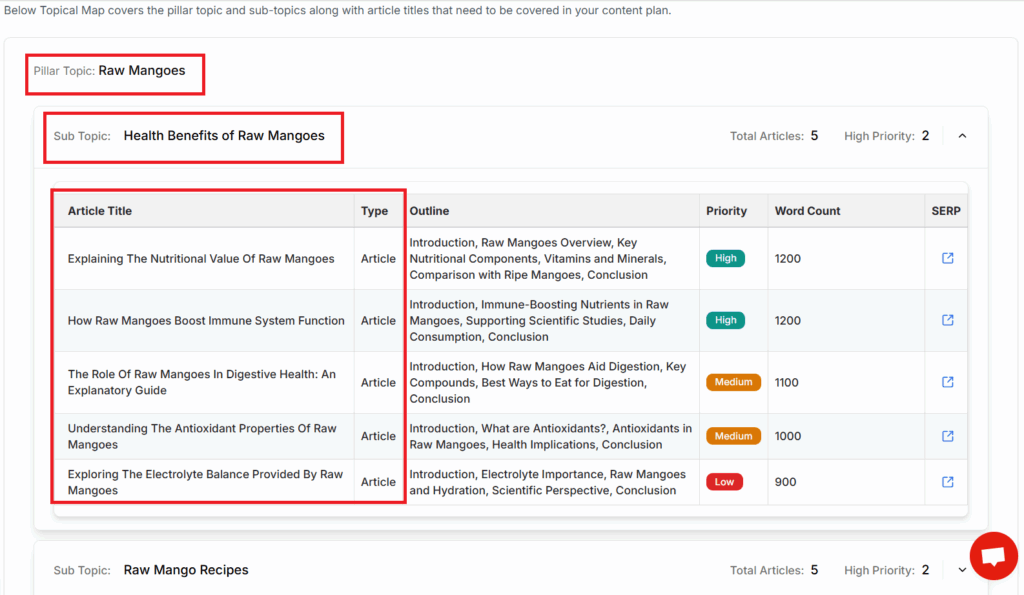
Good keyword clustering drives your entire content architecture: which topics become pillar pages, which support articles, and how internal links connect them. For instance, a SaaS company might turn a “project management software” cluster into a pillar, with supporting posts around “Kanban board,” “Gantt chart,” and “agile workflows.”
AI tools like Keywordly surface long-tail and related subtopics—“project management for nonprofits,” “remote project tracking,” or “PM software for agencies”—that inform hub-and-spoke models. The platform can suggest cluster-based internal link maps so every spoke article links back to the main pillar and to sibling topics.
Human editors then decide what deserves its own URL versus a section on an existing page. For example, an ecommerce SEO might keep “running shoes for flat feet” as a subheading on a broader “best running shoes” guide, while “trail running shoes” becomes a dedicated collection page.
How to Decide Based on Budget, Team Size, Industry Complexity, and Content Volume
Choosing between manual and AI clustering depends on your resources and risk profile. A small in-house team at a DTC brand with 2,000–3,000 keywords can lean heavily on Keywordly’s AI clustering, then manually refine high-traffic and branded clusters. This keeps costs down without sacrificing strategic control.
Enterprises, publishers, and agencies managing dozens of sites should prioritize AI-first workflows. With Keywordly, they can set consistent clustering rules, reuse templates, and maintain alignment across markets, while compliance or product experts review clusters in sensitive niches like healthcare or finance.
Highly regulated industries often need more manual oversight, even when AI handles the initial grouping. A practical model is: AI clustering in Keywordly → strategist review of critical clusters → ongoing, automated re-clustering as new keywords are discovered, matching your content velocity and tolerance for risk.
“When keywords are grouped by intent, content creation becomes clearer and more strategic.”
Reference:
Keyword Clustering: Probably The Best Guide You’ll Ever …
5. How Keywordly Does AI Keyword Clustering (With Human-Level Strategy)
Ingesting, Cleaning, and Preparing Your Keyword Data
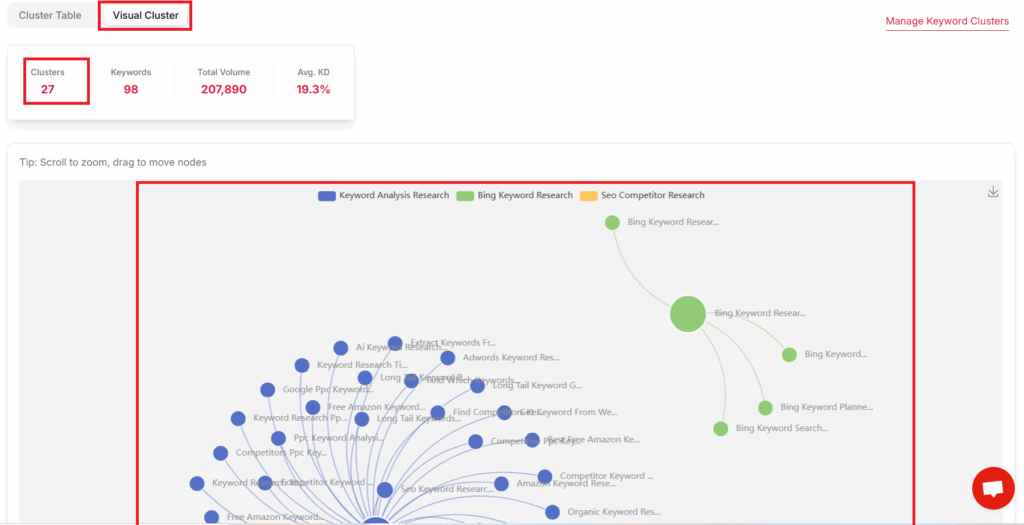
Manual keyword clustering often starts with messy spreadsheets exported from tools like Ahrefs, Semrush, or Google Search Console. Marketers copy-paste, merge CSVs, and hope nothing breaks. Keywordly automates this first mile so your strategy is built on clean, reliable data instead of error-prone manual work.
You can import keyword lists from SEO tools, analytics platforms, or internal CRM and product databases in a few clicks. For example, an ecommerce team at a Shopify store can pull product-related queries from Search Console, paid search terms from Google Ads, and customer phrases from Intercom, then centralize them in Keywordly.
Manual cleanup usually means sorting columns, using Find/Replace, and visually spotting duplicates. Keywordly automatically detects duplicates, normalizes casing and plurals, and filters out obvious junk like “www google com” or random URLs. This saves hours that would normally be spent cleaning exports after every crawl or report.
The platform also enriches each keyword with search volume, difficulty, and current ranking URLs where available. Similar to how Ahrefs or Semrush show metrics per keyword, Keywordly attaches these data points into a single view so you can weigh “SEO content tools” (2,200+ searches/month) against lower-volume but higher-intent phrases before clustering.
Keywordly’s AI Clustering Engine: Semantic Groups, Intent, and SERP Signals
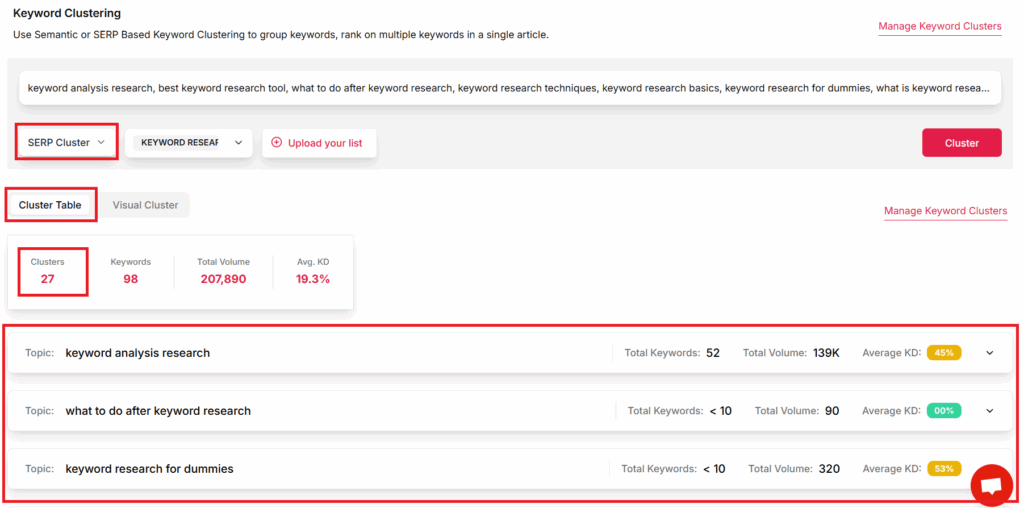
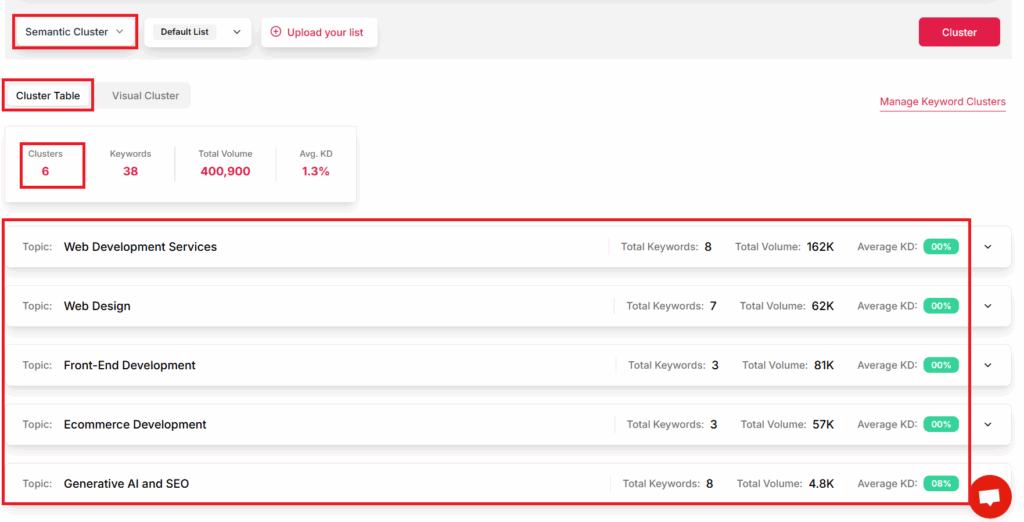
Traditional manual clustering relies on eyeballing shared words—grouping terms with the same root like “content brief tool” and “content brief software.” That misses nuanced relationships and search intent. Keywordly’s AI engine instead focuses on meaning, intent, and how Google actually serves results.
Using semantic analysis, the system groups terms that are conceptually related, even when wording differs. For instance, “how to create SEO content plan” and “marketing editorial calendar for SEO” end up in the same strategic cluster, because users are trying to structure ongoing content, not just write a single blog post.
Keywordly infers intent categories such as informational, transactional, navigational, and commercial investigation. A cluster around “best AI SEO tools” skews commercial investigation, while “what is topical authority” is clearly informational. This helps teams decide whether to create comparison pages, guides, or feature-led landing pages.
The engine also looks at SERP overlap—what URLs rank for which terms—similar to manual SERP-based clustering methods popularized by agencies like Authority Hacker. If the same top 10 pages rank for “AI keyword clustering” and “semantic keyword groups,” Keywordly treats them as one cluster, mirroring Google’s understanding and real user behavior.
From Clusters to Strategy: Mapping to Pages, Briefs, and Content Plans
Many SEOs stop at a list of clusters in a spreadsheet and then manually decide what to write. Keywordly goes further by transforming clusters into actionable content assets, bridging the gap between research, planning, and execution.
Within each cluster, Keywordly assigns a primary keyword and a set of secondary variants based on volume, difficulty, and relevance. A B2B SaaS brand might see “AI keyword clustering tool” as the primary term, with supporting queries like “automated keyword grouping” and “semantic keyword clusters” designated for subheadings and FAQs on the same page.
From there, the platform generates content briefs that outline suggested titles, H1–H3 structures, subtopics, and key user questions to answer. Similar to how agencies build briefs in tools like Content Harmony, Keywordly pulls in SERP questions, People Also Ask data, and competitor coverage so writers know exactly what angle to take.
Clusters are then mapped into a content roadmap: which topics need new pages, which should be merged, and which underperforming posts should be updated. For example, a blog with three thin posts on “SEO content templates” can consolidate into one comprehensive guide aligned to a single, strong cluster for better topical authority.
How Keywordly Unifies Clustering With Research, Content Creation, and Optimization
Manual keyword clustering typically lives in one Google Sheet, content briefs in separate Docs, and performance reports in yet another dashboard. Keywordly brings research, clustering, creation, and optimization into one workflow so teams are aligned and data stays in sync.
SEO leads, content strategists, and product marketers can collaborate on the same cluster views, leave comments, and assign content tasks. An agency managing multiple clients, for instance, can share cluster-based roadmaps with stakeholders instead of sending scattered exports from multiple tools.
Once content goes live, Keywordly tracks rankings and engagement for each cluster rather than only individual keywords. If Google starts favoring long-form guides for “AI SEO strategy,” the platform flags that the corresponding cluster might need deeper content, additional internal links, or a new supporting article.
This continuous feedback loop means clusters evolve as the SERP and user behavior change. Instead of redoing manual clustering every quarter, Keywordly updates cluster insights automatically, helping you keep content aligned with both Google’s understanding and emerging AI search surfaces like ChatGPT-powered experiences.
“A well-built cluster answers one big question through many smaller, related ones.”
Read this Article : Keyword Clustering: Definition, Core Principles And How to Do It effectively
Read this Article : SERP Keyword Clustering Tool: How and Why to Use
Read this Article : What Is Semantic Keyword Clustering? A Simple Guide
6. Building an SEO Workflow That Combines Manual Insight and AI Keyword Clustering
When to Layer Manual Review on Top of AI Keyword Clustering Outputs
Manual keyword clustering relies on spreadsheets, filters, and SERP checks to group terms by hand. AI clustering, whether via tools like Keywordly or Python-based scripts, uses semantic similarity and search intent patterns at scale. The most effective SEO teams combine both, letting AI sort thousands of terms, then applying human judgment where revenue and risk are highest.
Prioritize manual review for money pages such as “small business accounting software,” “B2B SEO agency,” or “ecommerce PPC management.” A SaaS brand like HubSpot will often have a strategist double-check AI clusters touching pricing, demos, and free trial pages, because a misclassified intent can impact millions in pipeline.
AI sometimes mixes informational and transactional keywords, such as “CRM examples” with “buy CRM software.” Human review should split these, ensuring comparison-intent terms feed into BOFU pages while how‑to searches map to guides. In specialized niches—like medical devices or industrial safety equipment—subject-matter experts need to review clusters so terms like “endoscope reprocessing” or “lockout/tagout” align with the correct compliance and technical content.
Validating Clusters Using SERP Analysis, Competitors, and User Intent
Once AI or manual methods generate clusters, validate them against live SERPs. Take a representative keyword from each cluster, plug it into Google, and confirm that top results share the same intent and content type. If “AI SEO tools” surfaces mostly listicles while “AI SEO automation platform” surfaces product pages, those belong in distinct clusters.
Study how top competitors structure topics. For example, Ahrefs and Semrush both separate “keyword research,” “rank tracking,” and “site audit” into clear hubs with individual feature pages. If your cluster tries to merge those, it is a signal to refine. Cross-check with real user data—support tickets in Zendesk, Gong call recordings, or on-site search logs—to confirm that clustered phrases map to the actual questions prospects ask.
Keywordly streamlines this by connecting clustered keywords with SERP snapshots and performance metrics in one workspace. You can quickly see whether a cluster like “local SEO for dentists” aligns with how dentists describe their needs in sales calls, then adjust the grouping before it goes into content production.
Turning Clusters Into Content Roadmaps, Topic Hubs, and Internal Link Structures
Clusters only drive growth when they become structured content. Group related clusters into topic hubs—for instance, “local SEO,” “Google Business Profile optimization,” and “local citation management” under a Local SEO pillar page. Each cluster becomes a supporting article, such as “local SEO checklist for multi-location restaurants,” linked tightly around the hub.
Plan URL structures to mirror this logic: /local-seo/, /local-seo/google-business-profile/, /local-seo/citations/. This makes it easier for users and crawlers to understand your topical hierarchy. Agencies like Siege Media use this approach to build pillar‑cluster architectures that consistently earn featured snippets and sitelinks for clients.
Internal links should lead readers from broad overviews to deep dives and back again. Keywordly helps by suggesting internal linking opportunities directly from the cluster view—surfacing, for example, that a new “AI content optimization checklist” article should link to existing pages on “content briefs,” “on-page SEO,” and “EEAT guidelines” to reinforce topical authority.
Ongoing Optimization: Refreshing Clusters as Search Behavior and AI Evolve
Search behavior and AI SERP formats shift constantly, so clustering is never a one‑and‑done job. Revisit clusters quarterly to spot new modifiers like “with AI,” “for SMB,” or “2025 guide” that deserve their own content or sections. When Google rolls out new AI Overviews, monitor which clusters lose clicks and consider richer, more expert-driven content to stay competitive.
Use performance data from Google Search Console and analytics to decide whether to expand, merge, or prune clusters. For example, if several “content brief” articles cannibalize each other, consolidate into a stronger, updated guide. Keywordly supports this workflow by tying rank trends, impressions, and conversions back to each cluster so you can adjust quickly.
As AI search engines and chat interfaces like ChatGPT and Perplexity highlight concise, well-structured sources, refine clustering to emphasize clear, question-based topics. Align clusters with how users phrase prompts—“how to perform an SEO audit step by step”—so your content becomes a trusted source both for traditional SERPs and AI-generated answers.
Reference:
How to Use AI for Keyword Research: A 6-Step Practical Guide
7. How to Get Started With Keyword Clustering in Keywordly
Importing or Discovering Keywords Inside Keywordly
Traditional, manual keyword clustering starts with messy exports from tools like Google Search Console, Ahrefs, or Semrush, then hours of copying, pasting, and color-coding in spreadsheets. Keywordly cuts that setup time by centralizing both imported keyword data and new research in one workspace.
You can pull in existing keyword lists from CSV exports or API-connected tools, then enrich them with Keywordly’s discovery features. For example, an eCommerce brand using Ahrefs can import 5,000 product-related keywords, then use Keywordly to uncover related long-tails like “nike pegasus 40 review” or “best running shoes for flat feet men.”
Organizing by project is critical before clustering. Inside Keywordly, segment keyword sets by site section (blog, category pages), product line (running shoes vs. hiking boots), or client accounts if you’re an agency. This mirrors how agencies like Victorious SEO structure client campaigns, ensuring each cluster aligns with a clear business area and avoids cross-project noise.
Running Your First AI Keyword Clustering Project Step-by-Step
Manual clustering means reading each keyword, guessing intent, and grouping terms into themes by hand. That can take days for a list of just 1,000 keywords. Keywordly’s AI clustering compresses that work into minutes while still letting you stay in control of the final structure.
Start by creating a new clustering project, selecting the imported keyword list or connecting a live source. Configure parameters like cluster granularity (broad themes vs. tight, page-level groups) and whether you want intent-aware clusters that separate informational from transactional terms.
Once you run the AI clustering, Keywordly groups keywords by semantic similarity and likely search intent, similar to how tools like Keyword Insights or ClusterAI work, but directly connected to your content workflow. Review the initial clusters, rename them to match your content strategy (for instance, “Chicago SEO services” vs. “national SEO agency”), then save or export to tools like Asana, Trello, or Notion to kick off content production.
Prioritizing Clusters for Content Production and Optimization
Not every cluster should become a page right away. In a manual process, SEOs usually build a prioritization spreadsheet combining search volume, keyword difficulty, and potential revenue. Keywordly streamlines this by letting you sort and filter clusters using the same data-driven criteria.
Rank clusters by a blend of volume, difficulty, and business relevance. For example, a SaaS company might prioritize a “content brief software” cluster over a high-volume but low-intent cluster like “what is content marketing,” because trials and demos are more likely from the former.
Look for quick wins where existing content can be updated or consolidated. An agency working on a B2B blog might find three underperforming posts on “B2B SEO strategy,” merge them into one authoritative guide aligned to a strong cluster, and schedule new articles for adjacent clusters to build topical authority around B2B search marketing.
Measuring Impact: Tracking Rankings, Organic Traffic, and AI Visibility
Manual keyword clustering often stops at the spreadsheet. Keywordly connects clustering to performance tracking, so you can see how each cluster behaves in search results and AI-driven experiences over time. This helps prove ROI to stakeholders and clients.
Monitor rankings for both primary and secondary keywords within each cluster, then correlate them with organic traffic, engagement, and conversions for mapped pages in Google Analytics and Google Search Console. For example, an online education brand can track how a “data analytics course” cluster drives sign-ups after launching a hub page and related articles.
As AI overviews and chat-based search grow on Google and Bing, watch visibility signals where available—featured snippets, People Also Ask, and answer-like appearances. Use these insights to refine clusters, adjust content briefs, and continuously improve your SEO strategy inside Keywordly, instead of constantly rebuilding manual cluster docs from scratch.
Reference:
What is Keyword Clustering and How to do it effectively
Conclusion: Making the Best Choice Between Manual and AI Keyword Clustering
Key Takeaways: When Manual, When AI, and When Hybrid
Choosing between manual, AI, and hybrid keyword clustering depends on your keyword volume, niche complexity, and internal resources. Manual clustering means an SEO specialist groups keywords by hand in spreadsheets, reviewing SERPs, search intent, and business priorities one by one.
This approach works best when you’re dealing with smaller sets (under 300–500 keywords) or highly nuanced industries like healthcare, legal, or fintech compliance. For example, a boutique law firm in New York targeting 200 local terms benefits from manual review, because the SEO expert can distinguish subtle intent differences such as “NYC employment lawyer free consultation” vs. “NYC wrongful termination statute.”
AI clustering shines when you’re handling thousands of keywords across multiple markets or domains. Large content teams, like SaaS companies competing with HubSpot or Semrush, often need to cluster 10,000+ terms by topic, funnel stage, and buyer persona. Here, AI tools can group keyword sets in minutes instead of days.
A hybrid workflow usually offers the best balance. You let AI generate a first-pass structure, then a strategist refines edge cases, merges or splits clusters, and aligns them with content strategy. Agencies managing 20+ client sites often use this hybrid model to keep speed high while preserving strategic control.
How Keywordly Simplifies Clustering and Ongoing SEO Optimization
Manual clustering without a dedicated platform usually means VLOOKUP-heavy spreadsheets, separate rank trackers, and disjointed content calendars. AI tools can automate clustering, but they often sit in isolation from your broader SEO workflow.
Keywordly centralizes keyword research, AI clustering, content planning, and optimization in one platform. You can import thousands of terms, let Keywordly’s AI cluster them by search intent and semantic similarity, and instantly map clusters to blog posts, product pages, or pillar/cluster content models.
For an agency managing 15 ecommerce brands, this means building cluster-driven content roadmaps in a few hours instead of a week. Teams get consistent naming conventions, repeatable processes, and a shared source of truth instead of scattered Excel files and ad‑hoc documents.
Keywordly also supports ongoing optimization as Google and AI search evolve. As queries shift toward conversational and multi-intent formats, you can re-cluster existing keyword sets, identify new content gaps, and update pages based on fresh cluster data and performance metrics.
Action Plan and Next Steps
The most effective way to choose between manual, AI, and hybrid clustering is to run a controlled pilot. Start with a defined topic—say, “email marketing for Shopify stores” with 500–1,000 keywords—and cluster them manually in a spreadsheet, then again using AI.
In Keywordly, you can run AI clustering on that same set, then have an SEO strategist review and adjust clusters for intent, funnel stage, and content type. Publish content based on the refined clusters, and track organic traffic, rankings, and conversions over 60–90 days to compare outcomes against any older, non-clustered content.
Once you see the lift, expand the process to additional topics or client accounts. Use Keywordly to standardize templates, automate cluster creation, and keep your content calendar tied tightly to keyword groups. When you’re ready to scale, explore a trial or demo of Keywordly so your team can turn clustering from a one-off project into a repeatable, operationalized part of your SEO engine.
“AI-powered keyword clustering makes modern SEO less guesswork — and more strategy.”
Read this Article : A Practical Keyword Clustering Guide and How to Implement in SEO Content Planning
Read this Article : Keyword Clustering: Boost Your SEO Content Strategy
FAQs About Manual vs AI Keyword Clustering
How Do I Know if My Site Is Ready for AI Keyword Clustering?
Sites are usually ready for AI clustering once you’re tracking hundreds or thousands of keywords across several themes. If you’re managing content for an ecommerce store with categories like “running shoes,” “trail shoes,” and “training gear,” manual clustering in spreadsheets quickly becomes slow and inconsistent.
AI tools, and specifically Keywordly, can process these large keyword sets at once, grouping them by intent and topic in minutes rather than hours. This is especially valuable when you’re planning a content hub or updating an existing library to target more competitive terms.
Brands with regular publishing schedules, like HubSpot or Ahrefs, gain the most because AI clustering keeps pace with weekly content briefs. Smaller sites can still benefit if they plan to scale or restructure around topics, using Keywordly projects to future-proof their content architecture.
Why Might Manually Built Clusters Outperform AI in Some Niches?
In highly technical or regulated spaces, manual clustering guided by subject-matter experts can outperform generic AI. For example, in B2B cybersecurity, the difference between “XDR,” “EDR,” and “SIEM” reflects distinct buyer intents that some models may blend into one cluster.
Healthcare, finance, and legal content have similar challenges. A compliance lead at a bank, for instance, might insist on separating “HELOC rates,” “HELOC requirements,” and “HELOC closing costs” into different pages for regulatory clarity. A manual approach here provides added control.
Keywordly helps teams combine both methods: you can start with AI-generated clusters, then refine them manually to reflect brand positioning and legal constraints. This hybrid workflow gives you speed without sacrificing nuance in sensitive niches.
How Often Should I Re-Run Keyword Clustering as My Site and SERPs Evolve?
Most sites benefit from revisiting clusters every 6–12 months, or sooner in volatile industries like SaaS and crypto. Google’s core updates, such as those in March and September 2023, reshuffled entire SERPs, making old topical groupings less accurate.
If you launch a new product line—say, a new CRM module or a DTC supplement—re-clustering helps you understand where those new keywords fit within your existing content hubs. It can also reveal cannibalization where two pages accidentally chase the same term.
Keywordly lets you import refreshed keyword exports from tools like Semrush or Ahrefs and re-run clustering on demand. You can then compare old vs new clusters in separate projects to decide which URLs need rewrites, redirects, or new content.