Pouring hours into keyword research only to end up with overlapping pages that cannibalize each other is one of the most frustrating parts of SEO. SERP keyword clustering offers a way out by grouping queries based on how Google itself understands intent, not just similar wording.
By understanding what SERP keyword clustering really means, how it differs from semantic clustering, and how to extract SERP keywords both manually and with AI-powered tools like Keywordly, you can plan content that ranks stronger, avoids duplication, and aligns tightly with searcher intent. It takes some upfront work, but used correctly these clusters become the backbone of a clear, scalable content strategy that fits seamlessly into your broader SEO workflow.
In an era where Google, Bing, and AI engines like ChatGPT decide who gets seen and who disappears, SERP keyword clustering isn’t a ‘nice-to-have’ tactic—it’s the strategic backbone that platforms like Keywordly use to turn scattered keywords into focused, revenue-driving content ecosystems.
1. Understanding SERP Keywords: Meaning, Intent, and Opportunity
SERP keywords meaning: what they are and why they matter
SERP keywords are the queries that trigger a specific set of results on a search engine results page. They don’t just describe what users type; they define which URLs, formats (articles, product pages, videos), and SERP features appear together.
When you Google “best CRM for small business,” you see list posts from HubSpot and G2, comparison tables, and review snippets. That pattern is the SERP for that keyword. SERP keyword clustering means grouping keywords that trigger highly similar SERPs, so you can target them with a single, stronger page instead of many weak ones.
To extract SERP keywords manually, SEOs often pull queries from Google Search Console, then inspect the SERPs in an incognito window. With Keywordly, you can automate this by importing seed keywords, pulling live SERPs, and letting the platform group terms that share overlapping URLs, saving hours of spreadsheet work.
“If you’re still grouping keywords manually, you’re spending hours on what a SERP clustering tool can automate in minutes — and losing ground to competitors.”
Search intent through SERPs: reading rankings, snippets, and entities
Search intent becomes much clearer when you read the SERP layout, not just the keyword. An informational query like “how to write a content brief” usually surfaces guides, featured snippets, and People Also Ask. A transactional query like “Ahrefs pricing” shows product pages, pricing tables, and maybe Google Ads.
Features such as featured snippets, People Also Ask boxes, and knowledge panels signal what Google believes users want most. For example, “SEO content brief template” often shows a snippet with bullet steps and downloadable templates from sites like Semrush or HubSpot, indicating users want a ready-to-use model, not theory.
Entities and brand results also clarify intent. If the SERP for “Jasper AI review” is dominated by blogs, YouTube reviews, and star ratings, Google interprets the query as commercial investigation. Keywordly can overlay SERP features and entity data, so your clusters are aligned with real user intent instead of just matching phrases.
How SERP overlap signals which keywords belong on the same page
SERP overlap measures how many of the same URLs rank across different keywords. If “SEO content brief,” “content outline for SEO,” and “SEO article brief template” share 60–80% of top-10 URLs, they likely belong in one SERP keyword cluster and can be targeted on a single page.
This approach is stronger than relying on semantic similarity alone. Two phrases may look similar linguistically but trigger very different SERPs. For instance, “SEO content strategy” surfaces strategic guides, while “SEO content calendar template” shows tools, templates, and downloadable sheets—different pages, different jobs.
Keywordly automates this by pulling SERPs at scale, calculating URL overlap, and forming clusters around primary terms. You see clear groups like “SEO content brief,” “SEO content outline,” and “content brief template,” each with their supporting variations mapped to a single URL, so you can plan content confidently.
Common mistakes: treating every keyword as a separate page opportunity
A frequent mistake is spinning up new pages for every close-variant keyword, which leads to keyword cannibalization. For example, creating separate posts for “B2B SEO content strategy,” “SEO strategy for B2B SaaS,” and “B2B SaaS SEO plan” often results in pages competing with each other, diluting authority and clicks.
Over-fragmented content makes it harder for Google to identify your best answer. One strong, comprehensive asset that targets a full SERP keyword cluster usually outperforms five thin, overlapping posts. HubSpot’s long-form guides that rank for hundreds of variations (e.g., “content marketing strategy” queries) are a clear proof of this approach.
SERP keyword clustering differs from semantic keyword clustering because it starts from actual SERP behavior, not just language models or topic similarity. Use SERP-based clusters in your content strategy by 1) assigning one core page to each cluster, 2) weaving all cluster terms into headings, subtopics, and FAQs, and 3) letting Keywordly monitor performance so you can expand or split clusters only when the SERP clearly diverges.
“The performance difference isn’t just in clustering — it’s in how quickly you can turn clusters into optimized content that outranks competitors.”
2. What Is SERP Keyword Clustering and How Does It Work?
Definition of SERP keyword clustering vs basic keyword grouping
SERP keyword clustering means grouping keywords based on how Google actually shows results, not just how those keywords look or sound. A cluster forms when multiple keywords trigger largely the same ranking URLs, signaling that Google sees them as one intent or topic.
Basic spreadsheet-style grouping relies on semantics or gut feeling: you might put “best CRM software” and “top CRM tools” together just because they look similar. With SERP clustering, you validate that by checking whether the same pages rank for both terms, aligning your plan with how search engines already organize topics.
Semantic clustering might group “project management tools” and “task management apps” together because they’re conceptually close. SERP clustering may split them if the top results differ, revealing that Google treats them as separate topics. Platforms like Keywordly and guides such as Mastering Keyword Clustering help you see and act on those distinctions.
How SERP similarity (URL overlap) is calculated in clustering tools
To build clusters, tools first fetch the top results for each keyword, usually the top 10–20 Google URLs. For “email marketing software” and “best email marketing tools,” a tool will pull those result sets and then compare which URLs appear in both lists.
Similarity is calculated by URL overlap. If 6–8 of the same domains or URLs appear in both top 10 lists, the tool considers them highly related and clusters them together. Strict clustering might require 7+ common URLs; loose clustering might accept 3–4, creating broader groups with more varied intent.
In Keywordly, you can set clustering strength so a term like “SEO content brief generator” either forms its own tight cluster or gets grouped with broader phrases like “SEO content tools.” This control helps agencies tune granularity for different markets or client strategies.
Benefits: fewer pages, stronger topical authority, less cannibalization
SERP clustering reduces redundant content by revealing when one comprehensive page can rank for dozens of related queries. Instead of publishing separate posts for “how to do keyword research,” “keyword research steps,” and “keyword research process,” you create one in‑depth guide targeting the whole cluster.
Consolidated pages attract more backlinks and engagement signals, strengthening topical authority. HubSpot’s pillar pages are a classic example: one long-form pillar ranks for thousands of variations because it covers the full clustered topic deeply and internally links to supporting assets.
Clustering also prevents keyword cannibalization. When two posts accidentally target the same SERP cluster, they compete against each other. A content audit in Keywordly will highlight overlapping clusters so you can merge, redirect, or reposition pages, clarifying which URL owns each primary cluster.
When SERP keyword clustering is especially powerful
Clustering is critical when planning a new site or content hub with limited resources. A startup in B2B SaaS, for example, can take 1,000 raw keywords, cluster them in Keywordly, and prioritize 30 high-value clusters to cover first instead of writing 200 scattered articles.
During content audits, clustering exposes thin or overlapping posts. An agency reviewing a blog with 500+ articles might find 20 separate posts targeting the same “social media calendar” cluster and consolidate them into a single authoritative guide, then redirect legacy URLs.
When expanding into new regions or topics—say, entering Spanish SERPs or branching into “AI content optimization”—clustering around those markets shows how Google interprets intent locally. Combining SERP clusters with Keywordly’s research and content briefs lets you shape a strategy that follows actual search behavior instead of assumptions.
“Tools aren’t just faster — the right clustering system uncovers hidden content opportunities most teams miss manually.”
3. SERP Keyword Clustering vs Semantic Keyword Clustering

Semantic keyword clustering explained (NLP, topic similarity, entities)
Semantic keyword clustering groups queries by meaning, not by how they rank in Google. Instead of looking at shared URLs in the SERP, it looks at linguistic similarity to understand whether “best running shoes,” “top sneakers for runners,” and “running footwear reviews” belong to the same topical bucket.
Modern NLP models and embeddings power this approach. Tools using technologies similar to Google’s BERT or OpenAI embeddings compare keyword vectors to detect topic similarity and entities such as brands, products, or locations. This helps you see that “Nike Pegasus 41” and “neutral road running shoe” often live in the same conceptual space.
Semantic clustering also surfaces valuable variations and questions. For example, a semantic engine will naturally group “how to start intermittent fasting,” “intermittent fasting schedule for beginners,” and “16/8 fasting results” as one topic hub, even if their SERPs differ slightly. That’s powerful for building FAQ sections, content briefs, and supporting subheadings.
Key differences: SERP-based behavior vs language-based similarity
To understand SERP keyword clustering, focus on search engine behavior. Here, you group keywords when they trigger overlapping ranking URLs. If “CRM software,” “best CRM tools,” and “HubSpot vs Salesforce” share 6–8 of the same top 10 results, a SERP cluster suggests a single page can rank for all three.
Semantic clustering, by contrast, uses language-based similarity only. Two keywords can look alike linguistically but generate very different SERPs. For example, “apple care” (Apple’s warranty) and “Apple care number” (support contact) sound similar but show different intent and result types.
That’s why SERP-based signals matter. If Google shows entirely different pages for “SEO content strategy” vs “SEO content calendar template,” they probably should not be forced into one page, even if an NLP model says they’re semantically close. Treat SERP overlap as your intent safeguard.
Pros and cons of SERP clustering vs semantic clustering for SEO
Both approaches bring distinct benefits to strategy, especially at scale. Teams using Keywordly can lean on each method at different stages of the workflow to avoid cannibalization and unlock new ideas.
Features of SERP keyword clustering
- Groups keywords by shared ranking URLs and SERP overlap.
- Highlights primary intent (informational, commercial, transactional) via result types.
- Shows realistic page-level opportunities based on what already ranks.
Pros of SERP clustering
- Strong intent alignment and reduced keyword cannibalization across large blogs.
- Real-world validation: mirrors how Google actually groups queries on page 1.
- Great for mapping specific keyword sets to individual or hub pages.
Cons of SERP clustering
- Can miss long-tail or emerging topics with sparse SERP data.
- Heavily dependent on current SERPs, which can shift after updates.
- Less useful for pure ideation or early-topic discovery.
Features of semantic keyword clustering
- Uses NLP embeddings, entities, and topic similarity instead of SERP overlap.
- Groups synonyms, variations, and questions into thematic buckets.
- Maps broader topical landscapes around a seed theme.
Pros of semantic clustering
- Excellent for brainstorming, content ideation, and FAQ expansion.
- Helps you cover a full topic, not just high-volume head terms.
- Supports AI-search readiness by aligning content with concepts, not just exact phrases.
Cons of semantic clustering
- May suggest grouping queries that Google currently separates by intent.
- Can lead to thin or unfocused pages if not validated against SERPs.
- Language similarity alone doesn’t guarantee ranking potential.
When to use SERP clustering, semantic clustering, or a hybrid approach
Both clustering methods are most powerful when used in a structured workflow. Keywordly is designed around this hybrid model: expand with semantics first, then validate and structure with SERP-based clusters.
Use SERP keyword clustering when mapping keywords to pages and building content architecture. For instance, an agency planning a B2B SaaS blog can take 1,000 CRM-related keywords, run SERP clustering, and clearly see which should become a single comparison guide vs separate feature pages. This reduces duplicate articles on “best CRM for small business” competing with each other.
Use semantic clustering for ideation, supporting keyword discovery, and enriching page content. Start with a seed like “content audit” and let semantic expansion surface related ideas such as “SEO content audit checklist,” “content pruning,” and “content refresh strategy,” which can become sections, FAQs, or internal links from your main guide.
A practical hybrid workflow in Keywordly looks like this:
1) Import or generate a broad keyword list around a topic.
2) Let Keywordly expand and semantically group variations, synonyms, and questions.
3) Run SERP-based clustering inside Keywordly to see which terms realistically belong to the same URL.
4) Use the resulting clusters to build content briefs, outlines, and internal link structures.
To extract SERP keywords in general, you can export queries from Google Search Console, pull suggestions from tools like Google Keyword Planner, and scrape SERPs via APIs. In Keywordly, you simply enter seed topics or upload existing keywords; the platform automatically fetches SERP data, groups terms by overlap, and presents ready-to-use SERP clusters that plug directly into your content strategy.
4. How to Extract SERP Keywords Manually and With AI
Manual SERP keyword extraction: autocomplete, People Also Ask, related searches
Manual SERP keyword extraction starts with reading the page the way Google users do. Your goal is to capture the exact phrases, questions, and modifiers people type before you scale them with tools or AI.
For example, type “best CRM for small business” into Google and slowly add letters. Autocomplete will surface long-tail variations like “best CRM for small business 2024” or “best CRM for small business under $50,” which reveal pricing and recency modifiers you should capture.
Scroll to the People Also Ask box and note question patterns such as “What is the easiest CRM to use?” or “Is HubSpot CRM really free?” These questions expose informational subtopics and pain points you can turn into H2s and FAQs.
At the bottom of the SERP, related searches like “small business CRM comparison chart” or “Zoho vs HubSpot CRM” show adjacent intents—comparison, evaluation, and alternatives—that belong in your keyword list and later in SERP keyword clusters.
Using SEO tools to collect seed and long-tail terms
Once you’ve gathered manual ideas, use SEO tools to expand them into a measurable dataset. The goal is to identify both seed topics and the long-tail phrases that drive qualified traffic.
Start in Google Search Console: filter by page or folder and export queries already getting impressions for your core articles. If your “email marketing” guide shows queries like “email marketing for nonprofits” or “Mailchimp email marketing tutorial,” those become proven long-tail candidates.
Then use keyword research tools such as Ahrefs, Semrush, or Keywordly’s research module to discover new opportunities. Apply filters for intent (informational vs. commercial), volume (e.g., 50–5,000 searches), and difficulty so you prioritize terms your domain can realistically rank for instead of chasing impossible head terms.
“The cost of the wrong tool isn’t just subscription fees — it’s missed content opportunities, rank loss, and wasted editorial time.”
AI SERP keyword extractor: how AI can expand, clean, and structure keyword lists
AI helps move from messy exports to structured SERP keyword clusters that are ready for strategy. It can take a small set of seed terms and generate related queries, modifiers, and questions that mirror how people actually search across Google and Bing.
In Keywordly, you can paste a list of seeds like “programmatic SEO,” “SERP keyword clustering,” and “AI content briefs.” The AI expands this into hundreds of variations, then deduplicates, normalizes spelling, and categorizes each term into themes before clustering.
Well-structured outputs—CSV files with tags, search intent labels, and cluster IDs—can then be pushed into a SERP clustering engine such as the Keyword Clustering Tool – Group Keywords by SERP, which can process up to 200k+ keywords and align them to live SERP data.
Criteria for a high-quality SERP keyword set
A strong SERP keyword set balances coverage and focus. You want head terms like “project management software” plus long-tails such as “project management software for agencies” that have enough volume to matter but are specific enough to rank and convert.
Check each cluster for intent and business fit: a B2B SaaS brand should favor “enterprise project management software” over generic “what is project management,” unless the informational query clearly supports top-of-funnel growth. Align clusters with products, pricing pages, and core content pillars.
Finally, weigh competitiveness against your site’s authority. If you’re competing with Atlassian and Asana on a term, prioritize related lower-difficulty phrases where you can realistically win, then use Keywordly’s AI to build content around those SERP keyword clusters first.
5. Using Keywordly as a Free SERP Keyword Clustering Tool
Importing or Generating Keyword Lists Inside Keywordly
SERP keyword clustering means grouping keywords based on which pages rank together in Google or Bing. Instead of guessing topics, you use live search results to see which queries search engines treat as part of the same intent.
To start in Keywordly, you can import existing keyword lists from tools like Ahrefs, Semrush, or Google Search Console. Simply copy-paste up to a few thousand terms into the input box, or upload a CSV if your workflow is export-based from GSC or a rank tracker like AccuRanker.
Keywordly also lets you generate new keyword ideas with AI. For example, a DTC brand like Allbirds could enter “sustainable running shoes” and have Keywordly expand this into long-tails around materials, care, and performance comparisons, then organize them into projects by site, client, or topic cluster before running any SERP analysis.
How Keywordly’s AI SERP Keyword Extractor Works with Live SERP Data
Traditional semantic clustering relies on language similarity; SERP keyword extraction instead looks at which URLs rank together. Keywordly fetches live SERP data for each keyword, pulling top-ranking URLs from Google or Bing, then analyzes overlap patterns across those results.
The AI refines and normalizes variants like “best crm for startups” and “crm software for small startups” by studying shared ranking pages. If HubSpot, Salesforce, and Pipedrive comparison URLs appear on both SERPs, Keywordly groups them as a single SERP cluster even if the wording differs significantly.
Because this uses fresh SERP data, you avoid outdated assumptions. For instance, Google recently split “AI writing tools” into separate results for enterprise vs. student use; a SERP-based extractor will show these as separate clusters while a static semantic model might still merge them.
Running a Free SERP Keyword Clustering Report
Once your list is ready, running a clustering report in Keywordly takes a few guided steps. This is where most users transform raw keyword dumps into content-ready groups tied directly to search intent.
Step 1: Select your keyword set. Choose the project and list, then set clustering strictness. A tighter similarity threshold groups only keywords that share many ranking URLs; a looser one accommodates broader topical hubs, helpful for authority-building content like Shopify’s ecommerce blog.
Step 2: Configure SERP settings. Pick region (e.g., United States), language (English), and search engine (Google or Bing) to mirror your real audience. Local agencies, for example, might cluster “personal injury lawyer” terms specifically for Google US-English to align with their local lead gen campaigns.
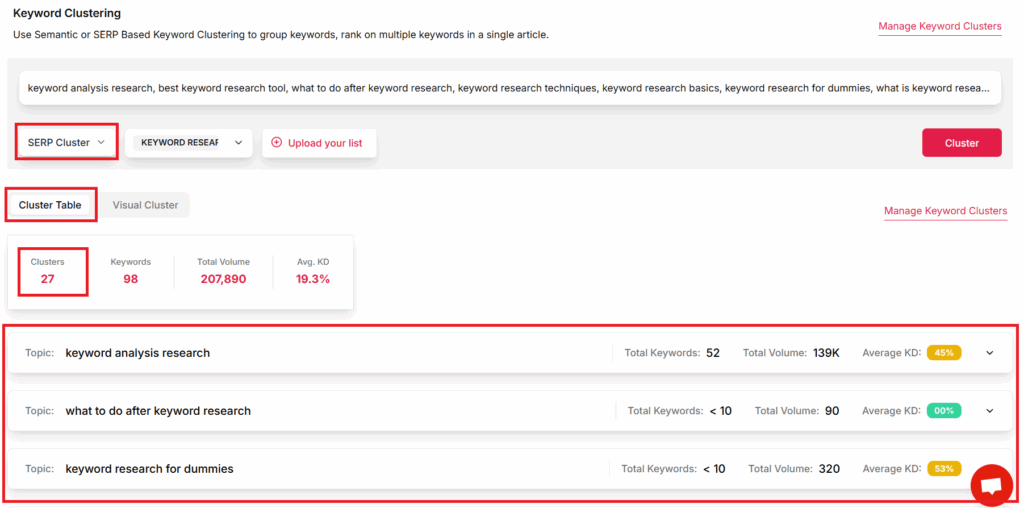
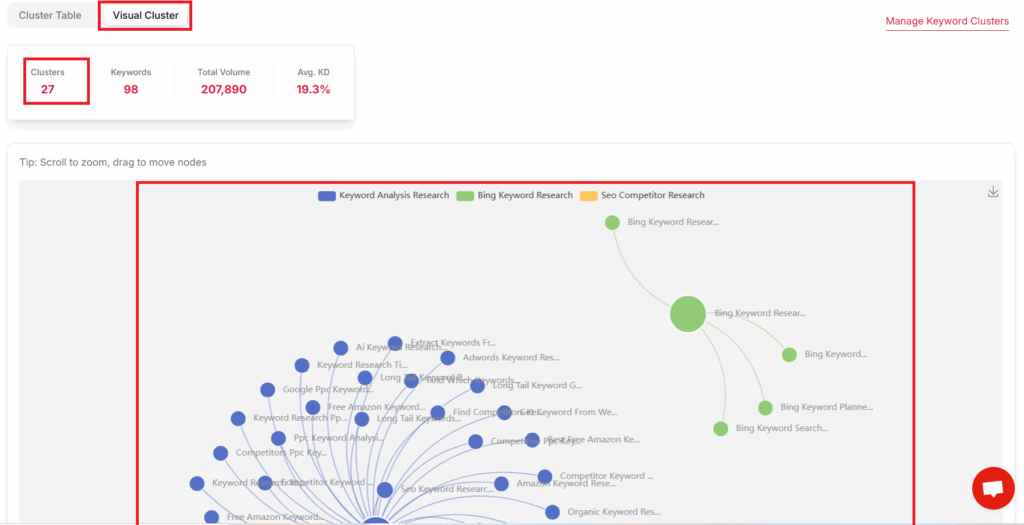
Step 3: Review report outputs. Keywordly returns clusters with a representative keyword, a list of all grouped terms, and stats such as cluster size and average search volume where available, helping you quickly prioritize which clusters deserve pillar pages.
Interpreting Keywordly’s Clusters: Cluster Labels, Primary vs Secondary Terms, Intent Tags
The real value comes from understanding cluster structure and applying it to your content strategy. SERP clusters differ from purely semantic clusters because they are grounded in what actually ranks together, not just similar wording.
Keywordly labels each cluster based on the dominant or highest-value keyword, typically the one with the strongest volume or commercial potential. That becomes your primary target, while lower-volume variants inside the same cluster—like “pricing,” “review,” or “near me” modifiers—act as secondary terms to weave into headings and FAQs.
Intent tags (informational, commercial, transactional, navigational) and metadata show whether to create a blog guide, comparison page, or product landing page.
“When semantic and SERP clustering are aligned, your content roadmap becomes a predictable traffic engine — not a guessing game.”
Read this Article : What Is Semantic Keyword Clustering? A Simple Guide
Read this Article : Keyword Clustering: Definition, Core Principles And How to Do It effectively
6. Turning SERP Keyword Clusters into Content Strategy
SERP keyword clustering groups queries that share similar search results, not just similar wording. Instead of relying only on semantics, you look at which keywords return overlapping URLs on Google and Bing and treat those as one intent cluster.
This matters because it mirrors how search engines interpret topics. When you build content around SERP clusters, you align with real user behavior and reduce cannibalization across your site.
Mapping SERP keyword clusters to content types
Once you’ve extracted SERP keywords—either manually from Google’s “People Also Ask” and related searches, or via tools like Keywordly’s SERP miner—you can map each cluster to a content type. Keywordly automatically groups keywords that share top-10 results into clusters so you can see intent at a glance.
Informational clusters like “how to do keyword research,” “SEO keyword tutorial,” and “keyword research step by step” clearly suit blog posts, guides, or academy-style resources. Ahrefs, for example, built a full guide around this cluster that drives thousands of organic visits per month.
Commercial and transactional clusters usually align with landing or product pages. A cluster containing “SEO content platform,” “AI SEO writing tool,” and “Keywordly review” should support a comparison page or product landing page optimized for signups or demos.
Broad clusters such as “content marketing strategy” can become pillar pages, while related long-tails like “content marketing strategy for SaaS” or “B2B content strategy framework” form supporting cluster articles. HubSpot’s content hubs are a well-known example of this pillar-and-cluster structure.
Choosing a primary keyword and supporting terms for each content asset
Within each SERP cluster, you need a clear primary keyword. Choose based on search volume, business relevance, and SERP fit. For instance, if Keywordly targets “SEO content workflow platform,” that might be the primary term, while “AI SEO content tool” and “content optimization software” become supporting terms.
Supporting terms should appear in H2s, body copy, and internal links, but all must reflect how Google currently groups them. If SERPs for two phrases show totally different results, they likely deserve separate pages instead of one combined asset.
Unlike semantic clustering, which groups phrases by meaning alone (e.g., via embeddings), SERP clustering respects search engine behavior. Two semantically related queries might belong in different SERP clusters because Google serves different intent: “SEO content checklist” vs. “SEO content template” often surface different page types.
Keywordly resolves this by analyzing overlapping SERP URLs so you can see when to merge or split topics. This prevents you from over-optimizing one page for multiple conflicting intents.
Structuring outlines and on-page SEO around SERP clusters
Use SERP clusters to shape your outline before writing. Build your H1 and core H2s from the dominant themes and questions in the cluster. For a “keyword clustering” cluster, your H2s might be “What is keyword clustering,” “SERP vs semantic clustering,” and “How to cluster keywords using Keywordly.”
Then, turn long-tail and question-style queries into FAQs. If users search “how to cluster keywords in Excel” or “best keyword clustering tools,” add a dedicated FAQ section, marked up with FAQ schema, to win rich results and AI overviews.
Optimize title tags and meta descriptions to match the cluster’s primary intent. For transactional clusters, lead with outcomes (e.g., “Boost organic traffic with an AI SEO workflow platform”). For informational ones, promise clarity and depth. Internal links should connect all pages in the same cluster hub, using descriptive anchor text like “SEO content workflow with Keywordly” instead of generic “learn more.”
Integrating clusters into your broader content calendar and topical authority plan
Turn clusters into a measurable roadmap. Rank clusters by potential traffic, conversion value, ranking difficulty, and gaps in your existing content. If you see strong demand for “AI content optimization” and few competing in-depth guides, that cluster deserves higher priority in your roadmap.
Keywordly can surface these gaps by overlaying your existing URLs on top of cluster maps, revealing unserved or under-served topics. This helps you avoid duplicating content and instead fill strategic holes.
Schedule related clusters in a logical order: first a broad pillar, then supporting articles every 1–2 weeks to signal topical depth. For example, an agency might plan Q2 around “local SEO” clusters, then Q3 around “programmatic SEO.”
Align clusters with campaigns and seasonality. Retail brands often push “Black Friday SEO deals” and “holiday gift guide SEO” clusters from September onward. Using Keywordly, teams can pre-build briefs, outlines, and optimization tasks around those clusters so content goes live well before peak search demand.
7. Advanced Ways to Use SERP Keyword Clustering in Keywordly

SERP keyword clustering groups queries that share similar search results, based on what Google actually ranks. Instead of relying only on semantic similarity, it clusters keywords by overlapping URLs in the top results, revealing what search engines consider the same intent.
You can extract SERP keywords manually by pulling terms from Google Search Console, scraping SERPs with tools like Ahrefs or Semrush, or exporting PPC search terms. In Keywordly, you import or paste these keywords, and the platform automatically fetches SERP data and builds intent-based clusters around real-ranking pages.
Auditing Existing Content for Cannibalization Using SERP Clusters
Content cannibalization happens when multiple pages compete for the same SERP space. SERP clustering makes this visible by showing which queries share overlapping ranking URLs, rather than just similar wording.
In Keywordly, run your existing ranking keywords from Search Console through the SERP clustering module. The tool groups queries where the same or similar pages appear in the top 10, helping you see where two or more URLs are fighting for the same intent.
Map each cluster to your current URLs in a simple table. For example, a SaaS like HubSpot might see both a blog post and a feature page ranking for “CRM for small business.” Keywordly helps decide whether to merge content, 301 redirect weaker URLs, or differentiate angles (e.g., comparison vs. use-case guide) so Google understands which page owns that cluster.
Identifying Content Gaps and New Topic Opportunities from Unclustered or Thin Clusters
SERP clusters also reveal where your site has no clear answer compared with competitors. When Keywordly clusters imported SERP keywords, you’ll often see groups with strong volume but no mapped URL from your domain.
Use those gap clusters to brief new content. For instance, an ecommerce brand like REI might discover a strong cluster around “ultralight backpacking food ideas” where competitors like Outside Online rank, but they have no targeted guide. That cluster becomes a brief for a pillar article with supporting recipes and packing checklists.
Thin clusters with just a few related terms can be expanded. If you see a small cluster like “B2B SEO reporting template” and “SEO client report PDF,” that’s a signal to build a focused asset library page, downloadable template, and supporting blog post, all tied to one master cluster in Keywordly.
Local and Transactional SERP Keyword Clustering
Local and bottom-of-funnel queries often look similar semantically but behave differently in the SERPs by geography and intent. SERP-based clustering respects those nuances better than pure semantic grouping.
Cluster local modifiers like “roofing company Denver,” “roof repair Denver CO,” and “emergency roofer Denver” to structure a city hub page and service subpages. Tools like BrightLocal show SERP variation by ZIP code; Keywordly lets you feed those location-specific terms into clusters so you can design distinct landing pages where SERPs diverge.
For transactional terms, group queries such as “buy project management software,” “project management tool pricing,” and “ClickUp pricing” into one bottom-of-funnel cluster. Use Keywordly’s cluster view to design pricing pages, comparison tables, and demo CTAs that align tightly with that cluster’s commercial intent.
Measuring Performance: Tracking Rankings and Traffic by Cluster, Not Just by Keyword
Single-keyword reporting hides the true performance of a topic. SERP clusters let you measure how well a page owns an entire intent space, not just one head term.
In Keywordly, aggregate rankings, clicks, and traffic at the cluster level. For example, instead of tracking only “content brief template,” track the whole cluster including “SEO content brief,” “blog brief example,” and “downloadable content brief.” A lift after optimizing the main page signals that you’re winning the wider SERP.
Monitor how changes to a key URL affect its full cluster. If you refresh copy or internal links and see cluster-wide ranking gains, prioritize similar updates for other strategic clusters. When a cluster’s visibility drops, that’s your cue for a focused content audit, rather than chasing isolated keywords.
8. Common Pitfalls and Best Practices for Clustering of Keywords in SERP
SERP keyword clustering means grouping keywords based on how Google actually ranks pages for those queries. Instead of relying only on semantic similarity, you look at overlapping URLs and intent in the live results.
You can extract SERP keywords by pulling queries from Google Search Console, Google Ads, or third‑party tools, then enriching them with live SERP data via scraping or APIs. In Keywordly, you can import keyword lists, auto-fetch SERP data, and generate intent-based clusters tied to target URLs and content briefs.
Over-clustering vs under-clustering: knowing when to split or merge clusters
Over-clustering happens when you throw too many different intents into one group just because URLs overlap. For example, putting “how to start a blog,” “blog business plan,” and “blog name ideas” in a single pillar can confuse both users and Google, since these map to guides, strategy templates, and ideation content.
Under-clustering is the opposite: you create separate pages for “best CRM for small business,” “small business CRM software,” and “CRM tools for small businesses,” even though the SERPs share 8–9 of the top 10 URLs. HubSpot and Salesforce rank with one core page here, not three thin ones.
As a rule of thumb, merge when 60–70%+ of top 10 URLs match and the page type is the same. Split when overlap drops below ~40% or when intent clearly shifts from informational to commercial. Keywordly surfaces overlap scores so you can decide when a new page is justified.
Ignoring intent differences inside a single SERP keyword cluster
Even strong SERP clusters can hide mixed intents. Google might rank both “what is zero-click search” and “zero-click SEO strategy” to similar articles, but one user wants a definition while another wants a playbook with tactics and metrics.
For high-value keywords like “link building services pricing” or “enterprise SEO platform,” manually review the SERP to confirm whether users want comparisons, service pages, or how-to content. Tools often label both as “commercial,” but the layout (local packs, product carousels, or featured snippets) reveals the nuance.
When you see intent split, structure your page accordingly. Use distinct H2 sections for “What is…,” “Pricing models,” and “How to choose,” or even create a separate commercial landing page and keep the educational guide as top-of-funnel. Keywordly’s brief builder can map sub-intents to specific sections so writers cover each angle cleanly.
Relying only on tools: when to manually review SERPs and adjust
Automated clustering can misread niche contexts, branded queries, or emerging topics. For example, when OpenAI launched GPT-4, many tools lagged in understanding whether “GPT-4 pricing” should be grouped with “ChatGPT Plus cost” or treated as a distinct intent with enterprise implications.
For strategic keywords, money pages, and terms with high CPC, always run a manual SERP check. Look at whether competitors are winning with guides, product pages, comparison tables, or programmatic templates. This context often reveals why a cluster underperforms even when the tool says it’s well-optimized.
Use performance data to iterate: if a Keywordly cluster drives impressions but low CTR, your snippet or angle may not match intent. If a secondary keyword in the cluster starts getting more conversions, consider splitting it into its own page and re-clustering around that emerging opportunity.
Workflow best practices: documenting clusters, updating as SERPs evolve, and aligning teams
SERP keyword clustering differs from semantic clustering because it’s based on ranking behavior, not just language similarity. Semantic clusters might group “SEO content platform” and “AI writing tool,” but live SERPs show very different competitors and layouts, signaling different strategies and landing pages.
Store your clusters in a shared system like Keywordly with columns for cluster name, primary intent, SERP type (guide, listicle, tool, product), and target URL. Add notes such as “FAQ-rich SERP” or “dominated by aggregators like G2 and Capterra” so your team knows how to differentiate.
Re-cluster at least quarterly, or monthly in fast-moving spaces like AI or ecommerce. Use these SERP-based clusters to drive your content roadmap: one pillar for the main cluster, supporting articles for long-tail clusters, and internal links mapped in Keywordly. This keeps SEO, content, and product teams aligned around real search behavior instead of guesswork.
“Brands that scale with clustered keyword strategies grow visibility faster — and often retain rankings longer — than those relying on isolated keyword tactics.”
Conclusion: From Isolated Keywords to Cohesive SERP-Driven Content
Key takeaways: what SERP keyword clustering is and how it differs from semantic clustering
SERP keyword clustering means grouping keywords based on the URLs that rank for them and how people actually search, not just on how similar the words look. If the same pages rank for “best CRM for startups,” “startup CRM tools,” and “HubSpot vs Pipedrive for startups,” those queries belong in one SERP cluster because Google treats them as one intent.
By contrast, semantic clustering groups terms by language similarity and topic meaning only. “CRM pricing models” and “SaaS pricing tiers” might cluster semantically, but their SERPs often show totally different pages. SERP clustering grounds your decisions in live search results, so you align content with what Google and Bing already understand about user intent.
Why using a SERP keyword clustering tool like Keywordly strengthens strategy and execution
Manually exporting SERPs from tools like Ahrefs or Semrush and comparing overlapping URLs across thousands of keywords is slow and error-prone. Keywordly automates this by pulling rankings, matching shared URLs at scale, and producing clusters in minutes instead of hours, so teams can move from raw keyword dumps to actionable content plans quickly.
When you consistently cluster SERP-based keywords, your site architecture tightens up: one pillar page targets the “SEO content brief” cluster, while supporting posts handle narrower clusters like “SEO content template” or “content brief examples.” This reduces keyword cannibalization, focuses each URL on a clear intent, and improves ROI by ensuring every published page has a defined role in your funnel.
The impact on brand visibility across Google, Bing, and AI-driven search
Clear topical clusters help search engines recognize you as the go-to source around specific problems. For instance, a finance brand that builds a cohesive cluster on “Roth IRA vs traditional IRA,” “Roth IRA contribution limits,” and “Roth IRA income limits” often sees stronger sitelinks and higher average positions in both Google and Bing.
Clustered content also feeds AI overviews and answer engines like ChatGPT and Bing Copilot. When your articles systematically cover every angle of a topic cluster, language models have richer, better-structured material to learn from, which can increase how often your brand is referenced or surfaced in synthesized answers as search interfaces evolve.
Next steps: run your first cluster, map it to content, and iterate based on performance
To extract SERP keywords, start by exporting related queries from Google Search Console, Ahrefs, or Semrush, then feed that list into Keywordly’s free clustering report. Keywordly pulls SERP data, groups terms by shared ranking URLs, and shows which keywords belong on the same page versus which deserve separate assets.
From there, 1) map your highest-value clusters to new or existing content, 2) prioritize by traffic and revenue potential, and 3) monitor rankings, CTR, and conversions in tools like GA4 and GSC. Re-run clustering in Keywordly quarterly so you can adapt to SERP shifts, merge overlapping pages, and keep your content strategy aligned with real search behavior.
“If your goal is measurable, predictable SEO growth, then automated clustering isn’t optional — it’s foundational.”
Read this Article : Manual vs AI Keyword Clustering: Which Is Best to Improves SEO Accuracy
Read this Article : A Practical Keyword Clustering Guide and How to Implement in SEO Content Planning
Read this Article : Keyword Clustering: Boost Your SEO Content Strategy
FAQs About SERP Keyword Clustering Tools
How is SERP keyword clustering different from traditional keyword research?
Traditional keyword research focuses on metrics like search volume, keyword difficulty, and CPC, then groups terms by topic or semantic similarity. For example, you might group “best CRM software,” “top CRM tools,” and “CRM platforms” together because they share similar wording and intent.
SERP keyword clustering, by contrast, looks at the actual search results pages and groups keywords based on overlapping ranking URLs. If “best CRM software” and “CRM for small business” share 7–8 results in common, tools like Keywordly treat them as one cluster and one page target. This leads to tighter page-level targeting, clearer information architecture, and fewer cannibalizing pages.
Why should I use a SERP keyword clustering tool instead of grouping keywords by hand?
Manually checking SERPs for hundreds of keywords is slow and error‑prone. You would need to Google each term, compare results, and guess which ones belong on the same page. Most teams stop early, which often leads to duplicate content or thin pages that never rank.
Keywordly can process thousands of keywords at once using live SERP data from Google and Bing. A workflow that might take an SEO strategist 10 hours in a spreadsheet can run in minutes, freeing your time for strategy, content quality, and conversion optimization instead of repetitive SERP checks.
When should I re-run SERP keyword clustering for an existing site or content library?
Search intent and competitors change. After major Google updates like the Helpful Content or Core updates, SERPs often shift from product pages to guides, or from blog posts to category pages. Re-clustering your keywords helps you see when one article should become a comparison page or when a blog post should be split into how‑to and informational guides.
For active sites publishing weekly, re-run clustering every 3–6 months and before redesigns, migrations, or IA changes. Agencies often do this before consolidating blogs, so they know which clusters should map to cornerstone content, support articles, or category hubs.
How can I use Keywordly’s AI SERP keyword extractor with other SEO tools in my stack?
Keywordly fits between your research and measurement tools. Start by exporting queries from Google Search Console, Semrush, or Ahrefs, then import them into Keywordly’s AI SERP keyword extractor. The tool pulls live SERP data, expands related terms, and groups them into intent‑based clusters.
Once clustered, you can export groups into your CMS (like WordPress or Webflow) or project tools such as Asana and ClickUp. Many teams then connect clusters to analytics and rank trackers, measuring which Keywordly clusters drive the most organic traffic and assisted conversions.
How do I know whether a cluster should be one page or broken into multiple pieces of content?
Start by checking intent consistency: if a cluster mixes “what is,” “how to,” and “pricing” queries, you may need several pages. For example, in B2B SaaS, “what is ERP,” “ERP examples,” and “ERP pricing” often show three different SERP types, signaling separate pages for education, use cases, and pricing.
Inspect the live SERPs: if top competitors like HubSpot or Shopify rank one long guide for all terms, one comprehensive page may work. If they dominate with multiple specialized pages, follow that structure and use internal links and content hubs to keep UX clean.
Why do some keywords with similar meanings end up in different SERP keyword clusters?
Search engines interpret context and intent, not just wording. “Invoice software” and “free invoice template” look similar linguistically, but Google usually shows tools like QuickBooks for the first and downloadable templates for the second. SERP clustering reflects this real behavior, even when the phrases sound alike.
Geography, commercial intent, and freshness also matter. “SEO conference” vs. “SEO conference 2026” or “near me” modifiers often lead to different SERPs and thus separate clusters. This is why SERP keyword clustering differs from pure semantic clustering: semantic methods rely on language models; SERP methods rely on overlapping ranking URLs.
What does SERP keyword clustering mean, and how do I extract SERP keywords (including with Keywordly)?
SERP keyword clustering means grouping queries based on the similarity of the search results pages they trigger. Instead of assuming terms belong together, you let overlapping ranking URLs decide which keywords should map to a single page, a supporting article, or a dedicated landing page.
To extract SERP keywords in general, you typically: (1) collect seed terms, (2) pull suggestions and related queries from tools like Google Keyword Planner, GSC, and third‑party platforms, and (3) manually inspect SERPs for patterns. With Keywordly, you upload or paste your list, let the AI SERP keyword extractor pull and organize related queries from live results, then auto‑cluster them into topics and subtopics.
How does SERP keyword clustering differ from semantic keyword clustering, and how do I use SERP clusters in content strategy?
Semantic clustering groups terms by meaning using NLP—great for understanding topical coverage, but it can merge queries that Google actually treats separately. SERP clustering uses real search results to decide grouping, so it’s directly aligned with how Google and Bing see intent and content types.
For content strategy, map each SERP cluster to a specific page type: guide, comparison, product, or hub. For example, a “best project management tools” cluster might fuel one long‑form comparison, while a “project management methodology” cluster drives an educational hub. Use Keywordly to generate briefs per cluster, align internal links within each group, and prioritize clusters based on traffic and revenue potential.