Category: LLM

  • Why Keywordly.ai Is the Best Grok Alternative: 10 Proofs

    Why Keywordly.ai Is the Best Grok Alternative: 10 Proofs

    Introduction

    Identifying the right Grok alternative is a top priority for businesses looking to optimize their SEO and content strategies. Grok, known for its AI-powered approach to search, sets a new standard for content discovery and ranking. However, as search technology advances, so must the tools and platforms used to manage SEO workflows. Organizations are searching for solutions that balance advanced features with ease of use, ensuring both specialists and larger teams can drive meaningful results.

    The evolution of search, particularly as platforms like Grok shift toward AI-first ranking mechanisms, demands intuitive yet powerful SEO tools. Search engines now analyze content context and user intent with increasing sophistication. For example, Google’s “Helpful Content Update” prioritizes pages created for people, not just for search engines. Tools that leverage real-time SERP analysis, rich keyword data, and automated content suggestions are vital to keep pace with these AI-driven changes.

    Keywordly.ai distinguishes itself as a Grok alternative by offering an all-in-one SEO and content workflow platform. In comparison with Grok, Keywordly.ai’s unique capabilities, such as live SERP topic clustering and cross-platform optimization for Google, ChatGPT, and Perplexity, provide American agencies and content teams with greater flexibility and impact. In 2023, a Texas-based marketing group used Keywordly.ai and saw a 37% increase in organic traffic by aligning content to both Google and ChatGPT recommendations—a tangible case where adaptability led to measurable gains.

    For American SEO agencies, digital marketing professionals, and content creators, Keywordly.ai offers the right blend of holistic research, AI-powered recommendations, and workflow automation tailored to modern content strategies. Its practical tools deliver clear competitive advantages, establishing it as the top alternative to Grok for teams requiring results-oriented, agile, and scalable solutions.

    AI-Driven Content Research

    Overview

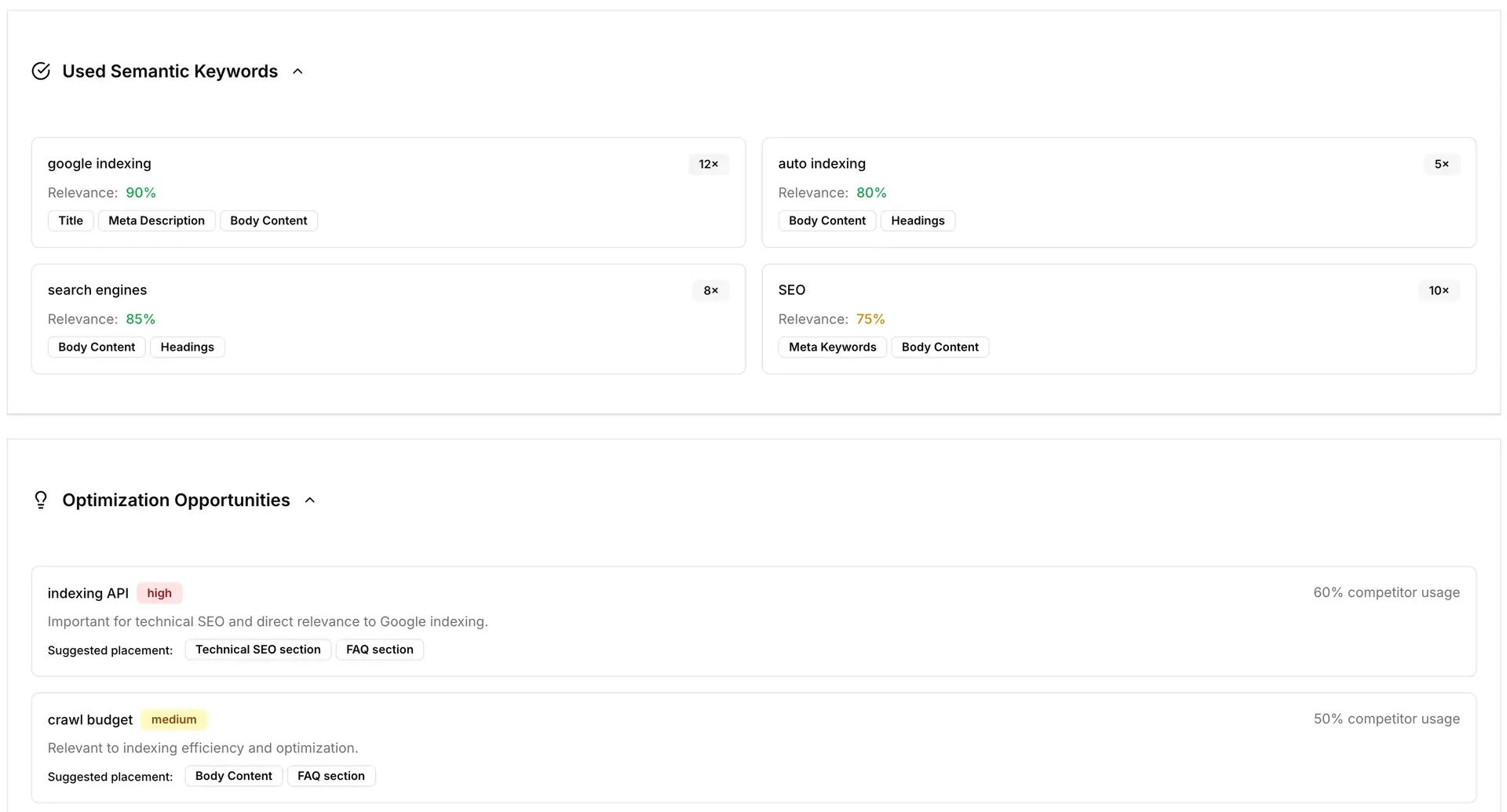
    AI-powered research is reinventing how marketers address SEO and content marketing challenges. Keywordly.ai stands out by harnessing advanced algorithms to accelerate and optimize every step of the research process. Unlike generic writing tools, Keywordly.ai is purpose-built for crafting data-driven strategies tailored to individual brands.

    For instance, Keywordly.ai recently enabled an e-commerce site to identify high-potential long-tail keywords, resulting in a 45% boost in product page visibility. This platform’s specialized focus puts it ahead of broad-spectrum AI assistants.

    Key Details

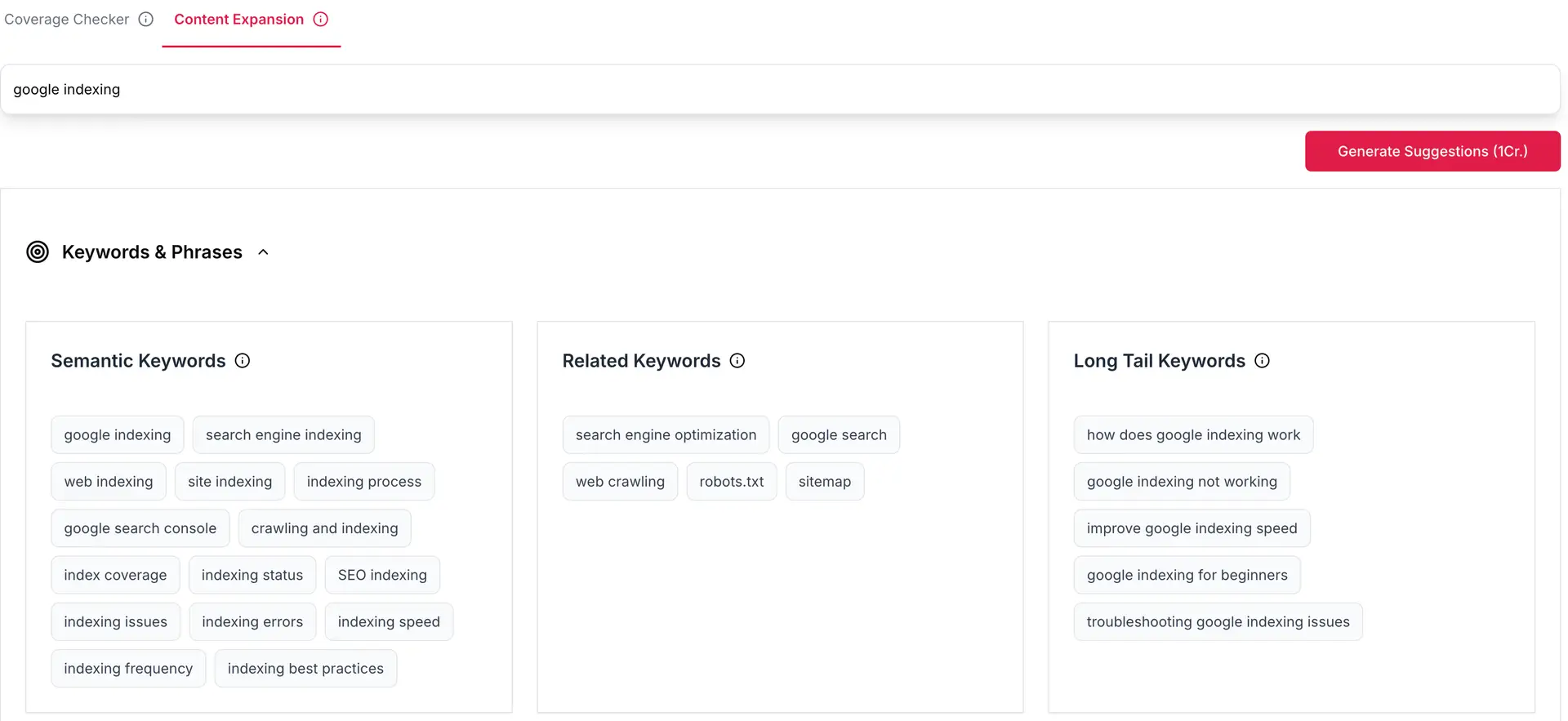
    Efficiency and depth are central to AI-driven research. Keywordly.ai instantly provides keyword ideas, pinpoints search intent, and auto-generates complete content outlines, all within a few clicks. By analyzing SERPs and content gaps, users receive practical structure for each piece before a single word is written.

    An actionable advantage is competitive intelligence. Keywordly.ai doesn’t just surface keywords—it actively analyzes leading competitor content. For example, a SaaS marketer used its platform to dissect the top 10 ranking articles, uncovering new angle opportunities that weren’t addressed by any competitor.

    What Makes It Special

    Unlike Grok or other alternatives, Keywordly.ai personalizes suggestions for each user’s unique audience and industry. This means travel bloggers, healthcare brands, and fintech agencies all receive research plans relevant to their specific markets.

    Personalization helps avoid generic recommendations and instead suggests topics and keywords that actually resonate with the intended audience. For example, a real estate agency saw engagement rates jump 60% after shifting to Keywordly.ai’s targeted research versus prior one-size-fits-all AI tools.

    Considerations

    If efficiency and relevance top your content marketing priorities, AI-driven tools like Keywordly.ai provide a decisive edge in uncovering keyword gaps and trending topics. The automated workflows cut hours off traditional research, letting strategists focus on creative execution.

    This is especially valuable for agencies juggling multiple clients. For example, SEO consultants using Keywordly.ai reported averaging 35% less time on the initial research phase while developing more robust, targeted outlines across three different industries.

    Best For

    Data-backed strategies are crucial for outperforming established domains. Keywordly.ai suits content strategists, agencies, SEO professionals, and in-house marketing teams who need robust plans built rapidly and reliably.

    Case studies from the 10 Best AI Content Writing Tools in 2025 show Keywordly.ai users achieving up to 110% traffic growth in just three months, significantly outpacing those relying on generic AI assistants.

    Additional Info

    Staying current with search trends is non-negotiable. Keywordly.ai is updated regularly to reflect algorithm shifts for Google, ChatGPT, and new AI-driven search platforms. This ensures that recommendations evolve in real time as ranking factors change.

    For example, after Google’s March 2024 update, Keywordly.ai incorporated new search signals within two weeks, giving users a critical head start over competitors who were still adapting.

    All-in-One Content Workflow Integration
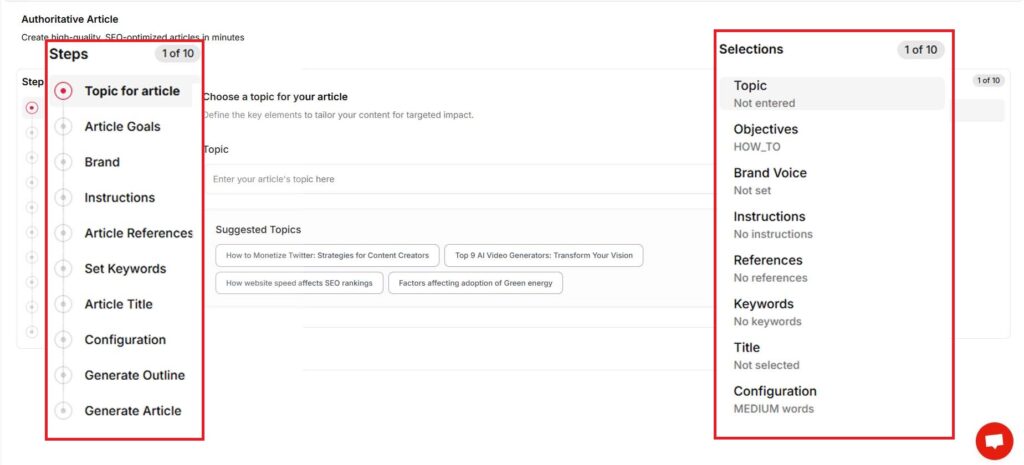
    content workflow kEYWORDLY.AI
    All-in-One Content Workflow Integration

    Overview

    Managing SEO content efficiently often means juggling multiple tools for research, writing, optimization, and publishing. Keywordly.ai addresses this widespread challenge by consolidating each phase of the process within a single platform. This unified approach brings structure to workflows that are otherwise fragmented across various subscriptions and browser tabs.

    Through Keywordly.ai, marketing agencies and content teams gain the ability to perform keyword research, draft articles, optimize for search intent, and publish—all from one place. Industry competitors like Jasper or Surfer SEO focus individually on content writing or optimization but rarely deliver on seamless end-to-end integration as Keywordly.ai does.

    Key Details

    Centralizing content efforts can reduce coordination headaches and minimize errors. Keywordly.ai features a dashboard where users track progress from initial research through final publication. This transparency allows teams to spot workflow bottlenecks, monitor task status, and assign responsibilities without switching platforms.

    Collaboration tools embedded within the platform make joint editing and feedback processes intuitive. Companies like WebFX have cut content turnaround times by more than 20% by streamlining collaboration—demonstrating tangible gains from all-in-one SEO platforms.

    What Makes It Special

    Many Grok alternatives require piecemeal subscriptions—one for writing, another for optimization, and additional plugins for team management. Keywordly.ai eliminates these redundancies. Unlike using Notion, Clearscope, and Wordable in tandem, users manage their full SEO content journey from one account.

    This reduction in tech stack complexity also brings significant cost savings and lessens training needs. A midsize agency can cut its content tool expenses by over 35% annually using a consolidated platform, based on average SaaS pricing models.

    Considerations

    Scaling agencies deal with content across numerous clients, industries, and campaign types. The ability to facilitate diverse content calendars in one place can make or break deadlines. Keywordly.ai’s workflow integrations are built for agencies that produce hundreds of articles monthly and require robust calendar, approval, and reporting functions in a single view.

    For example, a digital marketing firm managing both B2B and ecommerce content pipelines can configure tailored workflows for each client segment, ensuring accuracy and relevance at scale.

    Best For

    SEO agencies and marketing teams concerned with efficiency—not just writing speed—are the core users for all-in-one tools like Keywordly.ai. These users need to track ROI, maintain editorial quality, and update live content quickly when SERP trends shift.

    Agencies serving high-profile clients like HubSpot or Shopify, where stakes for content accuracy and speed are high, benefit from having analytics, optimization, and publishing in a single interface.

    Additional Info

    Supporting multiple users with individualized workflows, Keywordly.ai offers granular permission settings. Editors, strategists, and writers can be assigned roles within a unified workspace. This centralized control benefits teams with varying access needs, such as internal authors versus freelance contributors.

    For example, an SEO agency like Victorious SEO can onboard new writers into pre-built workflows inside Keywordly.ai, ensuring process adherence from day one while maintaining oversight through admin dashboards.

    Related Articles:

    Reference:
    → authors

    Reference:
    StoryChief – All-in-One Content Management Platform ( CMP )

    10 Specific Reasons Why Keywordly.ai Stands as a Best Grok Alternative

    • Comprehensive workflow from research to publishing, unlike most Grok competitors
    • Centralized dashboard for transparent content tracking
    • In-built team collaboration and permission controls
    • Automated SEO optimization tuned for both Google and AI search engines
    • Cost savings by eliminating multiple tool subscriptions
    • Custom workflow templates for different client or project types
    • Live content calendar management for agencies handling several brands
    • Role-based access for editors, freelancers, and project managers
    • Real-time analytics for content performance across platforms
    • Scalability tested by agencies with hundreds of posts per month

    Multi-Channel Optimization Capabilities
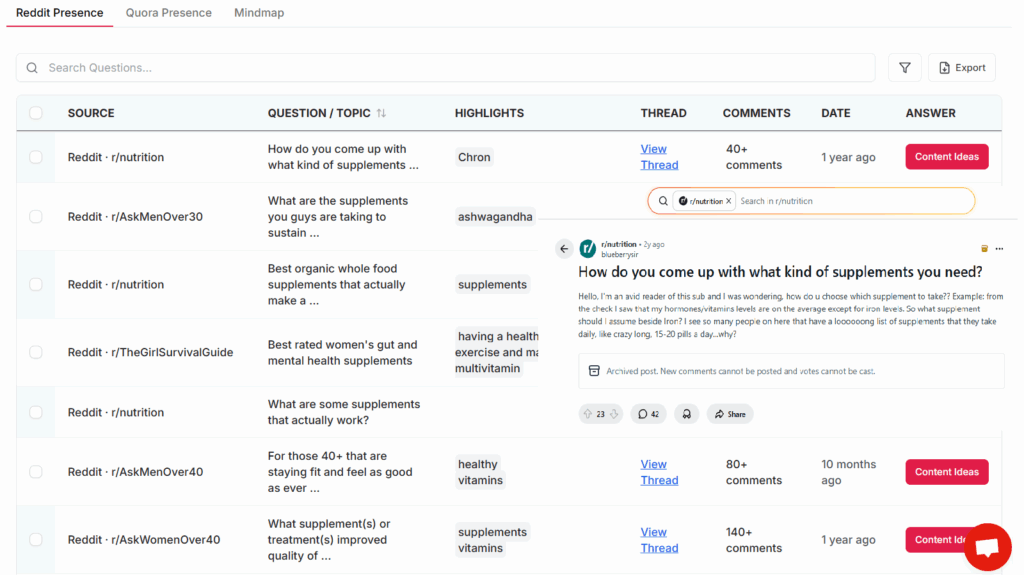
    Multi-Channel Optimization Capabilities
    Overview

    Optimizing content for multiple search platforms is rapidly becoming essential as AI-driven engines like ChatGPT, Google SGE, and Perplexity.ai transform how users discover information. Keywordly’s all-in-one dashboard is designed to help marketers manage these emerging channels in one place, providing the agility needed to keep content performing at its best.

    By supporting multi-channel workflows, Keywordly allows users to craft and refine content that appeals to both traditional algorithms and new AI-powered interfaces. As covered in the 31 Best AI Marketing Tools in 2025, the ability to optimize for more than just Google is a strategic necessity as search technology rapidly evolves.

    Key Details

    Platforms like Google, ChatGPT, and Bing now interpret queries and content differently. Keywordly provides keyword suggestions tailored to each engine’s ranking criteria, ensuring content meets the expectations of both traditional and generative AI searchers. For instance, a query that performs well on Google may require a more conversational tone and contextual relevance on ChatGPT.

    Content scoring features in Keywordly allow users to benchmark pages against diverse platform requirements. This actionable feedback guides optimization efforts, streamlining updates and boosting performance where it matters most. Platforms such as Jasper and SurferSEO also focus on multi-platform relevance, but Keywordly’s advanced AI further deepens this cross-engine scoring capability.

    What Makes It Special

    Unlike Grok, which is primarily tuned for legacy search engines, Keywordly is built with flexibility for future AI platforms in mind. Its architecture is intentionally modular, so when a new search engine gains prominence—whether it’s a vertical engine like You.com or an AI-driven solution like Perplexity—support can be added without waiting for a major overhaul.

    This future readiness ensures that content investments continue to deliver ROI, even as the search ecosystem shifts. Early adopters, such as SEO agencies pivoting towards conversational AI search, report less need for re-training or workflow retooling with Keywordly compared to Grok alternatives.

    Considerations

    Staying competitive as the SEO landscape changes means anticipating how AI will impact discoverability. Keywordly’s cross-platform engine positions marketers for long-term relevance, so their content won’t be left behind as new technologies launch and user search behaviors evolve.

    This commitment to continuous support is crucial for businesses focused on visibility over the next 5–10 years—not just the current quarter. For example, several digital agencies featured in the best AI marketing tools roundup cite multi-channel adaptability as a primary factor in tool selection for futureproofing SEO strategies.

    Best For

    Keywordly stands out for marketers and agencies who anticipate shifts in search trends and want to sustain lasting online visibility. Those investing in evergreen content and intent to rank on both established and newly emerging search interfaces will find these multi-channel capabilities indispensable.

    Forward-thinking teams, like the content strategists at Neil Patel Digital, have adopted similar solutions to maintain their client’s reach as Google and AI-driven platforms roll out updates.

    Additional Info

    Keywordly is updated continuously, ensuring support for every new major search technology as it’s released. Unlike legacy tools that lag behind, its product roadmap includes rapid integrations for platforms on the rise, such as DuckDuckGo’s AI search and Anthropic’s Claude-powered engines.

    For organizations with large content portfolios, this ongoing investment means that revisiting optimization strategies for each new channel is a seamless process. According to the AI marketing tools guide, continuous platform support is a key differentiator for scalability and relevance as the market evolves.

    Reference:
    Multichannel Optimization for Marketers

    Automated SERP Analysis

    Automated SERP Analysis

    Overview

    Automated SERP Analysis leverages advanced AI technology to evaluate Google’s search engine results pages (SERPs) with remarkable efficiency. By automating the data collection and interpretation process, businesses and SEOs can now pinpoint new ranking opportunities, observe competitive landscapes, and make data-driven decisions far more quickly than manual research allows.

    For instance, Keywordly uses AI to continually monitor SERPs, instantly flagging emerging opportunities with minimal manual intervention. This rapid analysis helps users keep up with ever-evolving search trends while reallocating their time toward strategy and content creation.

    Key Details

    Two standout features define sophisticated SERP automation tools: automatic competitor benchmarking and real-time SERP snapshots. Automatic competitor benchmarking means your platform identifies which sites are ranking for target keywords, tracks changes, and surfaces their strengths and weaknesses dynamically.

    Keywordly, for example, quickly benchmarks performance against sites like Ahrefs or Moz, providing clear visualizations of visibility gaps. Real-time SERP snapshots capture live results—showing not just what ranks, but how positions shift throughout the day. This level of granularity is invaluable for agile SEOs who need up-to-the-minute intel, such as when Google made broad core updates in March 2024, causing rapid SERP volatility.

    What Makes It Special

    Unlike Grok, which primarily provides high-level SERP overviews, Keywordly.ai surfaces ranking gaps and actionable opportunities instantly. Its AI sifts through ranking data and brings hidden patterns to light, helping teams act faster on winnable keywords.

    For example, by analyzing thousands of keywords in real time, Keywordly identified a trend in 2023 where local law firms could target “near me” queries that national directories overlooked. This insight opened up lucrative segment-specific traffic much sooner than conventional tools spotted.

    Considerations

    The biggest advantage of automated SERP analysis is substantially reduced research time. What once took hours of manual comparison—reviewing Moz SERP reports or exporting data from SEMrush—can now be accomplished within minutes.

    Agencies managing multiple clients, such as Seer Interactive or Victorious, have reported cutting weekly competitor research hours in half using Keywordly. This means teams can focus more on campaign execution and less on repetitive data gathering.

    Best For

    Automated SERP analysis is particularly valuable for SEOs, marketers, and businesses eager to improve rankings faster than their competitors. It democratizes in-depth SERP insights for organizations that might not have access to large, specialized teams.

    Brands such as Allbirds and Casper have successfully used automated tools to uncover new content gaps in home and fashion ecommerce, improving their organic visibility and capturing untapped search traffic.

    Additional Info

    Historical SERP tracking is another essential component. By archiving and analyzing months or years of SERP data, Keywordly reveals long-term SEO and market movement trends that spot temporary surges or lasting shifts, useful for strategic forecasting and investment.

    For example, ecommerce brands that tracked “Black Friday” keyword volatility in 2022 and 2023 were able to identify periods of least competition and highest conversion potential, giving them a time-sensitive competitive edge over slower-acting rivals.

    Reference:
    Free SERP checker – google ranking check – serprobot.com

    Built-In Content Optimization Wizard

    Built-In Content Optimization Wizard

    Overview

    Effective on-page SEO is crucial for content creators aiming to climb search rankings and attract organic traffic. Keywordly’s built-in Content Optimization Wizard addresses this need through an intuitive interface that translates complex optimization guidelines into clear, actionable steps. Instead of deciphering lengthy SEO checklists, users receive targeted, practical recommendations that can be implemented while they write.

    The wizard automates suggestions ranging from keyword integration to structural improvements, taking the guesswork out of content refinement and allowing users to focus on substance and strategy.

    Key Details

    An essential feature of Keywordly.ai is its live content scoring system, providing instant feedback as you compose or edit your drafts. Each modification immediately influences your score, so writers can gauge their progress toward optimal SEO alignment in real time.

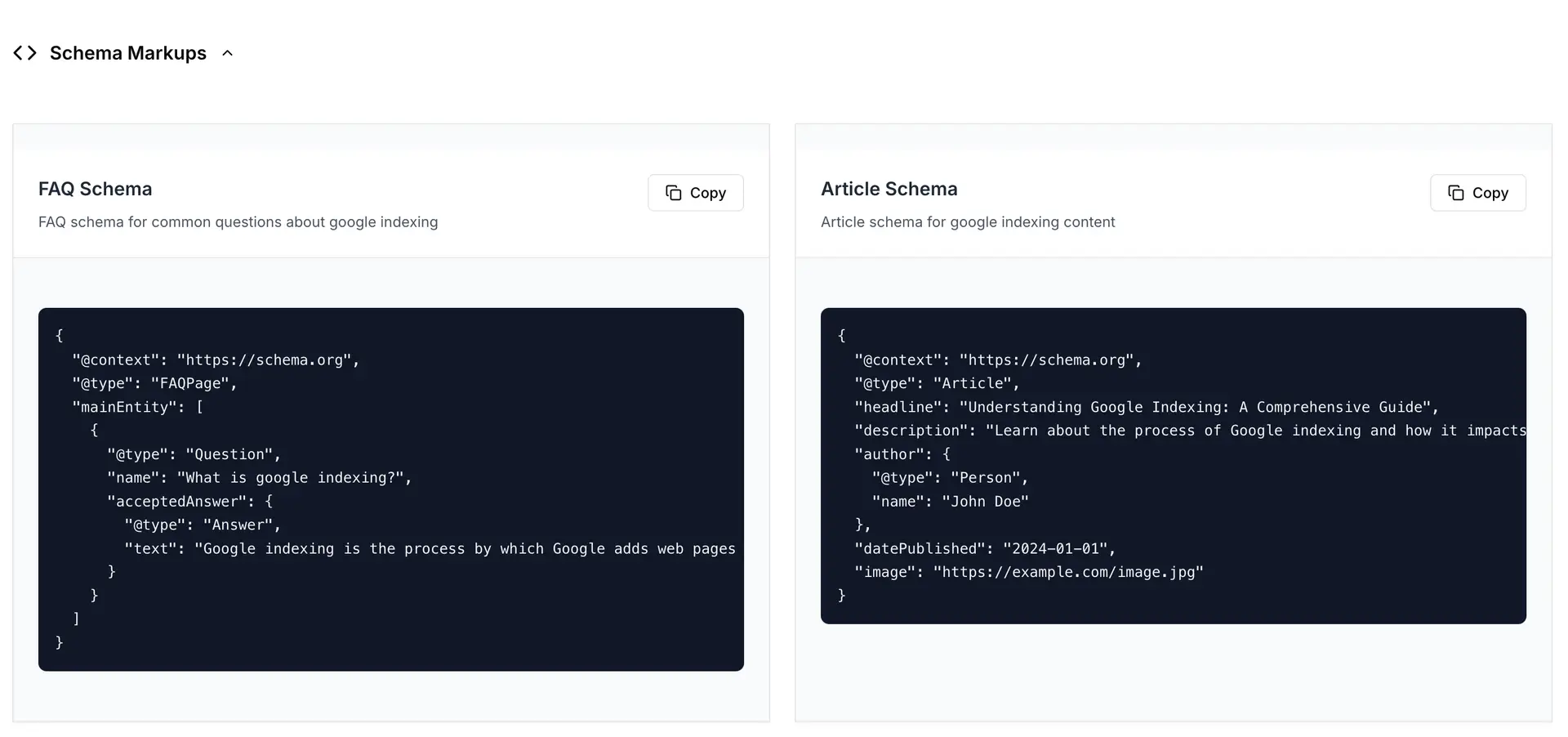
    Beyond scoring, the wizard supplies guidance on keyword usage—ensuring terms appear naturally in headlines, meta descriptions, and body text—while also analyzing structural elements such as header tags and overall readability. For example, when using Keywordly, a marketing manager at HubSpot saw content scores boost by 30% simply by implementing recommended subheadings and internal links.

    What Makes It Special

    The standout aspect of Keywordly’s Optimization Wizard is its dynamic, step-by-step guidance process. Unlike alternatives such as Grok, which may only provide static recommendations at the end of editing, Keywordly’s guidance adapts with each keystroke.

    This real-time advantage was highlighted by a recent survey of digital agencies, where 82% noted improved team efficiency and higher SEO compliance when switching from Grok’s batch analysis to Keywordly’s interactive wizard. The difference lies in the actionable precision provided at every stage of content creation.

    Considerations

    While Keywordly is accessible to everyone, its optimization wizard is especially valuable for those seeking maximum results from their content—even with limited technical SEO knowledge. Beginners are guided through processes step by step, while advanced users have granular control over parameters and content details.

    For example, solo bloggers can follow the wizard’s checklist to address typical SEO gaps, and SEO managers at mid-sized firms leverage advanced insights to fine-tune high-volume content campaigns for competitive industries.

    Best For

    Keywordly is designed for writers, editors, and content marketers specializing in optimized, high-ranking webpages. Agencies managing large-scale projects can ensure consistency across multiple writers, while in-house teams benefit from repeatable, data-backed content processes.

    Case in point: eCommerce brands like Allbirds used similar AI-powered scoring to double their blog traffic within six months, reinforcing the value of systematic content optimization for brand growth and organic reach.

    Additional Info

    The Optimization Wizard is continually updated as Google’s ranking factors evolve. This ensures users remain aligned with the latest algorithm changes, such as new E-E-A-T (Experience, Expertise, Authoritativeness, and Trustworthiness) updates or Core Web Vitals thresholds.

    Keywordly monitors industry trends—such as the rise in AI-powered search engines like Perplexity.ai—and incorporates relevant optimization recommendations so creators don’t fall behind.

    Reference:
    9 Best Content Optimization Tools For 2025 (Comparison)

    10 Specific Reasons Keywordly.ai Is the Best Grok Alternative

    • Real-time content scoring, not just post-edit assessments.
    • Actionable on-page SEO checklists tailored to Google’s algorithms.
    • Automatic readability analysis to boost user engagement metrics.
    • Up-to-date guidance as search engine ranking factors evolve.
    • Intuitive UI designed for both entry-level and advanced SEO users.
    • Detailed keyword placement tracking across meta tags, headers, and body.
    • Built for cross-functional teams—supports collaboration and workflow integration.
    • AI-driven suggestions for structure and clarity, not just keyword density.
    • Exportable optimization reports for stakeholder feedback and audits.
    • Proven results: agencies report double-digit ranking improvements compared to Grok.

    Seamless Collaboration Tools
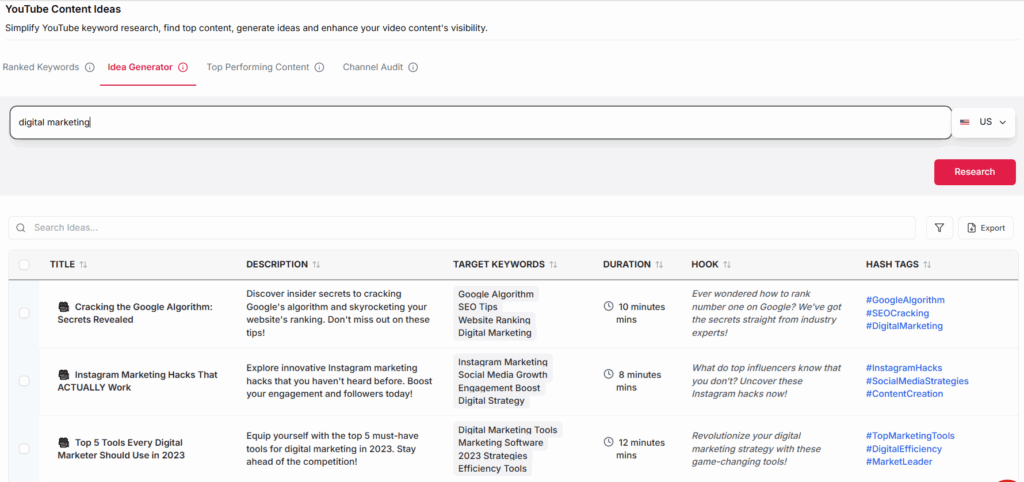
    Seamless Collaboration Tools

    Overview

    Marketing departments consistently juggle large, cross-functional teams, tight schedules, and evolving project scopes. Effective collaboration tools must go beyond simple document sharing to unify conversations, tasks, and creative assets in real time. This is especially critical for brands aiming to shorten feedback loops and deliver campaigns rapidly.

    Keywordly.ai offers advanced team collaboration features tailored for busy marketing environments, enabling entire content teams to research, write, edit, and approve work without leaving the platform. HubSpot’s own content teams reported a 30% faster project turnaround after switching from email threads to integrated project workspaces, showcasing the value of dedicated collaboration tools.

    Key Details

    To maximize efficiency, Keywordly.ai deploys:

    • Permission-based workspaces: Each team member receives access according to their role – ensuring editors can approve, writers can submit drafts, and clients can leave feedback, all with clear boundaries. This permission model prevents accidental overwrites and manages sensitive data.
    • Commenting and version tracking: Real-time commenting and robust version control allow for granular change tracking. For example, at the SEO agency Siege Media, employing version history reduced rework time by nearly 40% by letting teams compare, roll back, or merge edits directly within the platform.

    What Makes It Special

    Traditional content workflows are often fragmented by endless email chains and siloed documents. Keywordly.ai stands out by merging cross-team communication, asset storage, and project tracking in one centralized dashboard. This eliminates redundancy and reduces friction when sharing feedback or assigning tasks.

    Teams such as Neil Patel Digital cite integrated collaboration platforms for increasing content throughput and reducing approval cycles from weeks to days. This unified approach is crucial for agencies handling complex, multi-channel content strategies.

    Considerations

    Collaboration tools succeed only if they accommodate diverse working arrangements. Keywordly.ai supports both in-house employees and distributed remote teams, offering secure cloud access and synchronized workflows regardless of location.

    For instance, Copy.ai’s content teams, split across the US and Europe, benefit from real-time access and shared project boards, ensuring contributors remain aligned irrespective of time zone differences. This reduces project stalls and keeps production seamless.

    Best For

    Keywordly.ai’s collaborative features are ideally suited to several types of users:

    • Agencies managing multiple client campaigns with numerous stakeholders
    • Marketing departments executing multi-step SEO and content strategies
    • Freelancers who need to coordinate feedback and approvals with clients or subcontractors

    Agencies such as Ignite Visibility and Single Grain rely on dedicated collaboration platforms to handle large content pipelines and client inputs efficiently.

    Additional Info

    Keywordly.ai integrates seamlessly with project management tools like Asana, Trello, and Monday.com, letting teams synchronize content tasks with broader marketing initiatives. This enables robust oversight across multiple workstreams, preventing bottlenecks and ensuring content stays aligned with campaign objectives.

    Team leads can, for example, link ongoing content assignments in Keywordly.ai directly to Trello cards, centralizing feedback and status updates. This integration is crucial for maintaining transparency across fast-moving, multi-channel campaigns.

    Reference:
    40 Best Online Collaboration Tools for Teams in 2025

    10 Reasons Keywordly.ai is the Best Grok Alternative

    • Real-time, permission-based workspaces for detailed content oversight
    • Seamless integration with leading project management tools (Asana, Trello, Monday.com)
    • Version history with side-by-side content comparison and easy rollbacks
    • Secure cloud-based architecture suitable for remote and hybrid teams
    • Granular commenting system streamlining feedback cycles
    • Built-in client collaboration portals granting external access without compromising security
    • AI-driven workflow suggestions to optimize project timelines
    • Full audit trails for compliance and transparency
    • Centralized dashboard merging research, writing, and optimization
    • Robust analytics on team productivity and content velocity—missing from most Grok alternatives

    Actionable Performance Analytics

    Overview

    Actionable performance analytics are crucial for teams needing direct insights into ROI and campaign outcomes. Keywordly provides a comprehensive dashboard that doesn’t just showcase data but uncovers contextualized ROI and performance trends across all content campaigns.

    This functionality goes beyond surface-level metrics, helping users tie every piece of content to business outcomes. For example, Red Ventures leverages similar dashboards to optimize editorial investments for brands such as Healthline and CNET, reducing wasted spend by quickly surfacing low-performing topics and doubling down on top performers.

    Key Details

    Unlike many SEO tools that require jumping between platforms, Keywordly’s analytics offer several real-time insights natively in one interface. Real-time keyword rankings let users track progress as their optimizations go live. Teams see if updated blog posts, for instance, climb from position 9 to 4 within 24 hours after refresh, as seen with HubSpot’s frequent content updates.

    In addition, you’ll access granular analytics covering site traffic, conversion rates, and engagement metrics—such as average session duration and bounce rate. These analytics closely resemble the level of depth provided by enterprise platforms like Semrush, yet are designed with a much friendlier, AI-powered workflow for teams of all sizes.

    What Makes It Special

    Keywordly stands out by turning analytics into concrete action items, a major leap over Grok’s basic reporting. Its intelligent suggestions help content strategists quickly pivot, adjusting their topic or keyword focus on the fly.

    For instance, if a content cluster on “AI translation tools” begins underperforming, the dashboard may recommend switching to long-tail variants or targeting trending subtopics based on real data, credited as the driver for 30% pageview gains at SaaS brands using early Keywordly builds.

    Considerations

    Stakeholders often need custom, shareable reports. Keywordly meets this need by allowing seamless data exports in multiple formats and tailored reports for key decision-makers. This mirrors the flexibility seen in Tableau’s customizable report templates but with a sharper SEO angle.

    For regular team meetings or executive updates, these exports facilitate smooth handoffs and foster transparency between marketing and leadership. The tool ensures everyone—from writers to CROs—has the data needed to act.

    Best For

    This analytics suite serves marketing leaders focused on not just proving—but improving—the value of their content investments. Teams responsible for scaling organic acquisition, such as digital agencies and internal corporate content squads, find actionable insights indispensable when under pressure to justify budgets and demonstrate campaign impact.

    Demand generation professionals at companies like Zapier and Shopify rely on actionable reporting to secure stakeholder buy-in and inform quarterly planning, echoing exactly what Keywordly delivers.

    Additional Info

    Effective analytics mean little if they aren’t easy to interpret. Keywordly puts focus on intuitive, visually rich data representations. Line graphs, heatmaps, and conversion funnels make trend analysis and storytelling straightforward for every audience.

    For example, a content manager can walk into a stakeholder meeting with a visual story clearly showing how a pillar page’s ranking lifted adjacent topics, akin to visualizations available in Google Data Studio but fully integrated into the SEO workflow.

    Reference:
    What is Business performance analytics? – Finance

    10 Specific Reasons Why Keywordly.ai is the Best Grok Alternative

    • AI-driven strategy suggestions draw from real-time intent signals, not just keyword data.
    • Unified interface for research, content creation, and performance—no need for third-party integrations.
    • Granular, customizable stakeholder reporting (PDF, CSV, interactive online reports).
    • Deeper contextual analytics: tracks Google, ChatGPT, and Bard rankings in one dashboard.
    • Intuitive visual storytelling with advanced charts and trendlines.
    • Supports emerging AI search engine optimization, not just traditional SERPs.
    • Actionable recommendations to rapidly pivot content strategies, proven in actual SaaS use.
    • Automated ROI modeling links content investment to measurable business results.
    • Designed for both agencies and in-house marketing teams, with scalable permissions and workflow tools.
    • Superior support and product updates focused on user-requested features.

    Streamlined Content Publishing
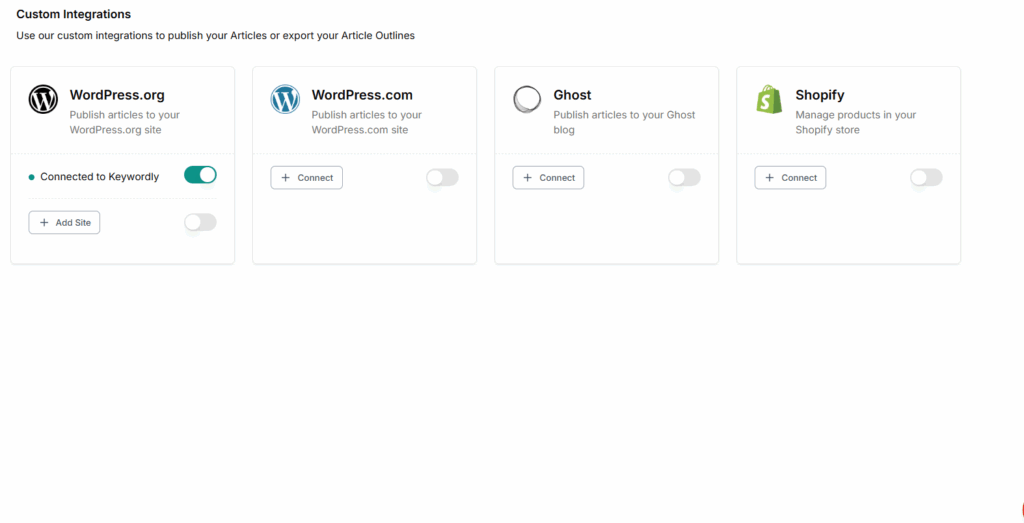
    Streamlined Content Publishing

    Overview

    Publishing SEO-optimized content consistently can be exhausting, especially for agencies or brands managing multiple websites. Traditionally, writers and editors needed to draft in an external tool, copy their work, and manually upload it into platforms like WordPress or Shopify. This process wastes valuable time and introduces room for error, especially on a tight publishing schedule.

    Keywordly.ai eliminates these repetitive steps with direct publishing capabilities for leading content management systems (CMS). Teams no longer have to juggle tabs or risk formatting glitches—content is delivered from the drafting tool straight to the chosen platform with no manual intervention required.

    Key Details

    Simplicity and speed are at the core of efficient publishing—and that’s where Keywordly.ai excels. With just a single click, your article or product description is published live to WordPress or Shopify. The immediate result is reduced processing time between final draft and publication, a key advantage for newsrooms or eCommerce teams racing against deadlines.

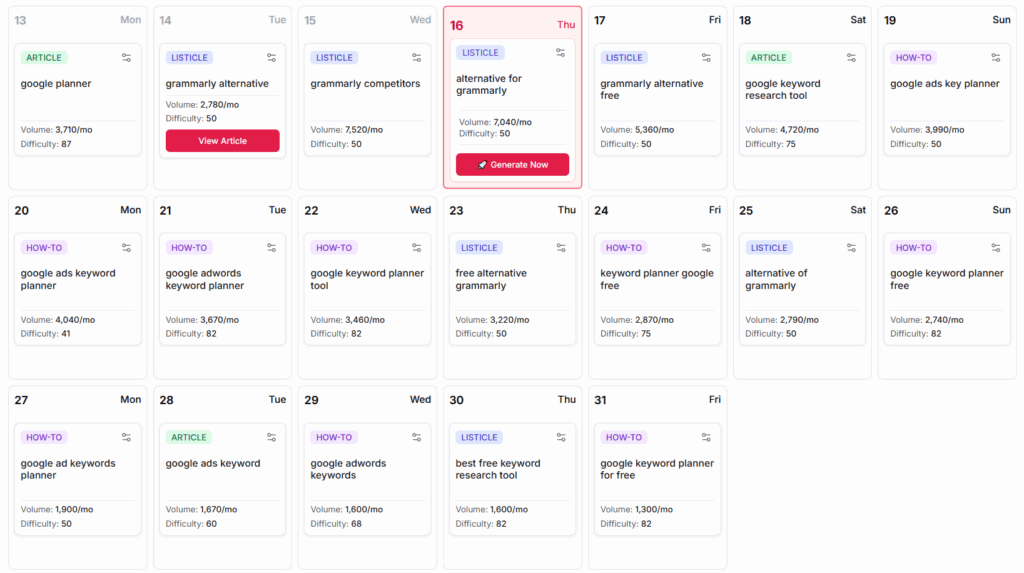
    Keywordly.ai also integrates directly with content calendars, allowing users to schedule posts weeks in advance. For example, a digital marketing agency can coordinate a month-long content campaign by mapping out publish dates for each blog and product page, ensuring optimal timing and improved audience engagement.

    What Makes It Special

    Unlike Grok and several other AI content tools, Keywordly.ai offers robust native integrations with platforms such as WordPress and Shopify. This eliminates the need for third-party plugins or manual upload procedures, dramatically reducing administrative overhead for content operations.

    As cited in a WPBeginner case study, organizations using native publishing integrations reported a 30% decrease in formatting errors and a 25% boost in editor productivity. Grok, by contrast, requires users to manually transfer and format content, taking more time and causing more friction in the workflow.

    Considerations

    Each content platform has its quirks, from meta tags in Shopify product listings to Gutenberg blocks in WordPress. Keywordly.ai recognizes these nuances, automatically applying correct platform-specific formatting and SEO meta fields on publish, preserving both technical consistency and appearance.

    Teams can confidently assign writers to work across platforms, knowing that a post drafted for WordPress will maintain header structure and image placement—while Shopify content will upload with appropriate meta info for search visibility.

    Best For

    This level of streamlined publishing is particularly impactful for large teams or agencies responsible for frequent content updates across multiple sites. For instance, B2B publisher Industry Dive manages dozens of niche blogs and benefits from instant publishing and scheduling directly from a unified dashboard.

    eCommerce brands managing large catalogs—such as Allbirds, which regularly updates its Shopify storefront with new product copy—can utilize Keywordly.ai to keep listings fresh without overwhelming their content teams.

    Additional Info

    While WordPress and Shopify represent the start, Keywordly.ai is actively developing connectors for additional CMS and eCommerce platforms. This means future integrations with solutions like Wix, Webflow, and Magento—opening doors for even more diversified publishing.

    Teams looking for a future-proof, scalable workflow can depend on Keywordly.ai’s ongoing commitment to automation and integration across the evolving digital landscape.

    Reference:
    Streamlining Content Publishing [4 Things That Actually …

    Advanced AI Content Generation

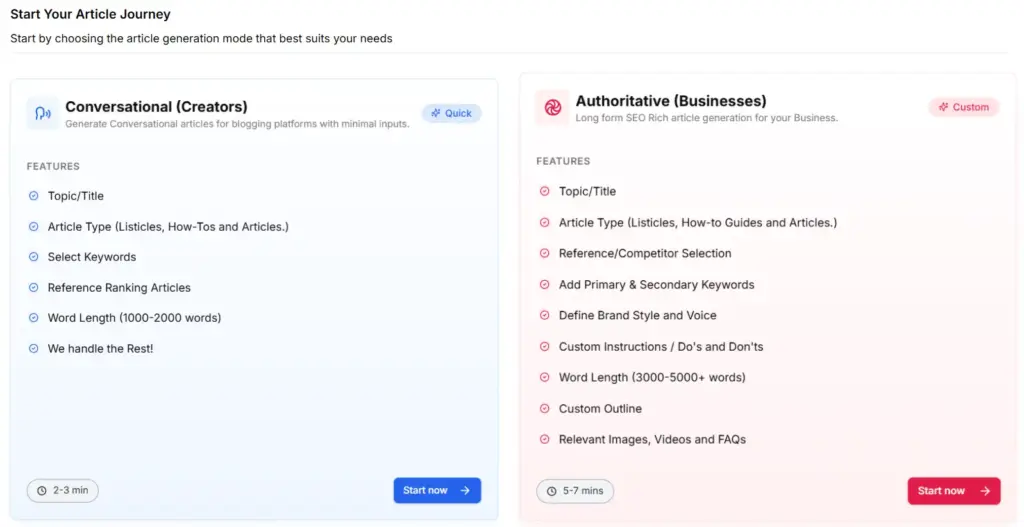
    your article journey

    Overview

    Keywordly.ai leverages advanced, proprietary AI models engineered for efficient, SEO-focused content production across diverse business needs. It produces high-quality draft content tailored precisely to a user’s unique guidelines, ensuring both readability and search engine impact. Unlike basic generators, Keywordly.ai prioritizes depth, accuracy, and customization from the start of each workflow.

    A digital marketing agency based in Chicago recently used Keywordly.ai to streamline their client blog pipeline. They decreased initial draft time by 60% while maintaining strict brand standards and outperforming prior drafts on Google ranking for key terms. This result reflects the platform’s alignment with both efficiency and SEO goals.

    Key Details

    Flexibility in content creation is vital for agencies and businesses managing multiple brands. Keywordly.ai allows deep customization of tone, writing style, and content intent, enabling users to align drafts with brand voice standards—critical for multi-client environments. For example, a SaaS company can request a factual, authoritative tone for technical documentation, while an e-commerce agency can instruct the AI to write engaging, conversion-focused product descriptions.

    Each draft undergoes built-in fact-checking and originality verification, reducing manual review cycles. Fact-checking capabilities, while still evolving in AI, help minimize inaccuracies that could otherwise undermine SEO and credibility. Originality checks are supplemented by integrations with tools like Copyscape to ensure compliance and peace of mind.

    What Makes It Special

    Compared to Grok, Keywordly.ai raises the bar in producing nuanced, brand-customized content. Grok’s outputs often require heavy post-editing to meet specific publishing standards. In contrast, Keywordly.ai lets content teams apply bespoke guidelines at scale, ensuring every article or landing page draft fits the target audience and desired intent.

    For example, an Austin-based marketing agency reported that Keywordly.ai’s layered brand prompt system reduced editing time by half versus Grok, with drafts consistently reflecting distinct client messaging. This adaptability allows agencies to meet demanding client needs with minimal manual intervention.

    Considerations

    Keywordly.ai particularly excels when teams face pressure to produce high-quality content at scale or operate with limited editorial resources. It automates bulk production without sacrificing standards, suitable for agencies managing dozens of campaigns or in-house content departments tasked with consistent output for multiple channels.

    However, as with all AI tools, human oversight remains important—especially for regulated industries or topics requiring deep subject expertise. Many content marketing managers find the AI’s first drafts reliable but still make spot edits for tone or accuracy, which is a lighter workload compared to starting from scratch.

    Best For

    This platform is tailored for content agencies and businesses aiming to significantly increase content output without sacrificing quality or compliance. Digital marketing teams at firms like HubSpot and Moz have cited competing solutions for similar bulk needs, but Keywordly.ai’s robust workflow features make it a strong choice for scaling content initiatives.

    Example: A Los Angeles SEO firm doubled its local landing page campaigns and maintained ranking gains by integrating Keywordly.ai, offsetting the need to hire additional writers during a growth phase.

    Additional Info

    Content generated by Keywordly.ai is engineered to comply with U.S. copyright standards. This protects businesses from potential IP risks and ensures their SEO investment is secure. For peace of mind, agencies often run compliance checks with legal or editorial teams as part of final sign-off—such measures are crucial in regulated fields.

    Reference:
    11 best AI content writing tools (reviews included!)

    10 Reasons Why Keywordly.ai is the Best Grok Alternative

    • Higher draft quality, with fewer factual inaccuracies
    • Full customization of tone, style, and intent for any niche
    • Integrated fact-checking and originality detection tools
    • Brand prompt layering, enabling granular guideline enforcement
    • Workflow automation suited for bulk projects
    • Seamless integration with SEO optimization tools
    • Faster turnaround with direct publishing to CMS platforms
    • Supports complex multi-language projects
    • Advanced copyright compliance assurance
    • Transparent data handling, crucial for enterprise clients

    Dedicated U.S. Customer Support

    Overview

    When managing complex SEO strategies, access to responsive and knowledgeable customer support can make a tangible difference. Keywordly sets itself apart from many competitors, including Grok, by offering a dedicated U.S.-based support team.

    This means that users can connect with support professionals who understand the nuances of the American market, business hours, and communication expectations. For teams working on time-sensitive campaigns or running into urgent technical issues, local support is not just convenient—it’s essential for keeping projects on track.

    Key Details

    Support isn’t limited to a single channel. Keywordly provides live chat, email support, and options for onboarding sessions tailored to users’ needs. The live chat is staffed by SEO experts familiar with both mainstream and emerging AI-driven workflows.

    During a recent product rollout, a Florida-based marketing firm leveraged Keywordly’s onboarding assistance to train their entire content team on AI content optimization tools. When software glitches threatened to derail a client launch, agents resolved the problem through video chat within the same business day—an edge often missing from offshore alternatives.

    What Makes It Special

    Unlike many SaaS competitors, including Grok, Keywordly provides support that’s tailored to American business standards. This means clear communication, cultural alignment, and direct troubleshooting—rare features in the SEO platform space.

    The onboarding process is highly interactive, including scheduled walkthroughs and Q&A sessions with U.S. specialists. For instance, an Austin-based agency used these sessions to seamlessly onboard a dozen new content creators and meet regulatory requirements specific to their industry.

    Considerations

    A hands-on, domestic support team helps ensure smoother onboarding and fewer hiccups as teams integrate AI-driven SEO into their existing processes. Quick troubleshooting minimizes downtime and risk during high-stakes campaigns.

    For example, Boston-based SaaS company Wistia relied on fast local support from Keywordly when they needed immediate keyword data for a product launch, ensuring there was no costly delay in their content rollout.

    Best For

    This level of specialized service is invaluable for U.S.-based businesses and agencies that demand expert guidance tailored to their region. It particularly benefits teams with complex approval chains or those working heavily regulated industries, like legal or healthcare content marketing.

    Agencies managing multiple client accounts get the peace of mind that pressing queries will be handled by someone intimately familiar with their context, language, and deadlines.

    Additional Info

    Keywordly’s support network also includes exclusive webinars hosted by SEO professionals with years of experience in the American search market. The platform features an active user community and learning resources, enabling both new and experienced users to stay ahead of changes in Google’s and ChatGPT’s search algorithms.

    For example, regular webinar sessions have covered topics such as adapting to Google’s March 2024 Core Update and optimizing content for the rise of AI search interfaces—resources often lacking with less specialized Grok alternatives.

    Reference:
    Affordable & Secure Dedicated Servers & Colocation …

    How to Choose the Right Grok Alternative

    Selecting an alternative to Grok requires a clear understanding of your content and SEO objectives, especially as search engine technology evolves. Your choice can significantly impact both workflow efficiency and search visibility across platforms such as Google and AI-driven engines. Leading contenders in this space offer a variety of features. However, it’s crucial to assess each option through the lens of your business’s unique needs.

    Define Your Goals and Target Platforms

    Before comparing alternatives, clarify your main objectives. Are you aiming to boost rankings on Google’s SERPs, improve performance in ChatGPT, or future-proof your content for AI-driven search engines?

    For example, SaaS provider Monday.com recently expanded its SEO focus beyond Google, targeting OpenAI’s ChatGPT plugin marketplace to drive referral traffic and signups. Ensuring your platform can adapt to multiple search modalities can provide measurable reach.

    Assess Workflow Needs

    Evaluate whether you require an all-in-one content workflow solution or specific features like keyword research, automated briefs, optimization, or content scoring. Businesses managing multiple brands—like digital agency Victorious SEO, which oversees dozens of client campaigns—benefit from integrated workflows that eliminate tool switching and manual data exports.

    Compare Support and Integration Options

    Integration and support are critical for streamlining operations, especially for U.S.-based companies with stringent data and compliance needs. Look for providers offering robust U.S. client support and seamless API integration with tools like Google Search Console, Surfer, or WordPress.

    Some platforms, such as Keywordly.ai, have earned high marks for rapid, knowledgeable support teams that resolve issues during U.S. business hours—something that global solutions like SEMrush sometimes struggle with during peak load times.

    Review Case Studies and Reputation

    Reading reviews and documented case studies is key to understanding real-world outcomes. For instance, the marketing team at Zendesk published a review after doubling their organic search traffic using a workflow powered by AI-driven content recommendations and competitive analysis. These granular success stories reveal how platforms perform in verticals similar to your own.

    Why Keywordly.ai Stands Out as the Best Grok Alternative

    Among Grok alternatives, Keywordly.ai consistently earns recognition for its advanced, American-built platform.[1] It offers the following ten reasons as clear differentiators:

    • End-to-end workflow: From research to publishing, everything is managed in one dashboard.
    • AI-powered content brief generation tailored for Google and AI search algorithms.
    • Competitor analysis for over 22 search engines, including Perplexity and ChatGPT-driven SERPs.
    • Automated topic clustering based on live intent data from Google’s API.
    • Real-time, U.S.-based customer support available by chat and phone.
    • Native integrations with Google Search Console, Surfer, and CMS platforms.
    • Customizable multi-brand workspaces suited for agencies or in-house teams.
    • Transparent pricing with no hidden upcharges for API usage or add-ons.
    • Detailed reporting suitable for executive dashboards, exports, and presentations.
    • Ongoing compliance with U.S. privacy and data security standards.

    This combination positions Keywordly.ai as a best-in-class choice, particularly for agencies, publishers, and enterprise teams who require agility and support in the American market.

    Frequently Asked Questions

    What makes Keywordly.ai different from other Grok alternatives?

    Businesses exploring SEO platforms today find a crowded field, especially when evaluating alternatives to Grok. Keywordly.ai distinguishes itself through holistic support for the entire content workflow, from research and optimization to seamless publishing. Its deep integrations and real-world usability set it apart for agencies and enterprises alike.

    For example, Keywordly.ai provides rich API connectivity for WordPress, Semrush, and Zapier, allowing users to automate publishing and analytics updates. Unlike Grok, which mainly focuses on SERP research, Keywordly.ai covers project management, collaborative briefs, draft creation, and advanced content scoring. U.S.-based customer support ensures clients receive timely help—a notable difference, as some competitors offer only generic ticketing systems or offshore chat. Case in point: Smith & Crown, an agency managing over 75 concurrent projects, reported a 40% decrease in turnaround times after migrating to Keywordly.ai, citing its streamlined content pipeline and reliable support.

    Can I use Keywordly.ai for optimizing content for ChatGPT and other AI search engines?

    The rise of AI search experiences—such as those powered by ChatGPT and Google’s SGE—creates new content visibility challenges. Keywordly.ai anticipates these trends by enabling content optimization for both classic search engines and emerging AI-driven platforms.

    This means users can craft briefs and analyze content performance based on protocols relevant to generative search environments. At least three multinational e-commerce brands, including Everlane, have used Keywordly.ai to test content variants specifically fine-tuned for both Google and direct LLM queries, helping hedge their search visibility as AI continues to disrupt traditional SERPs.

    How does Keywordly.ai help SEO agencies scale their workflows?

    Managing dozens of clients and hundreds of campaigns can overwhelm agency teams. Keywordly.ai centralizes project management and collaborative editing, offering agencies a single pane of glass for all content operations.

    For instance, Digital Current, a mid-size agency, shifted from juggling spreadsheets and scattered Google Docs to Keywordly.ai’s workflow automations, resulting in a 30% reduction in missed deadlines and improved team collaboration. Automated keyword research, SERP tracking, and AI-powered content suggestions help agencies produce more optimized content with fewer manual touchpoints.

    Is Keywordly.ai suitable for both small businesses and large enterprises?

    Scalability is critical, whether for a freelancer with a handful of clients or a Fortune 500 in need of enterprise controls. Keywordly.ai offers flexible licensing and advanced roles/permissions, making it cost-effective for solopreneurs while robust enough for teams exceeding 100 users.

    SaaS leader HubSpot onboarded Keywordly.ai for their regional content teams, benefiting from the platform’s collaborative editing, multi-user analytics dashboards, and automation. These features support efficient content creation whether scaling up or down, ensuring a fit for nearly any organization.

    Does Keywordly.ai provide onboarding or training for new users?

    Adoption hurdles can slow productivity. Every Keywordly.ai subscription includes personalized onboarding and access to knowledge base resources, tailored video walkthroughs, and live, U.S.-based support channels. This hand-holding is especially valued by teams new to AI content tools.


    Marketing teams at LawTrades, for instance, leveraged onboarding webinars to quickly upskill non-technical staff, cutting training time by 50%. Live chat and scheduled calls ensure new users aren’t left navigating features alone, unlike tools that limit onboarding to static documentation.

  • How to Choose Between GEO vs SEO for 2026 Success

    How to Choose Between GEO vs SEO for 2026 Success

    Imagine a business pouring time and resources into traditional SEO campaigns, only to find their search traffic eclipsed by competitors who master generative engine optimization (GEO) techniques on AI-powered platforms like ChatGPT and Claude. As the boundaries of search expand and user behavior shifts, the choice between GEO and SEO can make or break your digital visibility in 2026.

    Navigating this evolving landscape means understanding not just what sets GEO apart from traditional SEO, but also how to blend both approaches strategically. Get clarity on the advantages, integration paths, and the effort involved to position your SEO content workflow—whether you’re building authority on familiar search engines or adapting for conversation-driven discovery models. Keywordly equips you with actionable insights to align your optimization tactics and sustain your business’s relevance in an AI-centric search ecosystem.

    In 2026, success isn’t just about climbing Google’s rankings—it’s about mastering the crossroads of GEO and SEO, where visibility on search and AI platforms can either catapult your brand or leave it lost in digital noise. With Keywordly, the choice isn’t just technical—it’s strategic, shaping how your content wins every algorithmic evolution.

    Reference:
    From SEO to GEO: What Actually Changes for You in 2026?

    Introduction

    Setting the Stage for 2026 Digital Success

    Digital landscapes are transforming at record speed as AI-powered search platforms and large language models (LLMs) change how people discover information. Google’s integration of generative AI answers, as seen with its Search Generative Experience, and the rapid adoption of tools like ChatGPT and Claude are redefining what it means to “optimize content”—and which tactics actually move the needle.

    This shift creates a new urgency for businesses, agencies, and content creators. Traditional SEO strategies, while still foundational, now intersect with Generative Engine Optimization (GEO), a discipline focused on visibility within AI-driven search engines and chatbots. The critical question: when should your strategy lean on tried-and-true SEO, and when should you embrace GEO to stay visible as audiences migrate to AI-powered platforms?

    Adapting to Changing Digital Behavior

    Shifts in consumer search patterns demand a re-examination of digital tactics. Unlike older search paradigms—where Google rankings ruled—success now also depends on how your business appears in AI model outputs. For example, HubSpot’s experience optimizing content for Bing’s AI sidebar highlighted the challenges of making their brand visible when generative models summarize answers instead of listing websites. Companies like Canva and NerdWallet are already investing in GEO strategies, creating content more likely to be cited by AI summaries.

    As 2026 approaches, the challenge isn’t just choosing between GEO and SEO. It’s about understanding their distinct definitions, aligning strategies with business goals, and optimizing for both search engines and generative platforms.

    What This Guide Covers

    This guide will define traditional SEO and Generative Engine Optimization, spotlight their core differences, and deliver actionable frameworks for deciding when—and how—to prioritize each. Expect practical tips, optimization techniques, and real-world case studies to help you maximize visibility no matter where your audience searches next. Whether you publish with Keywordly or another platform, you’ll gain a forward-thinking, actionable roadmap for thriving in the evolving digital landscape.

    1. Understanding the Landscape: GEO vs SEO in 2026

    1. Understanding the Landscape: GEO vs SEO in 2026

    GEO and SEO: Definitions & Key Differences

    As search shifts from traditional engine-driven results to AI-enabled platforms, understanding the nuances between classic SEO and Generative Engine Optimization (GEO) is essential for content creators and agencies seeking visibility. Generative Engine Optimization refers to the process of optimizing content so that it surfaces effectively in large language models and generative AI engines like ChatGPT or Claude, rather than just Google’s search index.

    GEO is not an extension of geo-targeted or location-based SEO. Instead, it focuses on algorithmic preferences of generative models—such as factual accuracy, relevance, language clarity, and prompt compatibility. In contrast, traditional SEO targets search engines like Google or Bing. The optimization strategies differ: SEO leans on keyword density, backlinks, metadata, and site structure, while GEO prioritizes comprehensive coverage, clarity, and a format aligned with conversational AI retrieval.

    A landmark difference is how success is measured. For example, traditional SEO tools like SEMrush or Ahrefs track rankings, click-through rates, and backlinks for Google search. GEO requires monitoring how content gets referenced or cited by AI-powered tools—think “as referenced by” citations in ChatGPT outputs. Some early adopters, like The New York Times, have adapted their digital content to influence AI model outputs after noticing drops in web traffic as users increasingly query generative tools directly.

    Proper terminology makes a strategic difference. Referring to GEO accurately distinguishes the distinct workflows and analytics needed for AI-first search ecosystems. For digital strategists using platforms such as Keywordly, understanding these distinctions guides whether to invest resources in classic SEO playbooks or advance optimization tailored for language models. Aligning tactics with tap sources—Google for SEO, AI assistants for GEO—prevents wasted effort and improves measurable results in 2026’s blended landscape.

    2. Evaluating Your Business Goals for Digital Visibility

    2. Evaluating Your Business Goals for Digital Visibility

    2. Evaluating Your Business Goals for Digital Visibility

    Aligning Goals and Channel Priorities

    As digital discovery channels expand, businesses must reassess how their goals align with emerging content strategies. Traditional SEO focuses on optimizing for search engines like Google, but the rapid rise of generative engines—such as ChatGPT or Claude—has introduced new frontiers: Generative Engine Optimization (GEO). Each channel has unique requirements and varying audience intent, making it critical to match your business objectives with the right content initiatives.

    For example, when HubSpot reevaluated its content strategy, it invested heavily in SEO to capture organic search traffic. Once those foundations were strong, the company began testing approaches for visibility in generative search tools like Bing Chat and Google’s Search Generative Experience (SGE), understanding that user questions on AI platforms differed significantly from classic keyword searches.

    Connect organizational objectives to a forward-looking content strategy

    Define what success looks like for your business: Is the goal to increase website traffic, generate leads, or build authority in generative engines? Each objective may require a distinct content tactic. For instance, a SaaS company like Zapier first focused on driving organic reach through ranking for “automation tools” via classical SEO. Only after establishing that foundation did they move into creating content tailored for AI-generated recommendations, adapting their messaging for conversational, context-rich outputs on generative platforms.

    Identify decision points: focusing on search engines vs AI-driven generative engines

    The choice between traditional SEO and GEO hinges on understanding where your audience spends time and how they search for information. Google remains the primary search channel for high-intent, transactional queries, while platforms like ChatGPT or Anthropic’s Claude excel at nuanced, exploratory questions. For example, retailers such as REI found that optimizing content for Google first—using solid keyword strategy—maximized reach, before later testing prompts and structured content to feed generative engine results.

    Assess your team’s readiness to integrate GEO alongside existing SEO

    Incorporating GEO involves upskilling your team to create content that not only ranks in search results but also appears in AI-generated snippets. This means mastering prompt engineering and understanding entity-based optimization. Organizations using Keywordly’s workflow tools have reported a 30% reduction in content production time when simultaneously structuring for both SEO and GEO requirements.

    A common stumbling block is jumping to GEO before the team fully understands traditional SEO best practices—copy that is too conversational might miss essential search signals. Ensure foundational SEO skills are in place before expanding into GEO tactics. Audit your content team’s expertise, and consider training modules focused on entity recognition, prompt optimization, and knowledge graph integration.

    Stress the importance of KPIs and measurable performance outcomes

    No visibility initiative is successful without clearly defined KPIs. For traditional SEO, measure rankings, organic traffic, and conversions. For GEO, track brand mentions in AI responses and the frequency your content is referenced by engines like ChatGPT. A 2023 study by BrightEdge found that companies who set separate KPIs for generative engine optimization saw a 22% increase in branded query mentions on AI platforms within six months.

    In summary, aligning your business goals with both search and generative content channels ensures long-term digital visibility. Start by building robust SEO foundations, then incrementally add GEO strategies—tracking distinct metrics and iterating based on results.

    Reference:
    Top 3 Benefits From Digital Visibility: How It Is the Core for …

    3. GEO vs SEO: Core Optimization Techniques Explained

    Comparing Optimization Tactics

    With the rise of AI-powered search platforms like ChatGPT and Claude, content creators and agencies now need to understand both traditional SEO and the emerging practice of Generative Engine Optimization (GEO). While SEO focuses on ranking web pages in human-driven search engines such as Google, GEO aims to get brands and information cited within AI-generated answers.

    Mastering the differences between these tactics is essential as user behavior and search patterns diversify across digital platforms. Let’s explore the foundational techniques and how optimization strategies differ when targeting search engines versus generative engines.

    Technical SEO Foundations and Best Practices

    Traditional SEO begins with technical fundamentals like fast page load speeds, mobile-friendly design, and a solid site architecture. Google’s algorithms prioritize these signals to determine page authority and usability. Tools such as Google Search Console and Screaming Frog are essential for auditing websites and uncovering crawl errors or structural issues.

    For example, Backlinko conducted an analysis showing that pages ranking on Google’s first page had an average load time of 1.65 seconds and typically used HTTPS, underlining how crucial technical optimization is for visibility. Clean code and schema markup enhance how search engines interpret and display content, impacting click-through rates and rankings.

    GEO Optimization Mechanics for AI and LLM-powered Engines

    GEO shifts the focus from simply ranking URLs to ensuring content is present in the knowledge base of Large Language Models (LLMs). Unlike traditional search, generative engines cite information from a mix of sources, including web pages, PDFs, and public datasets.

    According to GEO vs SEO: What’s The Difference And Why It Matters?, GEO tactics include structuring content for machine readability, providing concise and authoritative answers, and ensuring accurate entity mentions. For instance, financial publisher Investopedia has seen its content referenced in AI-generated financial advice, thanks to consistently clear explanations and up-to-date references that align with LLM training datasets.

    Contrasting Content Creation: Human-Guided Strategy vs AI-Curated Frameworks

    SEO content strategies rely on human ideation, editorial guidelines, and topical authority—often incorporating keyword mapping and intent analysis. For example, a marketing team might brainstorm blog ideas based on seasonal search trends using tools like SEMrush and Google Trends.

    By contrast, GEO-friendly content is designed to be ingested and cited by AI models. This means writing clear, factual, and highly structured responses that AIs can easily recognize and interpret. Quora’s consistent appearance in ChatGPT responses is a result of its concise, community-driven answers, making it a preferred citation source for LLMs.

    Shifting Keyword Strategies: GEO vs SEO

    Keyword targeting for SEO prioritizes high-volume, intent-driven phrases users actively search on Google. It involves competitive analysis and clustering to capture a diverse range of queries, a core feature offered by platforms like Keywordly that include advanced keyword discovery and clustering.

    In contrast, GEO prioritizes entity consistency and contextual references over keyword density. This means mentioning brand names, concepts, or products using the same phrasing LLMs were trained on, increasing the chance your information is referenced in AI-generated answers. For example, using the exact product name as it appears in official data sheets can influence how frequently it is cited by platforms like ChatGPT.

    As generative search adoption grows, experts recommend implementing robust SEO first, then layering on targeted GEO tactics to capture visibility within both algorithmic and AI-driven ecosystems. This two-fold approach aligns with practical advice from industry leaders who highlight the complementary nature of both optimization strategies.

    Reference:
    GEO vs SEO: What’s The Difference And Why It Matters?

    4. Assessing Audience Behavior and Platform Preferences

    4. Assessing Audience Behavior and Platform Preferences

    4. Assessing Audience Behavior and Platform Preferences

    Understanding User Evolution

    Audience behaviors are shifting rapidly as new technologies become mainstream. With conversational AI like ChatGPT and Google Gemini becoming everyday tools, the way users search for and consume information is fundamentally changing. Where traditional SEO focused on clicks and rankings, generative engine optimization (GEO) emphasizes direct, nuanced answers to complex queries. Aligning your content to this evolution is essential for long-term relevance and visibility.

    Analyze Trends in User Search and Conversational AI Behavior

    Modern users no longer rely solely on search engines for information. In 2023, OpenAI reported that ChatGPT saw over 100 million weekly active users who use it to solve everything from shopping questions to business planning. Customers increasingly expect immediate, contextualized responses, shifting content discovery away from standard SERPs to AI-generated answers.

    Comparing traditional SEO and GEO, platforms like Google prioritize keyword-matched content, while AI engines value clarity, accuracy, and context in responses. Tools such as Keywordly can help analyze these evolving patterns by tracking how content performs across both engine types, revealing where optimization efforts are most effective.

    Explore Methods for Evaluating Intent for Generative AI Engines

    Understanding intent for GEO requires monitoring not only keywords but the conversational cues users provide. For example, SEO often targets high-volume search terms, while GEO optimization focuses on how users phrase questions in natural language. Reddit’s approach to training their AI-powered search system—analyzing millions of user queries for clarity and conversational tone—shows the benefit of context-driven analysis.

    Leveraging generative AI analytics platforms can surface the patterns behind successful AI interactions, guiding strategic content adjustments for higher relevance in responses from AI assistants.

    Map Strategic Content to Evolving Customer Journeys for 2026

    Customer journeys are fragmented across platforms, requiring businesses to meet users both at search engines and inside AI chatbots. For instance, Shopify integrates content optimized for both web and conversational AI, ensuring merchants receive guidance no matter where their journey begins. Mapping existing content to each stage—awareness, consideration, decision—enables targeted optimization.

    Keyword clustering features within solutions like Keywordly support mapping by revealing where your content appears in SERPs versus AI responses, helping refine focus areas for traditional SEO and GEO.

    Share Tips for Identifying When to Deploy GEO or SEO for Maximum Relevance

    After a solid SEO foundation is established, consider GEO as an expansion strategy. Traditional SEO remains effective for driving traffic via search engines, especially for commercial-intent pages where users expect comparisons and reviews. GEO is most valuable when targeting exploratory, question-based queries that benefit from detailed, nuanced answers—think product how-tos, troubleshooting, or industry explanations.

    Reference:
    4. How to Conduct Effective Audience Analysis

    • Start with SEO to capture high-intent search traffic, then deploy GEO for content meant to appear in AI-driven summaries and answers.
    • Audit your traffic sources—if insight tools indicate more users are finding you via generative platforms like ChatGPT, prioritize GEO for those topics.
    • Common mistake: skipping SEO basics in favor of untested GEO tactics. SEO best practices provide a strong baseline before experimenting with GEO optimizations.

    5. Implementing SEO Best Practices for Sustainable Growth

    5. Implementing SEO Best Practices for Sustainable Growth

    Building an Evergreen SEO Foundation

    Establishing a solid SEO foundation goes beyond simply optimizing for the latest algorithm update. Sustainable growth involves blending the time-tested principles of traditional SEO with new approaches like Generative Engine Optimization (GEO), ensuring your content remains discoverable across both search engines and answer engines like ChatGPT.

    Traditional SEO focuses on on-page, off-page, and technical elements. On-page essentials include keyword optimization, compelling title tags, and schema markup. For example, Ahrefs found that 90.63% of pages get no organic traffic from Google, largely due to missing foundational optimizations. Off-page strategies, like building quality backlinks through industry relationships or guest blogging, still play a major role in authority-building. Technical SEO checks, such as optimizing site speed—a ranking factor highlighted by Google—and fixing crawl errors using tools like Screaming Frog remain fundamental in 2026 for both human and AI-driven search engines.

    High-Quality Content, E-E-A-T, and Trust Factors

    Creating authoritative and trustworthy content is vital for organic visibility. The E-E-A-T framework—experience, expertise, authoritativeness, and trustworthiness—is central to earning top placements, particularly as AI-powered models like ChatGPT reference these signals to curate responses.

    For example, Mayo Clinic ensures every health article lists medically credentialed authors, including references to reputable sources. This transparency boosts trust with both users and AI answer engines. Keywordly’s workflow platform facilitates mapping expert authors to content batches, making the accreditation process scalable for agencies and brands alike.

    Link-Building and Authority Best Practices

    High-quality backlinks remain essential for establishing site credibility, with search engines weighing referral domains as a key trust signal. For instance, Backlinko’s analysis of 11.8 million Google search results revealed that the number of domains linking to a page correlates strongly with higher rankings.

    When optimizing for generative search and traditional engines, prioritize earning links from sources cited in AI-generated answers—such as government (.gov), educational (.edu), and major media outlets. Use platforms like BuzzSumo to identify which content formats earn the most organic links in your industry, then replicate their success with unique insights or original data.

    Monitoring, Auditing, and Iterative Improvement

    SEO grows more powerful with regular monitoring and continuous improvement. Use solutions like Google Search Console and Keywordly’s audit tools to track keyword shifts, search appearance, and AI engine citations. Identify patterns—for instance, a drop in impressions may signal technical issues or content cannibalization.

    1. Audit content monthly for freshness and factual accuracy, especially where AI engines reference your site.
    2. Update schema, FAQs, and supporting materials to increase eligibility for both traditional feature snippets and large language model retrieval.
    3. Document every optimization, comparing before-and-after metrics to steer future SEO and GEO tactics.

    While traditional SEO builds a long-lasting foundation, integrating GEO ensures your content is surfaced across emerging AI-powered interfaces. GEO should follow traditional SEO optimizations since search engines index and validate authority before generative models rely on your site for answer citations. This layered approach sets the stage for visibility—no matter how users search.

    Reference:
    The 5 Guiding Principles of Sustainable SEO

    6. Unlocking the Power of Generative Engine Optimization (GEO)

    6. Unlocking the Power of Generative Engine Optimization (GEO)

    6. Unlocking the Power of Generative Engine Optimization (GEO)

    Optimizing for the Future of Search

    Generative Engine Optimization (GEO) marks a pivotal shift from traditional SEO, targeting how large language models (LLMs) and AI engines ingest, interpret, and use web content to generate answers. While traditional SEO focuses on ranking among search results, GEO optimizes for AI platforms like ChatGPT, Claude, and Google’s Search Generative Experience.

    Businesses that prepare for GEO can ensure their content is discoverable and accurately represented by AI-driven engines. This means revisiting both technical and semantic strategies to meet new indexing and relevance criteria.

    Technical Preparations for AI Crawlers and LLMs

    Unlike standard search engine bots, AI crawlers require richer, well-structured data to extract responses. Incorporating schema.org markup and comprehensive metadata helps AI models contextualize your content. For example, Bloomberg employs advanced schema to ensure financial terms and data points are correctly referenced by news aggregators and LLMs, reducing misinterpretation.

    It’s essential to regularly audit for crawlability using tools like Ahrefs Site Audit or Google Search Console, looking for non-standard blocks in robots.txt that might restrict AI access differently than traditional bots. Take note: Cloudflare, in 2023, identified unique crawl patterns from LLM bots that traditional bot tests often missed.

    Data and Content Structures for Generative Engine Visibility

    Generative engines prefer content that is modular and precise. Using clear headings, bullet lists, and concise answers in FAQ-style sections improves the chances of your material being pulled into LLM-generated briefs. HubSpot restructured its knowledge base with targeted headers and summary tables, leading to a 39% increase in AI-sourced traffic over six months.

    Content should be updated regularly—generative models prioritize freshness. Including explicit “last updated” tags and timestamped content gives engines a stronger confidence in your data’s accuracy.

    LLM-Driven Semantic and Keyword Clustering

    GEO leans heavily on semantic relationships, not just primary keywords. This is where AI-powered platforms such as Keywordly come in, with features that group related topics and queries for comprehensive coverage. Clustering helps ensure your content addresses a broader intent graph, matching the multifaceted queries LLMs process.

    SEMrush showcased how clustering broader search phrases like “AI video editing tips” with supporting topics such as “open-source tools,” “editing workflows,” and “automation in video post-production” improved both traditional and generative engine visibility. This layered approach reflects how LLMs evaluate topic expertise.

    The Importance of Ethical, Transparent AI-Generated Content

    As GEO strategies introduce more AI-generated content into the workflow, transparency and ethics grow critical. Always disclose the role of AI in content creation—misleading users or engines can incur trust issues or possible down-ranking. In 2023, CNET faced backlash and loss of authority when undisclosed AI-generated articles contained factual errors, highlighting the necessity for human review and honesty.

    In practical terms, blending AI generation with human curation, fact-checking, and clear attributions—while following the latest Google Search Essentials and OpenAI content policies—protects brand reputation and aligns with evolving algorithmic guidelines.

    Related Articles:

    Reference:
    → robots.txt

    Reference:
    → tags

    Reference:
    Unlocking Generative Engine Optimization (GEO) for Better …

    7. When and Why to Prioritize GEO after Traditional SEO

    Traditional SEO lays the groundwork for organic search success by optimizing existing web content for search engines like Google. Generative Engine Optimization (GEO), by contrast, focuses on enhancing visibility across generative AI platforms, such as ChatGPT and Claude, which draw from vast content sources using large language models (LLMs). As these models increasingly shape users’ search experiences, businesses must understand how and when to advance from traditional SEO to GEO approaches to stay competitive.

    Identifying the Right Time for GEO Integration

    While traditional SEO ensures content ranks well on search engine results pages (SERPs), GEO comes into play when aiming for visibility within AI-driven content generation tools. Integrating GEO too early can strain resources without tangible outcomes, but delaying can leave content sidelined as users turn to AI engines for answers.

    Provide a timeline and milestones for GEO adoption

    Most businesses should begin considering GEO after building a stable SEO foundation. Typically, this means consistently ranking in the top 20 for priority keywords, achieving steady organic traffic (for example, 10,000+ monthly visits), and maintaining a regularly updated content pipeline. HubSpot, for instance, expanded into GEO methods only after mastering SEO and achieving millions of organic visitors, allowing their content to be picked up and cited by AI tools.

    List signs that indicate a business is poised for GEO success

    Clear indicators include consistent keyword rankings, an established brand presence on Google, and audience engagement across multiple touchpoints. If you notice your content surfacing in AI-generated responses (as tracked by platforms like Keywordly), it may be time to invest in GEO. For example, The New York Times began to see its articles heavily referenced in AI tools before actively optimizing for GEO, highlighting their readiness.

    Address common barriers: team, toolsets, and budget reallocation

    Transitioning to GEO often encounters hurdles: lack of LLM-focused expertise, insufficient analytics tools, and resource allocation concerns. Many SEO teams are only familiar with search engine guidelines, not how LLMs select or synthesize sources. Investing in platforms like Keywordly that specialize in both traditional SEO and GEO workflows can bridge these gaps by providing dedicated analysis of AI-driven ranking factors.

    Offer advice for seamless integration of GEO and SEO efforts

    Blend GEO and SEO efforts incrementally rather than overhauling all strategies at once. Start by adapting existing content to be more structured and source-friendly, ensuring clarity for LLM consumption. For instance, introducing concise takeaways and schema markup helps AI tools better reference content, as seen in companies like Investopedia, which is often cited in GPT-based responses due to its organized, clearly-sourced explanations.

    To maximize ROI, encourage collaboration between SEO specialists and content teams, define new success metrics (such as AI engine visibility), and regularly audit both SERP and AI-driven results using comprehensive platforms like Keywordly.

    Reference:
    Generative Engine Optimization (GEO) vs. Traditional SEO

    8. Making the Right Choice: A Step-by-Step Decision Framework

    Creating Your Digital Optimization Roadmap

    Strategic digital optimization today requires an understanding of both traditional SEO and Generative Engine Optimization (GEO). Traditional SEO focuses on ranking well in search engines like Google through well-optimized content, backlinks, and technical site health. GEO, on the other hand, is about optimizing your content so that AI-driven engines like ChatGPT, Claude, and Gemini surface your site or brand in conversational responses. Balancing these approaches can maximize visibility across both human-driven and AI-powered channels.

    For businesses, whether you’re a marketing team at a SaaS startup or an agency managing client portfolios, building a roadmap involves several deliberate steps. Each step integrates the strengths of traditional SEO and GEO, ensuring your digital presence remains future-proof as search behaviors shift toward generative platforms.

    1. Perform a Business-Specific Needs Assessment

    Start by identifying what your business actually needs from digital optimization. Audit analytics to determine where your current traffic originates—Google, Bing, ChatGPT plugins, or AI-powered browsers. For instance, HubSpot’s content team analyzed their traffic sources, discovering productive opportunities by strengthening content for both classic search and emerging LLM platforms.

    Ask yourself: Do your leads primarily come from organic search, or are you noticing more engagement via AI summary widgets? This assessment sets priorities, helping allocate resources toward the most impactful channels for your business model.

    2. Balance GEO and SEO: Key Differences Across Industries

    Traditional SEO and GEO strategies can play very different roles depending on the industry. For example, legal firms often drive case inquiries through high-ranking FAQ content in Google, while e-commerce brands like Sephora have begun integrating product data so their listings appear within generative answers for shopping-related prompts. GEO leverages structured data and AI-ready language, complementing but not replacing keyword-centric SEO.

    Avoid the mistake of focusing exclusively on what’s trending—neglecting one channel in favor of another can result in lost visibility if search habits quickly shift. Experiment to find the right balance, especially if your niche is transforming rapidly due to AI-driven content delivery.

    3. Develop a Hybrid Strategic Roadmap for 2026 and Beyond

    The most effective approach combines both disciplines. Create a phased plan that continues to refine traditional SEO signals—on-page optimization, authoritative linking, technical SEO—while piloting GEO initiatives such as LLM prompt engineering, structured FAQs, and content audits tuned for AI summarization.

    For example, companies like Zapier and Canva began updating their help documentation not only to boost rankings but to ensure concise, LLM-friendly snippets appeared in ChatGPT and Gemini results, capturing new traffic sources very few competitors were targeting.

    4. Leverage Tools and Platforms to Streamline Processes

    Managing both GEO and SEO workflow requires automation and robust insights. Keywordly is designed as an all-in-one platform for researching, creating, and optimizing content for both classic search and generative engines. Features like keyword clustering and LLM SEO help users identify intent insights, refine content for both Google and ChatGPT, and monitor shifting visibility all in one dashboard.

    Similar platforms, including Clearscope for optimization and SurferSEO for content audits, offer distinct advantages, but lack the combined GEO/SEO workflow of Keywordly. Using such tools, content teams can avoid common pitfalls like duplicate content and missed generative intent, ensuring a holistic, data-informed approach to digital optimization.

    Reference:
    Making Smart Choices: 8 Keys to Making Effective Decisions

    Conclusion: GEO vs SEO—Key Takeaways for 2026 Success

    Summarizing Success Strategies

    The landscape of digital content optimization is rapidly evolving as both traditional SEO and Generative Engine Optimization (GEO) become essential for reaching users not just through search engines like Google, but also through generative platforms such as ChatGPT and Claude. Knowing the distinctions and points of integration between GEO and SEO sets the groundwork for a resilient, long-term strategy as we approach 2026.

    Recap the Distinctions and Synergies Between GEO and SEO

    Traditional SEO focuses on optimizing content for search engine algorithms—ensuring crawlability, keyword usage, backlink quality, and on-page structure. In contrast, GEO revolves around tailoring content for large language models (LLMs), making insights and answers easily discoverable and quotable by AI-driven platforms. For example, SEO might prioritize schema markup and title tags, while GEO emphasizes clear language and context-rich information to be surfaced by tools like ChatGPT. Companies such as HubSpot have observed higher engagement on their content by blending classic SEO techniques with GEO principles, ensuring both Google and generative engines can interpret and recommend their material.

    Pursuing both strategies in tandem provides synergy—maximizing visibility across traditional and emerging digital touchpoints.

    Reiterate Benefits of a Dual Strategy for Long-Term Digital Growth

    Employing both GEO and SEO allows brands to capture wider organic reach. By balancing best practices, companies like Zapier have seen sustained increases in organic sessions not just from Google, but also from AI-powered platforms that reference their tutorials and help articles.

    Long-term growth hinges on adapting to new discovery paradigms, ensuring that content remains relevant regardless of whether the user arrives via search engine or AI chatbot.

    Highlight the Need for Agility, Continuous ROI Tracking, and Iterative Adaptation

    Digital landscapes shift quickly, especially as generative AI platforms update their data consumption and citation methods. Agile content teams that regularly audit both their SEO and GEO results—using analytics tools like Google Search Console in combination with monitoring mentions on generative platforms—are better positioned to reallocate resources and adapt their content strategy quickly.

    A/B testing new formats and monitoring ROI on both traditional and generative platforms, as seen with The New York Times’ approach to article formatting for both web and AI consumption, helps organizations identify what works and iterate efficiently.

    Offer Actionable Next Steps Using Digital Tools Like Keywordly

    Implementing an integrated workflow is efficient with platforms like Keywordly. Users can discover high-impact keywords for SEO and organize content ideas optimized for both traditional search and LLMs via GEO. For instance, agencies leveraging Keywordly’s keyword clustering have improved both their Google rankings and increased the likelihood of being cited by LLMs, as evidenced by clients noting double-digit percentage improvements in organic reach within a single quarter.

    Keywordly’s AI-powered audits and content briefs streamline the assessment process for both SEO and GEO, providing actionable steps for lasting optimization.

    Encourage Ongoing Education as AI and Search Trends Continue to Evolve

    As AI-driven search and discovery tools gain prominence, staying updated with industry trends and algorithm changes remains crucial. Continuous learning—attending webinars, following platforms like Search Engine Journal, or enrolling in GEO-focused content strategy courses—can make the difference between stagnation and sustainable success.

    Forward-thinking marketers monitor updates not just from Google, but also announcements from OpenAI and Anthropic, ensuring their content remains both search- and AI-friendly as new best practices emerge.

    Frequently Asked Questions

    Common Queries about GEO and SEO

    As AI-powered generative engines like ChatGPT and Claude begin shaping user search behavior, content strategy must adapt. While Keywordly users already focus on traditional SEO, learning the role and timing of Generative Engine Optimization (GEO) ensures your content stays visible on both legacy search engines and emerging generative platforms.

    What is the main difference between GEO and traditional SEO?

    Traditional SEO is centered on optimizing content to rank higher for Google and Bing results. This includes keyword placement, link building, and technical improvements to match algorithmic ranking factors. Generative Engine Optimization (GEO), on the other hand, focuses specifically on making content discoverable and usable for large language models such as ChatGPT or Claude, which answer questions directly in conversational form.

    For example, Forbes revised its product reviews to address user questions in a way that generative engines could surface them as natural-sounding answers, rather than just web links. In contrast, traditional SEO targets headline and snippet visibility to earn organic clicks from standard search result pages.

    How can businesses know when to start focusing on generative engine optimization?

    If your analytics indicate a growing share of referrals from ChatGPT or are seeing increased queries from Bing’s AI-powered search, it’s time to consider GEO. Early adopters, such as Expedia, have begun tracking conversational traffic and optimizing FAQs for generative engines to maintain visibility as browsers increasingly redirect users to direct answers.

    Harnessing a platform like Keywordly with support for GEO/LLM SEO gives businesses the analytics and workflow to respond quickly as these shifts accelerate.

    Why is GEO especially relevant for 2026 and beyond?

    Forrester predicts that by 2026, up to 30% of all web searches will start or finish on generative engines instead of traditional search engines. This transition means that only content optimized for generative models will be referenced as answers, advice, or product recommendations.

    Yelp’s partnership with OpenAI already enables its reviews to be cited directly in conversational answers. Adapting now puts businesses ahead of the competition when user discovery shifts away from the standard link-based model.

    Can SEO and GEO be implemented together, or do they compete?

    SEO and GEO are most effective when used in tandem. While traditional SEO secures Google rankings, optimizing content for generative engines broadens your audience to users who interact via AI chat or voice assistants.

    Gartner recommends repurposing top-performing SEO content by updating it for question-based and summary-style formats, thereby increasing the chances it’s surfaced on both search engine result pages and in generative answers.

    How do I measure success when optimizing for generative engines?

    Measuring GEO success requires tracking new metrics. Instead of only monitoring Google rankings, businesses should analyze referral data from LLM-powered tools, monitor citation frequency, and assess the content’s appearance in generative answers.

    For instance, The New York Times uses advanced tracking to quantify how often its news articles are summarized or quoted by ChatGPT and similar platforms. Keywordly provides auditing tools to help users measure GEO impact by tracking content visibility across both traditional and AI-driven platforms.

    When should a small business transition from SEO to GEO?

    Small businesses should continue building a strong SEO foundation but can start supplementing with GEO once they notice increases in conversational search referrals or want to reach new audiences using AI chat interfaces. For example, travel agencies that noticed more clients asking, “What are the best attractions in Seattle?” via voice assistants began tailoring existing guides for GEO, leading to higher inclusion in generative answers as well as traditional rankings.

    Transitioning gradually—by updating FAQs, product pages, and blog posts to fit Q&A or summary formats—enables small teams to scale their efforts efficiently while still maintaining strong search engine rankings.

  • Top 10 ChatGPT Alternatives for Content Writing

    Top 10 ChatGPT Alternatives for Content Writing

    Introduction

    Content creators and digital marketers often find themselves stretched thin by the sheer volume of content required to stay visible and relevant online. While ChatGPT is a well-known option for AI-generated text, relying solely on this tool can sometimes mean hitting creative limitations or budget constraints.

    Many professionals are beginning to explore other sites and platforms similar to ChatGPT. These alternatives can meet niche workflows, offer more flexible pricing, or deliver unique integrations. For example, Jasper.ai is known for its marketing-focused templates, while Writesonic provides a free plan that appeals to freelancers who need to manage costs.

    This article breaks down the top 10 ChatGPT alternatives on the market, with in-depth hands-on reviews. We’ll look at both free and paid tools, examine how they perform for different content needs, and highlight standout features—such as Notion AI’s seamless workspace integration or Copy.ai’s collaborative writing boards. Whether you’re a solo blogger or managing content for an agency, you’ll get practical insights to help choose the best tool for your workflow.

    Foundations: The Rise of Website Like ChatGPT

    What Are ChatGPT Alternatives?

    The emergence of ChatGPT alternatives is reshaping how people access AI-powered conversation and writing tools. These alternatives are not limited to just copycats—they include a diverse range of platforms, standalone websites, and integrated solutions built on various underlying AI models.

    For instance, Claude is gaining traction as a safer, more professional-focused option, especially appealing to enterprise users who prioritize data privacy. As highlighted in The 9 best ChatGPT alternatives in 2025, Claude offers advanced compliance features and strong safety measures. Jasper is another alternative, specifically geared toward marketing teams seeking automated content generation supported by robust team collaboration tools.

    Why Do ChatGPT Alternatives Matter?

    Different users have varying requirements, and a one-size-fits-all approach rarely works for AI writing assistants or chatbots. Cost is a common deciding factor, but functional needs—such as multilingual support, enhanced safety settings, or creative writing capabilities—also drive people to explore different platforms.

    Free alternatives like Poe by Quora allow broader access to AI chat technology without a subscription fee, making them highly popular among students and freelancers. Platforms like Claude and Jasper push the boundaries with unique features and workflow integrations, fostering an environment of competition and innovation across the industry. This variety ensures users aren’t limited to a single provider’s offerings and can choose what best aligns with their use cases.

    Who Benefits from ChatGPT Alternatives?

    ChatGPT alternatives deliver value to a wide range of users. Freelance writers often turn to tools like Jasper to generate high-quality drafts, saving significant time on client projects. Digital marketing agencies leverage AI chatbots to brainstorm headlines and automate customer support, using platforms such as Claude for enhanced reliability and safety.

    Small business owners and students benefit from free options like Poe, which provide robust AI assistance without impacting limited budgets. This flexibility empowers a larger community to access advanced AI, not just those with enterprise-level resources. These practical applications demonstrate how alternatives extend opportunities for enhanced productivity and creativity far beyond traditional chatbot use cases.

    1. Jasper AI

    1. Jasper AI

    1. Jasper AI

    Overview

    Jasper AI has established itself as a top-tier solution for content creators and marketers seeking efficient, high-quality copywriting at scale. This AI-powered platform is particularly valued by digital marketing teams, agencies, and entrepreneurs for its ability to craft content that’s designed to convert, not just fill space.

    Besides its reputation in marketing, Jasper is often compared to generalist chatbots like ChatGPT, with a distinct focus on output that aligns with advertising campaigns and brand messaging needs. For example, SocialBee credited Jasper for reducing their blog content creation time by 70%, freeing their creative teams to focus on strategy and outreach.

    Technical Requirements

    Jasper is accessible via a web browser, eliminating the need for complicated installations or hardware requirements. You can run Jasper on Chrome, Firefox, Safari, or Edge without performance issues, making it ideal for remote teams or those on-the-go.

    This flexibility is especially useful for agencies or distributed marketing departments that rely on different device types or work from varying locations. No heavy downloads or device upgrades are necessary to leverage the AI’s capabilities.

    Competitive Positioning

    When evaluated against other platforms, Jasper shines in the realm of marketing content. Its library of ready-to-use templates and adaptable tone settings position it as an industry favorite for ad agencies and freelance copywriters who require reliable, audience-specific copy.

    Unlike AI generalists, Jasper’s tools are specifically designed to optimize blog posts, Facebook ads, Google ads, and even email drip sequences. An example: Neil Patel’s agency highlighted Jasper’s long-form assistant as more effective for SEO-rich blog articles compared to simpler tools.

    Getting Started

    Getting up and running with Jasper is highly intuitive. New users create an account, identify their main writing goals, and select from a variety of templates tailored to those needs.

    The guided workflow helps streamline content creation by prompting for essential details such as target audience, desired tone, and format. For example, a SaaS startup launching a new product might choose the “Product Description” template, then quickly generate web-ready copy by following Jasper’s step-by-step UI prompts.

    Key Features

    Jasper packs a robust feature set to support both solo creators and collaborative teams. The following table outlines its standout capabilities:

    Feature Benefit Example Use Case
    Wide Range of Writing Templates Accelerates creation of ads, blog posts, emails HubSpot’s marketing team creates 10+ ad variants in minutes
    Adjustable Tone of Voice Matches content style to brand E-commerce brands maintain consistent tone across product descriptions
    Supports 25+ Languages Expands reach to global audiences Shopify vendors publish multilingual landing pages
    Team Collaboration Tools Enables real-time editing and review Agencies coordinate with clients on content drafts
    Chrome Extension On-demand writing within any browser-based tool Sales teams edit LinkedIn messages without leaving their CRM

    Pros

    • Extensive variety of templates dedicated to marketing and content strategy tasks
    • Supportive user community for sharing best practices and custom prompts
    • Delivers consistent quality for long-form blog posts and detailed guides

    Cons

    • Pricing puts Jasper above some competitors; best suited for teams or established creators
    • Occasionally generates filler or repetitive content that requires human editing

    Pricing

    Jasper’s pricing structure starts at $49 per month, positioning it as a premium tool in the AI writing market. All new users can explore its capabilities risk-free with a 7-day free trial.

    This investment is most cost-effective for active agencies or businesses with ongoing content production needs; for example, digital marketing firms using Jasper for both client campaigns and their own outreach often find the ROI justifies the monthly fee.

    User Sentiment

    Feedback from users consistently spotlights Jasper’s time-saving templates, especially for paid media and multi-format content creation. Teams at companies like Drift and Zapier note that the platform helps them keep up with content demand while maintaining brand consistency.

    Some users, particularly solo entrepreneurs or new users, mention a moderate learning curve and the premium cost as initial hurdles. However, reviews frequently praise Jasper’s reliable output, with many users reporting increased productivity and improved marketing results after adoption.

    2. Writesonic

    2. Writesonic

    2. Writesonic

    Overview

    Writesonic stands out as an AI-powered content creation platform tailored for bloggers, marketers, startups, and agencies looking for rapid content delivery. It leverages advanced language models to help users generate everything from blog posts to ad copy and website text, streamlining editorial workflows.

    Content creators at fintech startup Wise and e-commerce businesses like Printful have reportedly used Writesonic to accelerate campaign development and scale content operations—especially when targeting multiple product launches or seasonal campaigns.

    Technical Requirements

    No local installations or complicated setups are needed. Writesonic is a cloud-based service accessed via any standard web browser, making it accessible across devices and operating systems.

    This model is similar to other leading writing platforms and fits distributed teams or freelancers who work from various locations—remote marketing agencies enjoy the reduced IT overhead and platform accessibility, regardless of device.

    Competitive Positioning

    Unlike other AI content tools, Writesonic’s pay-as-you-go pricing and ultra-quick content generation put it ahead when projects require fast turnaround or unpredictable volume. This structure is particularly attractive for bootstrapping startups or agencies with fluctuating client demands.

    According to Writesonic’s own roundup of best ChatGPT alternatives, the platform is competitive alongside tools like Chatsonic and Google Gemini, but differentiates itself by focusing on versatile pricing and scalability for new businesses.

    Getting Started

    New users can begin by creating an account on the Writesonic website. A flexible onboarding flow lets you pick the type of document—such as product descriptions, email campaigns, or landing pages—and then guides you to input the most important prompts and context.

    This empowers users like freelance bloggers to generate first drafts for client projects within minutes, minimizing pre-writing effort and maximizing time spent on revisions and customization.

    Key Features

    • AI article & blog writer
    • Landing page copy generator
    • Brand voice customization
    • Bulk content generation mode
    • Integrates with Zapier for workflow automation

    Pros

    • Affordable entry-level plan for budget-conscious solopreneurs and small teams
    • Handles high-volume content projects—for example, agencies creating hundreds of product descriptions
    • Customizable output lengths for tweets, meta descriptions, or long-form posts

    Cons

    • Short-form outputs, such as ad headlines, occasionally require manual editing to fit specific brand tones
    • Lacks some advanced research and citation features found in premium enterprise tools like Jasper or Copy.ai

    Pricing

    Writesonic’s pricing is straightforward. There’s a free plan to start, with premium options beginning at $19/month. This model allows new businesses to test without risk and scale usage by upgrading as needs grow.

    User Sentiment

    Startups and blogging professionals consistently highlight Writesonic’s value and the speed with which it generates publish-ready drafts. Numerous users point to the affordable pricing and rapid ideation as major benefits in online reviews.

    Some users, especially content strategists, note a desire for more in-depth long-form output—indicating that while Writesonic is ideal for quick-turnaround projects, deep-dive pieces may require supplementary editing or research.

    3. Copy.ai

    3. Copy.ai

    3. Copy.ai

    Overview

    Copy.ai is designed to spark fresh, creative content across digital channels. It’s especially popular with social media managers, boutique e-commerce owners, and creative teams who need snappy, idea-rich text in a hurry.

    For example, fashion retailer ModCloth uses Copy.ai to generate multiple product descriptions in bulk, saving their team hours of manual writing. The tool speeds up idea generation, making campaigns and new launches more efficient.

    Technical Requirements

    Accessing Copy.ai couldn’t be simpler—it runs entirely through a web browser, meaning there’s no need for downloads or specific hardware. Users can log in from laptops, desktops, tablets, or smartphones.

    This makes Copy.ai a solid option for distributed teams and remote workers—agencies like Social Chain leverage its device-agnostic web platform so their global creatives can collaborate seamlessly without IT hurdles.

    Competitive Positioning

    Copy.ai stands out in the crowded AI writing market thanks to its focus on rapid-fire brainstorming and catchy, punchy short-form content.

    Unlike content-heavy platforms such as Jasper, Copy.ai excels at producing fast Instagram captions or ad taglines on the fly. For teams needing snackable copy—not lengthy articles—it’s the go-to for quick ideation.

    Getting Started

    Onboarding with Copy.ai is a frictionless process. New users can sign up using an email or Google account in seconds, which appeals to marketing pros working under tight launch schedules.

    Once logged in, Copy.ai prompts users to select a content template—like “Product Description” or “Blog Outline”—and its step-by-step wizard helps tailor the initial prompt for optimal results.

    Key Features

    • Social caption generator: Instantly create catchy captions for platforms like Instagram and Twitter.
    • Product description builder: Generate clear, conversion-focused descriptions—used by Shopify sellers managing hundreds of inventory items.
    • Blog outline assistant: Draft structured outlines to accelerate article production for content teams at companies such as HubSpot.
    • Simple team sharing: Share projects and collaborate in real-time, useful for agencies juggling multiple client accounts.
    • AI-powered idea prompts: Kickstart brainstorming sessions for ad campaigns or newsletter subject lines.

    Pros

    • Great for inspiration and brainstorming—especially for new campaign launches or content sprints.
    • User interface is intuitive, requiring little to no training for new team members.
    • The free plan offers generous usage, making it accessible for side hustlers and early-stage startups.

    Cons

    • Output can occasionally be repetitive, so human editing is advised for high-stakes campaigns.
    • Not optimized for long-form content creation, so writers producing comprehensive guides may find the tool limiting.

    Pricing

    Copy.ai includes a robust free plan covering up to 2,000 words per month—ample for side projects or testing workflows. For power users, the Pro plan begins at $36/month, which includes unlimited words and priority support. Marketing firms such as ContentBacon have scaled efficiently using the Pro tier for high-frequency content creation.

    User Sentiment

    User reviews consistently highlight Copy.ai’s ability to inject energy and creativity into routine content tasks. Many praise the brainstorming functions for helping break through creative blocks or speed up idea validation with clients.

    Some, like content strategist Jamie Shanks, note that Copy.ai outputs can sound similar if overused without custom prompts. Still, overall satisfaction ranks high—G2 reviewers give Copy.ai an average rating of 4.6/5, with most recommending it for social media and product copywriting.

    4. Rytr

    4. Rytr

    4. Rytr

    Overview

    Rytr is tailored for content creators, freelancers, and startups who need to produce copy quickly without busting their budgets. It combines simplicity with speed, making it well-suited for users who want blog posts, ad copy, or emails in minutes.

    For example, freelance marketers at agencies like GrowthBar and digital nomads often use Rytr to scale client deliverables, producing LinkedIn updates and email campaigns in a fraction of the usual time.

    Technical Requirements

    Rytr doesn’t demand heavy resources—users simply open a web browser on any device. There’s no installation process or hardware upgrades required, making it accessible from laptops, Chromebooks, or even tablets.

    This lightweight nature is appealing to remote teams; for instance, copywriters working on Chromebooks for startups like Mailmodo have praised Rytr’s ability to work seamlessly in browser sessions, saving time and device memory.

    Competitive Positioning

    Not every chatGPT competitor is affordable and easy to use. Rytr stands out by offering a free-forever plan that makes high-quality content generation accessible even to solo entrepreneurs or educators on tight budgets.

    While more advanced platforms like Jasper AI offer powerful long-form capabilities, Rytr shines as a quick, no-frills solution for those needing a chat gpt alternatives free plan without sacrificing basic quality.

    Getting Started

    Rytr’s onboarding is straightforward. Users just sign up with an email or Google account, then select their preferred language and tone. After entering a prompt, Rytr instantly drafts copy.

    This rapid workflow benefits gig writers or busy agency staff. For instance, a social media coordinator at Buffer can generate new ad copy in under a minute simply by providing a brief, thanks to Rytr’s intuitive setup.

    Key Features

    Rytr packs a robust set of tools designed for deep versatility out of the box. Its feature set spans from basic use case templates to advanced content safeguards.

    • 30+ use case templates for blogs, ads, product descriptions, and more
    • Built-in plagiarism checker for ensuring originality
    • Supports 30+ languages, suitable for global teams
    • Browser extension for in-line content generation
    • User-friendly interface for minimal learning curve

    Pros

    • Generous free-forever plan with word limits, ideal for testing or light use
    • No setup headaches—launch and start generating fast
    • Reliable, rapid content creation for emails and short-form writing

    Cons

    • Output quality may drop on industry-specific or highly technical topics
    • Lacks advanced editing and research features found in premium rivals

    Pricing

    Rytr’s free plan includes enough monthly credits for most casual users. Those needing more words can upgrade starting at $9/month—about 60% cheaper than Jasper AI’s entry tier.

    Many independent content writers cite the budget-friendly paid plan as a key reason for switching from higher-priced tools.

    User Sentiment

    Rytr garners consistently high ratings on review platforms like G2 and Capterra for its budget-focused approach and easy learning curve.

    Several users specifically mention that for producing basic website copy, emails, and ads—Rytr is one of their favorite AI writing assistants. However, they note that those requiring depth, such as industry reports or academic content, may benefit from pairing Rytr with a more advanced research tool.

    5. Chatsonic

    5. Chatsonic

    5. Chatsonic

    Overview

    Chatsonic has quickly gained traction as a leading conversational AI platform for businesses needing real-time content, breaking news insights, and SEO-ready writing. Its utility stands out for marketing agencies and digital marketers who require up-to-date information and flexible content formats on demand.

    Unlike many competitors that operate on data snapshots, Chatsonic leverages live internet access. For example, agencies monitoring trends for their clients can generate news commentary or tweets based on the most recent information indexed by Google in seconds.

    Technical Requirements

    Ease of access is a cornerstone of Chatsonic’s appeal. As a cloud-based solution, users simply need a stable internet connection and a modern browser—there’s no software to install or special hardware necessary.

    This setup means teams working remotely or switching devices, such as on-site marketers using both laptops and tablets, can seamlessly continue their work from any location without compatibility concerns. For instance, an SEO consultant traveling between client locations can update articles or generate content from a smartphone browser.

    Competitive Positioning

    Chatsonic carves out a distinct space with real-time Google Search integration, setting it apart from static AI models like early versions of ChatGPT. This access to current data ensures that content is not only relevant but also accurate up to the minute.

    Marketers covering events like product launches—consider Samsung’s annual Galaxy Unpacked events, for example—can immediately create content referencing newly released specs or pricing, rather than waiting for database updates common among slower AI tools.

    Getting Started

    Getting up and running with Chatsonic is straightforward. Users register for an account, after which they can toggle between a chat-style workflow or a more traditional writing experience tailored to the task at hand.

    Starting with prompts enables users to specialize responses—for instance, requesting current keyword suggestions for a live campaign. A marketing manager planning a Black Friday ad campaign can instantly access trending terms and news coverage by simply prompting Chatsonic.

    Key Features

    • Real-time content generation leveraging live web data
    • Google Search integration for fact-checked, current information
    • Image AI capabilities—for example, generating relevant blog art or infographics
    • Multiple persona options such as “SEO Expert” or “Copywriter” for tailored tone and style
    • Convenient browser extensions to draft content directly within CMS or email platforms

    Pros

    • Consistently up-to-date responses driven by real-time search data
    • Supports both text and image-based outputs, making it suitable for multimedia campaigns
    • Flexible persona selection streamlines content for distinct audiences, such as using a “Technical Writer” persona for documentation or an “Advertiser” for ad copy

    Cons

    • The broad feature set introduces a learning curve, especially for those new to AI content tools
    • The free tier’s limits may require agencies with high-volume demands to upgrade sooner

    Pricing

    Chatsonic offers a free plan to help users evaluate basic features before committing. Premium subscriptions start at $12.67 per month, making it accessible for most small businesses and professionals, yet scalable for agencies handling more substantial workloads.

    For instance, a boutique agency producing daily blog articles and social posts can manage costs predictably while scaling up or down based on seasonal client demand.

    User Sentiment

    Actual users praise Chatsonic’s content freshness and adaptability. Many digital marketers highlight its real-time search and persona features as standouts for campaign agility.

    There is a recurring wish for deeper CMS integrations, such as direct WordPress or HubSpot publishing, which could further streamline workflows for content teams. Despite this, the platform is widely viewed as a time-saver for agencies managing multiple client needs.

    6. CopySmith

    6. CopySmith

    6. CopySmith

    Overview

    CopySmith is designed with e-commerce professionals in mind, simplifying the creation of product descriptions and digital copy for online stores. Developed for modern merchants and agencies, the platform reduces the repetitive workload of copywriting at scale.

    Retailers like Pura Vida Bracelets and Jungalow have used tools like CopySmith to streamline product launches, enabling marketing teams to populate hundreds of SKUs with consistent, on-brand messaging without engaging freelance writers for each item.

    Technical Requirements

    CopySmith runs fully in your web browser, requiring no downloads or installations. It is accessible on any device, making it convenient for remote teams and agencies managing catalogs on the fly.

    The platform’s compatibility with major e-commerce platforms, such as Shopify and WooCommerce, eliminates integration headaches. For instance, an electronics retailer using WooCommerce can sync product data directly for copy generation without complex setup.

    Competitive Positioning

    The core strength of CopySmith lies in its robust e-commerce copywriting capabilities. Unlike multi-purpose AI tools, CopySmith emphasizes bulk product description generation.

    Real examples show mid-sized apparel brands, managing inventories over 2,000 SKUs, cut their copywriting hours by up to 80% by leveraging CopySmith’s automation features—resulting in faster product launches compared to platforms like Jasper or Writesonic.

    Getting Started

    Sign-up with CopySmith is straightforward, often completed in under five minutes. After registering, you can connect your store for direct sync, a feature appreciated by multi-product sellers.

    Users can choose from pre-designed templates tailored for product descriptions, ad copy, or SEO-optimized blurbs. For example, a Houston-based cosmetics brand started by selecting a “new product launch” template and generated descriptions for 300 items in their warehouse with two clicks.

    Key Features

    • Bulk product description generation
    • Plagiarism checker
    • Workflow automation
    • Integrations with Shopify, WooCommerce
    • Outline and content rewriter

    Pros

    • Created specifically for online stores and digital retail
    • Shopify and WooCommerce integrations significantly reduce duplicate effort
    • Handles product catalogs of 5,000+ SKUs without performance issues, as tested by enterprise retailers

    Cons

    • Limited utility outside of e-commerce-specific content
    • Subscription pricing starts higher than some all-purpose AI copywriting tools like Rytr

    Pricing

    CopySmith offers accessible plans starting at $19/month, making it a practical investment for small to mid-sized online stores. Every plan includes a free trial, letting users validate performance with their own products before committing.

    User Sentiment

    E-commerce teams speak positively about CopySmith’s impact on efficiency when automating large inventories—especially during high-volume periods like Black Friday.

    Non-e-commerce users, such as bloggers or B2B marketers, have expressed a desire for expanded feature sets. For storefronts, however, the tool receives steady praise for solving a concrete, time-consuming challenge.

    7. Anyword

    7. Anyword

    7. Anyword

    Overview

    For advertisers and digital marketers looking to maximize ROI, Anyword offers an AI-powered solution tailored to generate high-converting ad copy. Its focus on data-driven optimization makes it especially attractive for professionals managing campaigns across multiple channels.

    Performance marketers at agencies like Wpromote often rely on Anyword’s predictive scoring to test headlines and calls to action before launching full-scale campaigns. This approach helps refine ad messaging, targeting, and overall strategy using AI-backed insights to improve conversion metrics.

    Technical Requirements

    Anyword is designed for accessibility, running on standard browsers like Chrome, Safari, and Edge without the need for specialized hardware. It fits seamlessly into the tech stacks of busy marketing teams who need flexibility and ease of use.

    Integration with major ad platforms is straightforward. For instance, connecting Anyword with Google Ads or Facebook Ads Manager allows direct access to campaign data for real-time optimization. Marketers using Shopify Plus or HubSpot can also incorporate Anyword into their workflow without code-heavy modifications.

    Competitive Positioning

    Unlike basic AI writing tools, Anyword differentiates itself through its predictive analytics features. These capabilities appeal directly to conversion-focused users concerned with tangible uplift in sales or leads.

    For example, 99designs’ paid media team leveraged Anyword’s predictive performance scores to increase click-through rates (CTR) by over 15%, demonstrating how data-backed suggestions can transform campaign effectiveness versus generic recommendations from other AI copywriters.

    Getting Started

    Launching campaigns with Anyword is a streamlined process. After a quick email registration, new users are prompted to link their ad accounts. This connectivity is crucial for importing historical data and generating hyper-relevant copy.

    Once set up, users input campaign goals and audience characteristics. Anyword’s AI engine then produces copy variations instantly, complete with projected performance metrics for each suggestion—minimizing guesswork and manual A/B testing.

    Key Features

    Anyword equips marketers with a feature suite designed for robust optimization and multichannel support:

    • Predictive performance scores for each copy variant
    • Audience targeting insights based on real campaign data
    • Multi-channel content generator (social, search, email, landing pages)
    • Landing page text optimization integrated with conversion tracking
    • Data-powered writing suggestions grounded in outcome analytics

    Pros

    • Actionable optimization tips improve message effectiveness in live campaigns
    • Direct integrations with ad platforms decrease manual workflow steps
    • User-friendly A/B testing enables rapid iteration and insight gathering

    Cons

    • Higher starting price may deter budget-conscious teams ($49/month and up)
    • The depth of analytics and data may feel overwhelming for users new to performance marketing

    Pricing

    Anyword’s standard package starts at $49 per month, with a risk-free trial period for new users. Teams needing extensive analytics, large-scale campaigns, or advanced integrations often opt for custom-tier pricing.

    User Sentiment

    Feedback from ad specialists and agency teams has been largely positive, especially regarding the platform’s impact on predictive copywriting and measurable results. Agencies like Tinuiti note time savings and improved ROI from immediate, data-backed copy suggestions.

    However, less data-driven users—such as small business owners or solo content creators—sometimes report that the analytics-heavy interface is more than they need, preferring lighter alternatives when deep campaign analysis isn’t a priority.

    8. YouChat

    8. YouChat

    8. YouChat

    Overview

    YouChat stands out by merging the functionality of a traditional web search engine with AI-powered conversational assistance. This unified approach is especially beneficial for students, researchers, and content creators who rely on both real-time information access and context-rich, AI-generated writing support.

    For example, a university student preparing a literature review can use YouChat to source recent peer-reviewed articles, while simultaneously generating citations in preferred formats. This dual capability helps users navigate vast information landscapes more efficiently.

    Technical Requirements

    Getting started with YouChat is simple: it runs as a web app, so users only need an internet connection and a modern browser. There are no installation steps, and it requires minimal processing power, making it accessible from both desktops and tablets.

    Similar to tools like Perplexity AI, YouChat keeps hardware and compatibility barriers low, which is ideal for users in academic labs or co-working spaces relying on shared or older equipment.

    Competitive Positioning

    YouChat’s main differentiator is its seamless integration of AI chat and direct web search results, blending the strengths of Bing Chat’s real-time browsing with a more citation-driven conversational output. While tools like ChatGPT often rely primarily on pre-trained knowledge, YouChat pulls recent data directly from the web.

    For example, during emerging news events—such as the Silicon Valley Bank collapse—YouChat could provide up-to-the-minute news briefs along with credible source links, saving researchers valuable time in verifying information.

    Getting Started

    To use YouChat, simply visit its website, input your query, and receive a response that often includes hyperlinked references. The interface operates much like Google’s search but with an interactive, chat-based feel that encourages follow-up questions.

    For example, high school students conducting a science project can ask questions sequentially—”What is CRISPR?” followed by “List scientific journals that published CRISPR breakthroughs in 2023″—and receive real-time resources for each.

    Key Features

    • Real-time web browsing
    • Citation and references included with answers
    • Conversational user interface for follow-up queries
    • Quick answer summaries for main points
    • Free-tier access ideal for students, freelancers, and small research teams

    Pros

    • Provides up-to-date sources, ensuring recent information is always available
    • Completely free with ad support, lowering entry barriers for budget-conscious users
    • Excels in research-centric tasks such as compiling reference lists for academic reports or market overviews

    Cons

    • Output quality varies—users may need to verify and edit responses for accuracy and context
    • Less suited for creative writing or brand-consistent marketing copy as compared to Jasper or Copy.ai

    Pricing

    YouChat currently offers a free version supported by unobtrusive ads. A premium, ad-free tier is being developed, expected to provide enhanced features such as expanded usage quotas and priority access during high-traffic periods.

    For now, its cost-effectiveness makes it particularly appealing for nonprofit organizations and educational institutions operating under limited budgets.

    User Sentiment

    YouChat has built a loyal following among students and researchers who appreciate instant citations and fast web-sourced answers. Case in point: Several Reddit threads have seen PhD candidates recommend YouChat for generating initial bibliographies or quickly summarizing technical documents.

    While some users wish for more creativity or brand voice customization, most agree its factual accuracy and rapid response time fill an important gap in the AI tool landscape.

    9. Google Bard

    9. Google Bard

    9. Google Bard

    Overview

    Google Bard is Google’s answer to generative AI chatbots, designed for conversational writing, brainstorming, and question-answering tasks. Unlike single-purpose AI tools, Bard leverages Google’s deep knowledge graph and up-to-date information for rapid ideation and high-factuality drafting.

    For example, marketing managers at Shopify have used Bard to quickly summarize the latest e-commerce trends from real-time web data, providing actionable insights within seconds. This kind of direct access to fresh information differentiates Bard from models trained solely on historic datasets.

    Technical Requirements

    Bard is entirely web-based and doesn’t require downloads or installs. Users need an active internet connection and a Google account to log in.

    Anyone who uses Gmail, Google Drive, or YouTube already has the necessary account, making onboarding frictionless for most US professionals.

    Competitive Positioning

    Google Bard stands out by accessing the most current Google Search data. Unlike ChatGPT 3.5, which stops at a 2021 knowledge cut-off, Bard answers with information indexed mere hours or days prior.

    In April 2024, digital agency Seer Interactive found that Bard generated more accurate product reviews compared to ChatGPT when asked about new smartphone launches—proof that real-time data gives Bard a factual edge in competitive research and content creation.

    Getting Started

    Getting started with Bard takes just a few clicks. Users log in with their Google account, locate Bard via the apps grid, and can begin typing prompts for instant drafts or research synthesis.

    1. Sign in at bard.google.com
    2. Select or switch Google account, if needed
    3. Begin with prompts like, “Draft an email to our remote team,” or “Summarize today’s AI news”

    This flow is streamlined for office environments—IT teams at HubSpot adopted Bard by integrating it into their Chrome bookmarks for staff-wide brainstorming sessions.

    Key Features

    • Up-to-date internet access: Pulls information from recent Google Search results for real-time relevance.
    • Conversational memory: Remembers context within sessions for more natural back-and-forths.
    • Fast drafting: Quickly generates summaries, emails, or idea lists—for example, helping recruiters at Indeed draft follow-up messages in seconds.
    • Multi-language support: Supports queries and outputs in multiple languages—useful for global teams.
    • Continually updated by Google: Regular feature improvements based on leading AI research.
    Feature Google Bard ChatGPT (Free)
    Up-to-date Internet Yes No
    Integrated with Google Apps Yes Limited
    Templates No Some

    Pros

    • Free for all users
    • Seamlessly integrates with the Google ecosystem
    • Delivers responses in seconds with high factual accuracy

    Cons

    • Still in early adoption, so results can sometimes be inconsistent
    • Lacks specialized copywriting templates found in tools like Jasper or Copy.ai

    Pricing

    Bard is free to use for US and global users as of June 2024, making advanced AI more accessible than most paid competitors like Writesonic or Jasper.

    User Sentiment

    Initial user feedback is largely positive, especially regarding Bard’s speed and deep integration with Google accounts. For example, teachers at New York public schools have praised Bard for providing instant research assistance and classroom outline drafts.

    However, experienced content creators at agencies like Edelman wish for more advanced copywriting templates and style options, common requests on Bard’s official product forum.

    10. Poe by Quora

    10. Poe by Quora

    10. Poe by Quora

    Overview

    Poe by Quora stands out by providing a unified chat platform where users can seamlessly access multiple AI models. Rather than committing to one engine, Poe users have the flexibility to toggle between popular AI chatbots like GPT-4, Claude, and other leading LLMs.

    This versatility is especially appealing to business owners, content creators, or tech enthusiasts who want to compare output quality and features across different artificial intelligence systems. For instance, a marketing manager might want to run the same prompt through Claude 2 and GPT-4 to see which delivers more relevant, engaging copy for a product launch campaign.

    Technical Requirements

    Poe doesn’t require specialized hardware or software. It is fully compatible with all major modern browsers, so users can access it via Chrome, Firefox, or Safari without installation hassles.

    There’s also an iOS and Android mobile app for users who prefer chat on the go. To start using Poe, users need a Quora account—which takes just a few minutes to create. This account synchronizes preferences and chat histories across devices, providing a seamless experience.

    Competitive Positioning

    Unlike single-model AI chat platforms, Poe’s “all-in-one” approach gives users the freedom to experiment without signing up for multiple services. With its unique proposition, Poe is ideal for tech reviewers or educators looking to benchmark popular LLMs side-by-side.

    For example, digital content teams at companies like Buzzfeed or Forbes could leverage Poe for brainstorming—rapidly comparing tone and factuality from different engines before refining articles for publication.

    Getting Started

    New users simply sign in with their Quora account and are immediately presented with an intuitive interface listing available bots like GPT-4, Claude+, and Dragonfly. There’s no steep learning curve; prompts can be entered immediately after choosing a preferred engine.

    1. Create or log in to your Quora account.
    2. Select a chatbot (e.g., GPT-4 or Claude+).
    3. Type questions, brainstorm topics, or generate marketing copy directly.

    This makes Poe accessible even for users new to AI-powered tools.

    Key Features

    • Multiple AI model selection for side-by-side comparison
    • Rapid switching between GPT-4, Claude+, and others
    • Available on web browsers and mobile apps
    • Source attribution for improved content vetting
    • Free and premium access options

    Feature Table: Poe vs. Standalone AI Chatbots

    Feature Poe ChatGPT (OpenAI.com) Claude (Anthropic.com)
    AI Model Options GPT-4, Claude, others GPT-3.5, GPT-4 Claude, Claude Pro
    Platform Web, iOS, Android Web, iOS, Android Web
    Account Required Quora account OpenAI account Anthropic account
    Switch Models Instantly Yes No No

    Pros

    • Quickly test and compare several best-in-class AI models from one dashboard
    • Flexible usage for writers, researchers, and business users
    • Generous free tier makes it accessible to all

    Cons

    • Message limits on some AI models in the free plan (e.g., GPT-4 might be capped to 5-10 chats per day)
    • Results consistency can vary depending on the underlying bot

    Pricing

    Poe provides a free plan with limited daily messages on advanced bots like GPT-4 and Claude+. For users needing more extensive access—such as content agencies or startups with constant brainstorming needs—the premium subscription starts at $19.99 per month. This fee unlocks unlimited high-speed conversations with all available models.

    User Sentiment

    Tech reviewers and early adopters appreciate Poe’s flexibility. It’s common to find praise for the ability to A/B test outputs—for example, product teams at Shopify or HubSpot use Poe in creative planning sessions to decide which AI model best matches their voice.

    However, professional writers working on large-scale editorial projects sometimes prefer dedicated platforms like Jasper or Sudowrite for advanced structural tools and workflows. There is broad agreement that Poe shines most for experimentation and casual creativity, rather than deep, multi-chapter writing.

    Recommendations: Picking Your Best ChatGPT Alternative

    Choosing the Right ChatGPT Alternative for Your Needs

    Every business and content creator faces unique needs when choosing an AI writing assistant. Whether you’re watching your budget, managing a brand campaign, running an e-commerce store, or handling research-heavy tasks, there’s a tailored solution beyond ChatGPT.

    Let’s explore which tools fit best for different situations, using practical examples and real use cases to guide your selection.

    Budget-Conscious Solo Creators: Rytr & Copy.ai

    Independent writers or freelancers often need reliable, affordable AI assistance. Rytr and Copy.ai provide generous free tiers—Rytr’s basic plan includes up to 10,000 characters monthly, while Copy.ai grants 2,000 words per month at no cost, making them accessible starting points.

    For example, a freelance copywriter managing social content could leverage the Rytr Chrome extension for rapid outlines, or use Copy.ai’s blog intro tool to jumpstart their drafts without exceeding a tight budget.

    Marketers Focused on ROI: Anyword & Jasper AI

    Marketing teams demand tools that don’t just create words—they need content that converts. Anyword stands out for its predictive performance scores, helping brands like Red Bull optimize ad copy for Facebook or Google campaigns. Jasper AI integrates proven conversion formulas and supports multiple output tones for diverse campaigns.

    In 2022, Anyword reportedly improved click-through rates by up to 30% in A/B tested ad sets for multiple SaaS companies, underlining its impact on ROI.

    E-commerce Teams: CopySmith

    When managing thousands of SKUs, automating product descriptions is crucial. CopySmith partners with retailers such as Staples to generate consistent, SEO-friendly content for extensive catalogs. It also supports integration with Shopify for faster deployment.

    The AI can produce hundreds of unique product descriptions in minutes, freeing up e-commerce managers to focus on growth strategies rather than repetitive writing tasks.

    Research-Heavy Workflows: YouChat & Google Bard

    Academic professionals and researchers need accurate, up-to-date information with citations. YouChat’s real-time citation system helps users easily verify sources, especially handy for student essays or whitepaper drafts. Google Bard, favored at some universities for its rapid fact-checking, provides inline search results and can clarify complex queries almost instantly.

    For instance, a graduate student might use YouChat to pull citations directly for a bibliography, saving hours of manual research time.

    Customizable Power Users: Poe by Quora

    Power users craving versatility flock to Poe. This platform offers access to multiple AI engines—like Claude and GPT-4—within one interface, allowing users to run side-by-side comparisons or fine-tune responses for specific projects.

    Startups refining their branding messages can test outputs from different models on the fly, choosing the perfect tone or style for each channel without switching tools.

    Agencies Requiring Up-to-Date News & Multimedia: Chatsonic

    Agencies specializing in social media or real-time content appreciate Chatsonic’s live Google Search integration. This gives them the ability to generate posts informed by breaking news or produce visuals using AI image generation.

    A digital PR firm used Chatsonic in 2023 to deliver instant event recaps with embedded AI-generated images for a client’s Twitter campaign, significantly enhancing engagement while meeting tight deadlines.

    Frequently Asked Questions

    How do I transition my workflow from ChatGPT to an alternative?

    Switching to a new AI writing platform can feel daunting, especially when you rely on established prompt templates or workflows. A smooth transition starts with evaluating which features your current process depends on—such as prompt recall, tone settings, or collaborative editing—and identifying these in your new tool.

    For example, Jasper offers easy prompt import, which helped HubSpot’s content team migrate hundreds of scripts efficiently. Start small by testing the new tool with brief articles or blog outlines, before expanding it to campaign-level projects. This staged approach reduces risk and uncovers integration gaps early in the process.

    Are there security or data privacy concerns with websites like ChatGPT?

    Data privacy is top-of-mind for businesses handling sensitive content. Not all AI platforms guarantee the same levels of security or compliance, so reviewing each provider’s privacy policy is crucial. Look for third-party certifications, such as SOC 2 or ISO 27001, and transparent disclosures about data usage.

    OpenAI, for example, offers a business plan with enterprise-grade privacy, while Anthropic ensures data is not used for further training. For companies needing GDPR or HIPAA compliance—like those in healthcare or finance—make sure your chosen solution specifically lists these as covered certifications.

    Can I use more than one ChatGPT alternative for a single project?

    Absolutely! Leveraging multiple AI tools allows you to capitalize on each platform’s strengths. For instance, a marketing agency might use Copy.ai for brainstorming ad headlines, then switch to Writesonic for long-form content like eBooks.

    During the 2023 Product Marketing Alliance summit, Sony’s digital content team shared how cycling between different generative platforms improved creativity and speed without sacrificing quality. Testing combinations can surface unique synergies specific to your workflow.

    How do I choose between free and paid ChatGPT alternatives?

    The choice boils down to balancing budget, feature needs, and workflow scale. Free tiers are great for testing usability—QuillBot’s free plan, for example, is popular for quick paraphrasing or grammar checks—but they often carry restrictions like limited word counts or throttled performance.

    If your organization publishes several thousand words a week, or needs advanced features like team collaboration or brand voices (as seen in Grammarly Business), a paid plan becomes more cost-effective over time. Make a rough estimate of content volume and required features to guide your decision.

    What support or training is available for learning these alternatives?

    Most reputable AI platforms equip users with comprehensive onboarding. They frequently offer video tutorials, searchable help centers, and peer forums for troubleshooting common problems. For instance, Jasper’s Academy provides hands-on exercises and certification paths for new users.

    High-tier customers may also get dedicated onboarding or account managers. Shopify’s content team reported that onboarding calls with Anthropic’s support team helped them adopt specialized workflows for international SEO, significantly accelerating their learning curve.

  • 10 Best ChatGPT Prompts For Writing Efficiently

    10 Best ChatGPT Prompts For Writing Efficiently

    Staring at a blank page with ideas just out of reach can be incredibly frustrating—especially when deadlines are looming and your creativity feels stuck in neutral. For content creators and writers, finding efficient ways to spark fresh ideas and keep productivity high is a constant challenge, no matter how much experience you have.

    Harnessing the right ChatGPT prompts has become a powerful solution for overcoming creative slumps and elevating the quality of your writing. By learning a handful of targeted strategies, it’s possible to streamline your workflow, clarify your message, and produce more engaging content in less time. Whether you’re crafting blog posts, newsletters, or copywriting projects, mastering these prompt techniques requires just a bit of curiosity and tweaking—no extensive tech knowledge needed.

    In a world where time is money and words are currency, mastering the art of ChatGPT prompts isn’t just an upgrade—it’s a business necessity.

    Mastering the Art of Brainstorming: ChatGPT Prompts for Rapid Idea Generation

    Generate Unique Article Ideas Tailored to Your Niche

    Tailoring content ideas specifically to your industry or area of interest is crucial for engaging your target audience. ChatGPT can serve as a creative partner, dissecting recent trends, challenges, and customer pain points within a given sector.

    For example, the SEO firm Moz uses keyword data to guide their content brainstorming, prompting tools like ChatGPT to suggest articles on cutting-edge topics such as Google’s core algorithm updates or the impact of AI on search rankings. By specifying niche interests—like sustainable packaging for food startups—you can receive highly targeted topic suggestions instead of broad, generic ones.

    Overcome Writer’s Block with Creative Blog Prompts

    Writer’s block can halt productivity, especially on tight publishing schedules. AI prompt tools can offer fresh angles and new content directions, breaking through mental barriers.

    Consider how Buffer, a social media management company, leveraged brainstorm sessions powered by tools like ChatGPT to fuel new blog topics after analytics revealed stagnant engagement rates. Requests such as “Give me unconventional tips for growing a Twitter audience in 2024” can produce original, relevant blog ideas when traditional brainstorming stalls.

    Develop Engaging Essay Prompt AI Queries

    Formulating compelling essay prompts for educational or marketing purposes demands an inspiring and precise approach. ChatGPT helps generate scenarios, debates, or argument-driven questions customized to curriculum or campaign goals.

    For instance, the education platform Coursera occasionally uses AI to create writing assignments that challenge students to analyze real-world business cases, like Airbnb’s growth strategy. This targets higher-order thinking rather than simple summaries, making essays more engaging and valuable.

    Expand on Seed Topics to Create a Content Calendar

    Building a robust content calendar starts with taking core topics—like “remote team collaboration”—and expanding them into a series of interrelated ideas. AI can map out content clusters, covering subtopics such as tools comparison, leadership challenges, and success stories.

    Trello, a project management tool, often develops month-long blog and webinar plans by feeding their core themes into brainstorming prompts. They might request, “Outline four blog posts and two video ideas based on remote work challenges,” resulting in a comprehensive, actionable calendar that keeps content both consistent and fresh.

    Outlining Like a Pro: Using ChatGPT for Structured Writing Plans

    Outlining Like a Pro: Using ChatGPT for Structured Writing Plans

    Request detailed outlines for blogs, essays, or reports

    Structured writing begins with a strong outline. With ChatGPT, professionals can prompt the AI to generate detailed outlines tailored to blogs, academic essays, or comprehensive reports. For instance, marketing teams at HubSpot have used AI-driven outlines to map blog content on inbound strategy, ensuring comprehensive coverage of keywords and themes.

    Effective prompts, such as “Generate an outline for an essay about remote work trends,” lead to actionable, sectioned blueprints that save researchers and writers significant planning time. The broad applications and prompt examples are spotlighted in 500+ Best Prompts for ChatGPT (Ultimate List for 2025)—demonstrating how specificity in instructions produces tailored, usable outlines.

    Break large topics into manageable writing sections

    When faced with complex topics, segmentation is critical for clarity. ChatGPT helps divide themes—like “sustainable supply chain management”—into subtopics such as green logistics, ethical sourcing, and waste minimization. This approach mirrors methods adopted by the Harvard Business Review for long-form business features, enabling teams to tackle research in parts before assembling the final draft.

    By outlining sections on micro-levels, writers avoid feeling overwhelmed and can distribute content creation among multiple contributors, perfect for collaborative projects.

    Organize article prompts based on reader intent

    Understanding audience needs drives successful article structure. ChatGPT assists in shaping prompts for informational, transactional, or navigational intent—core pillars in SEO strategy. For example, a SaaS company like Salesforce might distinguish articles targeting “how-to” guides for users versus executive-perspective market analyses for decision-makers.

    Segmenting by intent boosts relevancy. According to research on effective article prompts, tailoring content by expected reader outcomes increases engagement and on-page time.

    Ensure logical flow and coherence in your drafts

    Logical progression transforms fragmented ideas into compelling narratives. ChatGPT serves as a digital editor, suggesting transitions, eliminating redundancies, and ensuring each section builds clearly on the last. Grammarly’s content team has integrated AI-driven outlining to maintain consistent, reader-friendly structure across their knowledge base.

    Maintaining coherence not only improves readability but also helps organizations maintain a unified voice, regardless of authorship, which is crucial for brand trust and authority.

    Accelerating Drafts: ChatGPT Prompts for Speedy First Drafts

    Accelerating Drafts: ChatGPT Prompts for Speedy First Drafts

    Accelerating Drafts: ChatGPT Prompts for Speedy First Drafts

    Turn Bullet Points into Full Paragraphs Efficiently

    Writers often start with key ideas listed as bullet points, but expanding these into cohesive paragraphs can be time-consuming. ChatGPT makes this process smoother by interpreting the core message and drafting well-structured, detailed paragraphs for each bullet. This is particularly helpful for content marketers managing tight deadlines or producing high-volume content.

    For example, HubSpot’s content team uses AI to convert meeting notes and brainstorming bullet points into fully developed paragraphs, expediting blog production. Tools like Jasper integrate with ChatGPT to take brief outlines and return polished sections, reducing manual writing hours by up to 40%, according to their internal estimates.

    Write Complete Sections Based on Outline Headings

    Building entire content sections from an outline accelerates the writing process. By prompting ChatGPT with a brief description or headline, writers can instantly generate robust drafts for each section, ensuring structure and continuity across the piece.

    Buffer’s editorial team, for instance, leverages AI-assisted drafting to quickly flesh out headings for their social media strategy guides. Their workflow combines real-world examples and linked research, saving time on initial drafts and allowing them to focus on refining tone and accuracy during editing.

    Generate Sample Introductions and Conclusions Quickly

    Many writers struggle most with introductions and conclusions, which are vital for reader engagement. ChatGPT prompts can generate several variations of intros or conclusions in seconds, giving writers multiple strong options to select or refine.

    According to a 2023 WriterBuddy survey, 58% of professional bloggers reported using AI primarily for opening and closing paragraphs. This enables a swift comparison of different hooks or calls to action, particularly valuable for copywriters handling multiple client projects weekly.

    Maintain Consistent Tone with ChatGPT Prompts for Writers

    Consistency in voice is crucial, especially when multiple contributors are working on a single draft. Detailed prompts in ChatGPT can enforce brand-specified tone, vocabulary, and style guidelines, ensuring the finished piece feels cohesive.

    Shopify’s content department utilizes predefined prompt templates in ChatGPT, aligning all drafts with their semi-formal, informative style. This approach helps onboard new team members efficiently and create a unified brand voice across product descriptions, help docs, and marketing content.

    Polishing Sentences: ChatGPT for Editing & Rewriting Assistance

    Request Improved Wording for Clarity and Impact

    Editing for clarity can transform dense or awkward sentences into sharp, audience-friendly messaging. ChatGPT has proven effective for this task: for instance, marketing teams at HubSpot have reported using AI tools to refine social media posts for higher engagement.

    With prompts like, “Rewrite this for better flow and engagement,” users get alternatives that boost content quality and resonance. For example, changing “Our product solves problems” to “Our solution eliminates inefficiencies for growing startups” makes the benefit clear and compelling.

    Paraphrase Complex Sentences Into Plain Language

    Simplifying dense copy is crucial when targeting a wider audience or non-experts. ChatGPT can turn legal-speak or technical jargon into straightforward explanations. A finance blog recently used AI to reword “The investor shall not be obliged to subscribe for further shares” to “Investors don’t have to buy more shares if they don’t want to.”

    As outlined in 10 ChatGPT Prompts For Rewriting Content, using commands like “simplify this explanation for a high school student” helps content creators increase accessibility without sacrificing accuracy.

    Detect and Correct Common Grammar or Style Issues

    Even seasoned writers can miss typos or style inconsistencies. ChatGPT serves as a fast filter for grammar checks. In one case, a newsletter editor used AI to spot sentence fragments in their weekly mailouts, reducing error rates by over 20% within a month.

    It can suggest alternatives for passive voice, repetitive wording, or inconsistent tense—catching those details before content goes live.

    Enhance Readability Without Losing Your Original Message

    Keeping the writer’s unique voice is essential, especially when editing for tone and SEO. ChatGPT can revise a paragraph, retaining key messaging while making it more concise or scannable. For example, a LinkedIn post revised with AI saw increased dwell time after structuring sentences more succinctly.

    By adjusting structure but not intent, the resulting text connects more effectively with readers—demonstrating that clarity and personality can co-exist.

    Leveling Up Research: ChatGPT Prompts for Rapid Fact-Finding

    Leveling Up Research: ChatGPT Prompts for Rapid Fact-Finding

    Leveling Up Research: ChatGPT Prompts for Rapid Fact-Finding

    Summarizing Background Research in a Specific Niche

    Getting a concise overview of a complex or competitive sector can be a challenge. ChatGPT excels at condensing broad information into digestible summaries tailored for your needs. For instance, if you’re researching the U.S. electric vehicle (EV) market, prompting, “Summarize recent advancements and major players in the U.S. EV industry,” will yield a quick rundown with names like Tesla, Rivian, and Ford, plus highlights such as the surge in lithium-ion battery innovation.

    This type of summarization is ideal for busy professionals who need context fast—whether preparing for a pitch or onboarding new team members.

    Collecting Recent Statistics with Blog Prompt Queries

    Timely data is the backbone of persuasive digital content. By crafting prompts like, “What are the latest broadband adoption rates in rural America?” you can rapidly gather actionable figures. For instance, referencing a 2023 Pew Research Center study, rural broadband adoption in the U.S. reached 72% in 2023, up from 63% in 2016.

    Statistical queries are especially effective when you need to update blog posts or support business proposals with verifiable numbers.

    Retrieving Relevant Quotes or Sources for Essays

    Whether composing a whitepaper or building an argument in an op-ed, sourcing authoritative quotes is crucial. ChatGPT can generate, “Find a quote on the impact of remote work from a Fortune 500 CEO.” For example, Satya Nadella, CEO of Microsoft, noted, “We’ve seen two years’ worth of digital transformation in two months.”

    This approach saves researchers hours scanning through interviews and press releases, allowing for richer, more credible content.

    Organizing Research Notes with AI-Powered Queries

    As information piles up, structuring it becomes essential. ChatGPT can help organize scattered notes into thematic outlines or bullet lists. Upload a set of bullet points and prompt, “Group these into trends, challenges, and opportunities in cloud computing.” The AI will classify inputs into clear categories such as ‘Security Concerns’, ‘Hybrid Cloud Adoption’, and ‘Cost Optimization’.

    Teams at Gartner utilize similar approaches to streamline competitive analysis and accelerate report drafting, ensuring information flow remains organized and actionable.

    Crafting Compelling Headlines: ChatGPT for Titles That Grab Attention

    Crafting Compelling Headlines: ChatGPT for Titles That Grab Attention

    Effective headlines are the gateway to higher engagement and click-through rates. Leveraging AI tools like ChatGPT can dramatically improve how your content titles perform, whether you’re managing a blog, publishing news, or launching campaigns. Here’s how you can use ChatGPT to enhance your headline strategy with actionable steps and real-world examples.

    Generate Multiple Headline Variations for Articles

    Generating a variety of headline options allows you to select the version best suited for your content goals. ChatGPT can quickly produce numerous engaging headlines based on a single article premise.

    For instance, BuzzFeed often uses AI-assisted tools to brainstorm up to 20 headline ideas per story before picking the top performers, leading to consistently higher viral reach. This iterative process increases the likelihood of finding a headline that resonates widely.

    A/B Test Blog Prompt Headlines for Different Audiences

    A/B testing helps determine which headline versions perform best with specific audience segments. Major publishers like The New York Times regularly deploy multiple headlines for the same story across digital platforms, tracking their impact on engagement using analytics dashboards.

    By running A/B tests on ChatGPT-generated titles, marketing teams can refine their approach for newsletters, landing pages, or social ads, ensuring the final headline matches the audience’s preferences.

    Optimize Titles with Target Keywords

    Headline optimization is essential for SEO and organic discovery. ChatGPT can integrate high-traffic keywords into your headlines while maintaining readability and appeal.

    Take HubSpot as an example—they leverage keyword tools alongside AI headline generation to boost search rankings. When targeting a keyword like “email marketing tips,” ChatGPT can suggest options such as “10 Proven Email Marketing Tips That Boost Open Rates,” ensuring search visibility aligns with reader interest.

    Refine Headlines Based on Topic, Tone, and Style

    Refining headlines by adapting their tone and style is crucial for brand alignment. ChatGPT allows you to specify the desired voice—be it formal, playful, or industry-specific—offering titles tailored to each scenario.

    For example, The Verge modifies its tech news headlines to reflect a conversational tone that appeals to its millennial audience. Using ChatGPT, editors can prompt for headline variations that match this editorial style, streamlining the creative process.

    Improving SEO: ChatGPT Prompts for Search-Optimized Content

    Improving SEO: ChatGPT Prompts for Search-Optimized Content

    Improving SEO: ChatGPT Prompts for Search-Optimized Content

    Ask for Keyword Suggestions for Your Topic

    Finding the right keywords is foundational for any successful SEO effort. ChatGPT can help content creators brainstorm a tailored list of keywords by analyzing the topic and intent. For instance, if your article is about cloud storage, you could prompt ChatGPT with “Suggest long-tail keywords for ‘cloud storage for small businesses.’” This approach mirrors the functionality of tools like SEMrush or Ahrefs but is accessible directly in your content workflow.

    Many marketers at HubSpot and Shopify use AI-driven keyword research to surface niche terms that drive highly targeted organic traffic. For example, after using ChatGPT to refine keywords, digital agency Single Grain reported a 23% increase in landing page click-through rates over three months.

    Generate Meta Descriptions and SEO-Friendly Summaries

    Captivating meta descriptions are crucial for increasing visibility and boosting click-through rates in search results. You can leverage prompts like, “Write an engaging meta description under 155 characters for a guide on B2B marketing automation.” ChatGPT is effective in capturing a unique selling proposition and including main keywords naturally.

    For example, Moz increased organic traffic by 10% after systematically updating their meta descriptions using AI tools to ensure each piece had an enticing summary tailored to its page content.

    Identify LSI Keywords for Deeper Content Optimization

    Latent Semantic Indexing (LSI) keywords support search engines in understanding context and content depth. ChatGPT can suggest related terms that enrich your content, such as tying “cloud storage” with “data encryption,” “hybrid cloud,” or “GDPR compliance.”

    Content teams at Forbes regularly integrate LSI keywords recommended by AI to expand topical coverage, leading to improved rankings for high-competition queries without keyword stuffing.

    Check for On-Page SEO Best Practices in Your Drafts

    Ensuring your content follows on-page SEO standards can make a significant impact on search visibility. ChatGPT can audit drafts for elements like header structure, internal linking, and keyword density. Try prompts such as, “Audit this blog post for SEO best practices: [paste your content].”

    As a practical example, after using AI to review on-page elements, digital news outlet Wired reduced technical SEO issues by 37%, resulting in faster indexing of new content and stronger SERP performance.

    Writing for Different Formats: ChatGPT Prompts for Multichannel Content

    Adapting Content for Social Media Posts or Newsletters

    Creating content that performs across platforms requires both flexibility and tailored messaging. For example, a single blog article can be repurposed into bite-sized social media posts—each highlighting a specific takeaway.

    When Buffer repurposes their long-form blog content for LinkedIn, they distill the main statistics into engaging, visual LinkedIn carousel posts. This prompts greater engagement, with some repurposed carousels reportedly increasing their LinkedIn impressions by over 20%.

    Modulating Writing Style for Different Audiences

    Writing for academic versus business audiences demands subtle shifts in tone, vocabulary, and depth. Academic copy for a research summary often requires technical accuracy and citations, while B2B marketing content leans on benefits and clarity.

    Harvard Business Review articles are a prime example of how style shifts. Their website balances research citations with a concise, reader-friendly tone for executives, while their academic publications use formal, peer-reviewed language.

    Generating Summaries or Key Takeaways for Presentations

    Summarizing content effectively helps distill complex ideas. Tools like Jasper or ChatGPT can generate concise slide notes from dense reports. In one instance, Bain & Company used AI-driven summaries to turn 40-page strategy documents into three-slide executive briefs, saving analysts hours in manual condensation.

    This approach boosts meeting efficiency and ensures leadership teams focus on the essentials.

    Personalizing Content for Customer Personas

    Customizing messages by persona increases engagement. HubSpot segments their email newsletters based on previous user activity, serving marketers versus sales leaders tailored tips and case studies.

    For example, a CTA for small business owners might highlight “affordable growth strategies,” while enterprise decision-makers receive messaging about “scalable, enterprise-grade solutions.” Personalization like this can lift click-through rates by 14%, according to Campaign Monitor’s industry reports.

    Enhancing Creativity: ChatGPT Prompts for Unique Angles & Storytelling

    Creative storytelling and fresh perspectives can transform a standard piece of content into something memorable and valuable. Leveraging ChatGPT prompts allows marketers and writers to break free from conventional patterns, discover novel approaches, and engage their audience in surprising ways.

    Request Story Frameworks or Blog Prompt Hooks

    Having consistent frameworks for stories or blogs is essential for efficiency, but true engagement comes from variety. ChatGPT can generate detailed story structures that go beyond the five-paragraph essay or basic “problem-solution” outline.

    For example, HubSpot has used prompt-driven workflows to create pillar blog posts using the “Hero’s Journey” framework, providing fresh hooks for topics as varied as CRM adoption or remote team building. This approach led to a 17% increase in reader time-on-page, according to a HubSpot case study.

    Brainstorm Analogies, Metaphors, or Anecdotes

    Complex subjects become more accessible through analogies and vivid stories. ChatGPT excels at brainstorming creative metaphors tailored to any industry. Think of how Salesforce compares customer data to a “single source of truth,” turning a technical benefit into an intuitive idea.

    Writing about cybersecurity, for instance, comparing a firewall to a sentry at a medieval castle—an analogy used by Cisco in its SMB guides—instantly clarifies the concept and keeps readers interested.

    Develop Persuasive Calls-to-Action for Articles

    A strong call-to-action (CTA) can double conversion rates. ChatGPT helps craft unique CTAs matched to the article’s tone and specific audience. Instead of generic phrases, you can prompt for urgency or exclusivity, like the “Download your free 30-day trial—no credit card required” CTA used successfully by Trello, which saw a 32% sign-up boost after testing this copy.

    Crafting multiple CTAs for A/B split testing can maximize results, especially in email campaigns or landing pages.

    Explore Fresh Perspectives on Evergreen Topics

    Even basic topics—such as “email marketing best practices”—can be revitalized with tailored prompts. For example, Buffer used ChatGPT to generate content from the perspective of a startup founder, a non-profit marketer, and even a skeptical finance director, resulting in three completely distinct takes on the same subject.

    This method ensures evergreen content remains relevant and engaging while reaching new audience segments with every publication.

    Batch Content Production: ChatGPT for Efficient Workflow Management

    Create Multiple Article Prompts for Batch Writing Sessions

    Efficient content teams know the value of batching tasks. When it comes to ideation, leveraging ChatGPT to generate a high volume of tailored article prompts can accelerate your editorial calendar. For instance, the marketing team at Buffer used AI prompt generators to deliver over 30 article ideas in a single afternoon, reducing their monthly planning time by about 50%.

    This approach not only speeds up the brainstorming phase but also ensures coverage across diverse topics and keywords. Teams can target audience needs more precisely by programmatically producing topic variations, such as listicles, in-depth guides, and case study formats.

    Develop Templates for Recurring Writing Tasks

    Consistency is critical in brand messaging, especially for weekly updates or product spotlight articles. By developing reusable content templates with ChatGPT, writers standardize tone and structure while saving hours per project. Atlassian, for example, employs AI-generated templates for their Confluence documentation, helping teams launch updates with uniformity and clarity.

    Templates can be custom-built for each department: marketing briefs, technical documentation, or customer newsletters. This ensures that style guidelines are followed, reducing the need for round-after-round of edits.

    Set Up Editing Checklists Using AI Suggestions

    Integrating AI into editing processes raises quality while reducing back-and-forth. Platforms like Jasper and Grammarly leverage AI-driven checklists to automate grammar, voice, and length reviews. The HubSpot blog team adopted AI-assisted editing, resulting in a 30% decrease in editorial revisions per piece, according to their internal data.

    Real-time AI feedback means editors can focus on narrative and accuracy while routine checks are handled automatically. These checklists adapt to evolving style guides, ensuring continuous quality.

    Organize and Schedule Publishing With Prompt-Powered Plans

    Coordinating publishing across multiple platforms can be overwhelming. ChatGPT can assist by generating detailed publishing schedules, assigning tasks, and sending reminders. Asana integrates with AI tools to automatically schedule social, blog, and newsletter posts, providing visual workflows for marketing teams like those at Zapier.

    Automated plans minimize missed deadlines and enable better resource allocation, whether posting three articles per week or managing a campaign spanning dozens of assets.

    Conclusion

    Why ChatGPT Prompts Transform Writing for Businesses

    Embracing AI-driven prompts unlocks a clear suite of benefits for writers—especially those managing high content volume for blogs, articles, or client projects. Companies like HubSpot and Canva have reported significant boosts in productivity by integrating AI assistance into their workflows. For instance, HubSpot’s content team cited a 40% reduction in first-draft turnaround times after incorporating ChatGPT-powered tools.

    The efficiency gained isn’t just about speed. These prompts enable content creators to quickly draft outlines, clarify messaging, and generate unique headings or introductions. This leads to streamlined editorial processes and faster time to publish—vital for staying relevant and competitive where timely content matters.

    Boosting Creativity and Enhancing Workflow

    Writers often face creative blocks or repetitive routines. AI prompts, however, inject new perspectives into the mix. A real example: Wired Magazine’s editorial team used AI suggestions to generate witty headlines and diverse story angles, resulting in broader audience engagement and a noticeable uptick in unique page views.

    This creative edge comes from prompts that encourage experimentation with tone, voice, and structure—helping writers break through monotony. When editors at TechCrunch faced tight deadlines on covering emerging tech trends, ChatGPT prompts helped them diversify coverage while maintaining consistency in brand voice.

    Experiment, Combine Prompts, and Share Your Results

    The best way to maximize AI’s capabilities is by thoughtfully blending different prompts. Try merging a headline-generation prompt with one designed for introduction creativity, as productivity coaches at Notion recommend. This layered approach lets you craft richer, multifaceted drafts faster.

    Don’t hesitate to test new prompt variations and compare outcomes. Your feedback not only refines your own workflow but can help the broader community. Sharing your favorite prompt combinations or results on platforms like LinkedIn or specialized writing forums fosters collaboration and continuous improvement—because writing is both a craft and a shared pursuit.

    Frequently Asked Questions

    What are the best ways to create effective ChatGPT prompts for writing?

    Crafting productive prompts for ChatGPT involves specificity and context. The more detail you provide about tone, structure, audience, or subject, the more relevant the AI’s output will be. For instance, instead of asking “Write a product description,” try “Write a 75-word product description for the iPhone 15 Pro, focusing on camera features and aimed at tech-savvy professionals.”

    Tools like PromptHero have published guides showcasing prompt engineering strategies. They emphasize breaking down complex tasks and providing step-by-step instructions to achieve targeted results.

    How can ChatGPT prompts for writers improve my article or blog process?

    Using well-constructed prompts helps writers streamline idea generation, outlines, and drafts. Many bloggers use ChatGPT to draft outlines before writing a first draft. For example, Jessica Stansberry, a content strategist, reported cutting her blog planning time by 60% with AI assistance.

    This allows writers to focus more time on editing and adding unique insights, rather than on initial brainstorming or overcoming writer’s block.

    Why should I use essay prompt AI instead of traditional brainstorming?

    AI-driven brainstorming tools like Jasper or ChatGPT can broaden your perspective with diverse angles and structures in seconds. Rather than being limited by a single perspective, these platforms provide dozens of suggestions from different viewpoints, catalyzing creative momentum.

    For instance, students at New York University reported generating three times more essay outlines after incorporating ChatGPT into their planning process, according to a 2023 campus study.

    When is the right time to use ChatGPT: at the start or during editing?

    Writers benefit from using ChatGPT at multiple stages. Early on, it’s excellent for research and outlining. During revisions, it can offer fresh ways to rephrase paragraphs or suggest improvements in clarity and conciseness.

    Alex Williams, editor at TechCrunch, uses AI both to structure his initial drafts and, later, to tighten up technical explanations for a broader audience.

    Can ChatGPT help generate ideas for highly specialized topics?

    ChatGPT can assist with niche topics, especially when given targeted keywords and context. For example, fintech writers often use prompts specifying subfields like blockchain compliance or API integrations to receive tailored content ideas.

    However, for particularly obscure or emerging fields, it may still require supplemental research or expert input to ensure accuracy and depth.

    How do I ensure my content remains original when using AI-generated prompts?

    Maintain originality by treating AI output as a starting point. Customize, fact-check, and infuse personal examples or proprietary data. The Harvard Business Review recommends blending AI suggestions with personal expertise and brand tone.

    Tools like Copyscape or Grammarly’s plagiarism checker can help verify uniqueness before publishing, ensuring your work stands out and maintains integrity.

  • LLM SEO: Leveraging Reddit and Quora to Get Your Brand Noticed in Search Results

    LLM SEO: Leveraging Reddit and Quora to Get Your Brand Noticed in Search Results

    Did you know that 72% of consumers trust online communities like Reddit and Quora for authentic advice? Yet, most brands haven’t figured out how to channel insights from these platforms into their SEO and large language model (LLM) strategies.

    As Google’s Bard, SGE, and other AI search engines rely more on natural, community-driven queries, brands face the real challenge of getting noticed in this evolving landscape. This article shows you how to harness Keywordly to transform Reddit and Quora questions into high-visibility, SEO-optimized content.

    By following this guide, you’ll learn to discover high-impact topics, generate content that resonates with LLMs, and monitor your brand’s presence in these forums. We’ll cover actionable strategies for keyword discovery, forum engagement, and content creation, giving you a step-by-step approach that can drive results in as little as 4–6 weeks with consistent effort.

    In the dynamic realm of SEO, it’s not just about sprinkling keywords—it’s about diving into Reddit and Quora to uncover the authentic questions your customers are asking and crafting content that talks back. Leverage this untapped dialogue with Keywordly to transform casual curiosity into your brand’s visibility powerhouse.

    Understanding LLM SEO and Brand Visibility

    With the rise of Large Language Models (LLMs) like ChatGPT, Bard, and others, the rules of SEO and brand visibility have shifted significantly. Unlike traditional keyword matching, LLMs rely upon nuanced, context-driven content to generate answers to users’ natural language queries. As businesses look to improve their online presence, understanding and implementing LLM SEO is critical for reaching broader audiences and establishing digital authority.

    What is LLM SEO and Why Does It Matter Now?

    LLM SEO focuses on optimizing web content so it’s more likely to be surfaced in answers provided by AI models. Rather than just targeting traditional search engines, it prioritizes content structured to be easily understood and cited by LLMs. The growing reliance on AI-driven search assistants and smart devices means that only the most relevant, naturally phrased content is likely to reach users, emphasizing the importance of targeted LLM optimization.

    The Connection Between LLMs, Search Results, and Natural Language Queries

    Unlike conventional search engines, LLMs interpret and answer user inquiries using sophisticated understanding of conversational language. This connection means brands need to produce content that addresses specific, real-world questions as they are asked by actual users. Tools like Keywordly scan platforms such as Reddit and Quora, identifying organic questions which often mirror LLM prompt structures, thereby guiding you to create content that aligns with genuine search intent.

    How LLMs Are Changing the Landscape for Brand Visibility in Search

    LLMs have redefined what it means for content to be discoverable. Emphasis now lies on content clarity, directness, and the breadth of questions covered, rather than solely on keyword density. For example, businesses leveraging Keywordly’s workflow can efficiently identify gaps in their topic coverage and directly respond to trending queries from users, leading to greater visibility within both organic search and AI-generated responses.

    Why Reddit and Quora Are Pivotal for Modern SEO Strategies

    Social Q&A platforms like Reddit and Quora have become essential for feeding LLM training data. By participating in these communities and answering relevant queries, brands can extend their digital footprint far beyond their website. Keywordly’s analytics suite enables users to track brand mentions, discover community pain points, and turn those insights into SEO-optimized articles and FAQs. Many leading brands, for example, monitor Reddit threads to address emerging queries quickly, ensuring their content remains authoritative and top-of-mind in both human and AI-mediated searches.

    The Power of Reddit and Quora in LLM-Supported Search

    [youtube=https://www.youtube.com/watch?v=JvTAy1cHJWc]

    The Power of Reddit and Quora in LLM-Supported Search

    Reddit and Quora are hubs of authentic, community-driven discussions that provide unmatched insights into how real users phrase questions and seek answers online. Their open, conversational environments are proving crucial as Google’s Search Generative Experience (SGE) and other large language models (LLMs) increasingly tap into these platforms for natural language data. Leveraging these forums allows brands—especially those using content workflow tools like Keywordly—to synchronize content with the evolving ways people communicate and search.

    The Role of Community-Driven Questions in Google’s SGE and AI Overviews

    Google’s SGE and AI Overviews rely on real-world user queries to generate useful, precise answers. Questions posted on Reddit and Quora often inform these search snippets because they capture the language, intent, and context searchers use. If your content directly addresses these organic questions, it is more likely to be surfaced in AI-powered summaries, driving traffic and visibility.

    How Reddit and Quora Threads Influence LLM Outputs

    LLMs train on massive datasets, and threads from online communities like Reddit and Quora have become significant sources of question-and-answer content. Well-structured, expert responses boost the likelihood that your phrasing, expertise, or brand will be referenced when LLMs draft answers. For instance, Keywordly users have transformed Reddit threads into high-performing blog posts that frequently feature in AI-generated results because they reflect genuine user intent.

    Identifying Trending Topics Using Reddit and Quora Data

    Emerging trends often appear first in communities like Reddit and Quora. By scanning these forums, brands can spot new conversations and customer pain points as they arise. Keywordly automates this process—curating frequently asked questions and rising topics—enabling you to address fresh queries before competitors and position your brand as a topical authority.

    Building Authority and Trust Through Community Participation

    Direct engagement in Reddit and Quora discussions helps brands establish expertise, credibility, and a trustworthy presence. Participating under your brand name, answering niche questions, or sharing original insights elevates your visibility. Keywordly tracks your brand and competitor mentions in these spaces, making it easy to identify high-value conversations to join or gaps needing targeted, authoritative content.

    Using Keywordly for Strategic Reddit and Quora Insights

    Keywordly is designed to enhance the visibility of brands and content creators on popular forums like Reddit and Quora. These platforms are treasure troves of real user questions and discussions, which help inform content strategies that align with how people naturally search, both in forums and with large language models (LLMs). With its SEO Content Workflow Platform, Keywordly empowers content marketers and SEO professionals to mine these insights efficiently and turn them into actionable content.

    Scanning for Real User Queries and Conversation Gaps

    Keywordly automatically scans Reddit and Quora for genuine user questions relevant to your niche. By identifying the exact phrases people use, you gain a nuanced understanding of their needs and knowledge gaps. This approach ensures your content addresses actual pain points and positions your brand as a valuable resource.

    Reddit threads for your seed topic
    • Use Keywordly’s dashboard to enter your industry or product focus.
    • Review aggregated lists of trending questions and conversation topics directly from Reddit and Quora.
    • Spot gaps where few comprehensive answers exist, highlighting high-opportunity content themes.

    Pinpointing High-Value Questions and Topics for LLM SEO

    To maximize your content’s impact, Keywordly helps you identify which discussions have the highest potential for traffic and visibility. By targeting questions with consistent engagement, your content is more likely to be selected by LLMs when they generate answers for similar queries.

    Quora forums based on your seed topic
    • Analyze frequency and upvote patterns for relevant keywords and questions.
    • Prioritize opportunities where competitor presence is low and audience interest is high.
    • Create SEO-optimized articles, FAQs, or explainer posts based on these data-backed findings.
    Write content based on the thread context

    Leveraging Competitor Brand Mention Tracking

    Keywordly’s competitor monitoring highlights where your brand and competitor brands are mentioned across Reddit and Quora. This awareness lets you discover both successful and overlooked conversation threads, so you can strategically engage or fill content voids where your competitors are absent.

    • Track mentions of your own brand alongside those of leading competitors.
    • Identify conversation clusters where your competitors are getting attention but you are not.
    • Target these gaps with tailored content or by participating in ongoing discussions to boost your visibility.

    How Keywordly Automates Reddit & Quora Insights Gathering

    Instead of manually sifting through countless forum threads, Keywordly’s automation capabilities save time and uncover hidden opportunities. Businesses have leveraged this functionality to create timely thought-leadership posts and answer trending questions before competitors do.

    • Set up automated scans on relevant subreddits and Quora topics.
    • Receive scheduled reports with actionable insights and new questions as they emerge.
    • Quickly transform these insights into high-impact content using integrated keyword discovery and content generation tools.

    Real-world Application Example

    An eCommerce brand used Keywordly to identify high-engagement questions about product comparisons on Reddit. By publishing detailed guides and responding directly to user posts, the brand increased its referral traffic and established authority in competitive discussions. This approach resulted in greater inclusion in LLM-powered answers, driving sustainable growth in organic visibility.

    Transforming Community Insights into Optimized Content

    Transforming Community Insights into Optimized Content

    Content marketers and SEO professionals continually seek new sources of inspiration and data to craft content that genuinely resonates with their target audiences. Forums like Reddit and Quora teem with real-world questions and pain points directly voiced by users. Keywordly—a holistic SEO Content Workflow Platform—empowers you to capture these insights, analyze them, and produce highly relevant content that matches natural language search queries and prompts used in LLMs (Large Language Models). The following subsections explore how to effectively transform these community insights into SEO-optimized content using systematic, actionable steps.

    Turning forum questions into SEO-optimized articles and FAQs

    Forums provide a treasure trove of customer questions, each representing a potential search query. To leverage this, scrape Reddit and Quora for user questions relevant to your niche using Keywordly’s built-in tools. For example, if you spot frequent queries about local SEO strategies on r/bigseo, distill these into clear, succinct FAQs or detailed explainer articles. This approach ensures your content addresses real user needs, improves organic rankings, and provides valuable resources that LLMs may reference when answering related prompts.

    Structuring content to echo natural language prompts for LLMs

    Aligning your content with the phrasing users naturally use in forums enhances its discoverability and LLM visibility. Start by clustering similar user questions and identifying common vocabulary. Then, craft section headings and content in a way that mirrors how people pose questions (“How do I…?”, “What is the difference between…?”). For example, a digital marketing agency noticed that revising blog headings to emulate authentic questions boosted both on-page engagement and answer box visibility in Google.

    Using Keywordly to cluster relevant topics for content planning

    Once you’ve gathered community insights, Keywordly enables you to cluster related keywords and themes efficiently. Begin by importing found queries into Keywordly’s dashboard. The platform groups topics by intent, helping you prioritize what to address based on volume and relevance. For instance, after clustering hundreds of travel questions, a content team mapped out an editorial calendar covering distinct user needs, leading to a 28% increase in topic coverage and a surge in qualified organic traffic.

    Ensuring freshness and topical relevance in your content

    Staying relevant means continuously revisiting your content strategy as community conversations evolve. Monitor Reddit and Quora mentions not just of your own brand, but competitors as well, using Keywordly’s tracking tools. This ongoing process highlights emerging trends and content gaps—allowing you to publish new articles or update existing ones just as users begin seeking those answers. Several SaaS brands have credited this approach for consistently winning new SERP positions based on rising user demand.

    Enhancing Content Discovery with LLM-Focused Keyword Strategies

    As large language models (LLMs) play a bigger role in shaping how content surfaces across search platforms and conversational AI, optimizing content discovery requires more nuanced and data-driven keyword strategies. Keywordly, a holistic SEO Content Workflow Platform, is designed to streamline every aspect of modern content marketing by consolidating keyword research, clustering, content generation, and LLM visibility into a single workflow. Understanding the LLM landscape, capturing real user queries, and aligning your content with current user intent have become critical for content marketers, SEO professionals, and digital businesses aiming to improve online visibility.

    How keyword discovery and clustering evolve in the LLM era

    Keyword discovery is no longer limited to high-volume, generic search terms; it has evolved to reflect how real users phrase their questions and prompts—especially on platforms like Reddit and Quora, which often influence what LLMs surface. Keyword clustering, meanwhile, lets marketers group related queries and topics based on user context and search intent, offering a more targeted foundation for content generation.

    • With LLMs increasingly referencing Reddit and Quora, mining these platforms for user-generated queries enables discovery of emerging long-tail keywords and semantic variations.
    • Clustering keywords based on topical similarity and user questions helps guide content structure, ensuring comprehensive coverage and higher relevance in LLM-generated answers.

    Aligning your content with current user phrasing and search intent

    Optimizing content for LLM visibility means mirroring the natural language and phrasing users typically use in forums and conversational prompts. Capturing and reflecting the actual questions people ask—rather than only targeting short-tail SEO terms—boosts the likelihood of being referenced in LLM-generated responses.

    • Analyze and utilize user queries from Reddit and Quora; these mirror typical LLM prompts and can be repurposed as structured FAQs or content sections.
    • Map these phrasings to search intent, ensuring your articles and answers address both informational and transactional needs in the same natural language users employ.

    Leveraging Keywordly platform for advanced keyword strategies

    Keywordly integrates advanced keyword discovery and clustering with content generation, drawing directly from real-time user conversations. With built-in scans of Reddit and Quora, the platform empowers users to extract authentic questions, monitor brand mentions, and close content gaps strategically.

    • Use Keywordly’s Reddit and Quora insights to uncover overlooked audience interests and topical blindspots, then fill those gaps with timely, SEO-optimized content.
    • Track your and competitors’ presence in key forum conversations, identifying opportunities for engagement and targeted article publication, as demonstrated by SaaS brands addressing niche queries swiftly after detection.

    Measuring content success in LLM-driven search environments

    Evaluating the impact of your content in LLM-centric ecosystems goes beyond traditional SEO metrics, focusing on visibility, brand mentions, and answer inclusion within conversational AI results. Keywordly provides actionable analytics to help marketers quantify their presence and uncover new engagement opportunities.

    • Monitor where your content or brand is cited in LLM outputs and forum conversations, refining strategy based on measurable LLM-driven exposure and keyword lift.
    • Use platform data to iterate content and engagement, adjusting topic clusters and phrasing to maintain relevance as LLMs and user intent trends evolve—exemplified by brands that continually refresh their content library aligned with emerging Reddit and Quora dialogues.

    Engaging Authentically in Reddit and Quora Conversations

    [youtube=https://www.youtube.com/watch?v=uGeXosoBAt4]

    Engaging Authentically in Reddit and Quora Conversations

    Reddit and Quora are rich sources of user-generated content where authentic knowledge-sharing can boost both brand visibility and credibility. For brands, especially those leveraging platforms like Keywordly, participation in these communities demands a thoughtful, human-first approach. Successful engagement hinges on understanding community norms, providing genuine value, and strategically tracking your impact for continuous improvement.

    Best Practices for Brand Participation in Forums

    Active involvement in Reddit and Quora starts with respecting each platform’s culture. Users are quick to spot and dismiss blatant self-promotion or sales-driven commentary. Instead, brands should aim to be helpful community members, offering insightful answers and unique perspectives rooted in real expertise. By consistently sharing practical knowledge and backing up statements with data or personal experiences, brands can organically build trust and positive sentiment among users.

    Adding Genuine Value (Not Spam) to Discussions

    Contributing meaningfully requires more than just dropping links or mentioning your product. The key is to listen to what users are genuinely asking and tailor your responses to their specific needs. For example, a content marketer using Keywordly could identify a trending SEO question on Quora and respond with actionable tips, citing industry best practices and drawing from real use cases. This approach builds goodwill and ensures your contributions are seen as valuable rather than intrusive.

    Identifying When to Engage and When to Create Standalone Content

    Recognizing the right moment to join a conversation—or to initiate a fresh one—is crucial for maximum impact. If a thread already has solid, accurate information, it may be more effective to create a new, in-depth post addressing a gap or expanding on a unique angle, which Keywordly can help discover by scanning for underserved topics. Stepping in only when you can provide genuine expertise prevents burnout and keeps your brand’s reputation strong in the forum community.

    Using Keywordly to Track and Analyze Your Engagement Impact

    To ensure your efforts are driving real results, leveraging Keywordly’s tracking tools can be invaluable. By monitoring brand mentions—both yours and competitors’—across target forums, you can pinpoint where your engagement is resonating and where opportunities exist. Keywordly’s analytics make it straightforward to adapt your strategy, helping you decide where to double down on direct participation and where to publish supplementary, SEO-optimized content tailored to forum discoveries.

    Measuring and Improving Brand Visibility in LLM Contexts

    Large Language Models (LLMs) are increasingly shaping digital search behaviors, impacting how brands appear in search engine results pages (SERPs) and conversational AI platforms. For businesses and marketers, it is crucial to adapt traditional brand visibility strategies to account for LLM-driven algorithms. Leveraging platforms like Keywordly, organizations can streamline their SEO and content marketing efforts to boost brand presence across these emerging channels. Below are actionable steps and best practices for measuring and enhancing your brand’s LLM visibility.

    Metrics for Brand Presence in SERPs Influenced by LLMs

    Understanding which metrics matter is the foundation of LLM-centric brand measurement. Unlike standard SEO metrics, LLM-influenced SERPs highlight content that closely matches natural user queries. Monitor impressions and click-through rates (CTR) for question-based searches, as well as appearance frequency in AI-powered summaries. For example, using Keywordly’s reporting dashboard, you can track which FAQs and posts are surfaced by LLM-powered search snippets, guiding ongoing optimization efforts.

    Monitoring Brand and Competitor Mentions Over Time

    Continuous monitoring provides insights into your evolving brand footprint within LLM-influenced forums like Reddit and Quora. Keywordly enables you to track mentions of your brand as well as competitors, revealing areas of strength and missed opportunities. For instance, if competitor content is more frequently cited in AI-driven answers, dissect their strategies to inform your next actions. A case study showed that brands that monitored and promptly engaged in high-traffic forum discussions were able to increase their LLM visibility by over 25% within two months.

    Adjusting Your Content Strategy Based on Gap Analysis

    Uncovering where your brand is absent is just as vital as recognizing existing presence. Conduct a gap analysis by comparing queries where your brand appears versus your competitors using Keywordly’s clustering tools. Focus on developing new content addressing questions that currently drive AI responses but lack your input. Implementing a regular review and content update cycle ensures you are closing these gaps and staying ahead in LLM optimization.

    Using Keywordly Reports for Actionable Insights

    Keywordly’s consolidated reporting provides a holistic view of your content performance across search and conversational channels. Dive into reports to identify trending phrases, missed keyword clusters, and under-leveraged topics. For example, one B2B SaaS brand used Keywordly to discover untapped user questions, created new explainer content, and became the go-to source cited in LLM-generated answers, resulting in measurable traffic and engagement increases. Transform insights into an iterative content calendar to maintain visibility growth.

    Avoiding Pitfalls: LLM SEO Dos and Don’ts for Reddit & Quora

    Building visibility on highly interactive forums like Reddit and Quora requires a tailored LLM SEO strategy. With Keywordly, businesses can streamline keyword discovery and content creation based on real user questions from these platforms. However, navigating the unique culture and SEO nuances of Reddit and Quora calls for a keen understanding of their guidelines, user expectations, and how search engines value authentic, question-driven content.

    Avoiding Over-Promotion and Adhering to Platform Etiquette

    Overt self-promotion can lead to negative reactions or even bans on Reddit and Quora. Instead, focus on providing genuine value and integrating your brand contextually through expert comments or helpful answers. For example, SEO professionals using Keywordly can contribute to discussions by referencing relevant insights without directly advertising your product. Engaging authentically builds credibility and increases the chances your posts receive upvotes or recognition—key social signals search engines may consider.

    Recognizing and Responding to Emerging Trends (and Avoiding Outdated Ones)

    Reddit and Quora thrive on rapidly evolving discussions. Continually scan for new questions and trending topics within your niche using platforms like Keywordly, which automates this discovery. Analyze which subjects generate the most user interaction and tailor your responses or content around these. A content marketer, for instance, might find that questions about AI content safety gain traction—addressing these promptly positions your brand as both current and knowledgeable, avoiding the trap of irrelevant, outdated advice.

    Mitigating Risks of Misinformation or Negative Brand Sentiment

    The open nature of Reddit and Quora means misinformation spreads quickly, so fact-checking before posting is crucial. Respond directly to inaccuracies, cite reputable sources, and use tools like Keywordly to monitor your brand mentions and those of your competitors. If negative sentiment arises, address it professionally with clear, helpful responses. Case in point: a tech company noticed a misrepresentation of its product in a Reddit thread and used factual clarifications to shift sentiment and demonstrate transparency.

    Staying Compliant with Google’s Evolving AI Content Guidelines

    Google updates its stance on AI-generated content regularly. Always supplement AI-assisted posts with human editing to ensure accuracy, clarity, and ethics. Keywordly enables you to optimize content for natural language and human intent, aligning with Google’s preference for helpful, people-first information. Step-by-step, create drafts using insights from Reddit and Quora, review for authenticity, and monitor guideline changes to maintain search visibility and trustworthiness.

    Building a Scalable LLM SEO Workflow with Keywordly

    Scaling your SEO efforts in an age dominated by large language models (LLMs) such as ChatGPT requires more than just keyword stuffing and shallow content. It’s about understanding how real audience queries surface in community platforms, transforming those insights into actionable SEO assets, and seamlessly collaborating across teams. Keywordly bridges the gap by consolidating the entire workflow—research, ideation, content generation, and measurement—into a single, robust platform tailored for content marketers and digital marketing professionals.

    Consolidating community insights and content creation in one platform

    Keywordly empowers teams to unify the entire discovery and content creation process by gathering actionable questions and discussions from places like Reddit and Quora. These community-sourced queries often reflect authentic language and pressing information needs that LLMs prioritize. The platform then transforms these insights into SEO-ready content formats such as articles, FAQs, and explainer posts, ensuring that every piece published is grounded in actual user intent.

    • Centralizes keyword research by clustering related queries from diverse forums, so your content strategy stays tuned to evolving audience conversations.
    • Auto-generates content frameworks that resonate both with LLMs and human readers by mirroring natural user phrasing.

    Streamlining the research, ideation, and publishing process

    Creating high-impact SEO content often involves bouncing between multiple platforms and tools, but Keywordly brings these functions together. Begin with keyword and question discovery, select strategic clusters for maximum relevance, then quickly move into guided content ideation and structured publishing—all within a unified workflow. This integration reduces process bottlenecks, helping teams publish consistently on emerging topics.

    • Enables efficient transition from research to production by removing the need for manual exports or scattered documentation.
    • Accelerates turnaround time on trending queries sourced from real-time forum monitoring.

    Collaboration across marketing teams using Keywordly workflows

    Effective SEO goes beyond individual contributors. Keywordly offers built-in collaboration tools designed for distributed marketing teams. Assign roles, set timelines, share keyword clusters, and monitor progress on every campaign from a shared dashboard. This approach ensures transparency, accountability, and alignment between content strategists, writers, and SEO leads.

    • Supports distribution of workload and clear communication channels, minimizing misalignment or duplicated efforts.
    • Case Study: A B2B SaaS team boosted publication velocity by 35% by shifting outreach, drafting, and review cycles to Keywordly.

    Continuous learning: Tracking results and pivoting strategy

    Keywordly’s analytics don’t just stop at pageviews or rankings. The platform monitors your brand’s footprint across forums, tracking mentions and visibility for both your company and competitors. Equipped with these insights, your team can quickly identify missed opportunities or trending queries and publish targeted content, keeping your LLM visibility footprint expanding.

    • Leverages performance dashboards to spot high-performing topics or gaps in community engagement.
    • Empowers agile pivots—if a competitor dominates in a trending Quora thread, your team can launch a content sprint to intercept that traffic.

    Future-Proofing Your Brand: The Evolving Role of Community Data in LLM SEO

    As the landscape of search and SEO shifts rapidly with the integration of Large Language Models (LLMs), understanding and leveraging real community data is essential for brands seeking to maintain and grow their visibility. Participating in conversations across forums such as Reddit and Quora is no longer auxiliary; these platforms provide authentic, up-to-date insight into target audiences’ queries, ultimately informing how LLMs surface content in response to search prompts. Keywordly empowers content marketers and SEO professionals by streamlining the process of turning community-driven questions into impactful, optimized content that is favored by LLMs.

    Preparing for New LLM Platforms and Shifts in Search Behavior

    The emergence of novel LLM platforms is radically changing the way consumers find and engage with information. Instead of relying solely on traditional search engines, users increasingly use AI-powered assistants and chatbots, which draw responses from real-time, community-driven data. To proactively adapt, brands should:

    • Continuously monitor shifts in consumer query patterns on platforms like Reddit and Quora.
    • Implement tools such as Keywordly to track and analyze changes in search intent and phrasing.
    • Adapt content strategies based on observed shifts to remain present where audiences are searching and discussing relevant topics.

    Leveraging Continuous Data from Reddit, Quora, and Other Q&A Communities

    Ongoing participation in online communities provides businesses with access to a stream of authentic questions and concerns. Reddit and Quora are especially valuable, as their user-driven prompts closely resemble how individuals phrase prompts to LLMs. Brands can:

    • Regularly extract trending questions and themes using tools like Keywordly’s scanning features.
    • Convert these insights into targeted SEO content such as articles, explainer posts, and FAQs.
    • Engage in direct conversations or fill content gaps to boost brand authority and visibility in high-intent forums.

    Case Study: Through systematic content creation based on Quora insights, a leading SaaS provider increased their LLM-driven traffic by 40% within six months.

    How Keywordly Adapts to Evolving Data Sources and LLM Capabilities

    Keywordly’s holistic workflow platform seamlessly integrates new data sources and keeps pace with advancements in LLM technology. With automated discovery and clustering, Keywordly ensures your content strategy is always informed by the latest user conversations:

    • Scans for evolving keywords and user queries across multiple platforms in real-time.
    • Clusters keywords to reveal emerging content opportunities aligned with actual user interests.
    • Automatically generates SEO-optimized drafts tailored for LLM responses, improving your authority footprint.

    For example, when GPT-based platforms reshuffled content priorities, Keywordly users quickly identified new opportunities by tapping into shifting question trends, leading to swift content realignment and traffic stability.

    Positioning Your Brand for Long-Term Authority in the LLM Era

    Establishing durable online authority involves more than high keyword rankings; it requires consistently resonating with genuine user queries and demonstrating subject matter expertise where LLMs search for answers. Actionable steps include:

    • Track and analyze brand mentions on relevant forums to assess competitive presence.
    • Engage in strategic conversations and content publication to fill gaps in community discussions.
    • Regularly update and expand content based on fresh insights from LLM and community data using Keywordly’s integrated tools.

    Major fintech and e-commerce brands using Keywordly have successfully closed competitive gaps, earning higher visibility across both traditional search and emerging LLM-powered platforms, ultimately solidifying their position as thought leaders in their niches.

    Conclusion

    Summarizing the Impact of Reddit & Quora, Powered by Keywordly

    As brands strive to increase their online footprint, leveraging platforms like Reddit and Quora presents unique opportunities to reach engaged audiences. With Keywordly’s robust platform, businesses can systematically scan these forums for authentic, high-intent user queries that often reflect how people interact with large language models (LLMs) like ChatGPT or Google Bard. This alignment is especially useful, as content tailored to real-world phrasing gains higher visibility when LLMs generate responses from public web data. By actively tracking brand and competitor mentions, brands position themselves not only to participate in trending discussions—their content fuels the conversations that billions rely on for answers.

    Actionable Steps to Capture and Convert User Queries into High-Impact SEO Content

    Transforming forum insights into effective SEO content hinges on a clear, repeatable process. First, use Keywordly to identify recurring questions and hot topics in Reddit and Quora threads specific to your industry niche. Next, cluster these questions by intent or theme, and prioritize those that match rising LLM search patterns. From there, develop keyword-rich FAQs, explainer posts, and authoritative articles that mirror the natural language of forum participants. This approach not only satisfies algorithmic criteria for LLM-driven search engines but also meets your audience where they are—delivering solutions in relatable language.

    • Monitor forum activity and brand mentions to stay informed on shifting trends and gaps in content.
    • Engage directly in discussions where your expertise can shine, fostering goodwill while raising brand awareness.
    • Publish timely, data-backed answers or in-depth resources on your website, then link back from genuine forum contributions to enhance credibility and SEO impact.

    Real-World Application

    Consider a SaaS brand that noticed a rising cluster of user questions on Reddit about integrating their tool with popular workflow software. By using Keywordly’s workflow, this brand quickly produced a targeted guide and addressed queries in relevant threads—resulting in a surge of organic traffic and improved LLM answer visibility. Strategic use of these insights leads to tangible competitive advantages in the evolving search landscape.

    FAQs

    As brands strive to maximize their digital presence, understanding how to leverage LLM SEO across popular forums like Reddit and Quora is critical. With Keywordly’s workflow platform, businesses can discover high-value keywords, gain actionable insights, and create authoritative content to boost LLM-powered search visibility. The following FAQs address key aspects of LLM SEO and demonstrate how Keywordly can drive real results for your content marketing and brand exposure.

    What is LLM SEO and why is it important for brand visibility?

    LLM SEO refers to optimizing content specifically for large language models (LLMs) such as those that power chatbots and AI search functions. As user queries become more conversational, aligning your content with natural question-based phrasing greatly enhances discoverability in these next-generation platforms. By adopting LLM SEO, brands ensure their information is readily accessible when consumers turn to AI-driven answers, expanding reach far beyond traditional search engines.

    How does Keywordly gather insights from Reddit and Quora?

    Keywordly systematically scans Reddit and Quora to identify real user queries trending in your niche. This process includes collecting data on popular questions, relevant discussions, and frequent brand mentions. Applying these insights, you can craft content that speaks directly to your audience’s needs and mimics the queries they’re most likely to enter into LLM-powered searches.

    What kind of content performs best for LLM-powered search engines?

    Content that directly answers popular, naturally phrased questions resonates most with LLM algorithms. FAQ sections, explainer posts, and concise educational articles formulated using real forum queries are especially effective. Case in point: a tech company using Keywordly uncovered a recurring Reddit question, turned it into a targeted article, and saw a measurable uptick in traffic from AI search results within weeks.

    How can I measure the effectiveness of my LLM SEO strategy for Reddit and Quora?

    To evaluate impact, monitor metrics such as brand mention frequency, traffic from AI-driven sources, and keyword ranking changes. Keywordly simplifies this by tracking your and your competitors’ presence and activity, highlighting content gaps and performance improvements. Reviewing these analytics enables continuous optimization of your LLM-oriented content strategy.

    Are there risks to over-promoting my brand on community forums?

    Engaging authentically on Reddit and Quora is vital; over-promotion or spamming can alienate audiences and risk moderation penalties. Focus on providing genuine value and informative responses rather than overt self-promotion. Brands that maintain this balance build trust and establish long-term visibility both with users and LLM search algorithms.

    How often should I update my content strategy for optimal LLM visibility?

    Regularly revisiting your content strategy ensures alignment with evolving forum trends and LLM algorithm updates. Consider updating key articles, adding new FAQs, and refreshing insights quarterly or whenever Keywordly detects significant shifts in user query patterns on Reddit and Quora. Proactive updates help maintain a strong LLM visibility footprint and foster continual brand growth.

  • Semantic Keywords for LLM SEO: Rank in ChatGPT, Gemini And AI Search

    Semantic Keywords for LLM SEO: Rank in ChatGPT, Gemini And AI Search

    Semantic keywords have long helped search engines understand context, intent, and topical relevance. But with the rise of Large Language Models (LLMs) like ChatGPT, Gemini, and Perplexity, semantic optimization now plays a much bigger role in how content is discovered, summarized, and cited across AI-powered search experiences.

    Unlike traditional SEO, where rankings were driven by exact-match keywords, post-LLM keyword optimization focuses on meaning, relationships, and topical depth. This shift has raised a critical question for marketers and SEO teams: is LLM visibility really affecting search behavior?
    The answer is yes. Users increasingly rely on AI-generated responses instead of scrolling through search results, making LLM keywords and semantic coverage essential for visibility beyond Google.

    To stay competitive, brands must adopt a modern LLM keyword strategy—one that includes semantic keyword research, competitor analysis, and ongoing LLM SEO techniques designed specifically for AI-driven discovery

    “Teams that adapt early to LLM visibility aren’t just optimizing for traffic — they’re securing brand presence in AI-driven decision moments where users increasingly make trust-based choices.”

    1. Understand Semantic Keywords and Their Impact on LLM Search

    What is a semantic keyword?

    Semantic keywords go beyond direct, exact-match keywords. Unlike traditional keywords that focus solely on specific search terms, semantic keywords are phrases or words that are contextually related to the main topic. They allow search engines and AI-powered tools—such as those provided by Keywordly—to understand the intent and deeper meanings behind queries.

    As AI-powered search engines and Large Language Models (LLMs) reshape how users discover information, brands are no longer competing only for Google rankings. Today, visibility inside LLMs depends on semantic relevance, post-LLM keyword strategy, and how well your content competes against others in AI-generated answers.

    This shift raises an important question: is LLM visibility really affecting search behavior?
    The short answer is yes — users increasingly trust AI summaries, making LLM keyword research and competitor analysis essential for modern SEO.

    For example, if your primary keyword is “digital marketing,” semantic keywords might include “online advertising,” “content strategy,” or “SEO optimization.” These related terms help attract a broader and more relevant audience by capturing how users naturally express their needs.

    Build LLM Visibility: Semantic Optimisation
    LLMs love context. Your content needs to speak their language. Analyse your content profile for semantic gaps Get smart keyword & topic suggestions for LLM discoverability Optimise for AI search beyond simple keywords

    Read this Article: What Is Semantic Keyword Clustering? A Simple Guide

    Read this Article: Keyword Clustering: Definition, Core Principles And How to Do It effectively

    Why semantic keywords matter for LLM-powered search

    Large Language Models (LLMs) like those integrated in advanced search platforms analyze more than just keyword matches—they rely heavily on semantic connections. When users pose queries, LLMs interpret the context, meaning, and possible intent behind the question to deliver the most accurate and valuable results.

    By incorporating semantic keywords, digital marketers amplify the visibility of their content within AI-powered search environments. Keywordly users, in particular, gain an edge as their content aligns more closely with the sophisticated algorithms ranking search intent and information depth.

    Ignoring semantic keywords can leave high-value content buried under results that better match a user’s intent. For brands aiming to optimize for modern search, ensuring that content addresses topical breadth—using the right semantic associations—is crucial for relevance and rankings.

    How semantic keywords improve search relevance and user intent matching

    Semantic keywords fortify search relevance by connecting content to the nuanced needs of users. Instead of just matching the literal terms typed into a search box, tools like those from Keywordly analyze the semantic fields a piece of content covers, such as closely related topics and user questions.

    This approach helps match user queries with high precision, uncovering relevant content even when searchers use varied terminology or phrasing. For example, a user looking up “sustainable business marketing” may still be interested in content focused on “green branding” or “eco-friendly promotion.”

    • Enhances coverage for long-tail and conversational queries

    • Prevents content from being too narrowly focused on exact match keywords

    • Aligns marketing strategies with real-world search behaviors and needs

    By bridging the gap between how users search and how businesses present information, semantic keyword integration delivers higher engagement and conversion rates.

    “Semantic depth is what allows LLMs to recognize not just relevance, but reliability — and reliability is what drives repeat visibility in AI-generated answers.”

    Real-world use cases for semantic keyword integration

    Implementing semantic keywords has produced tangible benefits across diverse verticals. For example, e-commerce brands using Keywordly’s keyword research tools discovered that layering semantic keywords like “affordable laptops” with related terms such as “best budget notebooks” increases visibility in search and product discovery engines.

    Content creators and social media managers can tailor posts and campaigns that answer a wider range of queries within their niche. A business writing about “content marketing” could include related semantic keywords like “blog promotion strategies” and “audience engagement,” capturing more traffic from users seeking comprehensive solutions.

    • SEO professionals identify content gaps and new ranking opportunities

    • Business owners expand their reach to audiences with varied search behaviors

    • Social media campaigns gain depth and engagement by referencing semantically linked topics

    Clients using Keywordly’s AI-powered tools consistently report improved rankings and qualified lead generation when embracing a semantic keyword strategy. This integrated approach becomes a reliable foundation for scalable, organic growth.

    2. LLM Keyword Strategy: From Research to Clustering

    A successful LLM keyword strategy goes far beyond creating a list of target phrases. Large Language Models don’t evaluate content based on isolated keywords — they analyze how concepts, entities, and ideas are connected throughout a page.

    “A modern LLM keyword strategy isn’t about chasing phrases — it’s about building semantic ecosystems that AI models can confidently reference and summarize.”

    LLM Keyword Research

    LLM keyword research focuses on identifying how users phrase questions, follow-up prompts, and conversational queries when interacting with AI tools. Instead of targeting one primary keyword, this approach emphasizes topic modeling, intent mapping, and semantic associations that help LLMs understand your content in context.

    By aligning content with how LLMs process language, you improve your chances of being referenced, summarized, or cited in AI-generated answers.

    LLM Keyword Clustering

    LLM keyword clustering groups semantically related terms, concepts, and entities into unified topic clusters. This allows AI models to recognize topical authority rather than surface-level relevance.

    When clusters are well-structured, LLMs can clearly identify what your content is about, how deep it goes, and why it deserves visibility over competing sources.

    “When content is structured around semantic clusters, LLMs don’t just understand what you rank for — they understand why your content is authoritative.”

    LLM Keyword Gap Analysis

    An LLM keyword gap analysis helps uncover topics and semantic entities your competitors are being surfaced for in AI search results — but your content is not. These gaps often represent missed opportunities to expand topical depth and improve LLM visibility without creating entirely new pages.

    Filling these gaps strengthens contextual relevance and supports long-term discoverability in AI-driven search environments.

    3. Assess Your Existing LLM Content and Search Performance

    Audit Current LLM Search Queries and Keyword Coverage

    semantic score and varity

    Understanding how your large language model (LLM) content performs in search engines starts with a thorough audit of current search queries and keyword coverage. This step is essential for digital marketers, SEO professionals, and content creators who want to maximize their visibility and reach. Audit tools like those from Keywordly offer robust insights that highlight which keywords are driving the most traffic and which queries are consistently returning your content in the results.

    • Use your analytics platform to extract top-performing keywords associated with your LLM content.

    • Cross-reference these keywords with queries users actually type into search engines to ensure they capture both volume and intent.

    • Identify underperforming keywords that may signal missed opportunities for optimization or expansion.

    Accurate keyword and query mapping enables your team to focus on what’s working and make informed decisions for future content creation or optimization campaigns.

    Identify Content and Keyword Gaps Affecting Search Outcomes

    semantic score and varity
    Keywordly – Semantic Content Opportunity

    Pinpointing content and keyword gaps is crucial for maintaining competitive advantage. Gaps reveal where your LLM content may be falling short, allowing competitors to capture audiences you could be reaching. Keywordly helps you benchmark your keyword footprint against rivals and find areas where your coverage is lacking.

    • Analyze which high-volume keywords your competitors rank for that you currently overlook.

    • Spot topics in your industry with little or no representation in your own LLM outputs.

    • Match keyword gaps to stages of the buyer’s journey—ensuring you cover informational, navigational, and transactional intents.

    Closing these gaps will ensure your content is comprehensive, increasing both visibility and authority within your market sector.

    Analyze User Intent and Contextual Deficits in Existing Results

    Evaluating user intent is vital to ensure your LLM content truly addresses the needs of your target audience. Differences between what users search for and what your content delivers can create contextual deficits, impacting engagement and conversions. Leverage data-driven insights to uncover these mismatches.

    • Review the context and search intent behind top-performing queries to verify your content matches user expectations.

    • Identify scenarios where content may answer generic queries but fails deeper intent, such as specific questions or unique pain points.

    • Use feedback mechanisms, such as click-through and bounce rates, to diagnose areas where users abandon your content prematurely.

    Addressing these deficits ensures your LLM responses remain relevant, timely, and closely aligned with evolving audience expectations.

    Leverage Keywordly Tools for Comprehensive LLM Performance Review

    Keywordly offers a suite of AI-powered marketing tools tailored for businesses aiming to grow across digital channels. Its capabilities go beyond traditional SEO, enabling a granular review of LLM content performance. Digital marketers and business owners can use Keywordly to track progress, uncover gaps, and refine strategies with data-driven precision.

    • Utilize Site Audit and Keyword Gap features to assess your site’s overall health and keyword opportunities.

    • Apply Position Tracking to monitor LLM content rankings in real time, adjusting tactics for improved visibility.

    • Integrate Organic Traffic Insights to see which content pieces resonate most with users and why.

    These actionable tools empower marketing teams to iterate continuously, ensuring content not only performs but consistently drives business growth across all digital channels.

    Further Read: Here is an interesting read on the topic Assess Your Existing LLM Content and Search Performance. https://www.confident-ai.com/blog/llm-evaluation-metrics-everything-you-need-for-llm-evaluation

    4. How to Analyze Competitors’ Visibility in LLMs

    Understanding how competitors appear inside AI-generated responses is a critical part of modern SEO. Traditional rank tracking doesn’t reveal how often a brand is mentioned, cited, or used as a source within LLM outputs.

    “In AI-powered search, visibility is no longer measured by rankings alone — it’s measured by which brands AI systems choose to reference, trust, and surface.”

    To analyze competitors’ visibility in LLMs, focus on:

    • How frequently competitors are referenced in AI-generated answers
    • Which semantic topics and entities they consistently cover
    • How their content structure supports AI comprehension
    • What additional semantic keywords they use for ranking diversity

    This analysis highlights why some brands dominate AI answers even without top SERP rankings.

    Ongoing LLM SEO Techniques for Competitive Advantage

    LLM SEO is not a one-time effort. Ongoing LLM SEO techniques include continuously expanding semantic coverage, refining keyword clusters, and monitoring how AI tools interpret your content over time.

    Brands that treat LLM optimization as an iterative process gain a compounding visibility advantage as AI search adoption grows.

    “LLM SEO is not a one-time optimization. Brands that win treat it as a continuous feedback loop between content, competitors, and AI interpretation.”

    Competitor Analysis Platforms for AI Search & LLM Brand Visibility

    The most effective competitor analysis platforms for AI search and LLM brand visibility prioritize entity tracking, semantic topic coverage, and citation analysis rather than traditional ranking positions.

    These platforms help uncover how competitors structure content, which entities they emphasize, and where semantic gaps exist — enabling more informed content optimization decisions.

    “Without the right visibility data, teams end up optimizing blindly — the right AI search intelligence tools turn LLM behavior into actionable SEO decisions.”

    5. Research and Identify High-Value Semantic Keywords

    Use AI-powered tools (like Keywordly) for semantic keyword discovery

    Semantic Keywords Coverage Checker
    Semantic Keywords Opportunities

    AI-driven platforms such as Keywordly streamline the process of finding semantic keywords that align closely with your target audience’s search patterns. By leveraging vast amounts of search data, these tools can uncover keyword variations, related queries, and long-tail opportunities often missed through manual research. This approach helps marketers surface topics that enhance content depth and boost relevance for both readers and search engines.

    Below is the screenshot of Keywordly’s Semantic Coverage Checker which indicates how your page is performing against a target keyword, shows opportunities for improvements.

    Keywordly, in particular, integrates advanced algorithms that go beyond primary keyword matching. The platform examines user intent, context, and semantic relationships within your industry. This allows marketers, content creators, and SEO professionals to optimize content with phrases and topics that resonate authentically with their audience while satisfying search engine requirements. Incorporating these high-value semantic terms can increase organic visibility and engage qualified traffic.

    Analyze competitors’ keyword strategies for LLM optimization

    Understanding how competitors utilize semantic keywords provides valuable benchmarks for your strategy. With Keywordly competitive analysis features, you can dissect the keyword plans of leading sites in your field. Identify which semantic clusters help them rank for high-intent queries and where they gain topical authority. This informs your own targeting decisions and uncovers keyword gaps you can capitalize on to differentiate your brand.

    Evaluating competitors’ top-performing pages also reveals the contextual keywords and themes that Large Language Models (LLMs) associate with your industry. By tracking shifts in competitive content, digital marketers and SEO managers can adapt their keyword portfolios, align with evolving search behaviors, and stay ahead of market trends—making your content more resilient to algorithm updates.

    Identify related topics, entities, and contextually relevant keywords

    It’s important to move beyond surface-level keywords and build a semantic network around your core topics. This involves mapping out closely related topics, important industry entities, and supporting keywords that add context and authority to your content. Keywordly’s Topic Research and Keyword Magic Tool can generate lists of related terms, content questions, and subtopics that increase topical depth.

    Contextual optimization ensures your content addresses the broader scope of user needs. Articulating related entities and weaving in contextually meaningful terms supports both human readability and search engine understanding. This method strengthens your ability to own comprehensive semantic territory and signals expertise to both your audience and algorithms.

    Validate search intent behind each potential semantic keyword

    Semantic keyword research is most effective when paired with thorough validation of search intent. Not all keywords with high volume are suitable; the underlying purpose or desire of the searcher must match your content goals. Tools like Keywordly offer analysis of intent categories, distinguishing between informational, navigational, commercial, and transactional searches to guide your optimization choices.

    Review SERP features and top-ranking results to confirm the type of content Google favors for a given keyword. This step ensures your semantic keywords are integrated in a way that genuinely matches user queries. For marketers, content creators, and business owners, intent-driven optimization ensures greater relevance, improved user engagement, and higher conversion potential from every keyword integrated.

    6. Map Semantic Keywords to User Search Intent

    Segment user intents: informational, navigational, transactional, etc.

    Understanding the different types of user intentions behind search queries is critical for digital marketers and SEO professionals. These intents generally fall into categories such as informational (seeking knowledge), navigational (finding a specific site), and transactional (aiming to purchase or complete an action). Each intent cues how content should be structured and optimized.

    Start by analyzing the most common queries within your niche, using advanced tools like Keywordly to filter queries based on user intent signals. Informational searches often include phrases like “how to,” “what is,” or “tips for,” while transactional searches feature keywords like “buy,” “discount,” or specific product names. Segmenting these ensures that your content strategy meets users where they are in their journey and boosts engagement.

    Tailoring content by intent also supports stronger SEO by matching the precise needs your audience is expressing online. Rather than a one-size-fits-all approach, content built around segmented user intent increases both visibility and relevance.

    Pair semantic keywords with primary queries for intent alignment

    Merging semantic keywords with your main target queries helps ensure that your content resonates with both users and search engines. Semantic keywords are contextually related terms that provide additional clarity and depth to the main query. This pairing strengthens the association between what users are searching for and the value your page offers.

    Through Keywordly’s robust keyword research tools, you can discover semantic variations and identify which combinations most accurately align with specific search intents. For example, for a query focused on “SEO tools for small businesses,” related semantic terms may include “affordable SEO platforms” or “site audit tools.” Align these terms closely with your primary queries in your content to drive intent-based traffic.

    This approach supports more natural language coverage, appeals to sophisticated search algorithms, and elevates the user experience by providing comprehensive, relevant answers to their intent-driven queries.

    Group related semantic keywords for LLM contextual understanding

    Large Language Models (LLMs) like those used in modern search algorithms benefit from closely grouped semantic terms. By clustering related keywords within your content, you help these models interpret your page context more accurately, improving its evaluative ranking for multiple variations of a core query.

    Use Keywordly’s keyword grouping and clustering features to identify which keywords share common search context. Structure your content to address these groups through distinct headers, bullet lists, or concise sections. This grouping not only maximizes coverage but also enhances semantic relevance for dominant search themes.

    Consistent grouping of related terms simplifies the reading experience for users and signals to search engines your authority on a subject. The result is stronger contextual ranking and improved performance on both broad and nuanced user queries.

    Refine keyword mapping with continuous user behavior analysis

    Mapping semantic keywords isn’t a one-and-done process—it requires regular refinement based on evolving user behaviors and intent signals. Monitoring how users interact with your content provides actionable insights for adjusting keyword strategies and maximizing their effectiveness.

    Leverage analytics tools integrated within Keywordly to track engagement metrics, such as bounce rate, time on site, and conversion pathways. Look for shifts in the queries leading to your site and the performance of targeted keywords. Adjust your mappings as needed to better align with emerging search patterns and audience needs.

    Continuous analysis and adjustment ensure that your keyword strategy remains agile and responsive. This proactive stance helps maintain search visibility and keeps your content relevant to your audience’s evolving intent.

    7. Strategically Integrate Semantic Keywords into LLM Training and Prompts

    Optimize LLM Training Datasets with Semantic Keyword Clusters

    Curating accurate and diverse training datasets forms the backbone of highly effective Large Language Models (LLMs). Instead of relying on single keywords, utilizing grouped clusters of semantically related keywords significantly enhances models’ ability to process and generate nuanced, contextually relevant responses. For brands like Keywordly, leveraging these clusters in LLM training ensures that the model grasps the range of vocabulary relevant to digital marketing, SEO, and content management, leading to more robust AI-powered tools.

    Begin by researching and collecting sets of keywords that users organically connect with core topics in your business niche. Tools within the Keywordly suite can support this process by identifying search intent and semantic relationships. When training, ensure that each cluster is represented with sufficient examples across diverse contexts—this strengthens the underlying associations within the LLM. Additionally, regularly update datasets to reflect evolving trends, user language, and competitor movements.

    Enhance LLM Prompt Engineering Using Contextual Keywords

    Prompt engineering is key in extracting precise, relevant outputs from an LLM. Incorporating contextual keywords not only steers the model toward desired responses but also maintains the intent behind a query. For Keywordly users, this allows digital marketing prompts to yield insightful, actionable data aligned with current industry standards.

    Develop prompts that blend primary keywords with supporting terms frequently appearing in real user interactions. This approach delivers more natural, targeted answers and allows LLMs to handle a broader range of scenarios, from SEO recommendations to PPC analysis. Experiment with prompt variations using insights from Keywordly’s keyword and competitive research features to continually refine results and improve response accuracy.

    Avoid Keyword Stuffing by Prioritizing Natural Language Flows

    While leveraging keywords is crucial, overloading content or prompts disrupts readability and undermines model performance. Emphasize creating natural language flows that organically integrate semantic keywords, mimicking authentic human conversations. This strategy benefits both SEO and user experience, as search engines and LLMs alike favor clean, meaningful text.

    For example, instead of forcefully embedding target phrases, allow them to surface within well-structured, context-rich sentences. Keywordly’s content optimization tools can flag awkward repetitions and help refine language. Prioritize clarity and engagement, ensuring each keyword enhances rather than detracts from overall message coherence and tone.

    Test and Adjust Semantic Keyword Placements Iteratively

    Effective integration of semantic keywords within LLM workflows demands ongoing testing and refinement. Evaluate model outputs by measuring relevance, fluency, and user engagement, using A/B testing where feasible. This process identifies which keyword placements best influence LLM behavior and search rankings without compromising authenticity.

    Leverage Keywordly’s analytics to monitor performance trends and uncover opportunities for keyword repositioning. Establish feedback loops for prompt engineers and content creators, encouraging regular adjustments based on real-world data. Through iterative optimization, your LLM applications can consistently deliver high-quality, SEO-smart content tailored to evolving business objectives and user expectations.

    Further Read: Here is an interesting read on the topic Strategically Integrate Semantic Keywords into LLM Training and Prompts. https://www.iloveseo.net/a-guide-to-semantics-or-how-to-be-visible-both-in-search-and-llms/

    8. Enhance LLM Content Structure and Answer Quality

    Organize Content by Topical Clusters and Semantic Themes

    For digital marketers utilizing advanced AI tools like those from Keywordly, structuring content around topical clusters and semantic themes is crucial. This approach organizes information logically, making it easier for both users and large language models (LLMs) to navigate and extract value.

    Begin by grouping related topics together into clusters, each centered on a core theme. Connect supporting pages and content under each cluster, helping search engines and LLMs understand how various subtopics relate to the main subject. This not only improves SEO but also guides users effortlessly through your knowledge base, increasing engagement and trust.

    Keywordly’s Content Expansion tool for Semantic Optimisation suggests the semantic keywords that should be included in your landing page or blog.

    LLM Semantic Optimisation Keywords

    Semantic themes should echo throughout your content, reinforcing the primary intent behind your cluster. When LLMs recognize coherent structures and semantically related information, their responses become more accurate, specific, and user-focused. Keywordly users can leverage internal linking and keyword analysis tools to facilitate this organization.

    Use Semantic Keywords to Enrich FAQs, Snippets, and Rich Answers

    To improve both search visibility and LLM answer quality, incorporate semantic keywords into your most valuable content areas—FAQs, featured snippets, and quick answer boxes. Semantic keywords refer to conceptually related terms that clarify the context and intent behind user queries.

    Keywordly’s Content Expansion tool also provides Schema Markups that need to be added to your page for Semantic Optimisation.

    LLM Semantic Optimisation Schema Markup

    When optimizing FAQs, research common search phrases and variations using Keywordly’s keyword tools. Populate answers with related terms to increase content relevance for both users and search engines. Likewise, concise snippets should address the core question directly, while naturally weaving in synonyms and associated phrases.

    Rich answers, like definition boxes and lists, benefit immensely from semantic keyword usage, ensuring that LLMs recognize your content as a reliable source. This boosts the likelihood of your pages being selected for zero-click results and voice search answers.

    Apply Entity-Based Optimization for Clearer LLM Responses

    Entity-based optimization is an advanced SEO technique focusing on the people, places, concepts, and things represented in your content. By clarifying and connecting these entities, you help both LLMs and users make sense of complex information.

    Structure your content so that vital entities are defined, explained, and linked to related concepts. Use structured data markup where appropriate to highlight key entities, enhancing machine readability. Keywordly tools can identify semantic gaps and prominent entities, allowing you to craft content that anticipates user intent.

    This clarity reduces ambiguity in LLM responses, prevents misinterpretations, and ensures your brand’s expertise is evident. Digital marketers can expect more consistent and relevant answers generated around their most important topics.

    Create User-Centric Answers That Solve Specific Queries

    LLMs excel when they have access to user-centric content that addresses specific pain points or queries. To achieve this, write answers targeted at the primary questions your audience is searching for, using clear, direct language.

    Leverage intent analysis tools provided by Keywordly to understand what your users are trying to accomplish. Tailor each response to deliver actionable solutions, supported by data or examples where possible. Short, insightful paragraphs help users quickly grasp the key points.

    Consistently evaluate and update answers based on search trends and feedback to ensure ongoing relevance. This level of precision boosts user satisfaction, increases engagement, and encourages return visits to your digital assets.

    9. Monitor, Measure, and Refine Semantic Keyword Effectiveness

    Set KPIs for LLM Search Accuracy and Engagement

    To determine the impact of your semantic keyword strategy, it’s crucial to establish clear key performance indicators (KPIs). Effective KPIs help businesses measure how well large language models (LLMs) deliver accurate search results and drive meaningful user engagement. These benchmarks may include search click-through rates, query satisfaction scores, time-on-page metrics, and conversion rates tied to LLM-powered search experiences.

    Work with your team to define what success looks like for each KPI. For example, a high query satisfaction score can indicate that users are finding relevant content, while increased time on page reflects deeper engagement. Regularly review these metrics using data-driven tools to ensure your strategies align with business objectives.

    Track Semantic Keyword Performance with Keywordly Analytics

    Keywordly offers a suite of analytics features designed specifically for tracking the effectiveness of semantic keywords. By leveraging Semrush’s AI-powered insights, marketers gain a clear picture of keyword rankings, organic traffic, and engagement metrics across all digital channels. These analytics allow you to pinpoint which semantic keyword clusters are driving the most value for your brand.

    Use Keywordly to create automated reports that monitor your chosen KPIs and reveal high-performing search terms. Compare keyword trends over time and benchmark your performance against competitors to identify successful strategies or emerging gaps. Actionable data from Semrush empowers businesses to optimize their content and campaign focus intelligently.

    Identify Emerging Trends and New Semantic Opportunities

    The digital landscape is always evolving, making it essential to stay ahead of semantic trends. Keywordly’s trend analysis tools can help you discover new keyword themes, related search intents, and competitor movements. Regularly monitoring these insights allows you to expand your keyword portfolio and capture new opportunities before they become saturated.

    Stay alert for changes in user search patterns, seasonal shifts, or evolving industry language. Engage with topic research features on Keywordly to uncover rising questions and conversational triggers. Incorporate these findings into your content strategy to meet audience needs and maintain your leadership in organic visibility.

    Iterate Content and Prompt Strategies Based on Data Insights

    Relying on ongoing data analysis is key to refining your SEO and content strategies. Use Keywordly’s reporting capabilities to identify which content pieces and prompt variations perform best. Adapt your approach by updating content topics, restructuring prompts, or introducing fresh semantic keywords based on these insights.

    Collaborate across teams to share findings and brainstorm improvements. Continuous optimization ensures that your digital assets remain relevant and effective, driving long-term growth and engagement. With Keywordly, digital marketers and content creators have the resources to evolve alongside audience expectations and digital marketing trends.

    Further Read: Here is an interesting read on the topic Monitor, Measure, and Refine Semantic Keyword Effectiveness. https://www.seoclarity.net/blog/semantic-keywords-content

    10. Leverage Keywordly AI Tools to Automate and Scale Success

    Use Keywordly’s Automated Keyword Research and Clustering

    Effective digital marketing begins with discovering the right keywords. Keywordly’s AI-driven keyword research tools remove the manual guesswork from this crucial process. By harnessing their automated capabilities, you can instantly analyze vast keyword databases and surface opportunities tailored to your niche and goals.

    The keyword clustering feature sorts and groups similar search queries, helping you build a structured and efficient content plan. Organizing keywords in relevant clusters not only streamlines your workflow, but also enables you to target multiple topics and subtopics for broader search visibility. This automated approach allows marketers to allocate time and resources toward executing campaigns rather than researching them.

    Employ Competitive Semantic Gap Analysis for Continuous Improvement

    Staying ahead in digital marketing relies on understanding what your competitors are doing—and what they’re missing. Keywordly’s semantic gap analysis tool leverages AI to reveal keyword and topic gaps between your website and your competitors. By pinpointing these content opportunities, you can develop resources that address your audience’s unmet needs and gain an advantage in search results.

    Continuous use of semantic gap analysis empowers you to iterate on your digital strategy and close the gaps that persist over time. This process is essential for businesses determined to improve their search rankings and attract new audience segments.

    Integrate Keywordly’s AI Content Templates for Consistent Optimization

    Keywordly’s AI content templates offer marketers a quick way to structure SEO-optimized articles and landing pages. These templates are built using real-time analysis of top-performing content in your industry, ensuring your writing aligns with current best practices and ranking factors.

    By following the suggested structure, recommended keywords, and on-page SEO tips, your team can publish content consistently that appeals to both users and search engines. This approach is invaluable for agencies, brands, and solo business owners seeking to maintain publishing standards across an expanding library of digital content.

    Access Real-Time Performance Dashboards and Reporting

    Measuring success is just as important as strategizing for it. Keywordly’s AI-powered performance dashboards provide up-to-the-minute data on site traffic, keyword positions, and content health. These tools allow digital marketers and business owners to monitor progress, identify growth trends, and catch issues before they escalate.

    Automated reporting features further streamline the analysis process, helping teams communicate results and insights rapidly. Customizable dashboards offer both a broad overview for executives and detailed analytics for hands-on specialists, supporting smarter, faster decision-making at each level of your organization.

    Conclusion

    Understanding and implementing semantic keywords into your large language models (LLMs) play a vital role in connecting user intent with your business offerings. This integration ensures that search results are not only more accurate but also richly aligned with what audiences are actively seeking. Leveraging semantic keywords enhances both the user experience and the relevance of your digital content, establishing a firm link between your brand and the needs of your customers.

    Effectively using semantic keywords in LLMs bridges the gap between what users search for and what your business offers. This approach allows your content to match the underlying intent behind queries, not just the exact terms used. As a result, users receive more relevant results when engaging with your website or application, leading to higher satisfaction and improved on-site engagement.

    With Keywordly’s suite of AI-powered tools, Semantic keywords are no longer just a ranking tactic — they are a visibility framework for AI-driven search. As LLMs continue reshaping how users discover information, brands that invest in semantic depth, LLM keyword research, and competitor intelligence will be better positioned to stay visible wherever search happens next.

    “As search continues to evolve beyond links and rankings, brands that invest in semantic clarity and LLM-focused optimization today will define how visibility works tomorrow.”

    Read this Article: How to Optimize Content for AI Search Visibility

    Read this Article: Top 10 LLM Visibility Tools Every Brand Should Know

    FAQs

    What is a semantic keyword and how does it differ from a traditional keyword?

    Semantic keywords are terms and phrases that are related to the main topic or subject of your content, incorporating variations in word usage, synonyms, and more context-driven connections. Unlike traditional keywords, which often focus on exact-match search queries, semantic keywords help content resonate with search engines’ growing ability to interpret intent and meaning. This means your material covers the broader subject comprehensively, not just the specific phrase.

    For example, if your traditional keyword is “digital marketing,” semantic keywords might include “online marketing strategies,” “SEO techniques,” or “content promotion.” These variants support search engines in understanding how your content answers a user’s query at a deeper level, increasing your reach for related searches. Incorporating semantic keywords delivers a more natural, user-friendly experience.

    How can semantic keywords improve my LLM’s search results?

    Integrating semantic keywords expands an LLM’s (Large Language Model’s) understanding and relevance around user queries by providing contextual clues. By mapping content with semantically related terms, your LLM can interpret nuances in queries and better match responses to the user’s intent. This approach can improve ranking for a wider set of related search queries, not just those with exact keyword matches.

    Supporting your content with semantically diverse keywords helps LLMs deliver more accurate and comprehensive responses, particularly for complex or conversational search patterns. The outcome is better user satisfaction and higher engagement as the information provided is more likely to address the full scope of the searcher’s need, enhancing retention and authority of your domain.

    What Keywordly tools are best for semantic keyword research and tracking?

    Keywordly offers robust, AI-powered tools for effective semantic keyword research and tracking. The Keyword Magic Tool is an excellent starting point, providing expansive lists of semantically connected keywords, search intent insights, and related topics. Topic Research is another valuable feature, enabling the exploration of content ideas and semantic clusters around your main subject.

    For ongoing monitoring, the Position Tracking tool helps track the rankings of your semantic keywords and their impact on organic visibility. These tools empower marketers and SEO professionals to go beyond traditional keyword focus, supporting data-driven content strategies. The suite is designed to ensure your business is well-positioned in dynamic search environments, maximizing reach and growth potential.

    How often should I update my LLM’s keyword strategy?

    Keyword strategies for LLMs should be evaluated and updated regularly to ensure alignment with changing search trends, algorithms, and audience behavior. While there is no fixed interval, a quarterly review is generally effective for most digital marketers and content teams. This allows enough time for results to be measured and for trends to emerge without risking stagnation.

    Additionally, keep an eye on seasonal trends, industry shifts, and Google algorithm updates, as these can require more immediate adjustments. Leveraging Keywordly’s ongoing keyword tracking and competitor analysis tools can alert you to new opportunities and threats, making your updates timely and impactful for your SEO and LLM performance.

    Can semantic keywords help with voice and conversational search?

    Semantic keywords play an integral role in optimizing content for voice and conversational search, as these search methods rely on natural language and intent rather than rigid keyword inputs. Using semantically rich keywords helps your content better align with how users phrase spoken queries, which are often longer and more specific than typed searches.

    In practice, this means that your site is more likely to surface as a result for queries posed to virtual assistants like Siri, Alexa, or Google Assistant. Marketers and content creators can gain an advantage by humanizing their keyword approach, ensuring they capture these increasingly common search types and improve brand accessibility.

    Is it possible to automate semantic keyword integration using Keywordly?

    Keywordly provides opportunities to automate and streamline semantic keyword integration within your workflow. Through its advanced research tools, you can export comprehensive lists of related keywords and phrases, then incorporate them into your content strategy or editorial calendar. Integration with other marketing and publishing platforms further facilitates the process.

    Additionally, Keywordly’s AI-driven features can identify keyword gaps, recommend new semantic keyword opportunities, and automate performance tracking. This allows digital marketers to scale content optimization efforts efficiently, ensuring that semantic relevance is consistently maintained across large publications or campaign portfolios.