Category: Keyword Clustering

  • A Practical Keyword Clustering Guide and How to Implement in SEO Content Planning

    A Practical Keyword Clustering Guide and How to Implement in SEO Content Planning

    Publishing endless articles but seeing flat traffic and scattered rankings is frustrating, especially when your keyword list is a tangled mess. The issue usually isn’t a lack of keywords—it’s the lack of structure. Without clear, intent-based clusters, your content competes with itself, wastes crawl budget, and confuses both Google and AI search engines.

    This practical guide walks through each step of advanced keyword clustering, from grouping semantic topics to organizing SERP-based clusters, then turning them into focused pages and supporting content using Keywordly. You’ll see how to integrate clusters directly into briefs, outlines, and internal links, what effort is realistically required, and the impact on rankings, topical authority, and organic traffic once your content plan is built around smart, scalable clusters.

    In a world where Google and ChatGPT are quietly rewriting the rules of discovery, advanced keyword clustering isn’t just a ‘nice-to-have’—it’s the strategic backbone of SEO content planning, and platforms like Keywordly are the difference between guessing what to publish and engineering what you rank for.

    Reference:
    Keyword Clustering: The Advanced Guide to Keyword … – Moz

    Clarify Your SEO Goals Before Building Keyword Clusters

    Define business and content goals for clustering

    Before you create semantic or SERP-based clusters in Keywordly, decide what success actually looks like. Are you trying to double organic traffic, capture more demo requests, or build topical authority around a theme like “B2B SaaS SEO”?

    For example, if your SaaS targets a $500 MRR increase per new customer, your keyword clusters should support KPIs like trial signups or demo bookings—not just more impressions. Map each cluster (e.g., “SEO content briefs” or “AI search optimization”) to a product or revenue objective so you avoid chasing vanity metrics like non-converting traffic.

    Decide primary use cases for your keyword clusters

    Once goals are clear, define where your clusters will live: blog hubs, landing pages, programmatic pages, or AI search visibility plays. In Keywordly, you might build deep semantic clusters for long-form guides, and tighter SERP clusters for high-intent landing pages.

    For instance, create an informational cluster around “keyword clustering for content strategy” for blog posts, and a commercial cluster like “SEO content workflow platform” for feature pages. This separation helps you design formats and depth correctly and prevents thin, mixed-intent content that underperforms in both Google and tools like ChatGPT.

    Map clusters to the buyer journey and content funnel

    Align each cluster with awareness, consideration, or decision stages so your content system works as a funnel, not a collection of random posts. Awareness clusters might target “what is keyword clustering,” while decision clusters target “best SEO content workflow platform.”

    Use buyer personas inside Keywordly’s planning workflow to tag clusters by stage and intent. For example, a content marketer researching “semantic keyword clustering examples” is likely mid-funnel, while “Keywordly pricing” is bottom-funnel. This mapping lets you design internal links from awareness posts to comparison pages, lifting both engagement and assisted conversions.

    Set measurement benchmarks for success

    Before launching content, set clear benchmarks at the cluster level, not just per URL. In Keywordly, define baseline metrics—current rankings, clicks, and conversions—and then set targets such as “rank top 3 for 10 core terms” or “increase organic signups by 25% from this cluster in 6 months.”

    Include AI search and ChatGPT presence as emerging metrics: track whether your brand or articles appear in AI summaries for core keywords. Teams that align clusters with measurable goals often see compounding gains—stronger topical authority, better click-through rates, and more consistent traffic growth across the entire cluster, not just a single winning page.

    Collect and Prepare a High-Quality Keyword Dataset

    Build your initial keyword list from multiple sources

    A strong clustering strategy starts with a wide, reliable keyword pool. Begin by using Keywordly to generate seed lists around your core products and pain points, then expand into related terms and long-tail variations. For example, a B2B SaaS targeting “sales enablement software” could instantly pull variants like “sales enablement tools for SMBs” and “enterprise sales enablement platforms” inside Keywordly.

    Layer this with data from Google Search Console, Keyword Planner, and autocomplete suggestions to capture how real users search. Analyze competitors with strong visibility—like how HubSpot ranks across hundreds of “marketing automation” phrases—to uncover content gaps. Guidance such as Mastering B2B Marketing Keywords shows how aligning with buyer personas can surface low-volume, high-intent terms that still drive pipeline.

    Clean and normalize your keyword data

    Once you’ve assembled a broad list, clean it so your clusters stay focused and actionable. Remove duplicates, off-topic ideas, and branded noise that doesn’t support your current goals (for example, old campaign names or discontinued product lines). In Keywordly, you can quickly bulk-delete obvious junk like “free login” or internal tag strings that crept into reports.

    Then normalize the remaining set to avoid fragmented clusters. Standardize casing, strip unnecessary punctuation, and decide how you’ll handle plurals so “CRM tools” and “CRM tool” don’t sit in separate groups. This cleaner dataset makes both semantic keyword clustering and SERP-based clustering more accurate and prevents you from diluting content briefs with near-identical phrases.

    Segment keywords by topics, products, and audiences

    Effective clustering depends on clear strategic buckets. Start by segmenting keywords into topical groups that mirror your main product lines or services—such as “B2B SEO services,” “content writing services,” and “SEO reporting” for a digital agency. In Keywordly, tag each keyword with these themes so you can later generate focused semantic clusters per topic.

    Go a level deeper by tagging keywords to audience segments or verticals, especially in B2B. Following the persona-aligned approach in Mastering B2B Marketing Keywords, separate “SEO for manufacturing companies” from “SEO for SaaS startups” so their semantic clusters reflect different pain points, objections, and content formats. If you serve multiple regions, create separate lists for U.S., U.K., and Spanish-language terms to prevent mixing intent and search behavior across markets.

    Enrich keywords with core performance metrics

    A high-quality dataset isn’t just clean—it’s decision-ready. Attach search volume, difficulty, and CPC where available so you can prioritize clusters that balance traffic potential with achievability. For instance, you might favor a cluster where most terms sit under a KD score of 35 but collectively reach 3,000 monthly searches, instead of chasing a single ultra-competitive head term.

    Then map user intent (informational, commercial, transactional) and note SERP features such as featured snippets, People Also Ask, or local packs. Within Keywordly, this enrichment helps you shape both semantic and SERP clusters into clear content types—guides for informational clusters, comparison pages for commercial ones, and local landing pages where map packs dominate. Over time, consistently acting on these enriched clusters can lift rankings across an entire topic, improve click-through rates, and drive steadier organic traffic growth rather than one-off keyword wins.

    Execute Semantic Keyword Clustering Step by Step (Using Keywordly)

    Execute Semantic Keyword Clustering Step by Step (Using Keywordly)

    Execute Semantic Keyword Clustering Step by Step (Using Keywordly)

    Understand what semantic keyword clustering is

    Semantic keyword clustering groups queries by meaning instead of exact match phrases. In Keywordly, this lets you organize everything users search around a topic, from synonyms to related questions, into one structured view for content planning.

    For example, a SaaS brand like Ahrefs might cluster “backlink checker,” “check backlinks to my site,” and “how to analyze backlinks” together, even though the wording differs. This creates a single topic hub you can turn into a guide, feature page, and supporting FAQs instead of writing disconnected articles.

    Run semantic clustering in Keywordly

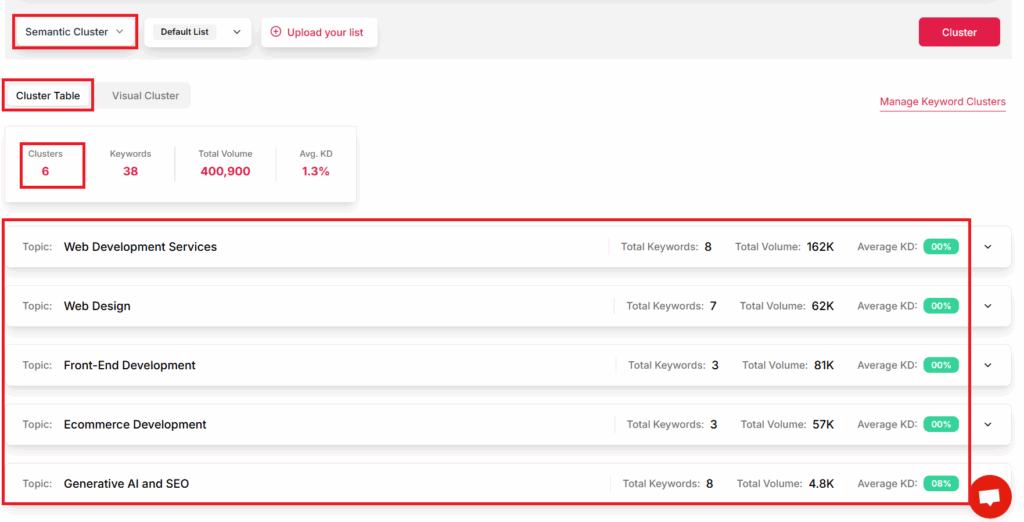
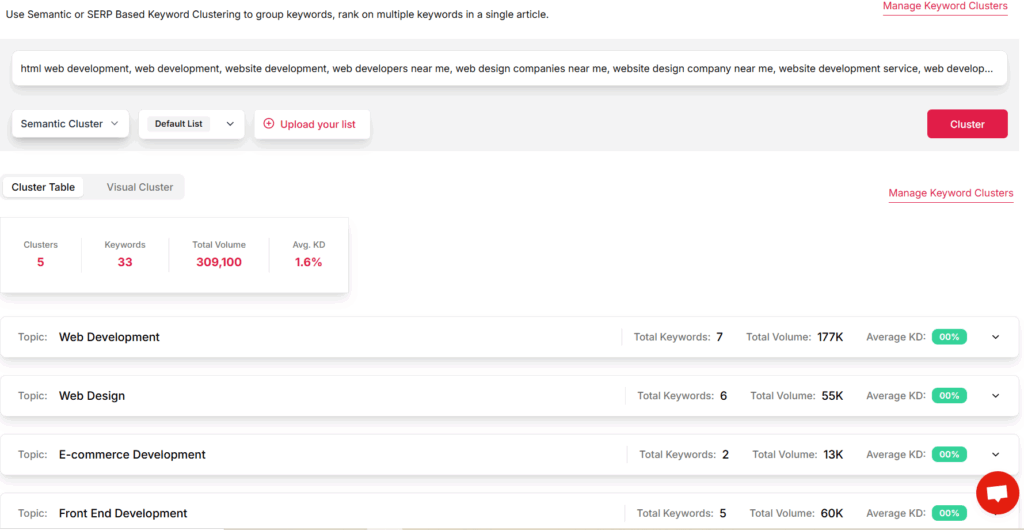
    semantic keyword clustering - cluster table
    Keywordly – Semantic Cluster

    Start by importing your cleaned keyword list into Keywordly’s clustering interface, either via CSV or direct integration with your rank-tracking and research projects. Make sure you’ve removed duplicates and obvious off-topic phrases so the algorithm focuses on meaningful patterns.

    Set your semantic similarity threshold to control how tight clusters should be. For a broad topic like “email marketing,” you might allow looser similarity; for “HubSpot workflows,” you want tighter clusters. Then run the workflow and review the topic-based groups Keywordly generates, such as “welcome email sequences,” “abandoned cart emails,” and “B2B newsletter strategy.”

    Evaluate and refine semantic keyword clusters

    Once clusters are generated, scan each one for topical coherence. All terms in a cluster should genuinely relate to the same subject. If you see “buy SEO tools” mixed with “what is SEO,” split them: one commercial cluster, one educational cluster.

    Check user intent inside each group. In Keywordly, you can tag clusters as informational, commercial, or transactional, then split clusters where the mix would confuse readers or Google. This makes it easier to map each cluster to a specific content type (guide, comparison, or product page) without diluting relevance.

    Prioritize semantic clusters by business value

    After refining, rank clusters by traffic potential, conversion opportunity, and alignment with your goals. An agency might prioritize clusters around “SEO audit services” over “what is SEO” because the commercial intent is stronger and more likely to drive leads.

    Keywordly lets you sort clusters by search volume and difficulty, helping you spot quick wins—such as a “local SEO checklist” cluster with mid-volume and low competition. Over time, publishing into both semantic and SERP-aligned clusters tends to lift topical authority, which can translate into higher rankings and compounding organic traffic growth across the entire topic.

    Reference:
    What is Keyword Clustering and How to do it effectively

    Execute SERP-Based Keyword Clustering Step by Step (Using Keywordly)

    Understand SERP-based keyword clustering

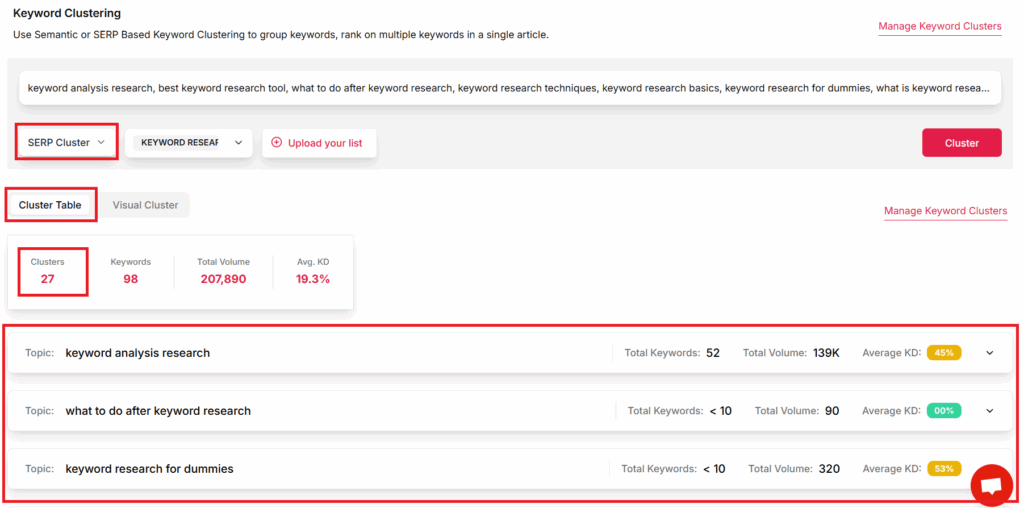
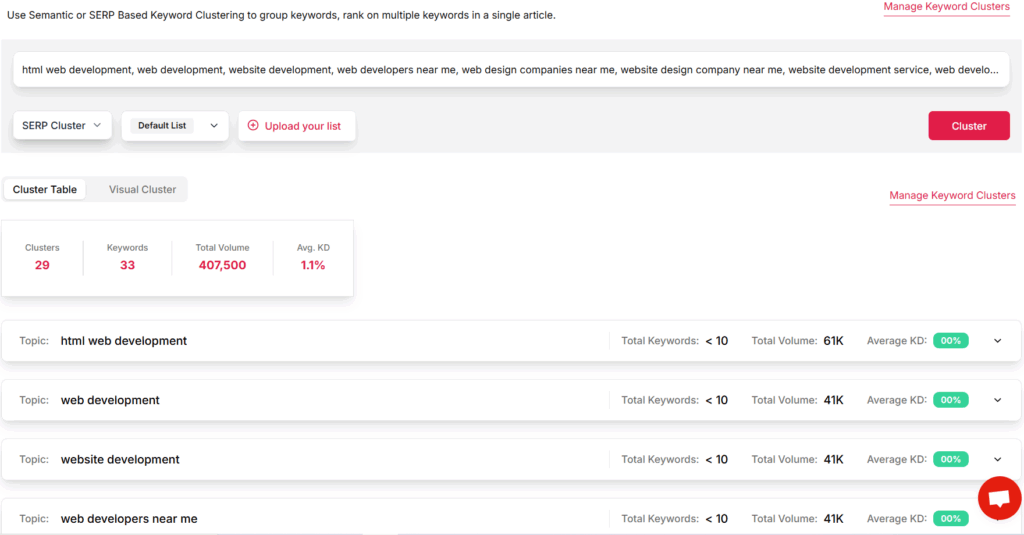
    SERP cluster table
    Keywordly – SERP Keyword Cluster

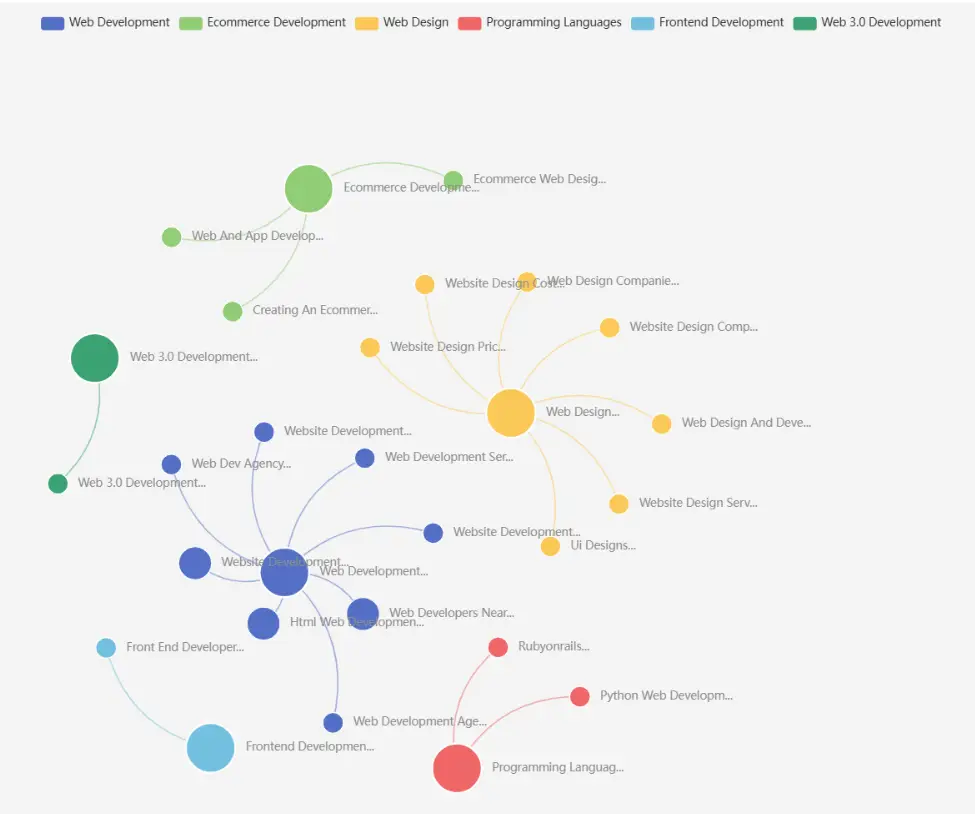
    SERP-based keyword clustering starts with how Google actually groups queries in live search results. Instead of guessing user intent, you look at which URLs rank for different keywords and cluster those that trigger the same or very similar pages.

    For example, if “best project management tools,” “top project management software,” and “project management apps” all show Asana, Monday.com, and ClickUp in the top 10, Keywordly can place them in one SERP cluster because Google treats them as the same topic. This approach aligns with how keyword clustering boosts your SEO content strategy by mapping real queries to focused content.

    Run SERP-based clustering in Keywordly

    Before clustering, load your keyword list into Keywordly from Search Console, Ahrefs, or Semrush. Then enable SERP similarity analysis so the platform can pull current top results for each query and compare overlapping URLs.

    Set clear rules: for instance, group keywords when at least 3 of the top 10 URLs match, or require 30–40% SERP overlap for inclusion. In Keywordly, this is as simple as choosing your similarity threshold and running the clustering job, then reviewing clusters like “CRM for small business” vs. “best CRM software for startups” to see exactly how Google is grouping them.

    Compare SERP-based clusters with semantic clusters

    Keywordly lets you run both semantic and SERP-based clustering on the same keyword set. Start by generating semantic clusters using NLP similarity, then layer SERP-based clusters on top to validate whether Google agrees with those groupings.

    If your semantic cluster groups “content calendar tool” with “social media scheduler,” but SERP-based clustering shows separate ranking pages and very little overlap, you know those topics deserve two pieces of content. This refinement directly supports the content mapping process described in Keyword Clustering: Boost Your SEO Content Strategy, and can mean one in-depth guide instead of three thin articles, which often leads to stronger rankings and higher click-through rates.

    Handle SERP edge cases and nuances

    As you review clusters, watch for mixed-intent SERPs where informational and transactional results rank together. For instance, “SEO content brief” might show tutorials from HubSpot and templates from Notion; Keywordly’s SERP view helps you decide whether to create a guide, a template landing page, or both.

    Pay attention to local vs. global SERPs, like “plumber near me” versus “how to fix a leaking pipe,” and to seasonal swings such as “Black Friday TV deals.” When you implement both semantic and SERP-based clusters into your content roadmap inside Keywordly, you reduce cannibalization, create pages that better match intent, and typically see improved organic traffic, more stable rankings around updates, and higher conversion rates from tightly targeted keyword groups.

    Reference:
    What is Keyword Clustering and How to do it effectively

    Combine Semantic and SERP Clusters into a Unified Strategy

    Combine Semantic and SERP Clusters into a Unified Strategy

    Combine Semantic and SERP Clusters into a Unified Strategy

    Decide when to rely on semantic vs SERP clusters

    Smart keyword clustering starts by knowing when to trust semantic relationships and when to obey the SERP. In Keywordly, you can first group terms using semantic similarity scores (e.g., “keyword clustering tools,” “SEO clustering software,” “content cluster platform”) to shape your content architecture.

    Then, run a SERP clustering pass in Keywordly to compare top-10 results. If Google consistently ranks the same URLs for two queries (e.g., “SEO content brief tool” and “AI content brief generator”), target them on one page. If overlap is weak, split them into separate articles to avoid keyword cannibalization.

    Build a master cluster map

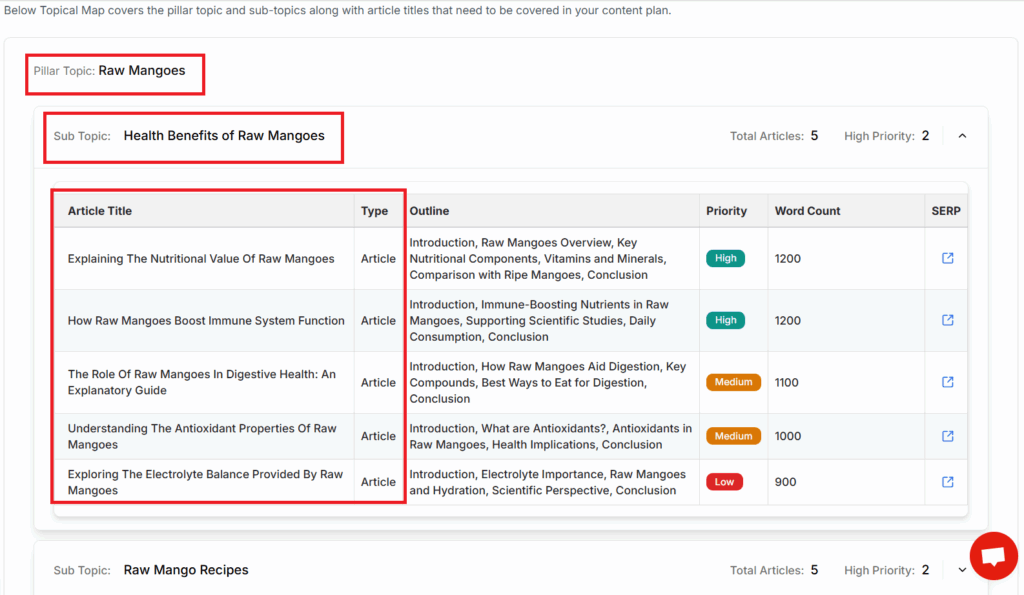
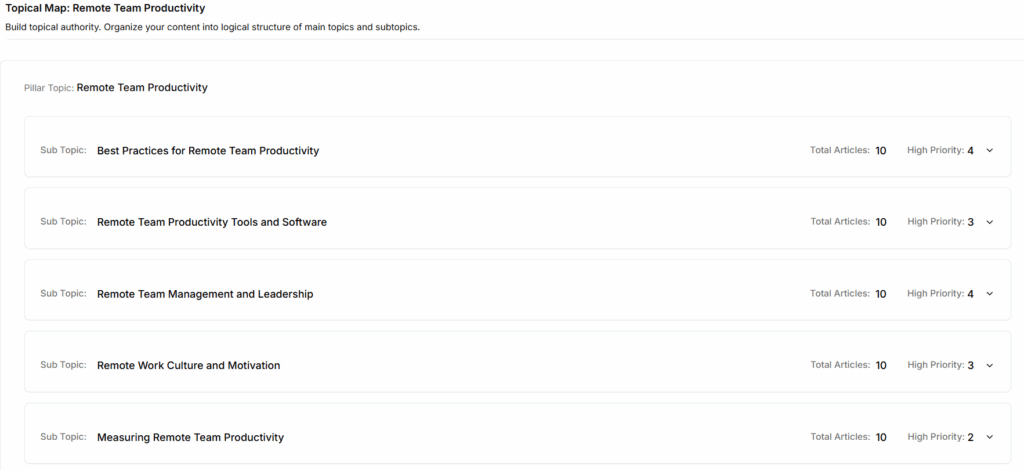
    topical map- pilar & subtopics
    Keywordly – Topical Map Feature

    A master cluster map turns scattered keyword lists into a structured content blueprint. In Keywordly, export your semantic and SERP clusters, then organize them into themes like “Technical SEO,” “Content Strategy,” and “AI Search Optimization” that mirror your site’s navigation.

    For example, an agency might create a pillar for “Keyword Clustering Guide,” with subclusters for “semantic clustering,” “SERP clustering,” and “cluster-based content briefs.” Editors and writers can reference this shared map so every new article reinforces an existing cluster instead of creating orphan content.

    Define roles for each cluster in your content ecosystem

    Assign pillar pages to broad, high-intent clusters in Keywordly, such as “SEO content strategy,” that deserve 2,000–3,000 word guides. Then map supporting articles to long-tail clusters like “B2B SEO content workflow” or “how to avoid keyword cannibalization,” linking them back to the pillar.

    Teams that follow this model often see clearer topical authority and higher rankings. For instance, many SaaS blogs report 20–40% traffic lifts after restructuring content around pillar-supporting clusters rather than isolated posts.

    Use Keywordly to maintain your cluster architecture

    Cluster strategy only works if it stays current. In Keywordly, store each cluster as a living asset: tag it by topic, funnel stage, and content type, and enable version history so you can see when terms were added or removed.

    Review clusters quarterly as new products, queries, or AI-search features appear. When you adjust a cluster and then see keyword groups climb from page two to page one, you can correlate that performance gain directly to your structural updates and refine your process over time.

    Reference:
    SEO to GEO: A Unified Content Strategy for Dual Visibility

    Turn Keyword Clusters into a Strategic SEO Content Plan

    Translate clusters into a content calendar

    A strong SEO content plan starts by turning raw keyword clusters into a realistic publishing schedule. Instead of writing randomly, you map each cluster to specific weeks and campaigns so production, design, and SEO work in sync.

    Step 1: Prioritize clusters by impact and effort. For example, an “email marketing for ecommerce” cluster with 2,000+ monthly searches and low competition should outrank a niche topic with 40 searches. Use a simple impact/effort matrix in Keywordly to tag clusters as High, Medium, or Low priority and then sequence them into a 90-day roadmap.

    Step 2: Schedule around demand and campaigns. A retailer like REI plans “winter hiking gear” content for September–November, not April. Mirror that approach by aligning clusters with seasonality, product launches, and paid campaigns. Step 3: Mix funnel stages each month—publish one awareness guide, one comparison piece, and one decision-focused page to keep the pipeline full at all stages.

    Define optimal page types for each cluster

    Each cluster should map to the page type that best matches search intent. This prevents thin, duplicated content and helps Google understand which URL should rank for which intent.

    Step 4: Choose formats by intent. For a “best project management tools” cluster, a long-form blog or comparison guide works best. For “Asana pricing” or “buy Asana alternative,” a focused landing page is more appropriate. Transactional clusters like “buy running shoes online” should feed into category or collection pages, while informational clusters become guides, FAQs, or tools.

    Step 5: Avoid splitting one clear intent across multiple pages. HubSpot often creates one definitive guide per core topic, then supports it with internal links. Use the same model: one primary page per cluster, supported by related subpages only when there are distinct, validated intents.

    Map primary, secondary, and supporting keywords

    Once the page type is defined, structure your targeting so each URL has a clear focus. This helps both crawlers and users quickly understand what the page is about.

    Step 6: Assign one primary keyword per page. For example, a guide might target “B2B SaaS content marketing” as the primary term. Step 7: Add 3–8 closely related secondary keywords from the same cluster, such as “B2B SaaS blog strategy” or “SaaS content marketing examples,” and weave them naturally into headings and body copy.

    Step 8: Use long-tail and supporting terms in subheadings and FAQs, like “How often should SaaS companies publish blog posts?” This broadens topical coverage, increases the chance of ranking for dozens of variations, and often leads to richer featured snippets and People Also Ask visibility.

    Use Keywordly to operationalize your content plan

    To make this process scalable, you need a workflow that ties clustering, planning, and production together. Keywordly lets you do semantic and SERP-based clustering, then connect those clusters directly to briefs, tasks, and performance tracking.

    Step 9: Build semantic and SERP keyword clusters in Keywordly

    Use Keywordly’s semantic clustering to group terms by meaning, such as “content audit,” “SEO content audit,” and “blog content audit template.” This ensures comprehensive topical coverage. Then layer SERP clustering by analyzing which keywords share the same ranking URLs—if Google ranks the same pages for “content audit checklist” and “how to run a content audit,” treat them as one SERP cluster.

    Attach these combined clusters to a single pillar page where intent overlaps, or separate them when SERPs show clearly different results. This approach mirrors how high-performing sites like Ahrefs structure their “keyword research” and “keyword research tools” content—one master guide plus specialized supporting pages.

    Step 10: Turn clusters into briefs, workflows, and measurable impact

    Within Keywordly, convert each cluster into a content brief, auto-including primary, secondary, and long-tail terms with SERP notes and content gaps. Assign tasks to writers, editors, and SEO reviewers, then track status from idea to publication in one dashboard.

    Teams that follow this structured clustering workflow typically see measurable gains—organic traffic spread across more long-tail queries, fewer cannibalization issues, and higher average positions for core topics. For example, agencies adopting cluster-based planning often report 20–40% traffic growth to key topic hubs within 6–9 months as Google rewards clearer topical authority and better-aligned content.

    Reference:
    Better SEO and Visibility with the Pillar and Cluster Content …

    Implement Keyword Clusters in On-Page Content (Practical How-To)

    Implement Keyword Clusters in On-Page Content (Practical How-To)

    Implement Keyword Clusters in On-Page Content (Practical How-To)

    Structure pillar pages around keyword clusters

    Start by turning each keyword cluster into a pillar page that covers the entire topic at a high level. In Keywordly, group your semantic and SERP-based keywords (for example, around “B2B content marketing strategy”) and export that cluster as the outline for a single, comprehensive resource.

    Break the pillar into sections that mirror the cluster’s subtopics: “what is B2B content marketing,” “strategy framework,” “examples,” and “metrics.” Use H2s and H3s that reflect these subtopics so Google and AI engines like ChatGPT can understand topical breadth.

    Then, link out to supporting articles from the pillar using descriptive anchor text, such as “B2B content marketing examples” or “content marketing KPIs.” This internal linking pattern signals that the pillar is the hub and the supporting pieces are spokes, reducing confusion about which URL should rank.

    Use secondary and supporting keywords naturally

    Once your structure is set, map secondary keywords to specific sections. For instance, if your primary topic is “email marketing automation,” supporting terms in Keywordly like “best email automation tools,” “email workflows,” and “behavioral triggers” can each live in their own H2 or H3.

    Write the copy first for humans, then use Keywordly’s editor to check coverage and density. If you see gaps, add supporting phrases inside examples or bullet lists, not by stuffing them into every sentence.

    For example, in a section on “behavioral email triggers,” mention how HubSpot saw higher engagement by sending cart-abandon emails within 30 minutes, naturally weaving in the phrase “behavior-based email workflows.”

    Avoid keyword cannibalization within clusters

    Keyword clusters can backfire when multiple URLs chase the same core query. In Keywordly, filter your cluster by primary keyword and identify pages that compete for terms like “SEO content strategy.” If two pieces target that query with near-identical intent, you’re likely diluting your ranking potential.

    Turn the strongest page into your primary asset and either merge overlapping sections from weaker articles or 301 redirect them. Use clear internal links that say “SEO content strategy guide” pointing to the chosen canonical page so search engines know which version to prioritize.

    For tricky cases where you must keep similar content (e.g., a 2024 vs. 2025 guide), apply canonical tags and differentiate intents, such as “SEO content strategy framework” vs. “SEO content strategy checklist,” to prevent cannibalization.

    Optimize with Keywordly’s content editor

    To operationalize both semantic and SERP clustering, bring your draft into Keywordly’s content editor. Start by selecting the semantic cluster for your target topic so the editor can show related entities, questions, and contextual phrases commonly found on top-ranking pages.

    Then layer in SERP clustering insights: if Keywordly shows that “SEO content plan,” “SEO content roadmap,” and “SEO content calendar” share similar SERP results, you can answer all three intents in one well-structured guide rather than three thin articles.

    As you refine headings and paragraphs, watch the real-time guidance to ensure you cover key subtopics without exceeding safe repetition thresholds. Teams that follow this workflow typically see higher topical authority, better time-on-page, and more impressions across long-tail variants, which often translates to steadier month-over-month organic traffic growth rather than isolated ranking wins.

    Reference:
    The Comprehensive Guide to Keyword Clustering in SEO

    Measure the Impact of Keyword Clustering on Rankings and Traffic

    Track performance at the cluster level

    Once you’ve built your semantic and SERP-based clusters in Keywordly, the next step is tracking impact at the topic level, not just by individual keywords. This helps you see whether your entire “Email Marketing for SaaS” or “Local HVAC Services” cluster is gaining visibility as a whole.

    Start by grouping all keywords in a cluster and monitoring the average position, impressions, and share of voice over time. For example, an agency working on a “B2B SEO” cluster can track the mean ranking across 40 keywords instead of obsessing over just “b2b seo agency.” This shows whether Google recognizes you as an authority on the topic, not just on a single term.

    In Keywordly, set up cluster-level reports that roll up rankings for semantic clusters (related by meaning) and SERP clusters (keywords that trigger similar search results). Use these reports to compare themes and quickly see which clusters are driving new visibility so you can double down on what’s working.

    Monitor traffic, engagement, and conversions by cluster

    Rankings alone don’t tell you if your clusters are profitable. Group pages by cluster in your analytics, then track sessions, time on page, bounce rate, and conversion events across the whole topic. For example, a Shopify store blogging about “running shoes” can compare how its “trail running,” “marathon training,” and “beginner running tips” clusters perform as topic groups.

    Connect Keywordly clusters with Google Analytics or Looker Studio dashboards using UTM structures or content groupings. This lets you see that your “SEO content strategy” cluster might drive fewer visits than a broader “content marketing” cluster, but convert 2–3x better on demo requests or lead magnets.

    Use this data to prioritize clusters with strong engagement and conversion metrics. Clusters with high traffic but poor conversions may need better CTAs, improved internal linking, or more bottom-of-funnel assets like comparison pages and case studies.

    Assess AI search and ChatGPT visibility

    AI search experiences are increasingly where users get answers, so you need to know whether your clusters surface there. With Keywordly’s AI visibility features, you can check which semantic clusters perform best across AI overviews, ChatGPT-style answers, and other generative search surfaces.

    For example, a B2B SaaS brand targeting “customer onboarding” can see if its cluster appears in Google’s AI Overviews for prompts like “how to improve SaaS onboarding” or in ChatGPT-style responses to “onboarding email sequences.” If certain clusters rarely appear, that’s a signal your coverage isn’t deep or structured enough.

    Use these insights to refine content outlines. Expand semantic clusters with more intent-specific articles, FAQs, and supporting guides. Align headings and schema with the types of structured, step-based answers AI models tend to show, increasing your chances of being referenced or paraphrased.

    Diagnose and improve underperforming clusters

    Not every cluster will perform well out of the gate. Use Keywordly to highlight clusters where average rankings, traffic, or AI visibility are stagnant or declining. This cluster-first diagnosis is more effective than chasing individual keyword drops.

    For weak semantic clusters, audit the content set: remove thin posts that cannibalize stronger URLs and merge overlapping articles into a single, comprehensive guide. For instance, instead of five shallow posts on “email subject lines,” consolidate them into a 3,000-word resource with examples, templates, and industry benchmarks from brands like HubSpot and Mailchimp.

    For SERP-based clusters where competitors dominate with long-form guides or video-rich results, upgrade your content format and depth. Add internal links across your cluster, improve E-E-A-T signals with expert quotes, and refresh outdated data. Over time, you should see cluster-wide gains in rankings, organic traffic, and assisted conversions as your topical authority strengthens.

    Reference:
    Keyword Clustering and Grouping | SEO Strategies For …

    Scale and Automate Advanced Keyword Clustering with Keywordly

    Create repeatable clustering workflows

    To turn keyword clustering into a reliable growth lever, you need a consistent workflow your team can run weekly without reinventing the process. A simple, repeatable system means new writers, clients, or product lines can plug in without quality dropping.

    Start by documenting each step: 1) discover keywords with Keywordly’s research tools and imports from sources like Google Search Console, 2) clean and dedupe, 3) cluster, and 4) prioritize by intent, difficulty, and value. For example, an agency handling 10 B2B SaaS clients can use one master workflow, then swap in each client’s data and goals.

    Automate core tasks with Keywordly

    Manual clustering breaks down once you’re dealing with tens of thousands of keywords. Keywordly lets you automate both semantic and SERP-based clustering so you can focus on strategy instead of spreadsheets.

    For semantic clustering, 1) upload or import your keyword list, 2) choose semantic clustering in Keywordly to group terms by topical similarity (e.g., “content brief generator,” “AI content outline tool”), and 3) review suggested clusters before locking them in. For SERP clustering, 1) run SERP-based clustering, 2) let Keywordly compare overlapping ranking URLs, and 3) merge only keywords where Google already shows similar results. This prevents thin, overlapping articles and typically improves click-through and rankings across the cluster.

    Use templates and SOPs for consistency

    Templates and SOPs help you turn raw clusters into production-ready briefs that any writer can execute. This is critical when multiple stakeholders touch the same topics across quarters.

    Create a cluster brief template inside Keywordly that includes: primary and secondary keywords from the semantic/SERP clusters, search intent, outline sections, internal link targets, and content angle. For instance, a “keyword clustering” hub page might target a 2,000-word guide, supported by three 1,200-word articles on semantic clustering, SERP clustering, and tools comparison, all defined inside one standardized template.

    Maintain and evolve your clusters over time

    Clusters are not one-and-done. Search intent, competitors, and your own product positioning can shift every 3–6 months, especially in fast-moving niches like AI and SaaS. A static cluster map slowly loses relevance and ranking power.

    Set a recurring schedule in Keywordly to refresh both semantic and SERP clustering on updated keyword sets from Search Console and rank trackers. When SERPs show new competitors outranking you for cluster terms, update your briefs, expand content depth, and adjust internal links. Teams that treat clusters as living assets typically see steadier traffic growth and fewer ranking drops, because content remains aligned with how people search—and how Google and AI search engines interpret topics.

    Reference:
    Keywordly – SEO Content Workflow Platform & Tools

    Conclusion: Key Takeaways from This Advanced Keyword Clustering Guide

    Understand the main benefits of advanced keyword clustering

    Advanced keyword clustering turns a messy keyword list into a clear content roadmap. Instead of writing random blog posts, you organize topics into strategic clusters that mirror how your audience searches and how your business sells.

    For example, an eCommerce brand like REI can cluster around “hiking boots” with subtopics such as “best hiking boots for women,” “waterproof hiking boots,” and “hiking boot sizing guide.” This structure supports product pages, guides, and comparison posts that collectively drive more qualified traffic and revenue.

    Leverage both semantic and SERP clustering together

    Semantic clustering in Keywordly groups queries by meaning and intent, so terms like “how to start intermittent fasting,” “intermittent fasting for beginners,” and “16/8 fasting guide” live in one intent-driven cluster. This helps you plan content that speaks your audience’s language instead of chasing isolated keywords.

    SERP clustering then validates those groups against live Google results. When Keywordly shows that “intermittent fasting schedule” and “intermittent fasting meal plan” share 7–8 overlapping URLs, you know they can rank together in one comprehensive guide, reducing content cannibalization and boosting click-through rates.

    Integrate clusters into content and internal linking for results

    Once your clusters are built, turn them into a hub-and-spoke structure. In Keywordly, assign one pillar page (e.g., “Complete Intermittent Fasting Guide”) and supporting articles (e.g., “Intermittent Fasting for Women Over 40,” “Intermittent Fasting and Workouts”) mapped to awareness, consideration, and decision stages.

    Link each spoke back to the pillar with descriptive anchor text, and cross-link related spokes. Sites like HubSpot use this model to reinforce topical authority, which has been associated industry-wide with stronger rankings and compounding organic traffic over 6–12 months.

    Use Keywordly to streamline your end-to-end workflow

    Keywordly centralizes research, clustering, briefs, and optimization so teams don’t juggle spreadsheets and disconnected tools. You can import keyword exports from sources like Google Keyword Planner or Ahrefs, auto-cluster them semantically, then refine with SERP data inside the same dashboard.

    By automating deduping, grouping, and brief creation, SEO teams free up hours each week for strategy and conversion-focused copy. Agencies managing dozens of clients can maintain live cluster architectures that update as new keywords emerge, keeping content aligned with evolving demand and AI-driven search experiences.

    Recommended next steps for implementation

    Step 1: Audit and organize your existing keywords

    Start by exporting your current keyword lists and top-performing URLs from Google Search Console and your preferred SEO tool. Import them into Keywordly and run an initial semantic clustering pass to see how queries naturally group by topic.

    Flag clusters tied to revenue pages (product, demo, pricing) as high priority. A B2B SaaS company might discover a strong “SOC 2 compliance” cluster already driving leads, signaling an opportunity for more supporting content.

    Step 2: Build semantic and SERP-based clusters in Keywordly

    Use Keywordly’s semantic clustering to group related terms, then open SERP views for each cluster. Merge clusters where SERP overlap is high, and split clusters when Google clearly serves different intents (e.g., “best CRM” vs. “what is a CRM?”).

    This dual approach reduces thin, overlapping articles and focuses your effort on robust resources that can capture dozens of related queries in one piece, often increasing organic traffic per URL instead of diluting it across many weak posts.

    Step 3: Translate clusters into content and internal links

    For each high-value cluster, create a Keywordly brief for the pillar and key supporting pages. Define search intent, target subtopics, and internal link targets inside the platform so writers and editors execute consistently.

    As content ships, use Keywordly’s monitoring to track rankings and traffic by cluster, not just by page. Over time, you should see stronger visibility for entire topic hubs, fewer cannibalization issues, and more stable rankings as Google and AI search models recognize your topical authority.

    FAQs About Advanced Keyword Clustering for SEO Content Planning

    How is advanced keyword clustering different from basic keyword grouping?

    Basic keyword grouping usually means putting similar phrases into a spreadsheet tab based on surface-level matching, like “best running shoes,” “top running shoes,” and “running shoes reviews.” Advanced clustering goes deeper, using semantic similarity and SERP overlap to understand how Google actually connects those queries.

    Inside Keywordly, you can upload a keyword list, run semantic analysis, and instantly see which phrases share meaning and search results. For example, “how to start a podcast” and “podcast setup checklist” often belong in one hub because they share results and intent, even though the wording is different.

    Why should I use both semantic and SERP-based clustering?

    Semantic clustering helps you mirror how people naturally talk. Keywordly groups terms like “content calendar template,” “blog planning spreadsheet,” and “editorial calendar examples” into one semantic cluster, guiding you to create a resource that speaks the same language as your audience.

    SERP-based clustering shows how Google groups those queries in practice. If the same URLs rank for “editorial calendar template” and “content calendar template,” Keywordly flags them as a SERP cluster. Combining both ensures your hubs satisfy real user intent while aligning with how Google structures the topic.

    When is the right time to rebuild or update my keyword clusters?

    Rebuild clusters when your business changes or your market shifts. If you add a new service—say, a B2B SaaS brand launches an AI writing assistant—use Keywordly to pull fresh keywords, then cluster around the new product’s use cases, industries, and pain points.

    Set a recurring workflow in Keywordly to review clusters quarterly. Many SEO teams do this after major updates like Google’s Helpful Content updates, checking SERP volatility and merging, splitting, or reassigning clusters where rankings or intent have clearly changed.

    How many keywords should be in a single cluster or content hub?

    There’s no magic number, but focus and coherence matter more than volume. In Keywordly, a strong cluster for “email onboarding sequence” might hold 20–40 tightly related queries, from “SaaS onboarding email examples” to “new user welcome email subject lines.”

    Use Keywordly’s cluster strength or similarity scores to avoid bloated hubs. If a keyword drifts too far semantically or shares little SERP overlap, move it into a separate subcluster with its own supporting page to prevent thin, unfocused content.

    How does keyword clustering impact rankings, traffic, and topical authority over time?

    Strong clusters help search engines see your site as the go-to resource for a topic. When Ahrefs studied content hubs, they found pages supported by internal links from related articles often earned more referring domains and steadier rankings over time, which lines up with what many agencies report in client case studies.

    Using Keywordly, you can map each cluster to a hub page and supporting articles, then audit internal links. Over 6–12 months, this usually leads to more stable impressions, better average position for long-tail queries, and a higher chance of winning featured snippets or being surfaced by AI assistants for those topics.

    How can I use Keywordly if I already have existing content and partial clusters?

    If you already have content, start by importing your keyword lists and URLs into Keywordly. The platform will auto-map existing pages to clusters, revealing gaps where high-intent clusters lack content and overlaps where two or more pages chase the same SERP.

    From there, follow a step-by-step workflow: 1) Merge cannibalizing pages, 2) Assign a primary page to each core cluster, 3) Create briefs for missing articles, and 4) Use Keywordly’s optimization tools to align on-page elements with cluster themes. Teams that do this often see cleaner architecture and more efficient traffic gains without publishing dramatically more content.

  • SERP Keyword Clustering Tool: How and Why to Use

    SERP Keyword Clustering Tool: How and Why to Use

    Pouring hours into keyword research only to end up with overlapping pages that cannibalize each other is one of the most frustrating parts of SEO. SERP keyword clustering offers a way out by grouping queries based on how Google itself understands intent, not just similar wording.

    By understanding what SERP keyword clustering really means, how it differs from semantic clustering, and how to extract SERP keywords both manually and with AI-powered tools like Keywordly, you can plan content that ranks stronger, avoids duplication, and aligns tightly with searcher intent. It takes some upfront work, but used correctly these clusters become the backbone of a clear, scalable content strategy that fits seamlessly into your broader SEO workflow.

    In an era where Google, Bing, and AI engines like ChatGPT decide who gets seen and who disappears, SERP keyword clustering isn’t a ‘nice-to-have’ tactic—it’s the strategic backbone that platforms like Keywordly use to turn scattered keywords into focused, revenue-driving content ecosystems.

    Reference:
    SERP Clustering

    1. Understanding SERP Keywords: Meaning, Intent, and Opportunity

    SERP keywords meaning: what they are and why they matter

    SERP keywords are the queries that trigger a specific set of results on a search engine results page. They don’t just describe what users type; they define which URLs, formats (articles, product pages, videos), and SERP features appear together.

    When you Google “best CRM for small business,” you see list posts from HubSpot and G2, comparison tables, and review snippets. That pattern is the SERP for that keyword. SERP keyword clustering means grouping keywords that trigger highly similar SERPs, so you can target them with a single, stronger page instead of many weak ones.

    To extract SERP keywords manually, SEOs often pull queries from Google Search Console, then inspect the SERPs in an incognito window. With Keywordly, you can automate this by importing seed keywords, pulling live SERPs, and letting the platform group terms that share overlapping URLs, saving hours of spreadsheet work.

    Search intent through SERPs: reading rankings, snippets, and entities

    SERP cluster table

    Search intent becomes much clearer when you read the SERP layout, not just the keyword. An informational query like “how to write a content brief” usually surfaces guides, featured snippets, and People Also Ask. A transactional query like “Ahrefs pricing” shows product pages, pricing tables, and maybe Google Ads.

    Features such as featured snippets, People Also Ask boxes, and knowledge panels signal what Google believes users want most. For example, “SEO content brief template” often shows a snippet with bullet steps and downloadable templates from sites like Semrush or HubSpot, indicating users want a ready-to-use model, not theory.

    Entities and brand results also clarify intent. If the SERP for “Jasper AI review” is dominated by blogs, YouTube reviews, and star ratings, Google interprets the query as commercial investigation. Keywordly can overlay SERP features and entity data, so your clusters are aligned with real user intent instead of just matching phrases.

    How SERP overlap signals which keywords belong on the same page

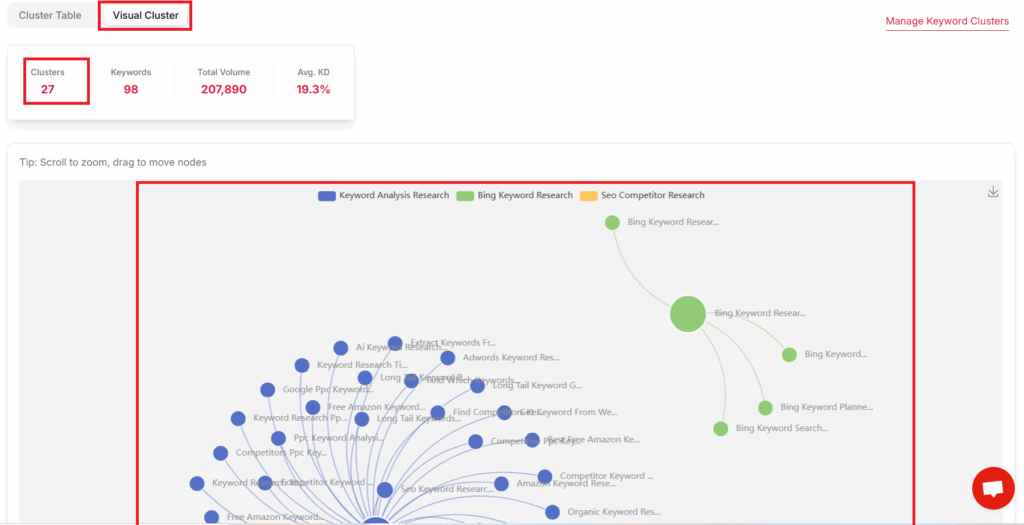
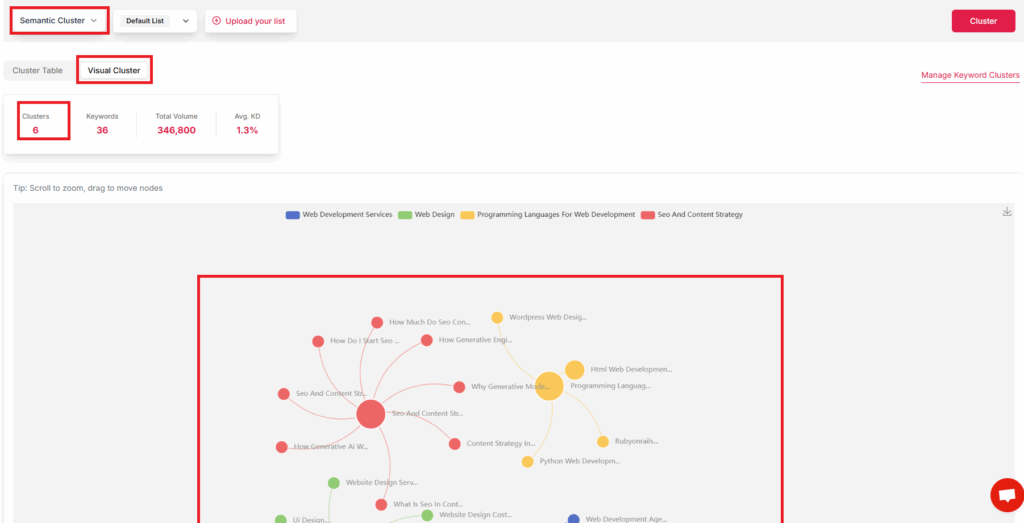
    serp visual cluster

    SERP overlap measures how many of the same URLs rank across different keywords. If “SEO content brief,” “content outline for SEO,” and “SEO article brief template” share 60–80% of top-10 URLs, they likely belong in one SERP keyword cluster and can be targeted on a single page.

    This approach is stronger than relying on semantic similarity alone. Two phrases may look similar linguistically but trigger very different SERPs. For instance, “SEO content strategy” surfaces strategic guides, while “SEO content calendar template” shows tools, templates, and downloadable sheets—different pages, different jobs.

    Keywordly automates this by pulling SERPs at scale, calculating URL overlap, and forming clusters around primary terms. You see clear groups like “SEO content brief,” “SEO content outline,” and “content brief template,” each with their supporting variations mapped to a single URL, so you can plan content confidently.

    Common mistakes: treating every keyword as a separate page opportunity

    A frequent mistake is spinning up new pages for every close-variant keyword, which leads to keyword cannibalization. For example, creating separate posts for “B2B SEO content strategy,” “SEO strategy for B2B SaaS,” and “B2B SaaS SEO plan” often results in pages competing with each other, diluting authority and clicks.

    Over-fragmented content makes it harder for Google to identify your best answer. One strong, comprehensive asset that targets a full SERP keyword cluster usually outperforms five thin, overlapping posts. HubSpot’s long-form guides that rank for hundreds of variations (e.g., “content marketing strategy” queries) are a clear proof of this approach.

    SERP keyword clustering differs from semantic keyword clustering because it starts from actual SERP behavior, not just language models or topic similarity. Use SERP-based clusters in your content strategy by 1) assigning one core page to each cluster, 2) weaving all cluster terms into headings, subtopics, and FAQs, and 3) letting Keywordly monitor performance so you can expand or split clusters only when the SERP clearly diverges.

    2. What Is SERP Keyword Clustering and How Does It Work?

    Definition of SERP keyword clustering vs basic keyword grouping

    SERP keyword clustering means grouping keywords based on how Google actually shows results, not just how those keywords look or sound. A cluster forms when multiple keywords trigger largely the same ranking URLs, signaling that Google sees them as one intent or topic.

    Basic spreadsheet-style grouping relies on semantics or gut feeling: you might put “best CRM software” and “top CRM tools” together just because they look similar. With SERP clustering, you validate that by checking whether the same pages rank for both terms, aligning your plan with how search engines already organize topics.

    Semantic clustering might group “project management tools” and “task management apps” together because they’re conceptually close. SERP clustering may split them if the top results differ, revealing that Google treats them as separate topics. Platforms like Keywordly and guides such as Mastering Keyword Clustering help you see and act on those distinctions.

    How SERP similarity (URL overlap) is calculated in clustering tools

    To build clusters, tools first fetch the top results for each keyword, usually the top 10–20 Google URLs. For “email marketing software” and “best email marketing tools,” a tool will pull those result sets and then compare which URLs appear in both lists.

    Similarity is calculated by URL overlap. If 6–8 of the same domains or URLs appear in both top 10 lists, the tool considers them highly related and clusters them together. Strict clustering might require 7+ common URLs; loose clustering might accept 3–4, creating broader groups with more varied intent.

    In Keywordly, you can set clustering strength so a term like “SEO content brief generator” either forms its own tight cluster or gets grouped with broader phrases like “SEO content tools.” This control helps agencies tune granularity for different markets or client strategies.

    Benefits: fewer pages, stronger topical authority, less cannibalization

    SERP clustering reduces redundant content by revealing when one comprehensive page can rank for dozens of related queries. Instead of publishing separate posts for “how to do keyword research,” “keyword research steps,” and “keyword research process,” you create one in‑depth guide targeting the whole cluster.

    Consolidated pages attract more backlinks and engagement signals, strengthening topical authority. HubSpot’s pillar pages are a classic example: one long-form pillar ranks for thousands of variations because it covers the full clustered topic deeply and internally links to supporting assets.

    Clustering also prevents keyword cannibalization. When two posts accidentally target the same SERP cluster, they compete against each other. A content audit in Keywordly will highlight overlapping clusters so you can merge, redirect, or reposition pages, clarifying which URL owns each primary cluster.

    When SERP keyword clustering is especially powerful

    Clustering is critical when planning a new site or content hub with limited resources. A startup in B2B SaaS, for example, can take 1,000 raw keywords, cluster them in Keywordly, and prioritize 30 high-value clusters to cover first instead of writing 200 scattered articles.

    During content audits, clustering exposes thin or overlapping posts. An agency reviewing a blog with 500+ articles might find 20 separate posts targeting the same “social media calendar” cluster and consolidate them into a single authoritative guide, then redirect legacy URLs.

    When expanding into new regions or topics—say, entering Spanish SERPs or branching into “AI content optimization”—clustering around those markets shows how Google interprets intent locally. Combining SERP clusters with Keywordly’s research and content briefs lets you shape a strategy that follows actual search behavior instead of assumptions.

    3. SERP Keyword Clustering vs Semantic Keyword Clustering

    3. SERP Keyword Clustering vs Semantic Keyword Clustering

    3. SERP Keyword Clustering vs Semantic Keyword Clustering

    Semantic keyword clustering explained (NLP, topic similarity, entities)

    Semantic keyword clustering groups queries by meaning, not by how they rank in Google. Instead of looking at shared URLs in the SERP, it looks at linguistic similarity to understand whether “best running shoes,” “top sneakers for runners,” and “running footwear reviews” belong to the same topical bucket.

    Modern NLP models and embeddings power this approach. Tools using technologies similar to Google’s BERT or OpenAI embeddings compare keyword vectors to detect topic similarity and entities such as brands, products, or locations. This helps you see that “Nike Pegasus 41” and “neutral road running shoe” often live in the same conceptual space.

    Semantic clustering also surfaces valuable variations and questions. For example, a semantic engine will naturally group “how to start intermittent fasting,” “intermittent fasting schedule for beginners,” and “16/8 fasting results” as one topic hub, even if their SERPs differ slightly. That’s powerful for building FAQ sections, content briefs, and supporting subheadings.

    Key differences: SERP-based behavior vs language-based similarity

    To understand SERP keyword clustering, focus on search engine behavior. Here, you group keywords when they trigger overlapping ranking URLs. If “CRM software,” “best CRM tools,” and “HubSpot vs Salesforce” share 6–8 of the same top 10 results, a SERP cluster suggests a single page can rank for all three.

    Semantic clustering, by contrast, uses language-based similarity only. Two keywords can look alike linguistically but generate very different SERPs. For example, “apple care” (Apple’s warranty) and “Apple care number” (support contact) sound similar but show different intent and result types.

    That’s why SERP-based signals matter. If Google shows entirely different pages for “SEO content strategy” vs “SEO content calendar template,” they probably should not be forced into one page, even if an NLP model says they’re semantically close. Treat SERP overlap as your intent safeguard.

    Pros and cons of SERP clustering vs semantic clustering for SEO

    Both approaches bring distinct benefits to strategy, especially at scale. Teams using Keywordly can lean on each method at different stages of the workflow to avoid cannibalization and unlock new ideas.

    Features of SERP keyword clustering

    • Groups keywords by shared ranking URLs and SERP overlap.
    • Highlights primary intent (informational, commercial, transactional) via result types.
    • Shows realistic page-level opportunities based on what already ranks.

    Pros of SERP clustering

    • Strong intent alignment and reduced keyword cannibalization across large blogs.
    • Real-world validation: mirrors how Google actually groups queries on page 1.
    • Great for mapping specific keyword sets to individual or hub pages.

    Cons of SERP clustering

    • Can miss long-tail or emerging topics with sparse SERP data.
    • Heavily dependent on current SERPs, which can shift after updates.
    • Less useful for pure ideation or early-topic discovery.

    Features of semantic keyword clustering

    • Uses NLP embeddings, entities, and topic similarity instead of SERP overlap.
    • Groups synonyms, variations, and questions into thematic buckets.
    • Maps broader topical landscapes around a seed theme.

    Pros of semantic clustering

    • Excellent for brainstorming, content ideation, and FAQ expansion.
    • Helps you cover a full topic, not just high-volume head terms.
    • Supports AI-search readiness by aligning content with concepts, not just exact phrases.

    Cons of semantic clustering

    • May suggest grouping queries that Google currently separates by intent.
    • Can lead to thin or unfocused pages if not validated against SERPs.
    • Language similarity alone doesn’t guarantee ranking potential.

    When to use SERP clustering, semantic clustering, or a hybrid approach

    Both clustering methods are most powerful when used in a structured workflow. Keywordly is designed around this hybrid model: expand with semantics first, then validate and structure with SERP-based clusters.

    Use SERP keyword clustering when mapping keywords to pages and building content architecture. For instance, an agency planning a B2B SaaS blog can take 1,000 CRM-related keywords, run SERP clustering, and clearly see which should become a single comparison guide vs separate feature pages. This reduces duplicate articles on “best CRM for small business” competing with each other.

    Use semantic clustering for ideation, supporting keyword discovery, and enriching page content. Start with a seed like “content audit” and let semantic expansion surface related ideas such as “SEO content audit checklist,” “content pruning,” and “content refresh strategy,” which can become sections, FAQs, or internal links from your main guide.

    A practical hybrid workflow in Keywordly looks like this:
    1) Import or generate a broad keyword list around a topic.
    2) Let Keywordly expand and semantically group variations, synonyms, and questions.
    3) Run SERP-based clustering inside Keywordly to see which terms realistically belong to the same URL.
    4) Use the resulting clusters to build content briefs, outlines, and internal link structures.

    To extract SERP keywords in general, you can export queries from Google Search Console, pull suggestions from tools like Google Keyword Planner, and scrape SERPs via APIs. In Keywordly, you simply enter seed topics or upload existing keywords; the platform automatically fetches SERP data, groups terms by overlap, and presents ready-to-use SERP clusters that plug directly into your content strategy.

    Reference:
    Semantic vs SERP Keyword Clustering

    4. How to Extract SERP Keywords Manually and With AI

    Manual SERP keyword extraction: autocomplete, People Also Ask, related searches

    Manual SERP keyword extraction starts with reading the page the way Google users do. Your goal is to capture the exact phrases, questions, and modifiers people type before you scale them with tools or AI.

    For example, type “best CRM for small business” into Google and slowly add letters. Autocomplete will surface long-tail variations like “best CRM for small business 2024” or “best CRM for small business under $50,” which reveal pricing and recency modifiers you should capture.

    Scroll to the People Also Ask box and note question patterns such as “What is the easiest CRM to use?” or “Is HubSpot CRM really free?” These questions expose informational subtopics and pain points you can turn into H2s and FAQs.

    At the bottom of the SERP, related searches like “small business CRM comparison chart” or “Zoho vs HubSpot CRM” show adjacent intents—comparison, evaluation, and alternatives—that belong in your keyword list and later in SERP keyword clusters.

    Using SEO tools to collect seed and long-tail terms

    Once you’ve gathered manual ideas, use SEO tools to expand them into a measurable dataset. The goal is to identify both seed topics and the long-tail phrases that drive qualified traffic.

    Start in Google Search Console: filter by page or folder and export queries already getting impressions for your core articles. If your “email marketing” guide shows queries like “email marketing for nonprofits” or “Mailchimp email marketing tutorial,” those become proven long-tail candidates.

    Then use keyword research tools such as Ahrefs, Semrush, or Keywordly’s research module to discover new opportunities. Apply filters for intent (informational vs. commercial), volume (e.g., 50–5,000 searches), and difficulty so you prioritize terms your domain can realistically rank for instead of chasing impossible head terms.

    AI SERP keyword extractor: how AI can expand, clean, and structure keyword lists

    AI helps move from messy exports to structured SERP keyword clusters that are ready for strategy. It can take a small set of seed terms and generate related queries, modifiers, and questions that mirror how people actually search across Google and Bing.

    In Keywordly, you can paste a list of seeds like “programmatic SEO,” “SERP keyword clustering,” and “AI content briefs.” The AI expands this into hundreds of variations, then deduplicates, normalizes spelling, and categorizes each term into themes before clustering.

    Well-structured outputs—CSV files with tags, search intent labels, and cluster IDs—can then be pushed into a SERP clustering engine such as the Keyword Clustering Tool – Group Keywords by SERP, which can process up to 200k+ keywords and align them to live SERP data.

    Criteria for a high-quality SERP keyword set

    A strong SERP keyword set balances coverage and focus. You want head terms like “project management software” plus long-tails such as “project management software for agencies” that have enough volume to matter but are specific enough to rank and convert.

    Check each cluster for intent and business fit: a B2B SaaS brand should favor “enterprise project management software” over generic “what is project management,” unless the informational query clearly supports top-of-funnel growth. Align clusters with products, pricing pages, and core content pillars.

    Finally, weigh competitiveness against your site’s authority. If you’re competing with Atlassian and Asana on a term, prioritize related lower-difficulty phrases where you can realistically win, then use Keywordly’s AI to build content around those SERP keyword clusters first.

    Reference:
    How to Use a SERP API for Keyword Research

    5. Using Keywordly as a Free SERP Keyword Clustering Tool

    5. Using Keywordly as a Free SERP Keyword Clustering Tool

    5. Using Keywordly as a Free SERP Keyword Clustering Tool

    Importing or Generating Keyword Lists Inside Keywordly

    SERP keyword clustering means grouping keywords based on which pages rank together in Google or Bing. Instead of guessing topics, you use live search results to see which queries search engines treat as part of the same intent.

    To start in Keywordly, you can import existing keyword lists from tools like Ahrefs, Semrush, or Google Search Console. Simply copy-paste up to a few thousand terms into the input box, or upload a CSV if your workflow is export-based from GSC or a rank tracker like AccuRanker.

    Keywordly also lets you generate new keyword ideas with AI. For example, a DTC brand like Allbirds could enter “sustainable running shoes” and have Keywordly expand this into long-tails around materials, care, and performance comparisons, then organize them into projects by site, client, or topic cluster before running any SERP analysis.

    How Keywordly’s AI SERP Keyword Extractor Works with Live SERP Data

    Traditional semantic clustering relies on language similarity; SERP keyword extraction instead looks at which URLs rank together. Keywordly fetches live SERP data for each keyword, pulling top-ranking URLs from Google or Bing, then analyzes overlap patterns across those results.

    The AI refines and normalizes variants like “best crm for startups” and “crm software for small startups” by studying shared ranking pages. If HubSpot, Salesforce, and Pipedrive comparison URLs appear on both SERPs, Keywordly groups them as a single SERP cluster even if the wording differs significantly.

    Because this uses fresh SERP data, you avoid outdated assumptions. For instance, Google recently split “AI writing tools” into separate results for enterprise vs. student use; a SERP-based extractor will show these as separate clusters while a static semantic model might still merge them.

    Running a Free SERP Keyword Clustering Report

    Once your list is ready, running a clustering report in Keywordly takes a few guided steps. This is where most users transform raw keyword dumps into content-ready groups tied directly to search intent.

    Step 1: Select your keyword set. Choose the project and list, then set clustering strictness. A tighter similarity threshold groups only keywords that share many ranking URLs; a looser one accommodates broader topical hubs, helpful for authority-building content like Shopify’s ecommerce blog.

    Step 2: Configure SERP settings. Pick region (e.g., United States), language (English), and search engine (Google or Bing) to mirror your real audience. Local agencies, for example, might cluster “personal injury lawyer” terms specifically for Google US-English to align with their local lead gen campaigns.

    Step 3: Review report outputs. Keywordly returns clusters with a representative keyword, a list of all grouped terms, and stats such as cluster size and average search volume where available, helping you quickly prioritize which clusters deserve pillar pages.

    Interpreting Keywordly’s Clusters: Cluster Labels, Primary vs Secondary Terms, Intent Tags

    The real value comes from understanding cluster structure and applying it to your content strategy. SERP clusters differ from purely semantic clusters because they are grounded in what actually ranks together, not just similar wording.

    Keywordly labels each cluster based on the dominant or highest-value keyword, typically the one with the strongest volume or commercial potential. That becomes your primary target, while lower-volume variants inside the same cluster—like “pricing,” “review,” or “near me” modifiers—act as secondary terms to weave into headings and FAQs.

    Intent tags (informational, commercial, transactional, navigational) and metadata show whether to create a blog guide, comparison page, or product landing page. For example, a SaaS SEO team at Notion might spot a “project management templates” informational cluster and spin up a long-form guide, while a “Notion pricing” transactional cluster maps directly to a high-converting pricing page.

    Reference:
    Maximize Your SEO Potential with These 10 Essential …

    6. Turning SERP Keyword Clusters into Content Strategy

    SERP keyword clustering groups queries that share similar search results, not just similar wording. Instead of relying only on semantics, you look at which keywords return overlapping URLs on Google and Bing and treat those as one intent cluster.

    This matters because it mirrors how search engines interpret topics. When you build content around SERP clusters, you align with real user behavior and reduce cannibalization across your site.

    Mapping SERP keyword clusters to content types

    Once you’ve extracted SERP keywords—either manually from Google’s “People Also Ask” and related searches, or via tools like Keywordly’s SERP miner—you can map each cluster to a content type. Keywordly automatically groups keywords that share top-10 results into clusters so you can see intent at a glance.

    Informational clusters like “how to do keyword research,” “SEO keyword tutorial,” and “keyword research step by step” clearly suit blog posts, guides, or academy-style resources. Ahrefs, for example, built a full guide around this cluster that drives thousands of organic visits per month.

    Commercial and transactional clusters usually align with landing or product pages. A cluster containing “SEO content platform,” “AI SEO writing tool,” and “Keywordly review” should support a comparison page or product landing page optimized for signups or demos.

    Broad clusters such as “content marketing strategy” can become pillar pages, while related long-tails like “content marketing strategy for SaaS” or “B2B content strategy framework” form supporting cluster articles. HubSpot’s content hubs are a well-known example of this pillar-and-cluster structure.

    Choosing a primary keyword and supporting terms for each content asset

    Within each SERP cluster, you need a clear primary keyword. Choose based on search volume, business relevance, and SERP fit. For instance, if Keywordly targets “SEO content workflow platform,” that might be the primary term, while “AI SEO content tool” and “content optimization software” become supporting terms.

    Supporting terms should appear in H2s, body copy, and internal links, but all must reflect how Google currently groups them. If SERPs for two phrases show totally different results, they likely deserve separate pages instead of one combined asset.

    Unlike semantic clustering, which groups phrases by meaning alone (e.g., via embeddings), SERP clustering respects search engine behavior. Two semantically related queries might belong in different SERP clusters because Google serves different intent: “SEO content checklist” vs. “SEO content template” often surface different page types.

    Keywordly resolves this by analyzing overlapping SERP URLs so you can see when to merge or split topics. This prevents you from over-optimizing one page for multiple conflicting intents.

    Structuring outlines and on-page SEO around SERP clusters

    Use SERP clusters to shape your outline before writing. Build your H1 and core H2s from the dominant themes and questions in the cluster. For a “keyword clustering” cluster, your H2s might be “What is keyword clustering,” “SERP vs semantic clustering,” and “How to cluster keywords using Keywordly.”

    Then, turn long-tail and question-style queries into FAQs. If users search “how to cluster keywords in Excel” or “best keyword clustering tools,” add a dedicated FAQ section, marked up with FAQ schema, to win rich results and AI overviews.

    Optimize title tags and meta descriptions to match the cluster’s primary intent. For transactional clusters, lead with outcomes (e.g., “Boost organic traffic with an AI SEO workflow platform”). For informational ones, promise clarity and depth. Internal links should connect all pages in the same cluster hub, using descriptive anchor text like “SEO content workflow with Keywordly” instead of generic “learn more.”

    Integrating clusters into your broader content calendar and topical authority plan

    Turn clusters into a measurable roadmap. Rank clusters by potential traffic, conversion value, ranking difficulty, and gaps in your existing content. If you see strong demand for “AI content optimization” and few competing in-depth guides, that cluster deserves higher priority in your roadmap.

    Keywordly can surface these gaps by overlaying your existing URLs on top of cluster maps, revealing unserved or under-served topics. This helps you avoid duplicating content and instead fill strategic holes.

    Schedule related clusters in a logical order: first a broad pillar, then supporting articles every 1–2 weeks to signal topical depth. For example, an agency might plan Q2 around “local SEO” clusters, then Q3 around “programmatic SEO.”

    Align clusters with campaigns and seasonality. Retail brands often push “Black Friday SEO deals” and “holiday gift guide SEO” clusters from September onward. Using Keywordly, teams can pre-build briefs, outlines, and optimization tasks around those clusters so content goes live well before peak search demand.

    Reference:
    Incorporating Topic Clustering Into Your Content Strategy

    7. Advanced Ways to Use SERP Keyword Clustering in Keywordly

    7. Advanced Ways to Use SERP Keyword Clustering in Keywordly

    7. Advanced Ways to Use SERP Keyword Clustering in Keywordly

    SERP keyword clustering groups queries that share similar search results, based on what Google actually ranks. Instead of relying only on semantic similarity, it clusters keywords by overlapping URLs in the top results, revealing what search engines consider the same intent.

    You can extract SERP keywords manually by pulling terms from Google Search Console, scraping SERPs with tools like Ahrefs or Semrush, or exporting PPC search terms. In Keywordly, you import or paste these keywords, and the platform automatically fetches SERP data and builds intent-based clusters around real-ranking pages.

    Auditing Existing Content for Cannibalization Using SERP Clusters

    Content cannibalization happens when multiple pages compete for the same SERP space. SERP clustering makes this visible by showing which queries share overlapping ranking URLs, rather than just similar wording.

    In Keywordly, run your existing ranking keywords from Search Console through the SERP clustering module. The tool groups queries where the same or similar pages appear in the top 10, helping you see where two or more URLs are fighting for the same intent.

    Map each cluster to your current URLs in a simple table. For example, a SaaS like HubSpot might see both a blog post and a feature page ranking for “CRM for small business.” Keywordly helps decide whether to merge content, 301 redirect weaker URLs, or differentiate angles (e.g., comparison vs. use-case guide) so Google understands which page owns that cluster.

    Identifying Content Gaps and New Topic Opportunities from Unclustered or Thin Clusters

    SERP clusters also reveal where your site has no clear answer compared with competitors. When Keywordly clusters imported SERP keywords, you’ll often see groups with strong volume but no mapped URL from your domain.

    Use those gap clusters to brief new content. For instance, an ecommerce brand like REI might discover a strong cluster around “ultralight backpacking food ideas” where competitors like Outside Online rank, but they have no targeted guide. That cluster becomes a brief for a pillar article with supporting recipes and packing checklists.

    Thin clusters with just a few related terms can be expanded. If you see a small cluster like “B2B SEO reporting template” and “SEO client report PDF,” that’s a signal to build a focused asset library page, downloadable template, and supporting blog post, all tied to one master cluster in Keywordly.

    Local and Transactional SERP Keyword Clustering

    Local and bottom-of-funnel queries often look similar semantically but behave differently in the SERPs by geography and intent. SERP-based clustering respects those nuances better than pure semantic grouping.

    Cluster local modifiers like “roofing company Denver,” “roof repair Denver CO,” and “emergency roofer Denver” to structure a city hub page and service subpages. Tools like BrightLocal show SERP variation by ZIP code; Keywordly lets you feed those location-specific terms into clusters so you can design distinct landing pages where SERPs diverge.

    For transactional terms, group queries such as “buy project management software,” “project management tool pricing,” and “ClickUp pricing” into one bottom-of-funnel cluster. Use Keywordly’s cluster view to design pricing pages, comparison tables, and demo CTAs that align tightly with that cluster’s commercial intent.

    Measuring Performance: Tracking Rankings and Traffic by Cluster, Not Just by Keyword

    Single-keyword reporting hides the true performance of a topic. SERP clusters let you measure how well a page owns an entire intent space, not just one head term.

    In Keywordly, aggregate rankings, clicks, and traffic at the cluster level. For example, instead of tracking only “content brief template,” track the whole cluster including “SEO content brief,” “blog brief example,” and “downloadable content brief.” A lift after optimizing the main page signals that you’re winning the wider SERP.

    Monitor how changes to a key URL affect its full cluster. If you refresh copy or internal links and see cluster-wide ranking gains, prioritize similar updates for other strategic clusters. When a cluster’s visibility drops, that’s your cue for a focused content audit, rather than chasing isolated keywords.

    Reference:
    Maximize Your SEO Potential with These 10 Essential …

    8. Common Pitfalls and Best Practices for Clustering of Keywords in SERP

    SERP keyword clustering means grouping keywords based on how Google actually ranks pages for those queries. Instead of relying only on semantic similarity, you look at overlapping URLs and intent in the live results.

    You can extract SERP keywords by pulling queries from Google Search Console, Google Ads, or third‑party tools, then enriching them with live SERP data via scraping or APIs. In Keywordly, you can import keyword lists, auto-fetch SERP data, and generate intent-based clusters tied to target URLs and content briefs.

    Over-clustering vs under-clustering: knowing when to split or merge clusters

    Over-clustering happens when you throw too many different intents into one group just because URLs overlap. For example, putting “how to start a blog,” “blog business plan,” and “blog name ideas” in a single pillar can confuse both users and Google, since these map to guides, strategy templates, and ideation content.

    Under-clustering is the opposite: you create separate pages for “best CRM for small business,” “small business CRM software,” and “CRM tools for small businesses,” even though the SERPs share 8–9 of the top 10 URLs. HubSpot and Salesforce rank with one core page here, not three thin ones.

    As a rule of thumb, merge when 60–70%+ of top 10 URLs match and the page type is the same. Split when overlap drops below ~40% or when intent clearly shifts from informational to commercial. Keywordly surfaces overlap scores so you can decide when a new page is justified.

    Ignoring intent differences inside a single SERP keyword cluster

    Even strong SERP clusters can hide mixed intents. Google might rank both “what is zero-click search” and “zero-click SEO strategy” to similar articles, but one user wants a definition while another wants a playbook with tactics and metrics.

    For high-value keywords like “link building services pricing” or “enterprise SEO platform,” manually review the SERP to confirm whether users want comparisons, service pages, or how-to content. Tools often label both as “commercial,” but the layout (local packs, product carousels, or featured snippets) reveals the nuance.

    When you see intent split, structure your page accordingly. Use distinct H2 sections for “What is…,” “Pricing models,” and “How to choose,” or even create a separate commercial landing page and keep the educational guide as top-of-funnel. Keywordly’s brief builder can map sub-intents to specific sections so writers cover each angle cleanly.

    Relying only on tools: when to manually review SERPs and adjust

    Automated clustering can misread niche contexts, branded queries, or emerging topics. For example, when OpenAI launched GPT-4, many tools lagged in understanding whether “GPT-4 pricing” should be grouped with “ChatGPT Plus cost” or treated as a distinct intent with enterprise implications.

    For strategic keywords, money pages, and terms with high CPC, always run a manual SERP check. Look at whether competitors are winning with guides, product pages, comparison tables, or programmatic templates. This context often reveals why a cluster underperforms even when the tool says it’s well-optimized.

    Use performance data to iterate: if a Keywordly cluster drives impressions but low CTR, your snippet or angle may not match intent. If a secondary keyword in the cluster starts getting more conversions, consider splitting it into its own page and re-clustering around that emerging opportunity.

    Workflow best practices: documenting clusters, updating as SERPs evolve, and aligning teams

    SERP keyword clustering differs from semantic clustering because it’s based on ranking behavior, not just language similarity. Semantic clusters might group “SEO content platform” and “AI writing tool,” but live SERPs show very different competitors and layouts, signaling different strategies and landing pages.

    Store your clusters in a shared system like Keywordly with columns for cluster name, primary intent, SERP type (guide, listicle, tool, product), and target URL. Add notes such as “FAQ-rich SERP” or “dominated by aggregators like G2 and Capterra” so your team knows how to differentiate.

    Re-cluster at least quarterly, or monthly in fast-moving spaces like AI or ecommerce. Use these SERP-based clusters to drive your content roadmap: one pillar for the main cluster, supporting articles for long-tail clusters, and internal links mapped in Keywordly. This keeps SEO, content, and product teams aligned around real search behavior instead of guesswork.

    Reference:
    8 Keyword Research Best Practices to Dominate SERPs in 2025

    Conclusion: From Isolated Keywords to Cohesive SERP-Driven Content

    Key takeaways: what SERP keyword clustering is and how it differs from semantic clustering

    SERP keyword clustering means grouping keywords based on the URLs that rank for them and how people actually search, not just on how similar the words look. If the same pages rank for “best CRM for startups,” “startup CRM tools,” and “HubSpot vs Pipedrive for startups,” those queries belong in one SERP cluster because Google treats them as one intent.

    By contrast, semantic clustering groups terms by language similarity and topic meaning only. “CRM pricing models” and “SaaS pricing tiers” might cluster semantically, but their SERPs often show totally different pages. SERP clustering grounds your decisions in live search results, so you align content with what Google and Bing already understand about user intent.

    Why using a SERP keyword clustering tool like Keywordly strengthens strategy and execution

    Manually exporting SERPs from tools like Ahrefs or Semrush and comparing overlapping URLs across thousands of keywords is slow and error-prone. Keywordly automates this by pulling rankings, matching shared URLs at scale, and producing clusters in minutes instead of hours, so teams can move from raw keyword dumps to actionable content plans quickly.

    When you consistently cluster SERP-based keywords, your site architecture tightens up: one pillar page targets the “SEO content brief” cluster, while supporting posts handle narrower clusters like “SEO content template” or “content brief examples.” This reduces keyword cannibalization, focuses each URL on a clear intent, and improves ROI by ensuring every published page has a defined role in your funnel.

    The impact on brand visibility across Google, Bing, and AI-driven search

    Clear topical clusters help search engines recognize you as the go-to source around specific problems. For instance, a finance brand that builds a cohesive cluster on “Roth IRA vs traditional IRA,” “Roth IRA contribution limits,” and “Roth IRA income limits” often sees stronger sitelinks and higher average positions in both Google and Bing.

    Clustered content also feeds AI overviews and answer engines like ChatGPT and Bing Copilot. When your articles systematically cover every angle of a topic cluster, language models have richer, better-structured material to learn from, which can increase how often your brand is referenced or surfaced in synthesized answers as search interfaces evolve.

    Next steps: run your first cluster, map it to content, and iterate based on performance

    To extract SERP keywords, start by exporting related queries from Google Search Console, Ahrefs, or Semrush, then feed that list into Keywordly’s free clustering report. Keywordly pulls SERP data, groups terms by shared ranking URLs, and shows which keywords belong on the same page versus which deserve separate assets.

    From there, 1) map your highest-value clusters to new or existing content, 2) prioritize by traffic and revenue potential, and 3) monitor rankings, CTR, and conversions in tools like GA4 and GSC. Re-run clustering in Keywordly quarterly so you can adapt to SERP shifts, merge overlapping pages, and keep your content strategy aligned with real search behavior.

    FAQs About SERP Keyword Clustering Tools

    How is SERP keyword clustering different from traditional keyword research?

    Traditional keyword research focuses on metrics like search volume, keyword difficulty, and CPC, then groups terms by topic or semantic similarity. For example, you might group “best CRM software,” “top CRM tools,” and “CRM platforms” together because they share similar wording and intent.

    SERP keyword clustering, by contrast, looks at the actual search results pages and groups keywords based on overlapping ranking URLs. If “best CRM software” and “CRM for small business” share 7–8 results in common, tools like Keywordly treat them as one cluster and one page target. This leads to tighter page-level targeting, clearer information architecture, and fewer cannibalizing pages.

    Why should I use a SERP keyword clustering tool instead of grouping keywords by hand?

    Manually checking SERPs for hundreds of keywords is slow and error‑prone. You would need to Google each term, compare results, and guess which ones belong on the same page. Most teams stop early, which often leads to duplicate content or thin pages that never rank.

    Keywordly can process thousands of keywords at once using live SERP data from Google and Bing. A workflow that might take an SEO strategist 10 hours in a spreadsheet can run in minutes, freeing your time for strategy, content quality, and conversion optimization instead of repetitive SERP checks.

    When should I re-run SERP keyword clustering for an existing site or content library?

    Search intent and competitors change. After major Google updates like the Helpful Content or Core updates, SERPs often shift from product pages to guides, or from blog posts to category pages. Re-clustering your keywords helps you see when one article should become a comparison page or when a blog post should be split into how‑to and informational guides.

    For active sites publishing weekly, re-run clustering every 3–6 months and before redesigns, migrations, or IA changes. Agencies often do this before consolidating blogs, so they know which clusters should map to cornerstone content, support articles, or category hubs.

    How can I use Keywordly’s AI SERP keyword extractor with other SEO tools in my stack?

    Keywordly fits between your research and measurement tools. Start by exporting queries from Google Search Console, Semrush, or Ahrefs, then import them into Keywordly’s AI SERP keyword extractor. The tool pulls live SERP data, expands related terms, and groups them into intent‑based clusters.

    Once clustered, you can export groups into your CMS (like WordPress or Webflow) or project tools such as Asana and ClickUp. Many teams then connect clusters to analytics and rank trackers, measuring which Keywordly clusters drive the most organic traffic and assisted conversions.

    How do I know whether a cluster should be one page or broken into multiple pieces of content?

    Start by checking intent consistency: if a cluster mixes “what is,” “how to,” and “pricing” queries, you may need several pages. For example, in B2B SaaS, “what is ERP,” “ERP examples,” and “ERP pricing” often show three different SERP types, signaling separate pages for education, use cases, and pricing.

    Inspect the live SERPs: if top competitors like HubSpot or Shopify rank one long guide for all terms, one comprehensive page may work. If they dominate with multiple specialized pages, follow that structure and use internal links and content hubs to keep UX clean.

    Why do some keywords with similar meanings end up in different SERP keyword clusters?

    Search engines interpret context and intent, not just wording. “Invoice software” and “free invoice template” look similar linguistically, but Google usually shows tools like QuickBooks for the first and downloadable templates for the second. SERP clustering reflects this real behavior, even when the phrases sound alike.

    Geography, commercial intent, and freshness also matter. “SEO conference” vs. “SEO conference 2026” or “near me” modifiers often lead to different SERPs and thus separate clusters. This is why SERP keyword clustering differs from pure semantic clustering: semantic methods rely on language models; SERP methods rely on overlapping ranking URLs.

    What does SERP keyword clustering mean, and how do I extract SERP keywords (including with Keywordly)?

    SERP keyword clustering means grouping queries based on the similarity of the search results pages they trigger. Instead of assuming terms belong together, you let overlapping ranking URLs decide which keywords should map to a single page, a supporting article, or a dedicated landing page.

    To extract SERP keywords in general, you typically: (1) collect seed terms, (2) pull suggestions and related queries from tools like Google Keyword Planner, GSC, and third‑party platforms, and (3) manually inspect SERPs for patterns. With Keywordly, you upload or paste your list, let the AI SERP keyword extractor pull and organize related queries from live results, then auto‑cluster them into topics and subtopics.

    How does SERP keyword clustering differ from semantic keyword clustering, and how do I use SERP clusters in content strategy?

    Semantic clustering groups terms by meaning using NLP—great for understanding topical coverage, but it can merge queries that Google actually treats separately. SERP clustering uses real search results to decide grouping, so it’s directly aligned with how Google and Bing see intent and content types.

    For content strategy, map each SERP cluster to a specific page type: guide, comparison, product, or hub. For example, a “best project management tools” cluster might fuel one long‑form comparison, while a “project management methodology” cluster drives an educational hub. Use Keywordly to generate briefs per cluster, align internal links within each group, and prioritize clusters based on traffic and revenue potential.

  • What Is Semantic Keyword Clustering? A Simple Guide

    What Is Semantic Keyword Clustering? A Simple Guide

    Ranking for hundreds of related keywords but still not seeing meaningful traffic or conversions is frustrating. The real issue often isn’t your content quality—it’s how your keywords are organized. Semantic keyword clustering fixes this by grouping related search terms based on intent and meaning, so each page can target a complete topic instead of a single phrase.

    By understanding what semantic keyword clustering is, how those clusters are defined, grouped, and extracted, and how Keywordly automates this process, you can build scalable topic maps, align content with search and AI-driven answers, and turn clusters into clear content strategies and briefs. It takes some upfront work—or smart automation—but the payoff is more focused content, stronger topical authority, and better performance across Google, Bing, and tools like ChatGPT.

    Semantic keyword clustering isn’t just about grouping similar search terms—it’s about teaching your content to think in topics the same way Google, Bing, and AI systems like ChatGPT do, so platforms like Keywordly can turn scattered ideas into a unified, high-performing content engine.

    Reference:
    How Semantic Keyword Clustering Revolutionizes SEO

    Introduction

    Why Traditional Single-Keyword SEO Is Breaking Down

    For years, SEO strategies revolved around assigning one “primary keyword” to each page. That approach no longer reflects how people search or how Google, Bing, and AI assistants interpret content. Users now type full questions, compare options, and refine searches across several queries before converting.

    Search engines respond with semantic understanding instead of matching one exact phrase. If you create separate posts for “email marketing tips,” “best email tips,” and “email strategy tips,” you fragment authority instead of building a strong, topic-based hub that answers the whole intent in one place.

    This single-keyword mindset often leads to dozens of thin pages targeting similar phrases, each too weak to rank or be surfaced in AI answers. A brand like HubSpot succeeds because it groups related queries into deep guides and clusters, not isolated keyword pages.

    The Core Problems Semantic Clustering Solves

    Without semantic clustering, keywords end up scattered across multiple URLs, causing cannibalization and internal competition. You might have five blog posts about “B2B SaaS pricing” all stealing impressions from each other instead of one dominant pillar backed by supporting content.

    Overlapping content also dilutes topical authority. When Google or ChatGPT sees near-duplicate pages saying the same thing, it is harder to decide which URL best represents your expertise. That weakens your chances of being cited in AI-powered answers or appearing in rich results.

    Semantic clustering structures topics so every piece covers a clear angle. Keywordly’s semantic keyword clustering identifies those overlaps automatically, flags weak pages, and guides you toward consolidating content into stronger, more comprehensive assets that perform better across traditional and AI search.

    The Opportunity: Smarter, Scalable Keyword Strategies

    Semantic keyword clustering starts by defining, grouping, and extracting queries around shared meaning and intent. Instead of a spreadsheet of 1,000 disconnected phrases, you get organized clusters like “local SEO for dentists,” “local SEO tools,” and “local SEO audits,” each mapped to specific content types.

    With Keywordly, these clusters are generated automatically from your keyword list or Search Console data. The platform groups semantically similar terms, removes noise, and exposes intent segments such as informational vs. transactional. That turns raw keywords into strategic topic groups you can actually execute on.

    Once clusters are defined, you can scale content production while keeping quality high. For example, an agency serving eCommerce brands can build a full cluster around “Shopify SEO” with a pillar, supporting tutorials, and comparison pages—all derived from Keywordly’s semantic clustering output.

    What This Guide Will Cover

    This guide will break down what semantic keyword clustering is, why it matters for both classic rankings and AI search visibility, and how the process works behind the scenes. You will see how semantic understanding helps Google and tools like ChatGPT decide which brands to surface.

    We will walk through building clusters manually and show where that approach breaks at scale. Then we will demonstrate how Keywordly automates definition, grouping, and extraction—turning messy keyword sets into clean, actionable clusters you can plug into your editorial calendar.

    Finally, you will learn how to use clusters across planning, content briefs, on-page optimization, and performance reporting, so each topic becomes a measurable growth asset rather than a set of disconnected posts.

    Who This Guide Is For and What to Expect

    This guide is built for SEOs, content marketers, agencies, and growth-focused businesses that need organic traffic to acquire customers. Whether you manage a small blog or a 5,000-page site, the principles are the same: organize by topic and intent, not just keywords.

    The focus will be on workflows, not theory—how to turn semantic clusters into real content decisions. You will see examples such as planning a SaaS knowledge base, structuring a publisher’s category hub, or reorganizing a service business blog.

    By the end, you will know exactly how to leverage Keywordly’s semantic keyword clustering to define topics, group and extract high-value queries, and use those clusters to drive a sharper, more scalable content strategy you can implement immediately.

    1. Understanding Semantic Keywords and Semantic Clustering

    What Is a Semantic Keyword?

    Semantic keywords are terms and phrases understood by search engines in relation to meaning, context, and closely related concepts, not just exact wording. Instead of treating “email marketing,” “email campaigns,” and “newsletter strategy” as separate targets, semantic analysis sees them as connected expressions of the same topic.

    These keywords are tied together by shared intent, topics, and entities such as brands, people, places, and products. For example, “Mailchimp automation,” “Klaviyo flows,” and “Shopify email welcome series” are semantically connected through ecommerce email automation. Classic exact‑match phrases ignore this nuance and often lead to content that matches a keyword string but misses user needs.

    Semantic Relationships: Topics, Entities, Intent, and Context

    semantic keyword clustering - cluster table

    Semantic SEO works by mapping how topics, entities, intent, and context relate. A topic like “email marketing strategy” naturally groups ideas such as “email automation,” “newsletter optimization,” and “list segmentation,” which should live together in one strong cluster instead of scattered posts.

    Entities give search engines concrete anchors: tools like Mailchimp and HubSpot, brands like Nike, or locations like “New York gyms.” Search intent—informational (“how to write subject lines”), navigational (“Mailchimp login”), transactional (“buy email list software”), and commercial investigation (“best email marketing tools 2025”)—shapes which queries belong in the same cluster. Context such as device, location, and previous searches then influences whether Google serves a tutorial, comparison table, or pricing page.

    Semantic Keyword Clustering vs. Classic Keyword Lists

    Classic keyword lists treat every phrase as a separate target, which often produces dozens of thin, overlapping pages. A SaaS brand might publish one article for “best SEO tools,” another for “top SEO platforms,” and another for “SEO software comparison,” diluting authority and cannibalizing rankings.

    Semantic keyword clustering flips this approach by grouping related terms under one page concept. Platforms like Keywordly automatically extract and group semantically related keywords, then map them to pillar pages and supporting articles. This reduces duplication while helping each page answer the full information need around a topic—definitions, use cases, pricing, integrations, and comparisons—in a single, comprehensive resource.

    Why Semantic Keyword Clustering Matters for Google, Bing, and AI Search

    Modern search engines use NLP and entity understanding to interpret meaning instead of exact strings. Google’s shift from Hummingbird to RankBrain and BERT means it can connect “how do I grow my newsletter subscribers” with “email list building tactics” and evaluate which cluster offers the best topical coverage. As noted in what is semantic keyword clustering and how to use it, clustering also exposes high‑potential keywords with no dedicated page.

    Well‑structured clusters help algorithms see your site as an authority on specific topics, improving your odds of earning featured snippets, “People Also Ask” visibility, and inclusion in AI-driven results on Google, Bing, and tools like ChatGPT. Keywordly’s semantic clustering feeds directly into your content strategy: clusters become briefs, outlines, and internal linking plans so each topic hub is optimized for both traditional rankings and AI-generated answers.

    2. How Semantic Keyword Clustering Works in Modern SEO

    2. How Semantic Keyword Clustering Works in Modern SEO

    2. How Semantic Keyword Clustering Works in Modern SEO

    From Single Queries to Topics: How Search Engines Interpret Meaning

    Search engines have shifted from matching exact keywords to understanding topics and intent. Google’s Hummingbird and RankBrain updates, along with BERT, allow it to interpret queries like “best running shoes for flat feet” and “top sneakers for overpronation” as the same core need.

    Keywordly mirrors this shift by clustering related phrases into unified topic groups, so you plan content around “running shoes for flat feet” as a topic, not 20 separate keywords. That lets your content strategy align with how Google and AI-driven engines like ChatGPT interpret meaning rather than chasing minor wording differences.

    Types of Semantic Keyword Grouping

    semantic keyword clustering - visual cluster

    Effective clustering requires different lenses: intent, topic, funnel stage, and entity. Keywordly automatically applies these dimensions so your clusters double as a content roadmap, not just a keyword dump.

    Grouping by intent: For “email marketing software,” Keywordly separates informational queries like “what is email marketing software” from transactional ones like “buy Mailchimp alternative.” You can then create guides, comparison pages, and product pages mapped to clear goals: learn, compare, or buy.

    Grouping by topic: Phrases such as “content brief template,” “SEO content outline,” and “blog post brief example” are grouped as one topic. That cluster becomes a pillar page plus supporting posts rather than scattered, overlapping articles.

    Grouping by stage: Keywordly maps terms to awareness (“what is technical SEO”), consideration (“technical SEO tools comparison”), and decision (“Screaming Frog pricing”). This lets agencies design full-funnel content calendars from one cluster view.

    Grouping by entity: Queries around “Shopify SEO,” “Shopify blog SEO,” and “Shopify schema markup” are grouped around the Shopify entity, helping you build platform-specific authority pages.

    The Role of Semantic Keyword Extraction in Building Clusters

    Semantic keyword extraction is the process of pulling meaningful terms, entities, and phrases from large data sets, then filtering noise. Keywordly automates this by scanning SERPs, competitor pages, your existing articles, and customer queries from tools like Google Search Console.

    For example, for the topic “B2B SaaS SEO,” Keywordly can extract recurring entities like “LinkedIn Ads,” “free trial,” and “lead scoring,” plus long-tails such as “B2B SaaS SEO case studies” directly from top-ranking pages. Those become the raw materials to form nuanced clusters grouped by intent and stage.

    How Clusters Improve Topical Authority, Relevance, and Rankings

    Covering all core subtopics in a cluster signals depth. When you build a “local SEO” cluster with content on Google Business Profile, local citations, reviews, and service-area pages, search engines see broad, structured coverage. Ahrefs has reported that top-ranking pages often rank for hundreds of related keywords, which is exactly what strong clustering supports.

    Keywordly goes further by suggesting internal links between pages in the same cluster, improving crawl paths and reinforcing semantic relationships. As users click between your cluster pages, time on site increases, pogo-sticking drops, and engagement metrics strengthen—factors that correlate strongly with better organic rankings and higher visibility across both Google and AI-driven search interfaces.

    Reference:
    How Semantic Keyword Clustering Revolutionizes SEO

    3. Core Components: Definition, Grouping, and Extraction

    Creating a Semantic Keyword Definition Framework

    Effective semantic clustering starts with a clear definition framework. Instead of collecting random keywords, you map core topics to the real problems your audience is trying to solve—like “content brief automation” or “AI content optimization” for a SaaS like Keywordly. This mirrors how semantic keyword clustering is defined in leading SEO workflows: group by meaning, not just matching words.

    Within Keywordly, you can label and categorize terms by topic (e.g., “topic clustering”), intent (informational vs. commercial), and journey stage (awareness, consideration, decision). For example, “what is semantic keyword clustering” sits in awareness, while “semantic keyword clustering tools” belongs in consideration. These definitions guide both content briefs and on-page optimization.

    The key is alignment with business goals. A B2B SaaS might prioritize clusters around “content ROI reporting” or “SEO content workflows” because those drive trials and demos. Keywordly surfaces these clusters, then ties them to content performance dashboards so you’re not chasing vanity metrics like volume alone, but qualified sign-ups and revenue.

    Semantic Keyword Grouping: Organizing by Meaning, Not Just Volume

    Grouping is where your framework turns into actionable clusters. Instead of splitting “semantic keyword clustering,” “semantic keyword groups,” and “keyword clustering by meaning” into three pages, Keywordly can group them under one primary intent: explain and show how to do semantic clustering. This echoes examples from what semantic keyword clustering is and how to use it, where multiple long-tails map to one strong guide.

    Relevance and intent beat raw search volume. A term like “ChatGPT SEO prompts” may have less volume than “SEO tools,” but is often far closer to your product if you offer AI-assisted workflows. Keywordly’s clustering engine compares SERP overlap—shared ranking URLs—to validate whether terms can realistically be satisfied by a single page, before you commit resources.

    This approach prevents cannibalization. For instance, an agency blog might collapse dozens of “content brief template” variants into one definitive resource, then use supporting articles for adjacent intents like “content brief vs. creative brief.” Keywordly’s content planner then assigns each cluster to a page with a clear primary keyword and semantic variations.

    Semantic Keyword Extraction: Sources, Methods, and Tools

    Extraction feeds the entire clustering process. Keywordly pulls raw terms from SERP analysis, keyword research APIs, and your own data sources like Google Search Console and on-site search logs. For a publisher with millions of monthly sessions, this automated harvesting reveals thousands of long-tail questions users type but you’ve never targeted.

    Real language often lives outside keyword tools. High-performing SEO teams at brands like HubSpot or Shopify routinely mine support tickets, live chat logs, and sales call transcripts to uncover phrases such as “content workflow bottlenecks” or “SEO reporting for executives.” Keywordly lets you import these data sources, then auto-detects entities and recurring patterns.

    Once collected, Keywordly’s semantic engine categorizes terms at scale, similar in spirit to the methodologies described in semantic keyword clustering guides, but embedded directly into your content workflow. You move from raw, messy keyword exports to clean, labeled clusters ready for briefs, outlines, and AI-assisted drafting.

    Common Mistakes in Defining, Grouping, and Extracting Keywords

    Many teams overcomplicate their plans by treating every variation as a new topic. You don’t need separate articles for “semantic clustering SEO,” “SEO semantic keyword clustering,” and “semantic SEO keyword clusters.” Keywordly flags overlapping clusters and suggests consolidation, so a single authoritative asset captures all those variations without bloating your editorial calendar.

    Another frequent issue is ignoring user intent and obsessing over volume or difficulty scores. An ecommerce brand might chase “shoes” (massive volume) instead of “women’s trail running shoes size 8,” which converts better. Keywordly combines SERP checks, behavioral data, and clustering to highlight intent-rich segments, not just big numbers.

    Teams also over-rely on tools without verifying SERPs or updating clusters. Search behavior shifts quickly—Google’s rollout of AI Overviews and rising use of AI assistants change how people phrase queries. Keywordly encourages periodic cluster reviews, showing performance trends and new emerging queries, so you refine definitions, regroup underperforming topics, and keep your semantic map aligned with fresh data and evolving products.

    Reference:
    Extract Components

    4. Building Your First Semantic Keyword Clusters Step by Step

    4. Building Your First Semantic Keyword Clusters Step by Step

    4. Building Your First Semantic Keyword Clusters Step by Step

    Collecting Seed Keywords and Topic Ideas

    Strong clusters start with clear, business-aligned seed keywords. List your core products, services, and the problems your audience is trying to solve. If you are a B2B SaaS offering invoice automation, phrases like “automated invoicing,” “accounts payable workflow,” and “reduce invoice errors” become natural starting points.

    Inside Keywordly, you can import these seeds, then connect them to content briefs and existing URLs. This keeps every idea tied directly to revenue-driving topics instead of random keywords that look good but never convert.

    Then, mine your performance data. Pull queries from Google Search Console, Google Analytics 4, and Bing Webmaster Tools to see what you already rank for. A publisher like HubSpot often finds clusters by grouping queries such as “marketing plan template,” “free marketing plan pdf,” and “how to write a marketing plan.” Keywordly centralizes this data so those emerging patterns are easy to spot and cluster.

    Expanding Lists with Tools, Competitors, and AI Prompts

    Once you have your seeds, expand them with research tools and competitor analysis. Use platforms like Semrush, Ahrefs, or Google Keyword Planner to uncover related questions and long‑tail phrases. For example, around “email deliverability,” you might surface “improve Gmail inbox placement” or “DKIM vs SPF explained.”

    Keywordly enhances this phase with AI-assisted expansion. You can send prompts such as “List all entities, subtopics, and FAQs related to ‘B2B SEO strategy’ for SaaS founders” and automatically capture angles you might miss manually. Reviewing top-ranking competitor pages, Keywordly’s extraction engine pulls recurring H2s, FAQs, and entities so your clusters reflect what Google already considers comprehensive coverage.

    Manually Clustering by Intent, Topic, and Search Behavior

    Effective semantic clusters are built around intent, not just matching words. Group queries that trigger similar SERPs and satisfy the same need. For example, “what is content pruning,” “content pruning meaning,” and “why prune content” clearly belong in an educational cluster, while “content pruning service” fits a commercial one.

    Keywordly’s semantic clustering engine analyzes language patterns and SERP similarity to auto‑suggest these groups, then lets you refine them manually. You can label a cluster as “Informational – ‘what is’ guide – long-form article” or “Transactional – comparison – landing page,” making it obvious which format to brief your writers on.

    Validating and Pruning Your Clusters

    Before turning clusters into content, validate them against real SERPs. Search a few representative terms and confirm that one page could realistically rank for most of them. If “how to use Surfer SEO,” “Surfer SEO tutorial,” and “Surfer SEO pricing” appear in mixed SERPs, split pricing into a separate commercial page.

    Keywordly supports this validation by showing overlap in ranking URLs and highlighting conflicting intents inside a cluster. You can quickly prune low-volume, off-topic, or duplicate groups, then push only strong clusters into your content roadmap. This keeps your strategy lean, scalable, and directly aligned with semantic themes that matter for both Google and AI-driven engines like ChatGPT, where topical depth and clarity are essential for visibility.

    Reference:
    How to do Keyword Clustering: A Step by Step Guide

    5. Using Keywordly to Automate Semantic Keyword Clustering

    How Keywordly’s Semantic Extraction Engine Works

    Keywordly’s semantic keyword clustering starts with a powerful extraction engine that ingests large keyword lists, content inventories, or even competitor URLs. It doesn’t just look at exact matches or prefixes; it analyzes topics, entities, and relationships between terms to understand what searchers actually mean.

    For example, if you import 10,000 keywords from Ahrefs around “email marketing,” Keywordly can detect entities like “Mailchimp,” “Klaviyo,” and “HubSpot,” distinguish between “how to start email marketing” (beginner intent) and “email automation workflows” (advanced intent), and map everything into coherent themes instead of fragmented lists.

    This definition and extraction process relies on semantic similarity, co‑occurrence patterns, and intent signals such as modifiers like “best,” “template,” or “pricing.” The result is automation that replaces hours of spreadsheet work while keeping the nuance you’d usually only get from manual review.

    Automatically Grouping Keywords into Clusters with Keywordly

    Once Keywordly has extracted entities and relationships, it groups keywords into meaningful clusters that are ready to plug into your content strategy. You can upload data from tools like Semrush, Google Search Console, or GA4, or connect them directly so new queries continuously feed into your clusters.

    Keywordly then organizes clusters by topic, intent, and relevance. A B2B SaaS brand, for instance, might see distinct clusters for “CRM for small business,” “enterprise CRM comparison,” and “CRM implementation guide.” Each cluster comes with a clear semantic neighborhood, making it obvious which ones should map to landing pages, comparison guides, or blog content.

    Cluster summaries help you quickly see content potential. If you notice a strong “free CRM for startups” cluster with high search volume and no dedicated page, that’s a signal to create a targeted resource instead of scattering those terms across generic posts.

    Interpreting Keywordly’s Cluster Outputs

    To use Keywordly’s semantic keyword clustering effectively, start by identifying the core topic keyword in each cluster. This is typically your primary target query, like “B2B SEO agency,” around which the rest of the cluster revolves.

    Supporting variants and related terms then inform headings, subtopics, and FAQs. If a cluster includes “B2B SEO pricing,” “B2B SEO case studies,” and “B2B SEO strategy,” you can design a page with sections on cost, real-world examples, and tactical frameworks, aligning your structure with actual search behavior.

    Cluster views also make content gaps obvious. An ecommerce brand selling running shoes might discover a high-value cluster around “best running shoes for flat feet” with strong impressions in Search Console but only thin blog coverage, signaling a need for a deeper guide, sizing advice, and product recommendations.

    Integrating Keywordly Clusters into Your Workflow

    To fully benefit from Keywordly, integrate clusters directly into your planning tools. Export them into your content calendar, sync with project management platforms like Asana or Trello, or tie them into your CMS so editors can assign briefs based on specific semantic groups.

    Each cluster becomes a content brief for writers: one core keyword, prioritized secondary terms, suggested H2/H3s, and FAQ ideas. Agencies can, for example, assign a “local SEO for dentists” cluster as a single long-form guide instead of three disconnected posts, ensuring comprehensive topical coverage.

    Close the loop by feeding performance data back into Keywordly. As you publish and track rankings, clicks, and conversions, you can refine clusters, merge overlapping ones, and import new keywords from Search Console. Over time, this turns your content strategy into an adaptive system that continuously aligns with how people search across Google, Bing, and AI-driven assistants.

    Reference:
    AI Keyword Clustering Tool – Group Keywords for Better …

    6. Turning Semantic Keyword Clusters into a Content Strategy

    6. Turning Semantic Keyword Clusters into a Content Strategy

    6. Turning Semantic Keyword Clusters into a Content Strategy

    Mapping Clusters to Content Types

    Semantic clusters from Keywordly group related queries by intent, language pattern, and topic depth, giving you a blueprint for which formats to create. The platform’s clustering engine analyzes SERP overlap and embeddings to define, group, and extract clusters that mirror how Google and AI assistants interpret topics.

    Start by matching each cluster’s intent to a content type. Informational clusters like “what is semantic SEO,” “semantic keywords definition,” and “how semantic search works” fit educational guides or blog posts. Transactional clusters such as “semantic SEO tools,” “keyword clustering software pricing,” or “Keywordly free trial” are better served by landing pages and comparison hubs built to convert.

    When Keywordly surfaces highly comprehensive clusters with dozens of related terms—e.g., “content strategy for SaaS” including pricing pages, lifecycle emails, and onboarding content—treat them as foundations for evergreen assets. Build a 4,000+ word guide that can be refreshed quarterly instead of scattering those terms across thin posts.

    Building Topic Clusters, Pillar Pages, and Internal Linking Models

    Keywordly’s clustering output naturally reveals your pillar topics and supporting subtopics. Large clusters like “semantic keyword clustering” can become pillar pages that broadly explain definitions, benefits, workflows, tools, and metrics in one central hub.

    Use smaller, more focused clusters as supporting articles: for instance, “how to cluster keywords in spreadsheets,” “Python keyword clustering scripts,” or “semantic clustering vs traditional keyword grouping.” Link these back to the pillar using anchor text drawn from the cluster phrases to clarify structure for both users and search engines.

    Agencies using this model often see stronger internal linking metrics. One B2B SaaS publisher reported a 22% increase in average session duration after restructuring content into pillar pages plus cluster-based internal links guided by their Keywordly exports.

    Writing Content That Covers a Full Semantic Grouping

    Once Keywordly has defined and grouped your clusters, use the core, variants, and supporting terms to shape outlines. Turn core phrases into H2s, variants into H3s, and support terms into FAQs, without repeating the same keyword unnaturally. This mirrors how Google’s helpful content guidelines emphasize topical depth over exact-match density.

    For example, in a piece targeting “semantic keyword clustering,” your sections might also cover “topic modeling for SEO,” “semantic similarity,” and “vector-based clustering” identified by Keywordly’s extraction engine. This lets readers get all their questions answered in one place instead of bouncing back to the SERP for definitions or comparisons.

    Keep language natural by writing for humans first, then checking coverage against your Keywordly cluster report. If key sub-concepts are missing—such as “cluster evaluation metrics” or “content briefs from clusters”—add sections rather than forcing keywords into existing paragraphs.

    Aligning Clusters with Buyer Journey and Business Goals

    Clusters only become a strategy when they align with funnel stages and commercial outcomes. Keywordly makes this easier by allowing you to tag clusters with intent and priority so you can map them to awareness, consideration, and decision content.

    For instance, an agency might assign “what is semantic SEO” clusters to top-of-funnel thought leadership, “semantic SEO case studies” to mid-funnel proof content, and “Keywordly pricing” or “semantic clustering tool for agencies” to bottom-of-funnel conversion pages. Each cluster gets a defined next step, such as newsletter signup, demo request, or template download.

    Prioritize clusters that tie directly to service lines or product features instead of chasing volume alone. A SaaS team could choose a 900-search-volume “AI content workflow platform” cluster over a 4,000-search-volume generic “SEO tips” cluster because it attracts qualified, purchase-ready traffic aligned with Keywordly’s positioning as a holistic SEO content workflow platform.

    Reference:
    Semantic Clustering in Content Strategy – AI-Like …

    7. Optimizing, Auditing, and Scaling with Semantic Clusters

    On‑Page Optimization Using Semantic Clusters

    Semantic clusters in Keywordly group keywords by meaning and intent, not just exact phrases. The platform automatically extracts, defines, and groups related queries (for example, “best CRM for small business,” “small business CRM software,” and “HubSpot CRM pricing”) into a single intent cluster.

    For on‑page optimization, use the core cluster keyword in your title, H1, and opening paragraph, then weave variants into H2s and body copy. A B2B SaaS blog targeting “sales pipeline stages” might use that core term in the H1, with H2s for “sales funnel vs pipeline,” “CRM pipeline examples,” and “pipeline reporting,” all sourced from the same Keywordly cluster.

    Support terms and entities from Keywordly’s extraction process—brands, tools, and concepts—belong in body text, image alt tags, and FAQs. A content hub about “local SEO” should reference Google Business Profile, Yelp, Map Pack rankings, and tools like Moz Local, aligning each section with a specific sub-intent from the cluster.

    Auditing Existing Content with Keywordly

    Keywordly’s clustering engine becomes even more powerful when you map it to existing URLs. Import your keyword lists, connect them with current pages, and let the platform group them into semantic clusters so you can see where content overlaps or under-serves key intents.

    For example, an agency managing 200+ articles for a regional bank might discover that five different blog posts all target variations of “mortgage pre-approval” within a single cluster. Keywordly makes these conflicts visible so you can prioritize consolidations and identify clusters—like “HELOC vs cash-out refinance”—with high volume but only thin coverage.

    Refreshing and Consolidating Based on Cluster Performance

    Once clusters are defined, Keywordly lets you track rankings, traffic, and engagement at the cluster level instead of only per URL. That view highlights underperforming topics where intent coverage or structure is weak, even if one or two keywords are ranking acceptably.

    A publisher covering “keto diet recipes” might see strong rankings for a few head terms but low cluster-level CTR and time on page. Using Keywordly’s cluster breakdown, they can add missing subtopics like “keto meal prep,” “budget keto shopping list,” and “macro tracking apps,” while merging thin 500-word posts into a single 3,000-word guide.

    Scaling Clustering Across Teams, Clients, and Markets

    To scale, teams need a consistent semantic clustering framework—how clusters are defined, named, and prioritized. Keywordly automates extraction and grouping for large keyword sets across languages and regions, so global teams follow the same structure whether they work on the U.S., Canada, or Brazil markets.

    An agency managing SEO for Shopify, HubSpot partners, and local service brands can build reusable cluster templates—like “CRM onboarding,” “Shopify SEO apps,” or “roof repair near me”—inside Keywordly. These templates plug into onboarding, briefs, and reporting, so writers, strategists, and account managers all reference the same semantic clusters when planning, creating, and optimizing content at scale.

    Reference:
    7 Best SEO Content Optimization Tools for a Competitive …

    8. Measuring the Impact of Semantic Keyword Clustering

    Key Metrics to Track

    Semantic keyword clustering only delivers value if you can clearly see how each cluster performs. With Keywordly’s semantic clustering, every group of related queries is tied back to specific URLs, so you can monitor performance at both the page and topic level instead of chasing a single vanity keyword.

    A practical starting point is tracking rankings for both primary and secondary terms in each cluster. For example, a Keywordly cluster around “B2B content marketing strategy” might include terms like “B2B content framework,” “content calendar for SaaS,” and “thought leadership content.” Watching how many of those secondary phrases move into the top 10 in Google and Bing reveals the true reach of the content, not just one core keyword.

    You should also monitor impressions, clicks, and organic traffic at the cluster level. In Google Search Console, you can export queries, label them by Keywordly cluster, and then group them in Looker Studio to see total impressions and clicks per topic. Agencies often find that a single “SEO content brief” cluster drives 5–7x more traffic than what’s visible from one headline term.

    Engagement metrics validate whether your cluster content actually satisfies search intent. Track time on page, scroll depth, and conversion rate for each hub page and its supporting articles. For example, after HubSpot expanded an SEO hub with in-depth cluster content, they reported higher scroll depth and lead form completion on those pages, signaling that broader semantic coverage matched user needs better than thin, keyword-stuffed posts.

    Cluster‑Level Performance vs. Single Keyword Performance

    Viewing performance at the cluster level reveals how powerful semantic coverage can be compared with chasing individual keywords. Keywordly’s dashboards can aggregate data for all URLs mapped to a cluster, so you see the total number of ranking phrases and their combined visibility.

    Instead of asking, “How do we rank for ‘AI content brief’?” you evaluate, “How many related AI content terms does this hub own?” It’s common to see a single pillar page rank for 100+ variations: plural forms, long‑tails, and question queries. This broader footprint is what drives sustainable traffic.

    Comparing aggregate traffic and conversions for a full cluster against a single term helps justify investments in long‑form and hub‑style content. For example, Backlinko’s SEO guides often rank for thousands of semantically related queries, generating consistent leads from one comprehensive resource. Keywordly helps you mirror this approach by identifying which clusters produce the highest organic sessions, assisted conversions, and new leads per 1,000 visits.

    When you can show stakeholders that a “content audit” cluster brings in 40,000 monthly visits and 150 trial sign‑ups, while an isolated blog on “content audit checklist” drives only minor traffic, budget conversations shift. Cluster views make the business case for consolidating thin posts into authoritative hubs supported by clearly mapped secondary articles.

    Supporting AI Search Visibility with Semantic Clustering

    As AI-driven search experiences expand, richly covered topics have a higher chance of being referenced in generative answers. Semantic clustering gives AI models clear, structured topical signals, improving your odds of being cited when tools like ChatGPT or Bing Copilot synthesize responses.

    When your content fully covers a topic cluster—definitions, how‑tos, comparisons, and FAQs—AI systems are more likely to treat your site as a reliable source. For instance, sites like NerdWallet that deeply cover personal finance topics are frequently surfaced or paraphrased in AI answers because they address full topic scopes, not just isolated keywords.

    Semantic coverage also supports visibility in featured snippets and People Also Ask boxes, which large language models often scrape and learn from. By using Keywordly’s clustering to map questions like “how to structure SEO content,” “what is a content brief,” and “SEO content outline example” to one hub, you increase the chance of capturing multiple snippets around the same topic.

    Clear topical structures and internal linking further help AI models understand and surface your content. With Keywordly, you can define a pillar page for each cluster, generate briefed subtopics, and interlink them logically. This hierarchy signals to both search engines and AI models which page is the authoritative hub, boosting its prominence in traditional SERPs and AI-driven summaries.

    Reporting and Refining Your Clustering Strategy

    To make semantic clustering actionable, you need reporting that reflects how people actually search—by topics, not isolated terms. Keywordly’s workflow lets you export clusters and connect them to analytics tools so reports are organized by topic, URL group, and intent instead of disjointed keyword lists.

    Build dashboards where each row is a cluster, showing metrics like total ranking keywords, organic sessions, average position, assisted conversions, and revenue. This view makes it easy for CMOs and clients to understand that “AI content creation” is a strategic topic worth expanding, while a niche cluster with minimal impact can be de‑prioritized.

    Cluster-level data should inform ongoing prioritization. Expand high‑performing topics with new supporting articles, updated examples, and fresh internal links. For example, if your “multi-location SEO” cluster starts ranking for 200+ terms and drives strong demo requests, you might add case studies, comparison pages, and a frequently asked questions article to deepen coverage.

    Semantic clustering is not a one‑time exercise. Schedule quarterly reviews to re‑cluster or update keywords as new queries and trends emerge. Keywordly can surface new long‑tail queries rising in impressions—such as “AI content workflow for agencies”—and suggest which existing cluster they belong to or whether a new hub is needed. Over time, this iterative approach keeps your topical map aligned with evolving search behavior and AI search patterns.

    Reference:
    Keyword Clustering & Semantic Cluster Explained

    Conclusion: Make Semantic Keyword Clustering the Backbone of Your SEO

    Key Takeaways from This Guide

    Semantic keyword clustering shifts your SEO from chasing individual phrases to building topic ownership. Instead of optimizing one page for “CRM software” and another for “customer relationship platform,” you group them under a single intent and message.

    This approach mirrors how Google’s systems like RankBrain and BERT assess meaning and context across entire topics, not just isolated keywords.

    With Keywordly, clusters start from three core activities: definition, grouping, and extraction. You define a primary topic such as “B2B email marketing,” then Keywordly groups related terms like “cold email sequences,” “B2B nurture campaigns,” and “email lead scoring.”

    The platform automatically extracts semantic signals—search intent, modifiers, and co-occurring terms—from your data so you can plan content around real user needs.

    These clusters then drive content calendars, on-page optimization, and performance tracking. For example, a SaaS brand could track one cluster for “project management for remote teams” and see how blogs, comparison pages, and feature pages collectively grow visibility and conversions.

    How Clustering Future‑Proofs Your SEO and Content Strategy

    Semantic clusters align with how modern search engines and AI models interpret content. When users phrase a query differently—“best budget project tools” versus “cheap project management apps”—a well-built cluster ensures your hub page still matches the intent.

    HubSpot’s topic cluster strategy helped them scale thousands of posts while maintaining topical authority around themes like “content marketing” and “sales enablement.”

    A topic‑first approach adapts to shifts in phrasing and trends. If “AI content writer” traffic starts shifting toward “AI writing assistant,” a cluster focused on the broader topic of “AI content tools” stays relevant without rewriting your entire strategy.

    This keeps your content calendar focused on durable themes rather than fragile, single-keyword bets.

    Investing in clusters also compounds authority. As your site builds dozens of internally linked assets around a topic such as “local SEO for lawyers,” Google sees depth, not just surface coverage, which often results in stronger rankings for multiple long-tail queries.

    The Role of Keywordly in Operationalizing Clusters

    Semantic clustering becomes powerful when it’s operationalized into daily workflows. Keywordly is built to handle the heavy lifting so strategy and execution teams can stay focused on content quality and outcomes.

    Instead of manually exporting keyword lists from tools like Ahrefs or Semrush and sorting them in spreadsheets, Keywordly automates extraction and clustering from your research data in a few clicks.

    For agencies working across 20+ clients, Keywordly keeps cluster definitions consistent across campaigns, regions, and languages. A content director can set a master cluster for “ecommerce SEO” and replicate that structure for different verticals like fashion, electronics, or home goods.

    This reduces manual errors, such as duplicating content for overlapping keywords or misclassifying intent. It also speeds up the feedback loop: performance data from published content feeds back into Keywordly’s clusters, helping you refine priorities for the next sprint.

    Teams can quickly see which clusters, like “beginners’ SEO guides” or “enterprise analytics,” are pulling in traffic and which need deeper coverage with new supporting articles or updated pillar pages.

    Next Steps to Get Started

    The fastest way to see the benefit is to start small but intentional. Choose one high-impact topic—for example, “B2B lead generation”—and pull an initial list of 100–200 keywords from your preferred keyword tools or Search Console.

    Import them into Keywordly to automatically define, group, and extract semantic clusters, such as “LinkedIn lead gen,” “lead magnets,” and “lead scoring frameworks.”

    Validate these clusters by mapping them to real content: a pillar guide on “B2B lead generation strategy,” supporting posts on “LinkedIn outreach templates,” and a comparison page for “lead gen tools for startups.”

    Add those pieces into your content calendar and assign clear roles, deadlines, and internal links.

    Once the first cluster is live, monitor performance over 60–90 days inside your analytics stack. Then standardize the process inside Keywordly and replicate it across other core topics like “customer retention,” “SEO reporting,” or “content distribution.” Over time, your entire site architecture becomes organized around semantic clusters that both search engines and users understand.

    FAQs About Semantic Keyword Clustering

    What Is the Difference Between Semantic Keyword Clustering and Traditional Keyword Research?

    Traditional keyword research usually ends with a spreadsheet of phrases sorted by search volume, difficulty, and maybe CPC. You might see entries like “project management software,” “best project management tools,” and “Trello alternatives” all treated as separate targets.

    Semantic keyword clustering groups those related phrases into one topic based on meaning and intent. In Keywordly, these phrases would fall into a single cluster like “project management software comparison,” which then becomes the foundation for a deep comparison page, not three thin articles competing with each other.

    How Do I Know When to Create a New Page vs. Cover Multiple Keywords in One Article?

    The fastest way to decide is to compare intent and SERPs. If “email marketing tools” and “best email marketing platforms for small business” trigger very similar results in Google, one comprehensive guide usually wins. HubSpot does this well by housing dozens of semantically related queries on single pillar pages.

    Keywordly surfaces SERP intent patterns inside each cluster so you can see when queries diverge. When a set of terms clearly aligns to different stages—like “what is SOC 2” vs. “SOC 2 audit checklist”—Keywordly flags them as distinct content opportunities instead of forcing them into a single, unfocused article.

    When Should I Use a Tool Like Keywordly Instead of Manual Grouping?

    Manual grouping can work when you’re handling 50–100 keywords for a niche blog. Many solo bloggers still drag terms into color-coded sheets to understand themes. This is practical for a narrow topic like “sourdough baking tips.”

    Once you’re working with 1,000+ keywords across several markets, manual work breaks down. Agencies managing 20 clients or SaaS brands like Notion targeting dozens of use cases benefit from Keywordly’s automated clustering, which can group tens of thousands of terms in minutes and keep those clusters updated as new data flows in.

    How Does Semantic Keyword Extraction Work Technically?

    Semantic extraction starts by parsing text and keyword lists with NLP. Keywordly uses entity recognition and dependency parsing to detect people, products, industries, and actions—like “CRM,” “sales pipeline,” or “lead scoring”—and understand how they relate.

    Then, Keywordly applies vector-based similarity (using embeddings) and co-occurrence analysis to score how closely terms are related. Queries that frequently appear together in top-ranking pages, like “B2B lead generation strategies” and “sales-qualified leads,” are grouped into shared clusters that express a single content theme.

    Why Do Semantic Keyword Clusters Perform Better in AI-Driven Search Results?

    AI-powered summaries from tools like ChatGPT or Bing Copilot look for pages that cover an entire topic, not just one keyword. When your article mirrors a Keywordly cluster—answering core questions, comparisons, and use cases—it sends richer context signals to these models.

    This often correlates with better visibility. For instance, long-form guides from Ahrefs that consolidate dozens of semantically related SEO queries are frequently cited or paraphrased in AI answers because they match intent breadth, structure, and topical depth in one place.

    How Often Should I Update or Re-Cluster My Keywords?

    Clusters are not static. For stable niches, reviewing clusters quarterly is typically enough to catch new modifiers like “2025 pricing” or emerging competitors. Keywordly lets you refresh clustering on demand so new queries from Search Console or ad campaigns roll into the right groups.

    In fast-moving sectors like AI tools or crypto, monthly or even bi-weekly updates can be justified. Teams tracking terms like “ChatGPT content policies” or “AI detection tools” can rely on Keywordly to spot new subtopics quickly and prioritize fresh content or updates to existing cluster pages.

  • Keyword Clustering: Boost Your SEO Content Strategy

    Keyword Clustering: Boost Your SEO Content Strategy

    Hundreds of keywords, one messy spreadsheet, and no clear idea what to publish next—that’s where many SEO content strategies stall. Traffic plateaus, content overlaps, and high-intent topics get buried because everything feels scattered and reactive instead of structured and strategic.

    Keyword clustering turns that chaos into a focused content roadmap, connecting related queries into topic groups that support search intent, internal linking, and scalable workflows. You’ll see how to group keywords into meaningful clusters, map them to content types, and align them with production processes. It takes planning and consistent effort, but the payoff is a more efficient strategy that compounds results over time.

    Keyword clustering isn’t just another SEO trick—it’s the shift from chasing individual keywords to architecting entire search ecosystems, giving content creators, agencies, and growth-focused marketing teams the power to turn scattered ideas into a streamlined, revenue-driving strategy.

    Reference:
    How Keyword Clustering Can Boost Your SEO Content …

    Introduction

    Hook

    Most brands don’t struggle with ideas; they struggle with organizing them into a repeatable SEO content system. If your blog looks like a mix of random posts on half-related topics, you’re not alone. That chaos usually shows up as inconsistent rankings, content that doesn’t convert, and keyword lists that never turn into a clear roadmap.

    When Ahrefs audited its own blog, they found overlapping posts targeting similar keywords that diluted performance. That’s exactly what happens when keywords live in spreadsheets instead of structured clusters. Keyword clustering turns scattered lists into a workflow that tells you what to write, when, and why.

    Problem and Opportunity

    Many content teams still publish one keyword at a time: one blog for “best CRM,” another for “CRM tools,” another for “CRM software comparison.” That approach creates keyword cannibalization, thin content, and bloated editorial calendars. It also makes it harder to build topical authority the way Google rewards brands like HubSpot or NerdWallet.

    By grouping related keywords into focused clusters—like a “small business CRM” hub with supporting articles—you consolidate intent and send clear topical signals. Structured clusters simplify planning, let you rank for dozens of variations with fewer pages, and drive more organic traffic without endlessly increasing word count or post volume.

    What Readers Will Learn

    This guide explains what keyword clustering means in modern SEO, beyond just dumping phrases into a tab. You’ll see how clusters connect search intent, internal linking, and content briefs into one workflow. That context is critical if you want your content library to behave more like a product roadmap than a blog archive.

    You’ll learn how to implement keyword clustering step-by-step inside an SEO content workflow platform—from importing research, grouping by intent and SERP overlap, and prioritizing clusters, to generating briefs and tracking performance. By the end, you’ll know exactly how to move from raw keyword exports to a measurable content engine.

    Who This Is For and Expectations

    This article is for solo content creators, SEO agencies, and in-house marketing teams that need structure without adding headcount. If you’re managing content for a growing SaaS company or an eCommerce brand and juggling dozens of topics, clustering will help you decide what deserves a full guide, a supporting post, or just a section.

    You can expect both strategy and tactics: frameworks for building topic clusters, plus concrete steps, examples, and workflows you can recreate inside your SEO content platform. The goal is simple—give you a repeatable process that turns keywords into briefs, briefs into content, and content into traffic and pipeline.

    1. Understanding Keyword Clustering and Topic Clusters

    What Is Keyword Clustering in Modern SEO?

    Keyword clustering means grouping semantically related search terms into a single topical set, then creating content that addresses the whole theme. Instead of writing one article for “CRM software” and another for “customer relationship management tools,” a modern cluster treats them as part of the same intent-driven topic.

    This approach aligns with how Google interprets entities, topics, and user intent using systems like RankBrain and BERT. When HubSpot publishes a guide on “CRM for small business,” it naturally ranks for dozens of variations, from “best CRM for startups” to “cheap CRM tools,” because the content covers the broader cluster comprehensively.

    Keyword Grouping vs. Single-Keyword Targeting

    Traditional SEO workflows centered on one page, one primary keyword, and a few exact-match variations. That often led to dozens of near-duplicate pages chasing tiny keyword differences like “SEO content workflow” vs. “content workflow for SEO teams.”

    Modern keyword grouping lets a single asset or cluster target many closely related terms and long-tail phrases. For instance, Ahrefs’ guide on “keyword research” ranks for thousands of keywords, reducing the need for multiple thin pages and concentrating authority into a few highly relevant resources.

    Role of Topic Clusters in Search Engine Understanding

    Topic clusters organize content around a central pillar page with multiple supporting pages, as described in SEO topic clusters and how to create them. This structure signals depth and breadth on a subject, showing search engines that your site is a credible authority on that theme.

    For example, an SEO agency might build a pillar on “technical SEO” supported by pages on crawl budget, log file analysis, and Core Web Vitals. Internal links between these assets help algorithms understand relationships between queries and pages, improving relevance and crawl efficiency.

    Why Keyword Clustering Is Critical for Scalable SEO Content Workflows

    Keyword clustering turns chaotic keyword dumps into clear themes and content roadmaps. Content teams can see, at a glance, that 200 keywords roll up under “local SEO for multi-location brands,” informing one pillar and 5–10 supporting articles instead of 50 disconnected posts.

    This prevents duplicate efforts, overlapping topics, and inconsistent optimization across writers and agencies. Platforms like Semrush and content workflow tools commonly use clustering to centralize briefs, assign topics by cluster, and maintain a coherent, scalable publishing calendar across large teams and high-growth websites.

    2. Laying the Foundation: Research for Effective Keyword Grouping

    2. Laying the Foundation: Research for Effective Keyword Grouping

    2. Laying the Foundation: Research for Effective Keyword Grouping

    Define Core Topics, Products, and Audience Problems

    Effective keyword grouping starts with clarity on what you sell and who you serve. Map each core product or service line to broad topics, such as “SEO content workflow software,” “content briefs,” and “keyword clustering” if you offer a platform similar to Clearscope or Surfer.

    Then list concrete pain points and jobs-to-be-done: a marketing team at HubSpot might focus on “scale content without losing quality,” while a small agency might care about “reduce time spent on keyword research by 50%.” Use these recurring questions and frustrations as anchors for initial keyword discovery and cluster planning.

    Collect Raw Keyword Data from Tools and SERPs

    Once themes are clear, pull large keyword sets from tools like Google Keyword Planner, Ahrefs, or Semrush. For example, export all terms related to “content brief template” with volume, CPC, and difficulty into a spreadsheet as your raw data.

    Complement tool data with SERP insights: scrape People Also Ask, related searches, and autocomplete suggestions for variations such as “SEO content brief example” or “how to write an SEO brief.” These SERP-driven phrases often reveal long-tail opportunities your competitors at agencies like Siege Media or Victorious are already targeting.

    Identify Search Intent Types

    Before clustering, classify each keyword by intent: informational (“what is keyword clustering”), commercial (“best keyword clustering tools”), transactional (“buy SEO content software”), or navigational (“Semrush login”). This mirrors how Google structures results and helps you align content formats with expectations.

    Use SERP signals as your guide. Heavy ad presence and product listings indicate transactional intent, while guides, how-tos, and comparison pages signal informational or commercial research. Avoid combining conflicting intents on a single page; for instance, keep “keyword clustering tutorial” separate from a “keyword clustering software pricing” page to maintain focus and relevance.

    Evaluate Difficulty, Volume, and Business Value

    With intents defined, evaluate keywords on three axes: difficulty, search volume, and business value. A term like “SEO content strategy” may have high volume but intense competition, while “AI-generated content briefs” might be lower volume yet easier to rank and tightly aligned with your product.

    Score business value by how directly a keyword connects to revenue. For an SEO content workflow platform, “content brief generator” is far more valuable than a broad term like “what is SEO.” Agencies such as Animalz often prioritize mid-volume, high-intent terms that consistently generate qualified leads rather than chasing only top-volume head keywords.

    Reference:
    The Complete Keyword Research Checklist for 2025 [Step- …

    3. How to Build Keyword Clusters Step-by-Step

    Group Keywords by Semantic Similarity and Intent

    Start by exporting a master keyword list from tools like Ahrefs or Semrush and scanning for phrases that clearly talk about the same thing. Group together keywords that share wording and topical meaning, such as “project management software,” “best project management tools,” and “SaaS project management platforms.” These all point to one core concept and can fuel a single, authoritative page.

    Then validate that each group shares the same primary search intent—informational, commercial, or transactional. For example, HubSpot separates “what is CRM” (education) from “CRM pricing” (buying research) instead of forcing them into one page. You can speed this up with automated clustering features in tools inspired by methods shown in How to Build an SEO Content Strategy with Keyword Clustering, then manually refine edge cases.

    Use SERP Overlap to Validate and Refine Clusters

    Once you have draft clusters, check the SERPs to confirm Google treats those queries as the same topic. Search each keyword and note how many of the top 10 URLs repeat. If “email marketing software” and “best email marketing tools” share 7–8 of the same ranking domains—like Mailchimp, Klaviyo, and HubSpot—you can confidently keep them in one cluster and plan a single comparison page.

    Low overlap means you’re probably mixing topics. For instance, “content calendar template” often shows free templates from Asana or Notion, while “content planning strategy” returns guides from Backlinko and Ahrefs. Those deserve separate clusters. This SERP-similarity approach is the same principle emphasized in the keyword clustering workflow, and it helps you avoid creating pages that confuse both search engines and readers.

    Reference:
    How to do Keyword Clustering: A Step by Step Guide

    4. Designing Topic Clusters that Align With Your SEO Content Workflow

    4. Designing Topic Clusters that Align With Your SEO Content Workflow

    4. Designing Topic Clusters that Align With Your SEO Content Workflow

    Map Clusters to the Buyer’s Journey and Funnel Stages

    Strong topic clusters mirror how real buyers search from first question to final decision. When you assign clusters to funnel stages, your content calendar becomes a guided path instead of a pile of disconnected posts.

    For awareness, focus on informational clusters like “what is marketing automation” or “how to do keyword research,” similar to HubSpot’s educational library that attracts millions of top-of-funnel visits each month. These explain concepts, define terms, and help users diagnose problems before they ever compare tools.

    For consideration, build clusters around comparisons and evaluation, such as “SEO content workflow tools” or “ContentKing vs Screaming Frog.” At the bottom of the funnel, design transactional clusters like “buy SEO content software” or “SEO content platform pricing” and tie them to high-intent pages, demos, and free-trial flows.

    Turn Keyword Clusters into Pillar Pages and Supporting Articles

    Once clusters are validated, translate them into a content architecture your team can execute repeatedly. Each cluster should include one comprehensive pillar page supported by several focused articles that go deeper into subtopics.

    For a “content brief templates” cluster, the pillar might be “The Complete Guide to SEO Content Briefs,” with supporting posts on “How Semrush Users Build Briefs,” “Content Brief Checklist,” and “Brief Examples for B2B SaaS.” In your content brief, document the primary keyword, secondary terms, FAQs from tools like AlsoAsked, and required internal links to related product and case study pages.

    Prioritize Clusters for Impact and Feasibility

    Not every cluster deserves attention right away, especially for lean teams. A simple scoring model keeps decisions objective and aligned with revenue goals rather than vanity traffic.

    Create a 1–5 score for potential traffic (based on search volume and SERP click-through), business value (likelihood to influence pipeline or sign-ups), and difficulty (Domain Rating of competitors from Ahrefs or Semrush). For example, a “SEO reporting templates” cluster with 3,000 monthly searches, clear SaaS intent, and mostly mid-tier competitors might outrank a huge but low-intent cluster like “what is SEO.”

    Integrate Keyword Clustering into Your Editorial Calendar

    When clusters drive your editorial calendar, content production becomes more predictable and your internal linking structure improves automatically. Instead of chasing isolated keywords, you ship complete topic ecosystems in focused sprints.

    Use tools like Asana or Notion to group briefs, drafts, design assets, and SEO QA tasks by cluster. For example, an agency might schedule the entire “local SEO for dentists” cluster in a two-week sprint: pillar guide in week one, supporting posts on Google Business Profile, reviews, and citation building in week two, all published within the same month to build topical authority quickly.

    Reference:
    SEO Topic Clusters: Complete Guide, Examples & Free … – Moz

    5. Operationalizing Keyword Clustering in a Content Team or Agency

    Build a Repeatable Clustering Process in Your Workflow Platform

    Operationalizing keyword clustering starts with turning it into a defined workflow, not a one-off SEO task. In platforms like Asana, ClickUp, or Notion, document each stage: keyword import from Ahrefs or Semrush, clustering rules, human validation, and final approval.

    For example, an agency might create a ClickUp template where every new cluster includes fields for target URL, cluster name, search intent, and optimization notes. Automations can tag high-intent keywords, sort by search volume, and assign scores based on difficulty, so strategists focus on decisions instead of manual sorting.

    Collaborate Across SEO, Content, and Stakeholders Using Shared Clusters

    Clusters work best when everyone can see and understand them. Use shared boards in tools like Monday.com or Trello so SEOs, writers, and product marketing can view topic clusters, mapped URLs, and status in one place.

    At a SaaS company, for instance, a shared “Customer Onboarding” cluster board can align SEO with customer success content. Stakeholders quickly see which cluster supports free-trial signups, which pages are live, and where gaps remain, reducing duplicate efforts and misaligned briefs.

    Create Content Briefs That Leverage Full Keyword Clusters

    Every content brief should translate a keyword cluster into a clear plan. Include the primary keyword (e.g., “marketing automation software”), secondary terms, related questions from People Also Ask, and intent (comparison, informational, transactional).

    A B2B agency might build a brief template in Notion that lists required H2s, FAQs, and internal links to the pricing and case study pages. Writers then know they must cover workflows, integrations, and ROI proof points to fully serve the cluster, not just rank for a single phrase.

    Version, Update, and Expand Clusters Over Time

    Clusters are living assets that need maintenance as search behavior and products evolve. Set quarterly reviews to add emerging queries from Google Search Console and remove terms that no longer match your offering.

    A DTC brand like Casper could update its “sleep hygiene” cluster when launching a new pillow line, adding keywords around neck support and side-sleeper pain. Tracking version history in Airtable or Notion helps teams see when a pillar page was last updated, why changes were made, and which new supporting articles are required.

    Reference:
    Keyword Clustering: The Complete Process for Organizing …

    6. On-Page Optimization and Internal Linking for Topic Cluster Success

    6. On-Page Optimization and Internal Linking for Topic Cluster Success

    6. On-Page Optimization and Internal Linking for Topic Cluster Success

    Optimize Pages to Cover the Entire Keyword Cluster

    Strong topic clusters start with pages that fully address the core topic and its related subtopics. Each asset should be mapped to a primary keyword plus several secondary terms that reflect real questions your audience is asking.

    For example, a pillar on “content brief software” might target that head term, while naturally including secondary keywords like “SEO content briefs,” “editorial workflow,” and “AI brief generation” in headings, FAQs, and examples.

    Use Headlines, Subheadings, and Copy to Reflect Clustered Terms

    Clear, descriptive headings help search engines and readers understand how each page fits the cluster. Align H1s and H2s with search phrasing, such as “How to Build a Topic Cluster Strategy for SaaS” instead of a vague title like “Our Content Approach.”

    Semrush and Ahrefs both recommend mirroring long-tail queries in subheadings to capture featured snippets, so include phrasing like “what is a topic cluster in SEO” or “topic cluster examples for agencies” where it fits naturally.

    Build Internal Linking Structures That Reinforce Topic Clusters

    Internal links signal relationships between cluster pieces and guide users deeper into your content. Link from supporting articles to your pillar using anchor text that reflects intent, such as “topic cluster framework” instead of “click here.”

    HubSpot’s topic cluster model shows this clearly: each blog post about content strategy, pillar pages, or keyword research links back to the main “SEO topic clusters” guide, while also interlinking related posts to form a tight hub.

    Measure Engagement Signals to Refine Cluster Coverage

    Analytics reveal whether your cluster content truly satisfies search intent. Track time on page, scroll depth, and bounce rate for each URL in the cluster using tools like Google Analytics 4 and Microsoft Clarity.

    If visitors consistently drop off before reaching internal links or FAQ sections, that usually indicates weak alignment with the query. In that case, expand sections, add examples, or restructure headings to surface answers earlier in the page.

    Reference:
    Top 6 Internal Linking Best Practices for SEO in 2025

    7. Measuring Performance and Iterating on Your Keyword Clusters

    Once your keyword clusters are live, success depends on how well you measure, compare, and refine them over time. Treat each cluster like a mini product line with its own visibility, traffic, and revenue goals, not just a collection of standalone blog posts.

    Teams at agencies and in-house SEO programs that review cluster performance monthly tend to spot content gaps and quick wins faster, leading to steady organic growth rather than sporadic spikes.

    Track Rankings, Traffic, and Conversions at the Cluster Level

    Instead of only tracking individual keywords, group them into clusters in tools like Semrush, Ahrefs, or SEOmonitor, and mirror those groups in Looker Studio or Google Analytics 4. For example, you might have a “content brief software” cluster with 20 keywords and 6 URLs, all reported together.

    Monitor combined impressions, sessions, assisted conversions, and last-click revenue for each cluster. An SEO agency working with a B2B SaaS client might see that their “content workflow” cluster drives 35% of organic trials, which justifies more budget for cluster expansion and link building.

    Identify Underperforming Pages and Gaps Within Clusters

    Within each cluster, compare URLs by impressions, click-through rate, and average position in Google Search Console. If a supporting guide gets 20,000 impressions but a 0.5% CTR while similar pages hold 3–4%, treat that as a signal to improve titles, meta descriptions, or on-page structure.

    Study top-ranking competitors in the same SERP. For instance, if HubSpot and Content Marketing Institute both cover “content operations roles” and your content workflow cluster doesn’t, add an article that targets that subtopic and interlink it with your pillar page and related how-to guides.

    Decide When to Merge, Split, or Retire Keyword Clusters

    Over time, clusters can drift or bloat. Merge clusters when search results and user intent heavily overlap—such as combining “content calendar tools” and “content planning software” if 70–80% of ranking domains are the same in Ahrefs or Semrush.

    Split clusters when content starts serving very different intents, like mixing “what is content governance” thought-leadership with “content governance software” commercial pages. Retire or de-optimize pages about outdated features or low-value topics that bring little traffic and no conversions over 6–12 months.

    Report on Cluster Performance for Clients and Leadership

    Roll up data into clear cluster-level reports that executives can read in minutes. Use Looker Studio or Power BI dashboards that show traffic, rankings, and pipeline or revenue per cluster so stakeholders can see which themes actually drive business outcomes.

    Highlight specific wins, such as, “Our ‘SEO content brief’ cluster increased organic sign-ups by 28% quarter-over-quarter,” or “After adding three new articles to the ‘content operations’ cluster, we captured 40 new top-10 keywords.” Use these stories to support future content roadmaps and budget requests.

    Reference:
    7 Keyword Metrics Every SEO Pro Knows (And You Should …

    Conclusion: Turning Keyword Clustering into a Competitive Advantage

    Core Benefits of Keyword Clustering for SEO Content Strategy

    Keyword clustering transforms scattered keyword lists into focused topic groups that are far easier to plan around. Instead of dozens of near-duplicate keywords, you work with a handful of tightly themed clusters that guide your content calendar, briefs, and on-page optimization.

    For example, HubSpot structures content around clusters like “content marketing strategy” and “sales enablement,” which helps them avoid overlapping posts and cannibalization. This approach reduces content chaos and ensures each new article has a distinct purpose and target cluster.

    Clustering also strengthens topical authority because you systematically cover a theme with one pillar page and multiple supporting articles. Brands like Ahrefs and Semrush rank for thousands of long-tail queries by organizing content around clusters such as “keyword research” or “technical SEO,” then connecting related guides internally.

    When clusters are prioritized based on revenue impact and funnel stage, SEO, content, and leadership can align on what to ship first. A B2B SaaS team, for instance, might focus clusters around “CRM for small business” or “marketing automation pricing” to connect organic traffic directly to sales-qualified leads and pipeline.

    From Raw Keyword Lists to Structured Topic Clusters and Workflows

    Turning raw keyword exports into a scalable content engine starts with comprehensive research tied to your audience and offerings. Instead of grabbing every phrase from a tool, you filter by intent, funnel stage, and business relevance, so a term like “what is project management software” is treated very differently from “Asana pricing.”

    Once you have that cleaned list, you group keywords by semantic similarity and search intent, then map them to pillar pages and supporting pieces. For example, an ecommerce brand might build a pillar for “running shoes” with supporting content for “best running shoes for flat feet,” “trail running shoes women,” and “how to choose running shoes for marathons.”

    The real advantage comes when these clusters are embedded directly into your workflow. Agencies that connect clusters to content briefs, production stages, and optimization checklists inside tools like Asana or ClickUp can manage dozens of clients without losing track of which cluster each article supports.

    Over time, these workflows ensure each new idea is evaluated through the lens of an existing or new cluster. That discipline keeps teams from publishing one-off posts that rank for nothing and instead builds connected, high-performing topic ecosystems.

    Role of an SEO Content Workflow Platform

    As clustering scales across dozens of topics and hundreds of URLs, spreadsheets and scattered docs quickly break down. An SEO content workflow platform gives you one place to centralize keyword data, clusters, content briefs, URLs, and performance metrics, so strategy and execution stay connected.

    High-performing teams often mirror their clusters inside these platforms so everyone sees which articles roll up to “B2B email marketing,” “enterprise SEO,” or “employee onboarding.” When SEO specialists, writers, editors, and product marketers share the same workspace, handoffs are smoother and fewer briefs go out of date.

    Automation becomes critical as volume grows. Platforms that auto-tag content to clusters, pull in data from Google Search Console, and flag cannibalization let teams focus on strategic questions like “Which cluster should we expand next?” rather than manual exports.

    Agencies managing 20–50 clients, for instance, can use automation to generate briefs from clusters, assign tasks, and track rankings at the cluster level. That level of structure makes it possible to report to clients not just on single keywords, but on how entire themes like “local SEO for dentists” are performing over time.

    Next Steps to Implement Keyword Clustering

    Getting started does not require rebuilding your content program from scratch. Begin with an audit of your existing content and keyword rankings to uncover overlapping topics, thin variants, and URLs competing for the same query. Tools like Semrush’s Organic Research or Ahrefs’ Site Explorer can quickly reveal clusters such as multiple blog posts ranking on page two for similar terms.

    From there, choose a handful of high-priority topics tied to revenue or pipeline and build your first clusters around them. A B2B payments company might prioritize clusters like “B2B payment processing,” “accounts receivable automation,” and “invoice financing,” then define one core pillar and 5–10 supporting articles for each.

    Treat your clusters as living systems rather than one-time projects. Monitor rankings, click-through rates, and conversions monthly to see which clusters respond best to optimization, new internal links, or additional content.

    As search behavior shifts—such as the rise of conversational queries or AI-overview influenced SERPs—adjust your clusters, titles, and content formats. Teams that review performance at the cluster level at least quarterly can reallocate effort quickly and keep their SEO investments aligned with real user demand.

    FAQs About Keyword Clustering and Topic Clusters

    How Do I Know When a Set of Keywords Should Be One Cluster vs. Multiple?

    Deciding whether keywords belong in one cluster or several comes down to how Google interprets them. Start by checking SERP overlap: search each term and see whether the same pages rank in the top 10. If the same domains and even the same URLs keep appearing, those queries can usually live in a single cluster.

    Then validate that the core intent matches. For example, “email marketing software,” “best email marketing tools,” and “Mailchimp alternatives” often share similar comparison-style SERPs, so they can form one cluster. But “how to write email subject lines” skews toward how-to guides, so it should be a separate, tutorial-focused cluster even though it’s related.

    Why Is Keyword Clustering Better Than Targeting One Primary Keyword per Article?

    Keyword clustering lets a single page rank for dozens or even hundreds of variations, instead of just one phrase. HubSpot’s blog posts routinely rank for 200+ keywords each because they structure content around clusters like “content marketing strategy” rather than chasing one narrow term.

    This approach also reduces cannibalization. Instead of publishing five similar guides on “SEO checklist,” “technical SEO checklist,” and “on-page SEO list” that compete with each other, you build one comprehensive pillar and support it with tightly linked subpages. Search engines reward this deeper topical coverage with stronger aggregate visibility.

    When Should I Update or Rebuild Existing Keyword Clusters?

    Clusters are not set-and-forget assets. Review them at least quarterly, or whenever you see major drops or jumps in impressions and clicks inside Google Search Console. If a cluster around “AI content tools” spikes in impressions but key pages lose rankings, it is a sign search intent or competitors have shifted.

    Revisit clusters when your offer changes as well. For instance, if your SaaS adds “content brief automation,” build or expand a cluster around that phrase. Ahrefs and Semrush both publish case studies showing significant traffic gains after reshaping clusters to match new features and emerging search behavior.

    How Can Small Teams or Solo Marketers Implement Keyword Clustering Without Enterprise Tools?

    You do not need expensive software to start clustering. Use Google Keyword Planner, the free version of Semrush, or tools like Ubersuggest to export keyword lists, then group them manually in Google Sheets based on shared intent and SERP overlap. Color-code clusters to keep them visually organized.

    Many small agencies start with three to five high-priority clusters such as “local SEO services,” “content audit,” and “link building strategies.” They then expand as traffic grows. Quick SERP checks in an incognito browser are often enough to validate whether two terms should live on the same page or in separate cluster assets.

    How Does Keyword Clustering Impact Internal Linking and Site Architecture?

    Keyword clusters naturally support a hub-and-spoke architecture. Your main pillar page targets the broad term, like “SEO content strategy,” while supporting pages cover subtopics such as “keyword clustering process” or “content briefs.” Internal links flow from each spoke back to the pillar and between related articles.

    This structure helps search engines understand topical relevance and priority. For example, Backlinko’s internal linking around “link building” funnels authority to its main guide, which ranks highly for extremely competitive queries. For users, clear cluster-based navigation makes it easier to explore content without getting lost.

    Best Way to Transition Existing, Unstructured Content into Organized Topic Clusters

    Start with a content inventory in a spreadsheet. List all URLs, their main keyword (if known), traffic, and conversions. Then map each page to a potential topic area like “technical SEO,” “content operations,” or “keyword research,” and highlight overlapping articles that target almost the same queries.

    From there, decide which piece should become the pillar (usually the highest-authority or most comprehensive page) and which should be merged, redirected, or repositioned as supporting content. For example, Shopify has consolidated and redirected older SEO guides into richer, updated clusters, then strengthened those clusters with new internal links to drive more consistent rankings and engagement.

  • Keyword Clustering: Definition, Core Principles And How to Do It effectively

    Keyword Clustering: Definition, Core Principles And How to Do It effectively

    Did you know that organized keyword strategies can improve your website’s organic traffic by up to 50%? Yet, figuring out how to group and prioritize hundreds of keywords often feels overwhelming—especially if you’re just starting out with SEO and content marketing.

    This step-by-step guide will walk you through keyword clustering, a proven technique to streamline your content creation, boost search rankings, and enhance online visibility. You’ll discover essential methods, beginner-friendly workflows, tool recommendations, and how platforms like Keywordly—an advanced SEO content workflow platform—can make everything easier, whether you create content solo or manage an agency team. Expect to invest a few hours upfront for lasting results, with ongoing improvements as your skills grow. Let’s demystify keyword clustering together.

    In a digital landscape where visibility is king, understanding the art of keyword clustering is akin to unlocking the playbook of online success—transform your content chaos into a symphony with Keywordly’s AI-powered precision.

    Understanding Keyword Clustering

    Keyword clustering is rapidly becoming an essential strategy for content teams who want to build strong SEO foundations. By strategically grouping related keywords, organizations can create content that matches user intent and captures a wider range of search traffic. Tools like Keywordly streamline this process, making advanced SEO more accessible for content creators, agencies, and businesses aiming to enhance online presence and visibility across platforms like Google and ChatGPT.

    What is Keyword Clustering?

    Keyword clustering involves grouping related search terms or topics into hierarchical clusters based on their similarity and intent. This process allows content strategists to target multiple, closely related search queries within a single piece of content or a topic cluster, increasing the chances of ranking for various keywords. For example, rather than targeting “best SEO tools” in one article and “top SEO platforms” in another, both can be clustered together to optimize for broader and long-tail queries.

    “Keyword clustering helps search engines understand topical depth rather than isolated keywords. Pages that comprehensively cover related queries tend to rank more consistently across variations.”

    Why Keyword Clustering Matters in Modern SEO

    As search engines advance in understanding context and semantics, keyword clustering has evolved from a luxury into a necessity. Clustering enables content teams to build highly relevant topic clusters, improving topical authority and internal linking structures. Instead of creating isolated pages for every keyword, you build interconnected content ecosystems—making it easier for Google to understand, index, and rank your site for multiple related terms.

    The Impact on Content Visibility and SERP Rankings

    Effective keyword clustering impacts how content appears in search results, increasing visibility for various related queries. By covering a subject comprehensively and answering different facets of user intent within a cluster, your chances of appearing in featured snippets and top spots in the SERPs are higher. For instance, a case study from an SEO agency using Keywordly demonstrated a 40% increase in organic impressions after implementing clustering strategies across service pages.

    How Keywordly Supports Beginners and Experts

    Keywordly offers both semantic and SERP-based keyword clustering, making it suitable for users with different experience levels. Beginners can use user-friendly workflows to generate content strategies rapidly, while experts can perform in-depth analysis to refine their cluster maps. The platform integrates AI-driven research, content generation, and auditing features, which have helped businesses streamline SEO processes and scale digital marketing efforts with confidence.

    Types of Keyword Clustering

    Keyword clustering is the process of grouping related search terms to guide strategic content creation, making it easier to target large topic areas and maximize SEO opportunities. Within Keywordly, this approach not only shapes a cohesive content strategy but also leverages AI-driven analysis to ensure that your brand or agency focuses on relevant themes and searcher intent. Below, discover the primary types of keyword clustering, their methods, and effective applications.

    Semantic-based Keyword Clustering

    semantic keyword clustering
    Keywordly – Semantic Keyword Clustering

    Semantic-based keyword clustering relies on grouping keywords that share similar meanings or context, rather than just exact phrases. This type is especially useful for content creators aiming to capture a range of related queries within a core topic. For example, a pet supply company might cluster keywords like “dog food advice,” “healthy dog diets,” and “canine nutrition tips” into a single content pillar addressing pet nutrition.

    SERP-based Keyword Clustering

    serp cluster table
    Keywordly – SERP Keyword Clustering

    SERP-based clustering groups keywords by analyzing search engine results pages (SERPs) to identify overlapping results for different queries. This technique works well when you want to mimic search engine understanding and compete more effectively for featured snippets or top-ranking spots. For instance, an SEO agency might notice that “best running shoes” and “top sneakers for running” often surface the same URLs, indicating they can be addressed together in content strategy.

    Manual vs. Automated Clustering Methods

    cluster visualisation
    Keywordly – Visual Cluster

    Manual clustering involves reviewing and categorizing keywords by hand, typically using spreadsheets or simple tools. Automated clustering utilizes platforms like Keywordly, which use AI to analyze large volumes of keyword data quickly and accurately. Automated methods save time and reduce bias, but manual reviews can add nuance where context is essential. As an example, a marketing team could manually review clusters generated by Keywordly to fine-tune groups for a niche campaign.

    Choosing the Right Clustering Approach for Your Brand or Agency

    Selecting a clustering method depends on your content volume, goals, and resources. Brands with limited content may benefit from manual clustering to ensure personalized strategy, while large agencies or enterprises are best served by automated tools that allow scalable keyword research. Keywordly enables both approaches, equipping teams to quickly generate and audit clusters—ideal for businesses seeking greater content visibility on Google and ChatGPT.

    “Manual keyword clustering breaks down at scale. SEO teams that rely on SERP-validated and AI-assisted clustering to consistently ship faster and avoid keyword cannibalization.”

    Core Principles of Effective Keyword Clustering

    Effective keyword clustering isn’t just about grouping similar keywords — it’s about strategically organizing search terms by intent, relevance, and semantic relationships so your content aligns with what real users are searching for and what search engines reward.

    At its heart, keyword clustering is designed to boost visibility across related search queries by ensuring that your content captures a broad semantic field rather than isolated phrases. This strategic approach increases topical relevance and improves your chances of ranking for multiple variations of related queries.

    To build clusters that work for both users and search engines, there are several fundamental principles: semantic similarity, intent alignment, comprehensive topic coverage, and smart prioritization of search terms.

    “Effective keyword clusters are built on shared search intent, not just semantic similarity. When intent aligns, rankings scale across an entire cluster—not just a single keyword.”

    Why Keyword Clustering Deepens SEO Impact

    Clustering keywords strengthens your content strategy by enabling you to:

    • Capture diverse user intents within a single logical topic
    • Improve internal site structure through topic hubs and subtopic linking
    • Build topical authority, helping search engines understand your expertise on a theme
    • Prevent cannibalization, so related pages don’t compete for the same queries

    By grouping terms like “keyword clustering meaning,” “keyword clustering examples,” and “keyword clustering methods” into one logical cluster, your content becomes more comprehensive and ranks for more variations of relevant queries

    Essential Cluster Terminology

    Understanding the language around clustering helps teams collaborate and plan effectively:

    • Seed Keyword: The central phrase that anchors a cluster
    • Cluster Keyword: Related search terms that support a main topic
    • Search Intent: The purpose behind a user’s query (informational, transactional, navigational, etc.)

    Clearly defining these terms helps you build tighter, more relevant clusters and avoids grouping unrelated search queries together

    Common Mistakes

    Even experienced SEO professionals can misapply clustering. Common pitfalls include:

    • Over-clustering unrelated terms, diluting focus
    • Ignoring intent differences between keywords
    • Failing to validate clusters against actual SERP behavior

    Avoiding these mistakes ensures your clusters are purposeful, relevant, and aligned with what search engines expect.

    Read this Article : Maximize Your SEO Potential with These 10 Essential Keyword Clustering Tools

    Gathering and Organizing Seed Keywords

    Building a robust SEO strategy begins with gathering and systematically organizing seed keywords. At this early stage, the quality and depth of your keyword research set the foundation for your entire content plan. Whether you’re a content creator, part of an SEO agency, or a business aiming to enhance online visibility, a methodical approach to seed keyword organization pays dividends in search performance and efficiency.

    Conducting Keyword Research with Keywordly

    Effective keyword research is crucial for high-performing content. Using an all-in-one platform like Keywordly streamlines this process by integrating keyword discovery, analysis, and clustering in one workspace. Start by entering broad topic ideas into Keywordly. The platform then leverages AI to surface valuable terms based on semantic relationships and real-time SERP data. This allows you to uncover not only high-volume head terms but also long-tail opportunities with clear intent, making your research both thorough and actionable. With Keywordly, you can conduct comprehensive research suited for websites of any scale.

    Sourcing Seed Keywords from Competitors and Tools

    Beyond native research features, gathering seed keywords from competitors provides a competitive edge. Analyze top-ranking domains in your niche with Keywordly’s competitor analysis tools to spot keyword gaps and winning strategies. Additionally, supplement your list using other SEO tools or manual checks of competitor sites, ensuring a diverse and high-potential keyword pool. Implementing this approach enables you to see what’s driving traffic for similar businesses and adapt successful tactics to your own objectives.

    Using Keyword Research Data for Clustering

    Once you’ve built an initial keyword set, clustering similar keywords provides structure to your content roadmap. Keywordly offers advanced semantic and SERP-based clustering, splitting terms into logical groups aligned with user topics and search intent. This organization helps content teams identify cornerstone topics, supporting articles, and relevant subtopics, improving content depth and overall authority. Real-world application: an agency used Keywordly’s clusters to develop topic hubs, resulting in visibly higher rankings and increased authority in their space.

    Organizing Keyword Lists for Easy Analysis

    Keeping your keyword research organized enhances collaboration and decision-making. Group your seed keywords by search intent, funnel stage, or topic relevance using Keywordly’s list management features. This allows teams to quickly access, update, and deploy keyword lists into content workflows, reducing time-to-publish and ensuring alignment with strategic goals. For example, a multi-author blog used segmented lists to assign topics and monitor performance, resulting in more targeted content output and measurable gains in organic visibility.

    Exploring Keyword Clustering Tools

    Keyword clustering tools play an important role in helping content creators, SEO agencies, and businesses identify topical groups of search terms. By grouping related keywords, these platforms allow for informed content planning and targeted optimization. With advanced features like AI-driven analysis, such tools simplify keyword management and streamline the content workflow.

    Overview of Top Keyword Clustering Tools (Including Keywordly)

    A variety of keyword clustering tools are available, each offering a unique approach to organizing and leveraging keywords. Tools like Keywordly, SEMrush, Ahrefs, and ClusterAi use algorithms to group keywords based on semantics, search intent, and SERP data. Keywordly stands out by providing both semantic and SERP-based clustering, enabling effective content strategy generation for Google’s algorithms and conversational AI like ChatGPT. Case studies show that using these tools can accelerate content visibility and audience targeting for various industries.

    Key Features to Look for in a Keyword Clustering Tool

    When selecting a keyword clustering tool, it’s important to evaluate its analytical capabilities, user interface, and integration options. Essential features include the ability to process large keyword lists, customizable clustering criteria, and visualization dashboards. AI-driven recommendations and real-time data updates are valuable for keeping your content strategy relevant. Users often prefer platforms that support seamless exporting and collaboration, making team workflows more efficient.

    Integrating Keywordly into Your Workflow

    Incorporating Keywordly into your existing workflow can greatly enhance efficiency. Start by importing keyword lists gathered from research or keyword discovery tools. Next, use Keywordly’s semantic and SERP-based clustering options to group terms according to your content strategy needs. With actionable insights and integrated content generation tools, teams can quickly move from keyword research to publishing optimized content. Many SEO agencies report reduced manual effort and improved campaign ROI after implementing Keywordly.

    Benefits of Using AI-Driven Clustering Platforms

    AI-powered clustering platforms like Keywordly offer significant advantages over manual processes. These tools use machine learning to detect subtle keyword relationships and emerging trends, supporting more accurate targeting. Automated clustering results in faster content ideation, less repetition, and more comprehensive coverage of user intent. By leveraging these benefits, businesses can enjoy improved rankings, better audience reach, and streamlined content production.

    The Process for Keyword Clustering

    The Process for Keyword Clustering
    The Process for Keyword Clustering

    The ability to organize keywords systematically is foundational for creating powerful, search-friendly content strategies. Keyword clustering streamlines this process, helping content creators, SEO agencies, and businesses make data-backed decisions. Platforms like Keywordly leverage AI to automate and refine clustering, making the entire process scalable and effective for varying SEO objectives.

    Step-by-Step Workflow for Keyword Clustering

    Successful keyword clustering begins with gathering your keyword list—pulled from sources like keyword tools or Analytics platforms. With your data in hand, it’s essential to follow a workflow to categorize, analyze, and map keywords based on their shared attributes and rankings. This systematic approach provides structure and clarity, ensuring that every keyword contributes to your content goals. For instance, Keywordly’s workflow allows agencies to upload bulk keywords, run automatic clustering, and review visualized clusters for further action.

    Setting Clear Clustering Criteria and Intent

    Defining clear criteria is a critical step that directly impacts the relevance and performance of your clusters. Set parameters like search intent (informational, navigational, transactional, or commercial) and business goals before clustering begins. When criteria are defined upfront, it becomes easier to ensure that each group aligns with your users’ needs and company objectives. For example, a B2B SaaS content team using Keywordly can cluster transactional terms separately from those intended for informational blog posts, optimizing conversion potential.

    Grouping Keywords by Semantic Relevance and SERP Similarity

    Clustering works best when keywords are grouped by both their semantic meaning and how their related search results appear in Google. Semantic relevance involves combining keywords that share the same core topic or concept, ensuring your content comprehensively covers a subject. Additionally, grouping by SERP similarity—analyzing which keywords trigger similar search results—helps predict which terms can be targeted together for improved visibility. Keywordly’s AI models automate both these dimensions, creating clusters that naturally map to Google’s ranking preferences.

    Validating and Fine-Tuning Your Clusters

    After the initial grouping, validation ensures clusters are logical and actionable. Review each cluster for overlap, uniqueness, and alignment with your intent criteria. Sometimes, clusters need to be split or merged based on deeper analysis or competitive insights. Regularly fine-tuning clusters—especially as you discover ranking patterns or shifting search intent—helps keep your strategy effective. Agencies relying on Keywordly can use built-in audit tools to reassess clusters over time, improving campaign performance through ongoing optimization.

    Analyzing Keyword Cluster Relevance

    Understanding which keyword clusters drive the most value is essential to building a robust SEO strategy. Keywordly’s semantic and SERP-based clustering tools empower content creators, agencies, and businesses to align keyword research with their content goals efficiently. Analyzing cluster relevance ensures your efforts are laser-focused, minimizing wasted resources and maximizing content visibility in search results and AI-powered tools like ChatGPT.

    Assessing Search Intent Alignment within Clusters

    To truly optimize your keyword clusters, begin by analyzing how well the grouped keywords reflect the underlying search intent. Clusters should be assessed for user queries behind each term—be it informational, transactional, or navigational. Review search engine result pages (SERPs) for a sample of keywords in each cluster and note the type of content ranking at the top. For example, if a cluster is built around “best project management tools,” confirm that users are looking for comparisons, not merely definitions.

    Mapping Clusters to Your Content Goals

    Every keyword cluster should serve a distinct role in your broader content marketing objectives—whether that’s lead generation, education, or product promotion. Identify how each cluster supports your KPIs by mapping topics directly to your content goals. For instance, clusters focused on “how to improve website traffic” can drive educational blog posts, whereas clusters like “SEO audit services” may align with service landing pages. Businesses using Keywordly find this step crucial in creating cohesion between research and actual site content.

    Identifying Gaps and Overlaps in Keyword Coverage

    Comprehensive keyword clustering also includes analyzing where your coverage is sparse or redundant. Use auditing tools within Keywordly to visualize keyword distribution and detect content gaps—areas where you’re missing high-potential clusters. Similarly, pinpoint overlap where multiple pages might target similar keywords, risking cannibalization. For example, an agency may discover two separate articles competing for the same keyword cluster, diluting ranking potential.

    Prioritizing Clusters for Maximum SEO Impact

    Once clusters are mapped and gaps identified, prioritize them based on traffic potential, competitiveness, and alignment with business objectives. Assign scores within Keywordly to estimate ROI, then tackle high-impact clusters first in your content calendar. An SEO agency using this prioritization process can focus their resources on clusters most likely to yield increased visibility, such as targeting “AI-powered SEO platforms” to capitalize on trending technology queries.

    Integrating Clusters into Your Content Strategy

    Integrating Clusters into Your Content Strategy
    Integrating Clusters into Your Content Strategy

    Keyword clustering enables businesses to structure their content around themes that align with user search behavior, significantly boosting visibility and authority. By organizing keywords into meaningful clusters, you can create rich content that addresses user intent and search engine requirements. Platforms like Keywordly make this process seamless by automating research, generation, and optimization workflows, guiding users from clustering to content planning, generation, and auditing.

    Translating Keyword Clusters into Content Topics

    Once you have identified keyword clusters using semantic and SERP-based methods in Keywordly, the next step is transforming these groups into targeted content topics. Start by reviewing each cluster to identify overarching themes, then brainstorm potential topics that thoroughly address the various aspects of these themes. This method ensures wide coverage of user intent and sets a foundation for building authoritative content portfolios.

    Using Clusters to Build Pillar Pages and Topic Clusters

    Pillar pages serve as comprehensive resources that cover broad subjects, with related topic clusters supporting them through interlinked articles. Create a main pillar page anchored on your primary keyword cluster; then, generate supporting content around sub-topics identified within the cluster, ensuring each links back to the pillar. For example, a digital marketing agency used Keywordly to build a content hub about “content strategy,” improving dwell time and keyword rankings by weaving together tightly connected articles.

    Leveraging Keywordly for Automated Content Generation

    Keywordly’s AI-powered platform can automate the process of transforming clusters into organized content briefs and even full articles, saving hours in manual planning. After cluster identification, use Keywordly to generate outlines, suggested headlines, and optimized copy built around your cluster data. A case study involving an eCommerce site found that automated briefs accelerated their content calendar by 30%, allowing editors to focus on creative strategy instead of repetitive setup tasks.

    Planning Publishing Schedules Using Your Keyword Clusters

    Once your content topics are mapped, schedule publishing based on search volume, seasonality, and business priorities. In Keywordly, you can tag clusters by urgency or campaign goals, then visualize your editorial calendar to ensure consistent coverage. This structured approach ensures every topic supports larger SEO objectives, helping content teams maintain regular output and track performance across each cluster efficiently.

    Tracking and Measuring Success

    Effective management of your SEO strategy is not complete without precise tracking and measurement of clustered keyword performance. Knowing which tactics yield the best results and which areas require adjustment enables businesses, agencies, and content creators to maximize online visibility. With Keywordly’s robust suite of tools, it is possible to systematically follow and assess SEO outcomes.

    Monitoring Performance of Clustered Keywords in SERPs

    Regular monitoring of how keyword clusters rank in search engine results pages (SERPs) provides valuable insights into content efficacy. Utilizing tools to track the rankings and traffic from specific clusters uncovers which topics resonate with audiences and reveal content gaps. For instance, an SEO agency managing a client’s blog can use clustered keyword reports to pinpoint profitable topics that require more focus or additional content, ensuring their strategy remains targeted and efficient.

    Using Keywordly’s Auditing Tools for Ongoing Optimization

    Keywordly’s auditing features support continuous improvement by identifying optimization opportunities for your clustered keywords. Regular audits can uncover underperforming keywords, mismatched intent, or untapped content areas. By leveraging these insights, businesses can update existing articles or develop new content tailored to emerging trends, as seen in a case where a content creator doubled organic traffic by addressing audit recommendations.

    Adjusting Your Strategy Based on Clustering Results

    Analyzing the outcomes of keyword clustering guides efficient strategy adjustments. When certain clusters underperform or outperform, this data prompts recalibration—such as shifting priorities, updating content, or expanding successful clusters into pillar pages. A content agency, for example, fine-tuned their editorial calendar after reviewing cluster performance, leading to improved engagement and client satisfaction.

    Reporting Outcomes to Stakeholders and Clients

    Clear communication of results is essential for demonstrating SEO progress. Creating detailed, insightful reports using Keywordly’s tracking features offers stakeholders and clients transparency and confidence in their SEO investments. Presenting metrics like rankings, traffic growth, and cluster success stories—as with a business client who saw sustained improvement after monthly reporting—builds trust and drives ongoing collaboration.

    Advanced Tips for Effective Keyword Clustering

    To maximize the impact of your content strategy, successful keyword clustering involves more than simply grouping similar keywords together. Keywordly—a comprehensive SEO Content Workflow Platform—enables content creators, agencies, and businesses to approach clustering with advanced techniques. Employing both semantic and SERP-based clustering, Keywordly’s tools support a scalable, data-backed strategy for driving online visibility.

    Combining Different Clustering Methods for Best Results

    For robust and accurate keyword clusters, it’s advantageous to integrate both semantic and SERP-based approaches. Semantic clustering groups keywords based on topic relationships and intent, while SERP-based clustering groups them according to search engine result similarities. With Keywordly, users can leverage both methodologies, creating more precise clusters that reflect real-world ranking possibilities. Mixing these methods ensures content addresses varied search patterns and improves relevance.

    • Case Study: A mid-size e-commerce site used both methods and discovered overlapping keywords that attracted different intent users, allowing the marketing team to tailor content and capture diverse audience segments.

    Avoiding Common Keyword Clustering Pitfalls

    Many teams make the mistake of over-clustering or grouping unrelated intents, weakening the SEO impact. It’s essential to treat keyword clustering not as a one-off task but as an iterative process. Regularly audit your clusters through Keywordly’s audit tools, remove outliers, and update your clusters as search trends evolve. This ongoing refinement strengthens the thematic focus of content and prevents diluted authority.

    • Real-world Application: A SaaS business noticed declining rankings after aggressive over-clustering. By refining clusters and separating loosely related keywords, their organic traffic rebounded within two months.

    Using Competition Analysis to Refine Clusters

    Analyzing competitor content provides actionable insights for keyword clustering. Tools like Keywordly can highlight gaps and successful patterns in competitors’ clustering strategies. Examine top-ranking pages for each keyword group and note the content structure, keyword targeting, and topic breadth. Adjust your clusters to capitalize on missed opportunities or to counter competitors’ strengths.

    • Application Example: An agency improved a client’s rankings by identifying missed subtopics in competitor content, clustering new keywords accordingly, and developing content that filled those gaps.

    Scaling Clustering for Enterprise Content Strategies

    With large-scale content requirements, clustering must be systematic and scalable. Utilize platforms like Keywordly to automate grouping, cluster assignment, and auditing. Standardize keyword clustering criteria across teams to maintain consistency, then scale the process through automation and clear documentation. This ensures that expanding content portfolios remain SEO-focused and manageable as your business grows.

    • Example: A national retailer used scalable clustering through Keywordly and aligned hundreds of blog posts into strategic clusters, driving unified topic authority and boosting domain-wide SEO.

    Conclusion

    Key Takeaways of Keyword Clustering for Content Creators, SEO Agencies, and Businesses

    Keyword clustering has evolved into a cornerstone of smart SEO and content strategies. For content creators, it streamlines the process of topic discovery, making content planning more data-driven and relevant. SEO agencies benefit by mapping comprehensive keyword themes that enhance their client’s content structure and drive targeted organic traffic. Businesses, regardless of size, unlock opportunities for higher search visibility and more meaningful customer engagement by grouping related keywords, ensuring their digital presence is both broad and coherent.

    How Keywordly Boosts SEO Efforts and Content Creation

    Utilizing a robust keyword clustering process with Keywordly simplifies and amplifies various aspects of SEO and content marketing. The platform’s Semantic and SERP-based clustering enables users to build a holistic, interconnected content strategy, leveraging AI to identify high-intent keywords and streamline ideation. For content creators and agencies, this translates to faster content production, targeted optimization, and measurably improved visibility on both Google and conversational platforms like ChatGPT. Real-world examples include agencies that have seen a 30% increase in organic impressions after implementing Keywordly’s workflow, and businesses that efficiently covered new topic clusters to outpace competitors.

    The Role of AI Tools and Continuous Process Optimization

    Embracing AI-powered platforms such as Keywordly ensures sustained SEO growth and the agility necessary to adapt to shifting search algorithms. These tools facilitate ongoing keyword analysis, competitor benchmarking, and performance audits, enabling you to refine clusters and content strategies over time. Businesses report that regular optimization—supported by AI’s actionable data—results in persistent ranking improvements, increased qualified leads, and consistently heightened brand authority. Case studies illustrate that integrating AI-driven workflow empowers teams to pivot quickly, maximizing ROI and securing long-term success in digital landscapes.

    FAQs

    Understanding keyword clustering can significantly boost your SEO strategy, but it’s natural to have questions. Below, we’ve compiled some of the most commonly asked questions about keyword clustering and Keywordly’s role in making this process seamless for content creators, agencies, and businesses aiming to improve their online presence.

    What is the main benefit of using keyword clustering for SEO?

    Keyword clustering streamlines your SEO efforts by grouping related keywords to strategically target topical themes. This approach prevents content overlap, allows you to cover broader search intent, and can enhance your website’s authority in specific niches. By doing so, clusters help in achieving higher rankings for multiple keywords, maximizing organic traffic potential.

    How does Keywordly make the clustering process easier for beginners?

    Keywordly’s user-friendly interface and AI-powered tools simplify the keyword clustering process, even if you have limited SEO experience. Its guided workflows automatically group keywords using semantic and SERP signals, saving you hours of manual sorting. The platform visually organizes clusters, making it easy to plan your content strategy and take actionable steps immediately.

    Should I use semantic clustering, SERP clustering, or both?

    Semantic clustering groups keywords by meaning and relevance, while SERP clustering focuses on how search engines rank related queries together. Keywordly supports both methods, and using both ensures you are comprehensively covering topics and matching Google’s perspective on keyword intent. Most users see the best results by combining both types to address user needs and search engine expectations.

    How many keywords should be in each cluster?

    The ideal size for a keyword cluster varies, but most effective clusters contain between 5-20 closely related keywords. Ensure each cluster stays focused on a single intent or topic. Keywordly’s algorithm helps you maintain meaningful clusters without diluting relevance, making it easy to optimize your pages for primary and secondary keywords alike.

    Can keyword clustering help my site rank for long-tail keywords?

    Yes, keyword clustering can be highly effective for long-tail keywords. By grouping these terms around main topics, you can create dedicated content pieces that target specific queries with less competition. Keywordly identifies and groups suitable long-tail keywords, giving your content greater opportunity to rank for detailed search intents and generate consistent traffic.

    Is keyword clustering suitable for small businesses and agencies?

    Keyword clustering is accessible and scalable, making it well-suited for both small businesses and SEO agencies. Keywordly’s intuitive tools reduce the learning curve, enabling resource-limited teams to build effective keyword strategies without the need for extensive SEO expertise. Real-world examples show agencies delivering improved results for diverse clients and small businesses rapidly expanding their organic reach through efficient clustering.