Category: Topical Map

  • How to Master SEO Topic Research for Your Blog

    How to Master SEO Topic Research for Your Blog

    You’ve done your keyword research, published “optimized” posts, and still watch competitors outrank you with content that doesn’t even seem that special. The problem usually isn’t keywords—it’s the lack of a clear SEO topic strategy that connects everything you publish into a coherent, authoritative whole.

    By mastering SEO topic research, you move beyond chasing individual terms and start uncovering content opportunities across entire themes, questions, and search intents. You’ll see how to build topical maps, identify clusters, and translate insights into a scalable content plan—then streamline it all with tools like Keywordly’s content planning and topical mapping features, which still require thought and consistency, but dramatically reduce the guesswork.

    If you’re still treating SEO topic research as a quick keyword grab instead of a strategic blueprint, you’re not just leaving traffic on the table—you’re handing it to your competitors. With platforms like Keywordly turning research into an end‑to‑end, AI-driven content workflow, the only real question is whether your blog strategy is as intentional as the tools now available to power it.

    Reference: How to Research Topics For Your Blog Posts & Ignore …

    Introduction

    Why traditional keyword research isn’t enough anymore

    Old-school keyword research focuses on isolated phrases like “best running shoes” or “email marketing tips.” That approach ignores how people actually search across multiple queries, devices, and touchpoints. A user might search “beginner marathon plan,” then “how to prevent shin splints,” and then “Nike Pegasus review” before converting.

    Google’s systems, including Helpful Content and semantic understanding, now evaluate whether your blog covers a topic comprehensively, not whether you stuffed a single keyword into one post. AI-driven search assistants like ChatGPT do the same, favoring sources that demonstrate depth, consistency, and context across many related pages.

    Blogs that only chase high-volume keywords from tools like Ahrefs or Semrush often see rankings spike and crash. They may win a few posts but struggle to build durable authority. Brands such as HubSpot and NerdWallet win long term because they organize content around full topics and questions, not just individual search terms.

    What topic research really is

    Topic research is the process of mapping out the broader themes your audience cares about, then breaking those themes into subtopics, questions, and supporting angles. For a SaaS SEO agency, that might mean building a full cluster around “B2B SaaS SEO,” including pricing pages, case studies, technical guides, and playbooks.

    Instead of chasing raw volume, topic research looks at search intent, entities (brands, concepts, people), and how each article connects internally. This structure helps search engines see your blog as an expert hub, not a pile of disconnected posts.

    Keywordly supports this by generating topical maps that visually group related ideas, suggested internal links, and content gaps. That makes it easier to decide which pieces to publish first and how to align them with revenue-driving offers.

    What readers will learn in this guide

    This guide walks through a step-by-step SEO topic research workflow you can apply to any blog, whether you publish once a week or manage a 500-article library. You’ll see how to move from raw topics to structured clusters with clear priorities.

    You’ll learn how to uncover content opportunities that keyword tools alone miss—like low-volume, high-intent questions prospects ask in sales calls, support tickets, and communities such as Reddit or Slack groups. These often convert far better than generic “best” or “top” keywords.

    We’ll also show how to use Keywordly for content planning: building topical maps, grouping posts into clusters, and scheduling briefs so writers can create search-optimized articles at scale. By the end, you’ll have a repeatable system to grow topical authority and organic traffic across Google and AI-driven search.

    1. Understand What SEO Topic Research Really Is (and Why It Matters)

    Topic research vs. traditional keyword research

    Traditional keyword research treats each phrase as a separate target. You plug a term like “best CRM” into Ahrefs or Semrush, export related keywords based on volume and difficulty, then assign one keyword per blog post. This leads to dozens of isolated articles, each loosely connected but not structured as a coherent resource.

    SEO topic research flips that. Instead of chasing single phrases, you organize related keywords, questions, and entities into topic clusters such as “CRM for small business.” You map core pillars (e.g., “What is a CRM?”, “CRM implementation,” “CRM pricing comparisons”) and supporting content, then interlink them. Keywordly’s content planning and topical map features make this clustering visual, so a strategist can see coverage gaps at a glance.

    The result is a library that covers an entire subject area in depth, not 20 disconnected posts.

    “Ranking for isolated keywords builds traffic. Owning interconnected topics builds authority.”

    How search intent, entities, and topical authority changed SEO

    Search intent is the underlying goal behind a query—research, comparison, or purchase. Google’s documentation and case studies, as well as resources like The Ultimate Guide to Mastering SEO in 2025, highlight how aligning content format with intent (guides for informational, comparison pages for commercial) is now critical. Topic research makes you plan an entire journey: from “what is link building” to “best link building services pricing.”

    Entities—people, brands, tools, products—help search engines understand context. When you repeatedly cover entities like “Shopify,” “Klaviyo,” or “GA4” within a specific niche, Google can better connect your site to that topic space. Topical authority grows when you consistently publish high-quality, interlinked content around a niche, turning your domain into a recognized resource rather than a scattered blog.

    Keywordly’s topical map helps you identify missing entities and intent types, so you’re not just matching keywords but building an ecosystem of content that reflects how your audience actually searches.

    Why topic research is essential for both Google and AI assistants

    Google increasingly rewards sites that demonstrate structured, in-depth coverage of core topics with features like featured snippets, People Also Ask boxes, and AI overviews. When your content is organized into clusters, Google can easily surface the right page and reference others via internal links, boosting both visibility and dwell time.

    AI assistants such as ChatGPT, Perplexity, and Gemini draw from broader patterns of expertise, not just single pages. If your site has a robust cluster on “B2B SaaS SEO,” including strategy guides, case studies, and technical checklists, you’re more likely to be cited or paraphrased in conversational answers. Topic research ensures you’re present across the knowledge graph, not only for one or two high-volume terms.

    Planning clusters with Keywordly lets you align pages to snippet-friendly formats—definitions, step-by-step lists, and comparison tables—so your content is better positioned for both Google’s AI overviews and assistant-style queries.

    Risks of only chasing high-volume keywords

    Only writing for high-volume keywords like “SEO tools” or “content marketing” often produces thin, generic content. You end up with broad posts that can’t compete with giants and don’t answer specific user problems. This approach ignores long-tail opportunities such as “SEO workflow tools for agencies” where you can realistically win.

    Another risk is content cannibalization. If you publish multiple posts targeting similar broad terms without a clear topical map—e.g., three separate “SEO checklist” articles—your own pages start competing against each other. That confuses Google and frustrates users who find repetitive content.

    Keywordly’s topic research and planning views help prevent this by mapping each idea to a cluster and intent type. You see whether a new piece should be a pillar, a supporting guide, or merged with existing content, improving user experience and strengthening your topical authority instead of diluting it.

    2. Lay the Foundation: Define Your Blog’s Focus and Audience

    2. Lay the Foundation: Define Your Blog’s Focus and Audience

    2. Lay the Foundation: Define Your Blog’s Focus and Audience

    Clarify your niche, positioning, and content boundaries
    article objective

    A focused blog attracts the right readers and sends clear topical signals to search engines and AI assistants. Instead of covering “marketing,” narrow into a sub-niche like B2B SaaS content strategy, eCommerce SEO, or local service businesses.

    Set explicit content boundaries. A blog about SEO content strategy might include keyword research, topical maps, and content briefs—but exclude generic entrepreneurship or personal productivity. Keywordly’s topical map features help you see which ideas support your core focus and flag tangents that dilute authority.

    Map your ideal readers and their information journey

    Strong SEO blogs write for real people at specific stages, not generic “traffic.” Start by defining 2–3 reader personas: for instance, a solo blogger trying to reach 10,000 monthly visits, a content lead at a 20-person SaaS startup, or an agency SEO building client retainers.

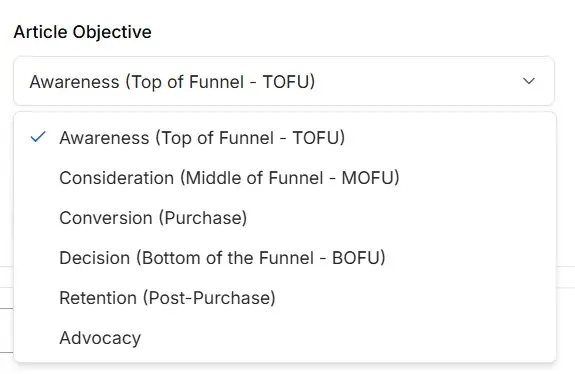
    Then map their journey: awareness (learning SEO basics), consideration (comparing tools like Keywordly vs. Surfer), decision (selecting a workflow), implementation (publishing content), and optimization (scaling what works). Each stage comes with distinct questions and content formats.

    Use this journey map inside Keywordly to cluster topics: how-to guides for awareness, comparison pieces for consideration, and process checklists for implementation. This keeps your topical map tied directly to user intent, not just keyword volume.

    Align topic research with business goals and revenue drivers

    Your blog should move readers toward concrete actions—trials, demos, signups, or purchases. List your key offers (e.g., Keywordly subscriptions, SEO consulting retainers, audits) and reverse-engineer content themes that naturally lead to those outcomes.

    For instance, posts like “How to Build a Topical Map in 60 Minutes” or “Content Brief Templates for Agencies” attract readers who are close to needing a workflow platform. Compare that to chasing high-volume topics like “what is SEO,” which may bring traffic but little qualified demand.

    Use Keywordly’s content planning to tag each topic with a primary business objective—lead gen, free trial, MQL, or retention. Filter out ideas that can’t be linked to any meaningful metric, even if the search volume is tempting.

    Prioritize themes where you can realistically build authority

    Not every topic is worth fighting for, especially against entrenched publishers. Audit where you already have an edge: hands-on experience, proprietary data, or unique workflows. A small agency that’s run 50+ content migrations can credibly own “SEO site migrations” more than “SEO tips” in general.

    Select 3–5 core themes—such as topical mapping, content operations, AI-assisted SEO, eCommerce category SEO, or B2B content strategy—and commit to publishing consistently. Depth across these themes signals authority to Google and systems like ChatGPT, helping your content surface as a trusted source beyond traditional keyword targeting.

    Related Articles:

    Reference: → keyword-clustering-boost-your-seo-content-strategy

    Reference: → seo-content-optimization-tools-comparison

    Reference: Brand Your Blog: A Step-By-Step Guide | by Robyn Roste

    3. Start with Core Topics: Turn Broad Ideas into Structured Topic Clusters

    Brainstorm seed topics from real-world inputs
    topical map subtopics with target keywords

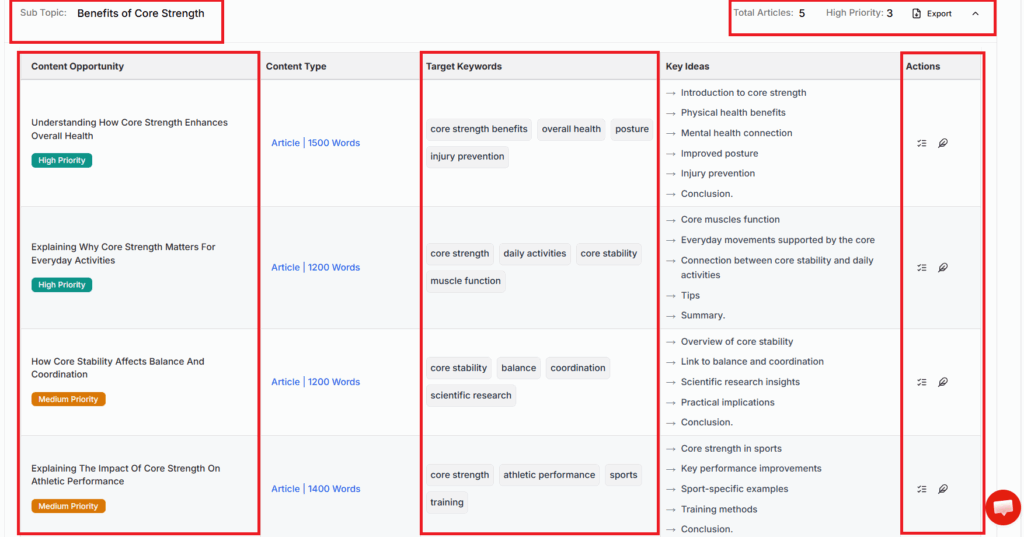
    Strong topic clusters start with clear, real-world inputs—not abstract keyword lists. Begin by mapping seed topics directly to your main products, services, and solutions inside Keywordly so your content plan aligns with revenue, not vanity traffic.

    For example, a B2B SaaS like HubSpot could log seed topics such as “marketing automation,” “sales CRM,” and “email workflows.” You can do the same by pulling recurring themes from customer support tickets, sales call notes, and onboarding surveys, then capturing them as seed topics in your Keywordly workspace.

    Expand your list by reviewing webinar Q&A logs, product demo chat transcripts, social media comments, and competitor FAQ pages. A tool like Zoom or Gong can surface repeated objections, while competitor FAQ pages often reveal baseline education topics your audience still needs.

    “Search engines don’t rank pages in isolation — they evaluate how deeply you cover a subject.”

    Group related ideas into topic clusters and subtopics

    Once you have raw ideas, turn them into structured topic clusters. Start by grouping related concepts under broader parent topics that can become pillar pages—such as “B2B content strategy” or “local SEO for ecommerce.”

    Under each pillar, outline subtopics like how‑tos, comparisons, use cases, and best practices. For example, a pillar on “topic clusters for SEO” might link to posts on internal linking, pillar page structure, and content audits, similar to the structure Semrush outlines in Topic Clusters for SEO: What They Are & How to Create.

    Keywordly’s topical map view helps you visualize this as a hub‑and‑spoke hierarchy, where one core page supports dozens of targeted articles. This reduces duplication and ensures every new piece strengthens an existing cluster.

    Validate core themes using competitor and industry sites

    Before you commit to clusters, validate that people actually care about these themes. Analyze competitor blogs to see where they publish most frequently and which hubs attract the most engagement or backlinks.

    Look for patterns in successful formats—like Ahrefs’ in‑depth guides, Shopify’s step‑by‑step ecommerce playbooks, or case‑study driven posts on industry sites. Cross‑check these angles with what performs well in Semrush’s topic cluster examples to confirm demand.

    In Keywordly, you can tag clusters by format (guide, checklist, case study) and performance metrics, so you double down on themes and content types that consistently move organic traffic and assisted conversions.

    Spot content gaps in existing clusters

    Once clusters are mapped, look for holes across the buyer journey. Many brands over‑optimize for mid‑funnel keywords and ignore beginner explainers or advanced implementation guides, leaving traffic and authority on the table.

    Compare your clusters against competitors: Do they have “What is…?” posts, tool comparisons, and integration tutorials that you lack? Semrush’s breakdown of how to create topic clusters that drive organic traffic is a useful benchmark for spotting missing formats.

    Keywordly’s content planning dashboard flags thin or orphaned topics and surfaces quick‑win ideas—like creating a high‑intent comparison page or expanding a 600‑word post into a full pillar—to help you close gaps faster than manual spreadsheet audits.

    Reference: Topic Clusters for SEO: What They Are & How to Create …

    “The fastest way to uncover topic opportunities isn’t brainstorming — it’s identifying what competitors rank for that you haven’t structured yet.”

    4. Go Beyond Keywords: Find Deep Content Opportunities with Topic Research Tools

    4. Go Beyond Keywords: Find Deep Content Opportunities with Topic Research Tools

    4. Go Beyond Keywords: Find Deep Content Opportunities with Topic Research Tools

    Why “keywords only” is limiting

    Traditional keyword tools show search phrases like “SEO content” or “blog ideas,” but they rarely reveal how those ideas connect into a complete topic. That gap leads to thin, fragmented articles instead of robust content ecosystems that search engines can trust.

    When you only chase individual keywords, you often publish overlapping posts such as “SEO content strategy,” “content SEO tips,” and “SEO blog strategy” that all say nearly the same thing. Google may struggle to understand which URL to rank, diluting your authority. Keywordly’s topical map view helps you see how entities like “content clusters,” “E‑E-A-T,” and “internal linking” relate, so you structure one strong hub with clear supporting pages.

    Use topic research tools to expand themes

    Start with one core theme—say “B2B SaaS SEO”—in a topic tool like Keywordly’s content planner. You’ll uncover related long-tails, People Also Ask questions, and sub-angles such as “SaaS SEO landing pages,” “PLG SEO,” or “demo request optimization.”

    Cluster these into formats the data suggests: how-to guides, templates, definitions, comparisons, and case studies. For example, group “B2B SaaS SEO examples,” “SaaS SEO case study,” and “SaaS organic growth examples” into a case study cluster, then map them in Keywordly so each article supports a single pillar page.

    Mine communities for topic-level insights

    Keyword tools rarely capture the raw language your audience uses. Mining Reddit (r/SEO, r/Entrepreneur), Quora, Slack communities like Traffic Think Tank, or Facebook Groups for content marketers reveals recurring questions and myths that deserve full clusters, not just one-off posts.

    If you see dozens of threads about “Why did my traffic drop after publishing more content?” you can build an entire mini-cluster on content cannibalization. Use Keywordly to tag these ideas as pain points, then turn them into articles, checklists, and troubleshooting guides that mirror the exact phrasing people use in those discussions.

    Distinguish evergreen vs. trend-driven opportunities

    Strong content portfolios balance timeless topics with timely spikes. Evergreen themes like “technical SEO checklist,” “content brief template,” or “how to build a topic cluster” can drive steady traffic for years and should anchor your main Keywordly topical maps and pillar pages.

    Trend-driven topics—such as “Google’s Helpful Content Update impact” or “how to rank in ChatGPT search results”—can earn short bursts of traffic and links. In Keywordly, label topics as Evergreen or Trend, then allocate your calendar (for example, 70% evergreen, 30% reactive) so you protect long-term growth while still capturing news-driven demand.

    “Without a structured topic map, content planning becomes reactive instead of strategic.”

    Related Articles:

    Reference: → reddit-keyword-research-tools

    Reference: → topical-cluster-examples

    Reference: Deep Topic Research & Analysis Tool For Unbeatable …

    5. Use Keywordly’s Topic Planning and Topical Maps to Build an SEO Content Engine

    Transform seed ideas into structured topical maps with Keywordly
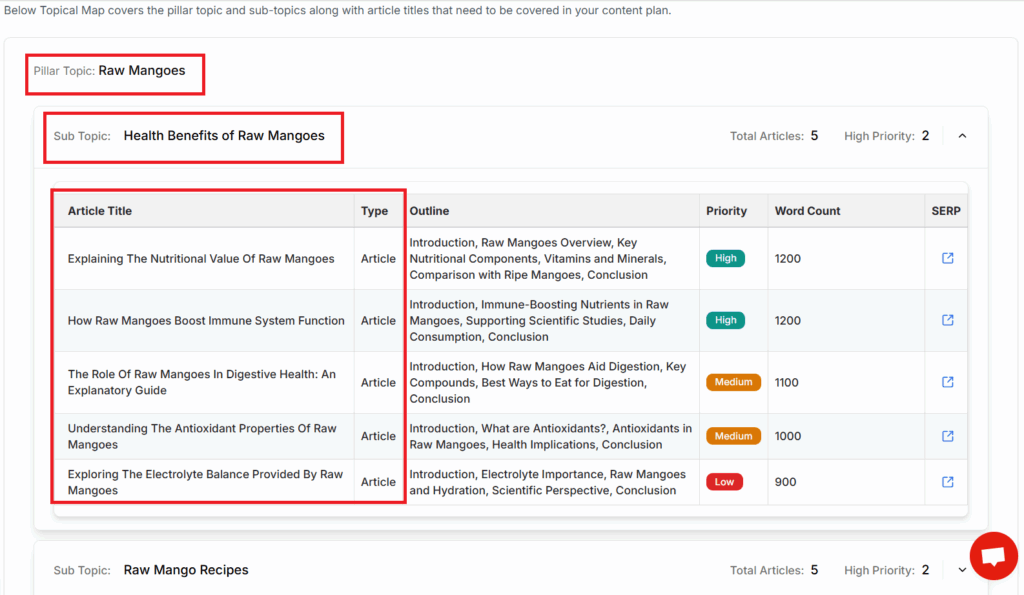
    tropical map
    Keywordly – Topical Map Feature – Generate Pillar topic, Sub topic & Topic titles with Seed Keyword

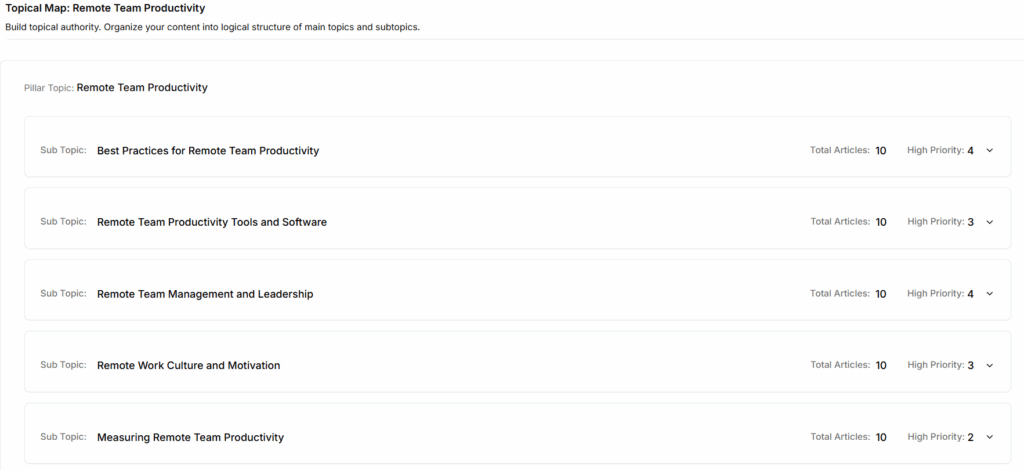
    Strong SEO doesn’t start with keywords; it starts with understanding topics, questions, and problems your audience actually cares about. Keywordly helps you turn loose seed ideas like “creator economy tools” or “B2B SaaS onboarding” into structured topical maps that reveal content opportunities beyond individual keywords.

    Begin by inputting a few seed topics into Keywordly. The platform automatically surfaces related themes, subtopics, and audience questions, then clusters them using its AI engine. For example, a DTC skincare brand might see clusters form around “acne routines,” “ingredient education,” and “dermatologist tips,” each packed with long‑tail opportunities.

    Use Keywordly’s clustering view to generate visual topical maps from your raw ideas. Refine and label each cluster so it reflects your blog’s positioning, like “beginner education,” “product comparisons,” or “advanced technical breakdowns” for a SaaS brand. This makes it easier for content, SEO, and stakeholders to see where to invest effort and where gaps exist.

    Map pillar pages, hubs, and supporting articles
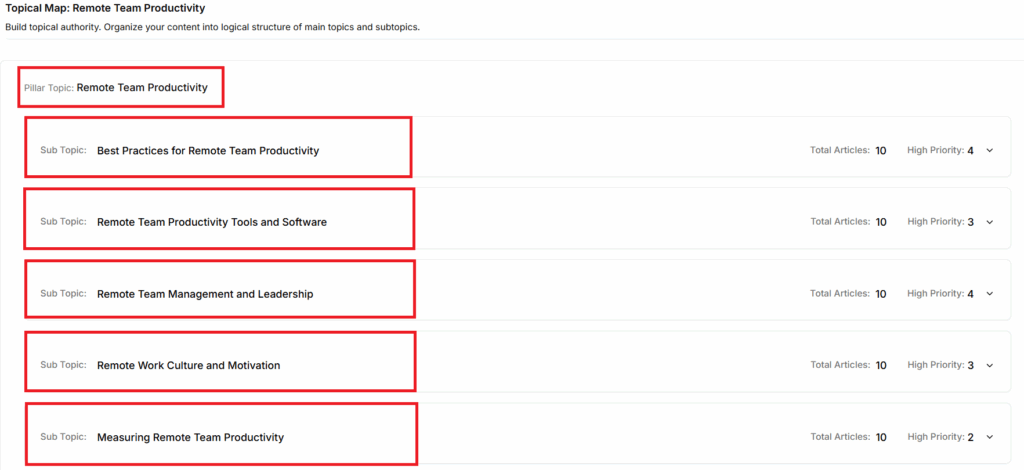
    topical map- pilar & subtopics

    Keywordly – Topical Map Feature – Map pillar pages, hubs, and supporting articles

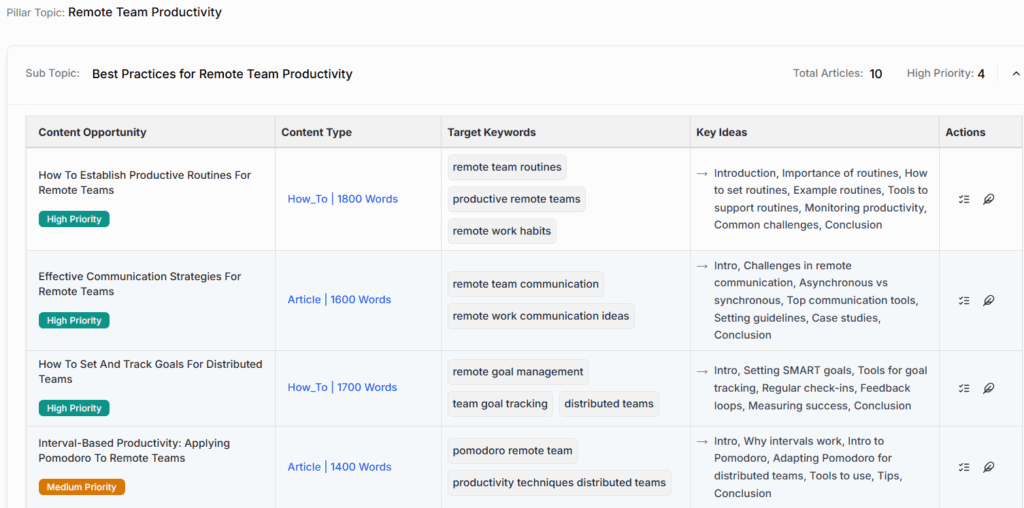
    Once your topical map is clear, you can architect a content structure that search engines understand and users love. Keywordly makes it straightforward to translate abstract clusters into concrete pillar pages, hubs, and supporting articles with clear internal links.

    Designate pillar pages in Keywordly for your highest-value topics—like “email marketing for ecommerce” or “AI content strategy”—and attach in-depth briefs. Then define hub or category pages that connect related clusters, similar to how HubSpot groups “Blogging,” “SEO,” and “Lead Generation” under broader marketing hubs.

    Assign supporting articles to each pillar so each piece has a defined role. For instance, a pillar on “local SEO for dentists” might link to supporting posts on “Google Business Profile setup,” “local citation building,” and “patient review strategies,” creating a clean internal link path that reinforces topical authority.

    Prioritize topics by demand, difficulty, and business impact

    topical map subtopics with target keywords
    Prioritize topics by demand, difficulty, and business impact

    Not every cluster deserves equal attention. Keywordly’s metrics let you weigh search demand, competition, and business value so you focus on topics that can actually move revenue, leads, or sign-ups—not just vanity traffic.

    Use search volume and difficulty metrics to compare clusters like “AI SEO tools” versus “manual keyword research.” Then layer on your own priorities: if you sell an AI SEO platform, a smaller but highly qualified cluster might beat a big, generic one. A common mistake is chasing only high-volume keywords; Keywordly helps you see topic groups where you can realistically win and still align with product fit.

    Build a ranked list inside Keywordly that balances traffic, competition, and commercial intent. For example, prioritize “SEO content workflows for agencies” over broader “SEO tips” if you’re targeting agency retainers, even if the latter has more volume but weaker monetization potential.

    Integrate Keywordly into your ongoing workflow

    To build a true SEO content engine, Keywordly needs to become your operational source of truth—not just a one-off research tool. Treat your topical maps as living assets that evolve as you publish, learn, and see performance data.

    Adopt a simple workflow: 1) plan topics and clusters in Keywordly, 2) create and optimize content from its briefs, 3) publish and track performance, and 4) revisit maps monthly to add new questions, prune underperformers, and expand winning clusters. This helps you uncover content opportunities like emerging queries from Search Console or customer support tickets and fold them back into your map.

    Use Keywordly to align SEO, content marketing, and leadership around the same roadmap. Agencies can share topical maps with clients during strategy reviews, while in‑house teams can use them to justify budget for new content pillars, instead of relying on scattered spreadsheets and one-off keyword lists.

    Reference: Keywordly – SEO Content Workflow Platform & Tools

    “The brands that dominate search don’t publish more — they structure smarter.”

    Read this Article : Topical Clusters Examples: How Leading Sites Organize Content

    Read this Article : What Is Topical Authority? A Must-Know SEO Strategy

    6. Validate, Qualify, and Prioritize Topics with Data

    6. Validate, Qualify, and Prioritize Topics with Data
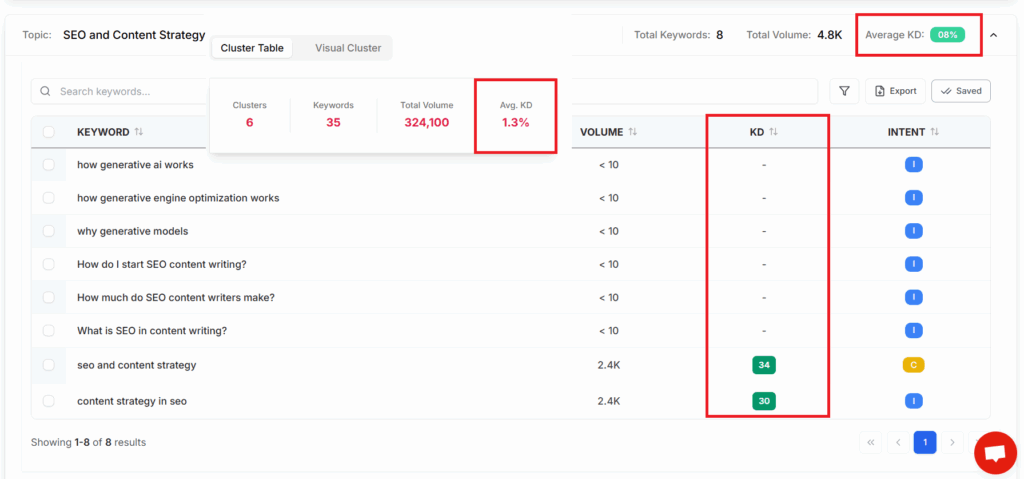
    6. Validate, Qualify, and Prioritize Topics with Data

    keyword difficulty in clustering and topical map

    Evaluate search demand, competition, and intent

    Once you’ve mapped potential topics, validate them with real numbers. Start by checking search volume and trend data in tools like Google Keyword Planner, Ahrefs, or Semrush to confirm each topic has meaningful demand. For example, “headless SEO” may show 2,000–3,000 US monthly searches with a steady 2-year uptrend, making it a stronger bet than a similar term stuck under 100 searches.

    Then review competition on the SERPs. Look at domain authority, content depth, and brand presence of top results. If pages from HubSpot, Shopify, and Moz dominate with 3,000-word guides, you’ll need a differentiated angle or supporting cluster to compete. Finally, verify search intent: if “SEO content template” surfaces mostly downloadable resources, a short opinion article will likely miss the mark and underperform.

    Use SERP analysis to refine angles and formats

    Deep SERP analysis helps you see how Google currently “expects” the topic to be covered. Review the top 5–10 pages for structure, H2s, media types, and content depth. For example, searches for “content brief template” show comparison posts, free templates, and how-to guides, signaling that a hybrid guide-plus-template format works best.

    Look for content gaps: maybe no one addresses AI-assisted briefing or workflow automation. That’s where Keywordly’s content planning and topical maps can surface missing subtopics across clusters, so you can position your piece as the most complete resource instead of another lookalike list post.

    Choose topics for quick wins vs. long-term authority

    Balance your editorial calendar between quick wins and long-term authority plays. Quick wins are lower-difficulty, moderate-demand topics like “SEO content checklist PDF,” where you can outrank weaker blogs within a few months. These posts drive early traffic and prove your strategy to stakeholders.

    At the same time, plan pillar pieces for high-value, competitive themes such as “SaaS content marketing strategy.” Treat these as cornerstone pages supported by multiple cluster posts. Keywordly helps by visualizing topical maps, so you can see which supporting articles to publish first to gradually strengthen your authority around each pillar.

    Related Articles:

    Reference: → keyword-clustering-boost-your-seo-content-strategy

    Reference: → best-ai-keyword-research-tools

    Reference: The 6 Data Quality Dimensions with Examples

    7. Turn Topics into High-Impact Content Briefs and Editorial Calendars

    Translate topics into detailed content briefs

    Once you’ve validated your topics and clusters, the next step is turning them into repeatable, high-impact briefs. Keywordly makes this easier by pulling topic intent, SERP data, and related questions directly into your brief so writers don’t start from a blank page.

    For each topic, define a clear target audience, goal, and primary angle. For example, a brief on “AI content workflows for agencies” might target mid-size agencies (10–50 employees), aim to reduce production time by 30%, and angle around replacing 5 disconnected tools with a single workflow platform like Keywordly.

    Then outline key subtopics, FAQs, and competitor references. You might include headings inspired by top results from HubSpot and Ahrefs, plus SERP-driven requirements like comparison tables or FAQ schema. Add target query families, internal link targets, and notes on E‑E‑A‑T signals (author bio, data sources) directly in the brief.

    Map internal links across topic clusters

    Strong topical authority comes from how your content connects, not just what it covers. Before a single draft is written, plan how each article will link to your pillar page and to related sibling posts within the same cluster.

    For a “topical map SEO” cluster, your pillar might be “SEO Content Workflows,” supported by posts on topical maps, content briefs, and content calendars. In Keywordly, you can visualize these relationships and specify required links in the brief so every writer knows to link “content brief templates” back to the main workflow guide and across to “internal linking strategies.”

    Keep an internal linking plan or diagram in a shared doc or within your content planning tool. This reduces missed opportunities and keeps new content reinforcing existing authority instead of becoming isolated orphan pages.

    “Internal linking is the distribution engine of topical authority.”

    Build a realistic editorial calendar from your pipeline

    Topic research only drives results when it’s translated into a cadence you can sustain. Start by prioritizing briefs based on potential impact and capacity: high-intent, bottom-funnel clusters first, then supporting educational content.

    Build in buffers for editing, design, and optimization. A common mistake is scheduling by publication date only; instead, reverse-plan from publish date to draft, review, and SEO QA milestones so every article fully covers its topic and passes quality checks.

    Collaborate around topics, not just keywords

    High-performing SEO teams align around topics and clusters, not isolated keywords. Share your topical maps and cluster plans with writers, editors, and stakeholders so everyone understands why a piece exists and how it advances your visibility on Google and ChatGPT.

    Use a shared workspace—whether in Notion, Asana, or directly in Keywordly—to centralize briefs, topical maps, and internal linking plans. Invite feedback at the topic level: your sales team might suggest a “content ROI dashboard” article after seeing prospects ask about reporting, which then becomes a supporting piece in your “SEO analytics & reporting” cluster.

    This topic-first collaboration prevents redundant content, uncovers content opportunities beyond obvious keywords, and keeps every new article strengthening a coherent, long-term topical strategy instead of chasing one-off trends.

    Reference: 7 Steps to a More Strategic Editorial Calendar

    8. Measure, Optimize, and Expand Your Topic Coverage Over Time

    Track performance at page, cluster, and topical levels

    Once your topical map is live, you need consistent feedback loops, not guesswork. Track how each article, cluster, and overarching topic performs so you can double down on what actually drives business results, not just clicks.

    In Google Analytics and Search Console, monitor organic traffic, rankings, and on-page engagement (time on page, scroll depth, conversions) for each URL in a cluster. For example, a B2B SaaS blog might see that a single post on “sales playbooks” ranks for 300 queries and drives a 4% demo conversion rate, making it a priority page for ongoing optimization.

    Then, roll metrics up by cluster in Keywordly’s content planning views to see which topic collections are moving the needle. A marketing agency might learn that its “local SEO” cluster brings 40% of organic leads, while “branding” drives traffic but almost no form fills.

    Watch for signs that you’re gaining topical authority: higher average positions across a cluster, more long-tail variations, and rising impressions for related entities. This kind of pattern is what helped Backlinko grow from a few SEO guides into a recognized authority on search marketing.

    Identify underperforming topics and refresh content

    Not every topic will perform as expected, even with a strong topical map. The key is spotting underperformers quickly and deciding whether to fix, merge, or retire them.

    Use Keywordly and Search Console to flag posts that stay stuck beyond page two for 3–6 months or receive very low impressions relative to search volume. At the cluster level, you might find your “AI content tools” group lagging while “content strategy frameworks” surges.

    Diagnose why: Is the content thin compared to HubSpot or Ahrefs? Does it miss intent (e.g., offering a high-level guide when searchers want templates)? Is internal linking weak, or are statistics outdated? Each issue suggests a different fix.

    Then refresh systematically. Add new data points (like 2024 pricing or benchmarks), expand sections that users dwell on, and restructure with clearer H2s and FAQs. Content Refresh case studies from Siege Media show traffic lifts of 50–100% after targeted updates to posts that were previously stuck on page two.

    Use performance data to find adjacent topics

    Performance data often reveals topics you never planned but your audience clearly wants. Instead of focusing only on pre-selected keywords, mine your queries and landing pages for emerging angles and questions.

    In Search Console, filter by a strong-performing page and look at the “Queries” report. You might see that a guide about “email marketing strategy” is unexpectedly driving clicks for terms like “newsletter welcome series examples” or “B2B onboarding email flow.” Those are content opportunities beyond your original keyword list.

    Turn recurring related queries into new subtopics, gated resources, or even fresh clusters. For instance, Buffer noticed sustained interest around “social media content calendar” and eventually built a dedicated cluster and template resources, which now attract thousands of signups per month.

    With Keywordly, you can map these adjacent ideas directly onto your topical map, attaching them to parent clusters so your site structure grows logically instead of chaotically.

    Automate recurring topic research with tools like Keywordly

    Manual research works for a launch, but ongoing topical coverage requires automation. You want a system that continually surfaces new angles, entities, and questions without starting from zero each quarter.

    Set up recurring topic audits inside Keywordly to re-check demand, competition, and content gaps for each major cluster. For a Shopify store blog, this might reveal new long-tail searches around “eco-friendly packaging examples 2025” long before competitors notice.

    Use automation to collect related queries, People Also Ask questions, and entity data around your core topics, then sync these insights into your editorial calendar. This keeps your roadmap aligned with how people actually search and how SERPs evolve.

    Finally, let Keywordly’s topical map view guide prioritization: extend clusters that are winning, prune those that stall, and plan spin-off clusters where interest spikes. Over time, this creates a living, evolving content ecosystem that strengthens both Google and AI search visibility while staying tightly aligned with your business goals.

    Reference: 8 Tips to Measure & Maximize Your Content

    “Topic research turns random blog posts into a scalable content ecosystem.”

    Conclusion: Turn SEO Topic Research into a Repeatable Growth System

    Recap the Shift Toward Strategic SEO Topic Research

    SEO has evolved from chasing one-off keywords to building topic ecosystems that match how people actually research and buy. Instead of creating isolated posts like “best CRM tools,” teams now cover connected angles such as implementation, integrations, pricing comparisons, and use cases to build true topical authority.

    Brands like HubSpot and Ahrefs rank so consistently because they map out entire topic clusters around entities like “content marketing,” “keyword research,” or “technical SEO,” not just single phrases. That breadth and depth makes them more visible in Google, featured snippets, and AI-driven answers in tools like ChatGPT and Gemini.

    Blogs structured around well-planned topical maps are also more resilient to algorithm and SERP feature changes. When one post dips, the cluster still drives impressions and links, giving you a more stable organic growth engine instead of volatile, keyword-by-keyword wins.

    Summarize the Core Steps and Next Actions

    Turning topic research into a system starts with a clear focus and a defined audience. For example, a B2B SaaS analytics tool might choose “marketing analytics for SaaS startups” as its core focus, then interview 5–10 customers to uncover real questions, objections, and decision triggers that go beyond what keyword volumes show.

    From there, cluster related topics, use research tools to validate demand, prioritize by business value, and then execute content in logical sprints. A practical starting point is to build one simple topical map, such as a cluster around “content opportunity discovery,” with pillars on zero-volume keywords, SERP gap analysis, and competitor content audits.

    Track performance in Google Search Console and analytics, then iterate on what works. If you see a cluster driving assisted conversions or strong engagement, expand it with deeper guides, comparison pages, and supporting FAQs until it becomes a self-reinforcing content system.

    Scale with Tools Like Keywordly

    As your library grows, managing topic discovery, clustering, briefs, and optimization manually becomes hard to sustain. Keywordly helps centralize this workflow by combining SEO topic research, content planning, and topical map visualization in one AI-powered platform so you can see exactly where to build next.

    For example, you can use Keywordly to uncover content opportunities beyond keywords by analyzing SERPs, entities, and competitor gaps, then auto-generate a topical map around themes like “local SEO for multi-location retailers.” That map can feed briefs, internal links, and publishing cadence without juggling spreadsheets.

    By running research, planning, drafting, and optimization inside Keywordly, agencies and in-house teams can turn topic research into a repeatable process instead of ad-hoc brainstorming. If you want an end-to-end workflow that supports topic-led SEO—from ideation to publishing and performance feedback—Keywordly is built to make that system achievable and manageable at scale.

    “In competitive niches, topical authority isn’t optional — it’s the differentiator.”

    Read this Article : What Is Semantic Keyword Clustering? A Simple Guide

    Read this Article : SERP Keyword Clustering Tool: How and Why to Use

    FAQs About SEO Topic Research for Your Blog

    What is topic research in SEO, and how is it different from keyword research?

    Topic research looks at the broader subject your audience cares about, not just isolated phrases. Instead of only targeting “best running shoes,” you’d map the whole subject: training plans, injury prevention, shoe lifespan, and surface types.

    Keyword research then refines each node in that map. Keywordly helps you see both the cluster and the specific queries inside it so you’re not guessing what to write next.

    How do I know when a topic is worth creating a full cluster around?

    A topic deserves a cluster when you see multiple related questions and consistent demand. If “email marketing” surfaces queries like “welcome series,” “abandoned cart flows,” and “Klaviyo vs Mailchimp,” you’re looking at a pillar plus many supporting posts, not a one-off article.

    In Keywordly, you can group these ideas under a single pillar page and instantly see search volume, difficulty, and intent. This makes it easier for agencies managing dozens of clients to prioritize clusters that both drive traffic and support revenue, such as “B2B SaaS onboarding emails” for a CRM brand.

    How to find content opportunities beyond keywords (with Keywordly)

    Focusing only on obvious keywords misses gaps where competitors are weak. Look for under-served angles like formats (checklists, calculators), audiences (beginner vs advanced), or stages (post-purchase, churn risk).

    Keywordly’s topical mapping lets you spot these gaps visually. You can see where a cluster has no comparison guides, no case studies, or no “how-to” workflows, then plan those assets. This turns your SEO strategy from chasing single keywords into building a complete, search-friendly resource library around each topic.


  • Topical Clusters Examples: How Leading Sites Organize Content

    Topical Clusters Examples: How Leading Sites Organize Content

    You’ve published dozens of articles, built some backlinks, and watched traffic…flatline. Meanwhile, competing sites with fewer posts outrank you for every valuable keyword. The difference often isn’t volume—it’s how their content is organized around clear topic clusters.

    Understanding what topic clusters are and how leading sites structure them can turn scattered posts into a connected system that builds authority, improves internal linking, and boosts visibility across Google and AI search. You’ll see real topical cluster examples by industry—from SaaS and e-commerce to education, travel, events, and agencies—and how tools like Keywordly’s Topic Clusters generator turn this strategy into a repeatable, scalable workflow that still takes intention and planning to execute well.

    Topical clusters aren’t just how leading sites organize content—they’re how they quietly dominate entire conversations online, and with platforms like Keywordly turning clustering, mapping, and tracking into a single seamless workflow, the gap between random blog posts and strategic search authority has never been wider.

    Reference:

    How to Organize Topic Clusters for SEO: A Complete Guide.

    Introduction

    Why Random Blog Posts Are Dying

    Publishing disconnected blog posts used to be enough to capture long‑tail keywords. That approach struggles now because Google’s Helpful Content and EEAT guidelines prioritize coherent, topic‑driven websites instead of scattered articles that barely relate to each other.

    Sites like HubSpot and NerdWallet win because their content is organized into clear topic areas, not isolated posts. Brands that still push random ideas each month often see impressions without consistent rankings, weak internal linking, and almost no cumulative authority around core business themes.

    What Topical Clusters Are in Modern SEO

    Topic clusters organize content around one core “pillar” page supported by multiple in‑depth, interlinked articles. For example, a pillar on “B2B SEO” might link to supporting pieces on technical audits, link building, and reporting dashboards, all pointing back to the main hub.

    This structure helps Google and AI search systems understand that you cover a subject comprehensively, not superficially. That perceived depth is a key reason why brands like Ahrefs and Moz dominate entire subjects rather than just a handful of keywords.

    The Opportunity with Topic Clusters

    When you build clusters, you aim to own a whole conversation. An event planning company, for instance, can cluster “corporate events” into budgeting, venue selection, run‑of‑show templates, and sponsor packages, capturing dozens of transactional and informational queries around one intent.

    Smart internal links guide users from broad to specific content, improving time on site and conversion paths. This typically leads to stronger organic visibility, higher‑intent traffic, and more demo requests, bookings, or sales from the same content investment.

    What This Article Will Cover

    This article explains what topic clusters are, why they matter for modern SEO, and how they differ from old one‑off blogging habits. You’ll see practical examples tailored to event planners, SaaS platforms, e‑commerce brands, education institutes, travel agencies, and digital marketing agencies.

    You’ll also learn how to build and scale clusters using tools like Keywordly’s Topic Clusters generator, turning your site into a one‑stop solution for your audience’s content needs while tracking visibility across Google and AI‑powered search.

    1. What Are Topic Clusters and Why They Matter for Modern SEO

    Definition of Topic Clusters in SEO

    Topic clusters are an SEO framework where you build one central, comprehensive page and then support it with multiple, narrower articles. Instead of publishing isolated posts, you create a connected ecosystem around a core theme so search engines can clearly understand what you’re an authority on.

    The pillar page is that central hub. For example, a SaaS analytics brand might publish a 4,000-word guide on “Marketing Analytics” covering definitions, tools, dashboards, and reporting. This page targets the broad core topic and becomes the main destination you want ranking for competitive terms.

    Cluster content surrounds the pillar with focused articles like “Google Analytics 4 Event Tracking Tutorial,” “How HubSpot Reports Tie to Revenue,” or “Marketing Attribution Models Explained.” Each post answers specific questions, use cases, or long‑tail searches and links back to the pillar.

    Internal links are the glue. Every cluster page links to the pillar, and the pillar links out to each cluster, forming a unified topic web. As outlined in The complete guide to topic clusters and pillar pages for SEO, this structure helps Google interpret your content as one cohesive resource rather than disconnected articles.

    How Topic Clusters Build Topical Authority

    Topical authority comes from covering a subject in depth from multiple angles. When Google sees 15–30 interlinked pages around “event planning software” or “B2B SEO strategy,” it’s easier to trust your site as an expert than if you only have a single post. This depth signals that your content can reliably answer a wide range of related questions.

    This approach matters even more as AI‑powered search and answer engines summarize results directly on the SERP. Systems like Google’s AI Overviews favor domains that demonstrate clear coverage of a topic, not just one well‑optimized page. A strong cluster increases your odds of being cited or used as a source for these AI‑generated answers.

    Clusters also expand your visibility for long‑tail and semantic queries. A travel agency with a pillar on “Italy Travel Guide” and clusters like “7‑Day Tuscany Itinerary,” “Budget Travel in Rome Under $100/Day,” and “Family-Friendly Hotels in Florence” can rank for hundreds of related searches, collectively driving far more traffic than a single generic guide ever could.

    Topic Clusters vs Traditional Keyword Lists and Silos

    Traditional SEO often started with a big spreadsheet of keywords and one page per term. That method treats each keyword as a separate battle, which leads to thin, repetitive content and cannibalization. Topic clusters flip the model by grouping related keywords under a shared theme and distributing them strategically across pillar and cluster pages.

    Classic silo structures were hierarchical and rigid: “/blog/seo/on-page/” with minimal lateral linking between posts. Clusters are more user‑journey oriented. A prospect researching “email marketing automation” might jump between pricing, templates, integrations, and ROI; your internal links should mirror that behavior rather than forcing a strict path.

    Instead of chasing volume alone, clusters prioritize search intent, depth, and interconnected experiences. A digital marketing agency, for instance, may build a “Local SEO” cluster around intents like “learn,” “compare,” and “hire,” ensuring that educational guides, case studies, and service pages all connect. This structure turns your site into a navigable knowledge hub rather than a pile of disconnected articles.

    Where Tools Like Keywordly Fit In

    Building effective clusters at scale requires smart research and planning. Keywordly helps you group thousands of related keywords into logical topic clusters automatically, so you can see that terms like “virtual event planning,” “Zoom conference checklist,” and “hybrid event run‑of‑show” should all support a single event-planning pillar.

    Within Keywordly, you can map each cluster to specific pillar and supporting pages, creating a visual content blueprint before writing a single article. This is especially useful for SaaS companies or e‑commerce brands managing hundreds of SKUs or features, where manual mapping becomes unmanageable.

    Once live, Keywordly’s AI‑driven tracking lets you monitor performance by cluster instead of just by individual keyword. When you see that your “online courses” cluster for an education institute is earning impressions but low clicks, you can refine titles, add new lessons, or expand FAQs to strengthen topical authority over time and stay competitive across both Google and AI‑powered search engines.

    “Topical authority isn’t built by publishing more content — it’s built by publishing strategically connected content.”

    2. Core Components of an Effective Topic Cluster Strategy

    2. Core Components of an Effective Topic Cluster Strategy

    2. Core Components of an Effective Topic Cluster Strategy

    Pillar Page Best Practices

    topical map- pilar & subtopics

    A strong topic cluster starts with a pillar page that acts as the central hub for everything related to a core theme. For Keywordly users, this might be a “Complete Guide to Topic Clusters” that links to subpages on research, mapping, internal links, and measurement.

    Effective pillar pages are comprehensive (often 2,500–5,000 words), clearly structured with H2/H3 sections, and supported by intuitive UX elements like sticky tables of contents, jump links, and clear CTAs. HubSpot’s “What is SEO?” guide is a classic example: it covers concepts broadly, then hands off depth to cluster articles.

    Supporting Cluster Content

    cluster mapping

    Cluster articles drill into specific subtopics, long‑tail queries, and real questions. An event planning company might build posts like “How to Plan a Corporate Retreat for 100+ Attendees” or “Wedding Budget Checklist for Under $20,000,” each mapped to a clear primary intent.

    Each piece should target informational, commercial, or transactional intent explicitly, address a defined pain point, and add original insight or data. For a SaaS brand, a post on “Salesforce Integration Best Practices” can include screenshots, workflow diagrams, and benchmarks from tools like Zapier to stand out.

    Internal Linking and Anchor Text Strategy

    Internal links turn isolated pages into a coherent cluster. Every supporting article should link back to the pillar using descriptive anchors like “SEO topic cluster strategy” rather than generic “click here,” and cross-link to closely related cluster pieces.

    An e‑commerce site selling running shoes might link from “Best Trail Running Shoes for 2026” to its pillar “Running Shoes Buyer’s Guide,” while also connecting to “Trail vs Road Running: Injury Risk Data.” This structure helps users navigate naturally and signals topical depth to search engines.

    Governance and Ongoing Optimization

    Clusters are living systems that need governance. Quarterly content audits in Keywordly can reveal outdated stats, thin pages, and overlapping posts targeting the same keyword, especially for education institutes or travel agencies with seasonal content.

    Prune or consolidate low‑value pages, merge cannibalizing articles, and expand high‑performing posts with new queries from Keywordly’s Topic Clusters generator. A digital marketing agency managing dozens of clients can standardize this process, ensuring each cluster remains current, authoritative, and tightly focused on revenue-driving topics.

    Reference:

    Topic Cluster and Pillar Page SEO Guide [Free Template]

    3. How Leading Sites Organize Content into Topical Clusters

    Common Topic Cluster Patterns

    High-performing SEO sites rely on clear cluster patterns to build topical authority and simplify navigation. The most common is the hub-and-spoke model, where a comprehensive hub page targets a broad, high-intent keyword and links to focused, long-tail articles.

    For example, HubSpot’s “Content Marketing” hub links to spokes on content audits, calendars, and distribution. Keywordly lets you map this structure visually, then generate briefs for each spoke so every article reinforces the same core topic.

    Leading brands also build content hubs grouped by lifecycle stage or audience segment, such as “Beginner SEO,” “Advanced Technical SEO,” and “Agency Operations.” Resource libraries go deeper, combining guides, templates, tools, and FAQs under one topical umbrella so users never leave the cluster to get what they need.

    Real-World Topical Cluster Examples

    Brands that dominate SERPs usually organize around customer problems, not just keywords. Ahrefs structures a cluster around “link building,” with tutorials, case studies, and tool comparisons interlinked. As highlighted in Content Cluster Examples: 5 Real-World Case Studies, this depth signals strong topical authority to search engines.

    B2B SaaS companies like Notion create clusters for “project management,” “knowledge base,” and “personal productivity,” each with use cases, templates, and onboarding guides. B2C brands such as REI use similar principles for hiking, camping, and climbing, but emphasize shopping guides and gear comparisons.
    Ecommerce and education sites mirror this approach with clusters for product categories or degree paths, while agencies build clusters around services like SEO, PPC, or event marketing.

    On-Page Elements That Support Clusters

    Leading sites reinforce clusters through deliberate navigation. Persistent mega menus expose hub categories, while contextual in-article links guide readers to related spokes. Clear CTAs like “See all guides on technical SEO” keep users inside the same topic family.

    Breadcrumbs strengthen hierarchy (e.g., Home > SEO > Technical SEO > Log File Analysis) and improve UX on large libraries. Schema markup, category pages, and dedicated hub pages give search engines explicit signals about how topics relate, helping clusters from Keywordly’s Topic Clusters generator get crawled, understood, and surfaced more consistently.

    Measuring Cluster Performance

    Top teams measure performance at the cluster level, not just by URL. They group pages by hub topic in analytics tools, then track combined traffic, rankings, and engagement metrics such as time on page and depth of visit.

    They also monitor assisted conversions and revenue influenced by each cluster—critical for B2B funnels where multiple pages contribute to a deal. Insight into which clusters drive leads or sales informs where to expand, refresh, or retire content. Keywordly’s unified tracking helps you compare clusters side by side and double down on the topics compounding the most organic growth.

    Reference:

    Mastering Content Clusters to Build Topical Authority

    4. Topic Cluster Example for an Event Planning Company

    4. Topic Cluster Example for an Event Planning Company

    4. Topic Cluster Example for an Event Planning Company

    Pillar Topic and Sub-Pillars

    An event planning company can anchor its SEO strategy around a comprehensive pillar page like “Complete Event Planning Guide: From Idea to Execution.” This guide walks users through discovery, budgeting, timelines, vendor management, and post-event follow-up in a structured, educational way.

    From there, create sub-pillars for “Wedding Planning Guide,” “Corporate Event Planning Guide,” and “Nonprofit Fundraising Event Guide.” Each sub-pillar becomes a hub linking to niche topics, similar to how The Knot structures its wedding advice or how Eventbrite organizes event management resources.

    Supporting Cluster Content Ideas

    Each sub-pillar should be surrounded by detailed cluster content that answers specific questions. For example, publish “Wedding Budget Breakdown: How to Plan a $25,000 Ceremony in Chicago” or “Corporate Retreat Cost Guide: Sample Budgets for Teams of 20–100.”

    You can also build timelines like “12-Month Wedding Planning Checklist” and “8-Week Corporate Product Launch Timeline,” plus templates in Google Sheets. Add how-to guides on choosing caterers, comparing venues, or evaluating AV vendors, referencing real platforms like Cvent, Peerspace, and Tripleseat.

    Internal Linking and User Journeys

    To capture both local and national traffic, separate content such as “Best Wedding Venues in Austin Under $10,000” from broad guides like “How to Compare Wedding Venues.” Local pages should highlight service areas and link back to evergreen education content.

    Use clear internal paths: a user lands on “Austin rooftop wedding venues,” clicks into your “Austin Wedding Planning Guide,” and is then guided to a “Work With Our Austin Event Planners” page. Keywordly’s topic cluster generator can help map and connect these journeys at scale.

    Converting Traffic into Event Leads

    Once visitors trust your guidance, guide them toward action with on-page calls to “Get a Custom Event Budget in 24 Hours” or “Book a 20-Minute Planning Call.” Place these CTAs within and at the end of your pillar and high-intent cluster articles.

    Offer downloadable wedding checklists, gala run-of-show templates, or event budget calculators as gated content. Short embedded forms beside pricing sections or venue comparison tables capture leads at the exact moment users are considering hiring an event planner.


    5. Topic Cluster Example for SaaS Companies

    Pillar Topic: Complete Buyer’s Guide

    A strong SaaS cluster often starts with a buyer’s guide pillar page that answers every major question prospects have before booking a demo. For a CRM brand, this could be a long-form page titled “CRM Software: Complete Buyer’s Guide for Growing Sales Teams.”

    This guide should compare solutions like HubSpot, Pipedrive, and Salesforce, explain pricing tiers, and outline implementation steps. Treat it as a neutral, educational resource so it can rank for broad discovery keywords and become link-worthy for partners and industry blogs.

    Cluster Content Around Use Cases and ROI

    Once the pillar exists, build supporting articles around specific use cases, verticals, and ROI stories. For example, a B2B SaaS analytics tool could publish “How a 20-Person SDR Team Increased SQLs by 32% Using Real-Time Dashboards.”

    Complement that with onboarding and change management guides, plus integration content such as “Connecting Our CRM with Slack, ZoomInfo, and Google Workspace.” These pieces help buyers visualize adoption, reduce perceived risk, and justify budget requests with concrete numbers.

    Balancing Product-Led and Problem-Focused Content

    A healthy SaaS topic cluster mixes non-branded education with subtle product-led content. Publish problem-first posts like “How to Reduce SaaS Churn Below 5% Annually” that reference your product only where it genuinely fits.

    Then create higher-intent pages—feature breakdowns, demo walk-throughs, comparison pages—that users can flow into. Internal links from problem-focused guides to these deeper product pages help capture demand without turning every article into a hard pitch.

    Using Keywordly to Uncover SaaS Content Gaps

    Keywordly’s Topic Clusters generator helps SaaS teams reveal missing content for each stage of the buyer journey. You can surface overlooked intents like “SOC 2 compliant CRM,” “Salesforce alternative for nonprofits,” or “SaaS onboarding checklist for remote teams.”

    Map all existing and new assets into clusters inside Keywordly so you can see which personas, industries, or integrations lack coverage. This makes your SaaS content hub a one-stop solution for research, evaluation, and implementation questions.

    “A strong pillar page answers the broad question — but it’s the supporting cluster pages that signal depth to search engines.”

    Read this Article : How to Master SEO Topic Research for Your Blog

    Read this Article : What Is Semantic Keyword Clustering? A Simple Guide

    6. Topic Cluster Example for an E‑Commerce Business

    6. Topic Cluster Example for an E‑Commerce Business

    6. Topic Cluster Example for an E‑Commerce Business

    Pillar Topic: Ultimate Buying Guide

    For an e‑commerce store, a pillar guide acts as the central education hub that supports all category and product pages. Think of what Zappos does with its in‑depth running shoe education pages that explain cushioning, pronation, and terrain.

    For a footwear store, create a “Running Shoes Buying Guide” pillar for men, women, and trail runners. Cover types of shoes, pronation, arch support, heel‑to‑toe drop, and how different foams compare in durability and energy return.

    Align the guide with both informational and commercial intent. Someone searching “best running shoes for flat feet” should discover advice, brand comparisons like Brooks vs ASICS, and clear pathways into category pages filtered for stability shoes and top‑rated models.

    Supporting Cluster Content Examples

    Supporting articles deepen the cluster and target long‑tail queries. Comparison posts such as “Nike Pegasus vs adidas Ultraboost: Which Is Better for Daily Training?” help shoppers choose between specific models while capturing high‑intent search volume.

    Size and fit guides reduce returns by clarifying how brands fit differently. For example, note that Nike often runs narrow while New Balance offers 2E and 4E widths, and show conversion charts between US, EU, and UK sizes.

    Add care guides like “How to Make Your Running Shoes Last 400+ Miles,” seasonal pieces such as “Best Waterproof Running Shoes for Boston Winters,” and troubleshooting FAQs addressing heel slippage, blisters, and arch pain.

    Structuring Collections and Content into a Hub

    To turn this into a true hub, connect your category structure with your content. On the main “Running Shoes” category page, feature tiles for the buying guide, size guide, and comparison content above the product grid.

    Create a resource center—“Running Knowledge Hub”—where all guides are grouped by topic: choosing shoes, fit and sizing, care, and performance. Retailers like REI organize education this way, driving both engagement and assisted revenue.

    From each guide, make it effortless to jump into filtered listing pages such as “Neutral Shoes Under $150” or “Best Marathon Shoes.” This tight UX loop keeps users learning and shopping within the same journey.

    Linking Informational and Transactional Pages

    Internal linking is what turns isolated articles into a high‑performing cluster. Within buying guides, add contextual product blocks such as “Top 5 Stability Shoes” that deep‑link to relevant PDPs with UTM tags for attribution.

    On product pages, link back to supporting content like “Find Your Running Shoe Type” and the brand‑specific size guide to increase confidence and reduce cart abandonment. ASOS and Nordstrom both use this pattern for complex sizing categories.

    Monitor revenue, conversion rate, and assisted conversions at the cluster level in GA4 or Looker Studio. Keywordly’s Topic Clusters generator can help you design similar hubs across categories, then track which clusters drive the most organic and AI‑search visibility.

    7. Topic Cluster Example for an Education Institute

    Pillar Topics for Educational Sites

    Education institutes can use a strong pillar page to organize every program, degree, and course into a single, navigable hub. A “Programs and Courses” pillar might group bachelor’s, master’s, online, and certificate options the way Arizona State University structures its program finder, letting users filter by subject, delivery mode, and duration.

    Another pillar angle is decision support, such as “How to Choose the Right Data Science Degree.” This guide can compare bootcamps, four-year degrees, and online master’s programs with salary ranges from sources like the Bureau of Labor Statistics, clarifying which route suits career changers versus recent high school graduates.

    Effective pillars must address early research questions: admission difficulty, costs, time to completion, and job prospects. Use Keywordly to surface questions like “is an MBA worth it at 35” or “coding bootcamp vs CS degree” and weave them into detailed FAQs, comparison tables, and internal links to deeper cluster pages.

    Cluster Content for Prospective Students

    Once the pillar is live, build cluster content around concrete admission journeys. Create guides such as “How to Apply to the Fall 2026 Computer Science BS at NYU” with sections on SAT/ACT expectations, GPA ranges, portfolio requirements, and exact dates pulled from the admissions calendar, then interlink it back to the pillar.

    Funding content is critical. Develop pages on “Scholarships for First-Generation Students” or “Financial Aid for Part-Time RN-to-BSN Programs,” including Pell Grant ranges, institutional scholarships, and work-study examples. Link to FAFSA resources and calculators that estimate monthly loan payments to make costs more tangible.

    Career and lifestyle content rounds out the cluster. Publish alumni success profiles like “How a Community College Cybersecurity Grad Landed a $85,000 Role at Cisco,” plus campus life articles that highlight clubs, dorm options, and mental health services, mirroring the depth seen on sites like UCLA or Michigan.

    Local and International SEO Considerations

    Education searches are heavily location-driven, so create geo-focused pages such as “Nursing Programs in Chicago with Clinical Placements at Northwestern Medicine.” Describe commuting options, public transit passes, and local employer partnerships, then connect these pages to the main programs pillar for strong internal linking.

    For international recruitment, build content on visas, accommodation, and cultural support. An article like “Study Computer Science in the U.S. from India” can outline F-1 visa timelines, typical I-20 processing periods, on-campus work limits, and sample monthly housing costs in cities like Boston or Austin.

    Target key markets with language and country-specific pages: Spanish content for Mexican applicants or Portuguese content for Brazilian students, for example. Optimize meta titles with city and country modifiers, and use hreflang tags so Google serves the right version to users in Madrid versus Miami.

    Using Keywordly to Map the Student Journey

    Keywordly helps map queries from curiosity to enrollment. At the awareness stage, uncover searches like “what can you do with a psychology degree” and assign them to broad guides. At consideration, track phrases such as “online MBA with GMAT waiver,” then craft comparison posts and program highlight pages that address those needs.

    Use Keywordly’s clustering and topical mapping features to connect each keyword to the correct pillar or cluster asset. For decision-stage queries like “apply to Johns Hopkins MPH deadline,” build deadline-focused landing pages and application checklists that link to your main “Programs and Courses” pillar.

    As you launch new formats—micro-credentials, short online courses, or hybrid MBAs—revisit clusters inside Keywordly. Add new subtopics, merge overlapping articles, and monitor visibility trends across Google and AI-driven search so your content stays aligned with real student behavior over time.

    Reference:

    10 Topic Cluster Examples To Learn From

    8. Topic Cluster Example for a Digital Marketing Agency

    “Search engines reward comprehensive topic coverage, not isolated keyword wins.”

    Pillar Topics for Agency Services

    A digital marketing agency can anchor its content strategy around a few core service pillars that mirror how clients actually buy. Instead of scattered blogs, each pillar becomes a structured hub that connects strategy, execution, and measurable outcomes.

    One approach is a broad pillar like “Digital Marketing Services”, summarizing your integrated offering, methodology, and industries served. Another is splitting into dedicated pillars for SEO Services, PPC Management, Social Media Marketing, and Content Marketing, similar to how Disruptive Advertising and WebFX structure their service pages.

    Each pillar should clarify your approach, success metrics, and ideal client profile. For example, your SEO pillar might highlight technical audits, content strategy, and link acquisition for B2B SaaS firms with $50k+ monthly ad spend, while your social media pillar targets e-commerce brands focused on Meta and TikTok performance.

    Cluster Content Ideas for Agencies

    Once pillars are defined, clusters deepen each topic with proof and process. Case studies work well here; for instance, a detailed breakdown of how you helped a Shopify retailer increase organic revenue by 78% in six months, similar to the performance stories shared by KlientBoost.

    Support these with pricing explainers (“How Our PPC Management Pricing Works”), step-by-step process pages, and engagement models like retainers vs. project-based work. You can also offer strategy guides, SEO audit checklists, content briefs, and tool stacks featuring platforms such as Keywordly, Google Search Console, and Ahrefs.

    Each cluster piece should link back to its pillar page and other related resources, forming a tight internal network that helps prospects self-qualify and understand how you work before they ever book a call.

    Demonstrating Expertise and Thought Leadership

    Agencies need content that proves they can execute, not just repeat best practices. Deep, tactical posts like “How We Recovered a Site After a Google Core Update” or “Our Exact Bidding Strategy for Google Ads in High-CPA Niches” show real expertise and decision-making.

    Use current examples, such as unpacking the impact of recent Google core updates or Meta Ads changes, with annotated screenshots and data trends. Many leading agencies reference real client dashboards (anonymized) to illustrate how they adjusted budgets or targeting in response to performance shifts.

    Close the loop by explaining how your agency operationalizes these insights for clients: your testing cadence, reporting framework, and how platforms like Keywordly help you track topical authority across search and AI over time.

    Aligning Clusters with B2B Lead Generation

    For B2B agencies, every topic cluster should map cleanly to a revenue-generating offer. High-intent articles—like “SEO Agency Pricing for Manufacturing Companies” or “PPC Audit Checklist for B2B SaaS”—should lead directly to corresponding service pages or audit offers.

    Use context-rich CTAs such as “Request a 30-Minute SEO Strategy Call” or “Get a Free Google Ads Audit” embedded after value-dense sections, not just at the bottom. For decision-makers and budget owners, publish C-suite focused content such as “How to Evaluate an SEO Agency” or “Forecasting ROI from Content Marketing.”

    Pair this with lead-qualifying forms that ask about monthly revenue, ad spend, and internal marketing resources. Then analyze which clusters bring in the highest-value leads using analytics layered with Keywordly’s topic cluster performance data.

    Reference:

    8 Best Topic Cluster Examples to Plan Your Content

    “Without structure, content becomes noise. With structure, it becomes authority.”

    9. Topic Cluster Examples for a Travel Agency

    Core Pillar Topics for Travel Brands

    Travel agencies can anchor their SEO strategy on a few robust pillar pages that answer end-to-end questions about a destination or trip style. These pages become the main hubs that internal links, ads, and social campaigns point to, helping Google understand your topical authority.

    For example, a New York–based agency could build “Complete Guide to Italy Travel 2025” as a 4,000-word pillar covering visas, costs, must‑see cities, and sample routes, then branch out to supporting articles on Rome, Florence, and the Amalfi Coast. Similar pillars can target themes like “Family Travel Guide to Europe” or “Backpacking South America on a Budget.”

    You can also cluster pillars by traveler type or trip style: “Luxury Honeymoons in the Maldives,” “Solo Female Travel in Southeast Asia,” or “7‑Day Adventure Trips in Costa Rica.” Each pillar should be broad enough to host 15–30 internal cluster articles that Keywordly’s Topic Clusters generator surfaces from destination-focused keyword groups.

    Supporting Travel Cluster Content

    Once pillars are in place, cluster content fills in specific questions travelers actually search before booking. Detailed itineraries perform well, such as “10-Day Japan Itinerary Under $3,000” or “4-Day Vegas Weekend for Bachelorette Parties,” each linked back to a broader Japan or USA travel pillar.

    Supplement those with pages on “Best Time to Visit Bali by Month,” “Paris Weather by Season,” or “Thailand Peak vs Off‑Peak Travel Costs,” using data from sources like Skyscanner or Google Flights trend insights. These pages often capture long‑tail, high‑intent queries that lead to consultation or quote requests.

    Deep-dive guides on topics like “How to Use Japan Rail Pass,” “Dubai Transit and Metro Guide,” “How to Avoid Tourist Scams in Barcelona,” or “Cultural Etiquette in Morocco” answer anxiety-driven searches. Internally linking them to relevant itineraries and destination pillars signals complete topical coverage.

    Multi-Language and Multi-Region Strategy

    Travel interest is highly regional and seasonal, so international SEO structure matters. A U.S. agency targeting Spanish-speaking customers could localize core pillars into Spanish and host them under /es/, like /es/viajes-a-italia, while maintaining English under /en/ to keep geo-targeting clear.

    Use Keywordly’s clustering to research region-specific queries, such as “viajes baratos a Cancún desde Los Ángeles” versus “cheap flights to Cancun from NYC,” then create separate pages optimized for each origin market. This avoids keyword cannibalization while matching local search behavior.

    To prevent duplication, keep one master English pillar and create localized variants only where intent and SERPs differ meaningfully. For instance, a “Winter Trips to Iceland” page might be adjusted for UK vs US audiences based on typical holiday dates and flight availability, while still sharing a consistent URL structure and internal link pattern.

    Scaling Travel Content with Keywordly

    As a travel agency expands destinations, manual topic mapping becomes hard to manage. Keywordly’s Topic Clusters generator lets you drop in a seed term like “Costa Rica adventure travel” and instantly see cluster ideas for rafting, canopy tours, volcano treks, and family-friendly activities.

    You can then roll out structured clusters: one for eco‑travel (Monteverde cloud forest, Corcovado National Park, sustainable lodges), another for digital nomads (long‑stay visas, Wi‑Fi cafés in San José, living costs), each mapped to specific funnels like inquiries or on-site quote forms.

    By integrating Keywordly’s tracking, you can monitor which clusters push the most inquiries and bookings—for example, noticing that pages around “Costa Rica 7-Day Adventure Package” convert at 4–5% while generic “Things to Do in Costa Rica” posts bring traffic but fewer leads—and then prioritize similar high-intent clusters across new regions.

    Reference:

    9 content marketing ideas for travel companies

    10. Using Keywordly to Build and Scale Topic Clusters at Speed

    From Seed Keyword to Mapped Cluster

    Topic clusters help you own an entire theme instead of chasing isolated keywords. With Keywordly’s Topic Clusters generator, you can turn a simple idea like “event planning software” or “B2B SEO strategy” into a mapped network of pillar and supporting pages in minutes.

    Start by dropping a seed keyword or topic into the generator. Keywordly then analyzes related queries, search intent, and semantic relationships to propose a central pillar page plus tightly related subtopics. For example, a travel agency targeting “Italy travel guide” could instantly get clusters like “Italy itinerary 7 days,” “best time to visit Italy,” and “Italy travel budget.”

    Once the draft cluster is ready, you review, refine, and approve. You might prioritize “wedding planning checklist” over lower-intent topics if you run an event planning company focused on high-ticket packages. This ensures the cluster map reflects real business goals, not just search volume.

    Unified Workflow for Research and Briefs

    Most SEO teams juggle multiple tools for keyword research, topical mapping, and briefing writers. Keywordly brings these steps into a single workflow so your topic clusters move smoothly from strategy to content production.

    For each cluster, Keywordly lets you connect the keyword research directly to content planning. A SaaS company targeting “CRM for small business” can see all subtopics—pricing, integrations, onboarding, comparisons—and turn them into briefs with one click.

    These briefs include primary and secondary keywords, suggested headings, intent notes, and internal link targets. A digital marketing agency managing 20 clients can enforce consistent depth, structure, and on-page optimization standards across every article without rebuilding processes in spreadsheets.

    Automating Content Generation and Optimization

    Scaling topic clusters often stalls at the writing stage. Keywordly’s AI-assisted drafting helps you produce first drafts and optimize them against your cluster’s keyword set so no key angle is missed.

    For an e-commerce brand targeting “running shoes,” Keywordly can propose H2/H3 structures like “best running shoes for flat feet” or “trail vs road running shoes,” along with semantic terms such as “heel-to-toe drop” and “pronation control.” This keeps every article aligned with searcher language.

    On-page recommendations cover headings, internal links back to the pillar page, and formatting standards. An education institute publishing a “data science degree guide” hub can standardize tone, reading level, and CTAs across dozens of pages, creating a cohesive experience that feels like one curated resource.

    Tracking Topical Authority and Visibility

    Winning with topic clusters is about owning the whole theme, not just one keyword. Keywordly tracks performance at the cluster level, helping you see how your content hub performs across Google and AI-powered search experiences.

    You can monitor rankings, impressions, and traffic for an entire “content marketing strategy” cluster and compare it to a “PPC advertising” cluster for your digital marketing agency. If you notice that long-tail posts like “content brief template” are driving assisted conversions, you know where to expand.

    Travel agencies, SaaS platforms, and event planners can use these insights to decide which clusters to refresh, which to replicate in new niches, and where internal links are boosting topical authority. Over time, this turns Keywordly into a one-stop solution to plan, produce, and measure high-impact topic clusters at scale.

    Reference:

    Maximize Your SEO Potential with These 10 Essential …

    Conclusion: Key Takeaways from These Topical Clusters Examples

    Main Lessons from the 10 Topic Cluster Examples

    “Most failed clusters don’t lack content — they lack connection.”

    Across SaaS platforms, e-commerce stores, event planners, and travel agencies, the clearest pattern is that structured topic clusters consistently outperform scattered posts. Brands like HubSpot and Shopify have shown that a single, authoritative pillar page supported by 15–30 tightly focused cluster articles can drive exponential gains in rankings, traffic, and demo signups.

    The same structure works for an event planning company, an education institute, or a digital marketing agency. A pillar such as “Corporate Event Planning Guide” or “Online MBA Guide” becomes the hub, while detailed posts on budgeting, timelines, tools, and vendors form the spokes, all interlinked with intent-based anchor text.

    Why Organized Content Hubs Win

    Organized content hubs give users a logical way to move from broad information to tactical answers. For example, a travel agency can build a “Thailand Travel Guide” hub with clusters on visas, costs, 7‑day itineraries, and best islands, helping visitors plan trips without bouncing back to Google.

    Search engines reward this depth and structure. HubSpot has reported that its topic cluster strategy contributed to double-digit organic growth by consolidating thin posts into coherent hubs. Content hubs also let agencies and SaaS teams clearly see which clusters generate trials, calls, or course enrollments.

    Keywordly as a Central Content Solution

    Managing these hubs manually across dozens of event planning, SaaS, e-commerce, and education topics becomes inefficient as sites scale. Keywordly acts as a one-stop solution to research keywords, group them into clusters, generate briefs, and optimize live content in a single workspace.

    Using the Topic Clusters generator by Keywordly, a digital marketing agency can map an entire “Local SEO” hub in minutes, then track how each cluster performs across Google and AI-powered search engines. This reduces guesswork, shortens production cycles, and keeps clusters aligned with real search demand.

    Next Steps to Implement Topic Clusters

    The most effective starting point is a structured audit. Identify pages that could become pillars for key lines of business—such as “Event Planning Services,” “B2B SaaS Pricing Models,” “E-commerce SEO Guide,” or “Study Abroad Programs”—and flag thin or overlapping posts to either merge or reposition as cluster content.

    From there, choose one priority cluster tied directly to revenue, like “Shopify SEO” for an e-commerce-focused agency or “Virtual Event Planning” for a hybrid event company. Use Keywordly to generate the cluster map, assign briefs to your writers, and ensure every new article internally links back to the pillar and across related cluster pages for maximum impact.

    “Topical clusters turn scattered blog posts into a cohesive growth engine.”

    Read this Article : What Is Topical Authority? A Must-Know SEO Strategy

    Read this Article : Keyword Clustering: Definition, Core Principles And How to Do It effectively

    FAQs About Topic Clusters in SEO

    What Is a Topic Cluster in SEO and How Is It Different from a Content Silo?

    A topic cluster is a structured way to organize content around one main pillar page and multiple supporting articles. The pillar targets a broad phrase like “email marketing,” while cluster pieces cover subtopics such as “welcome email sequences,” “abandoned cart flows,” and “Klaviyo vs Mailchimp comparisons,” all interlinked.

    Traditional content silos used by large publishers often lock content into rigid folders, such as /blog/email/ versus /blog/social/, with minimal cross-linking. Topic clusters, by contrast, prioritize user journeys and modern intent patterns, connecting pages based on how searchers actually navigate, not just URL structure.

    How Do I Decide Which Pillar Topic to Start With?

    Choose a pillar that directly supports revenue, such as “project management software” for a SaaS like Asana or ClickUp. Review your analytics to see which categories already drive leads, demos, or sales, then identify the broad concepts behind those pages.

    Evaluate search demand and competition with Keywordly by grouping related queries—e.g., “pricing,” “templates,” “integrations.” When you see dozens of closely related terms with clear intent gaps on your site, that’s a strong signal it can sustain a full cluster.

    When Should I Use Topic Clusters vs Single High-Volume Keywords?

    Topic clusters shine when a subject has many angles and questions, like “SEO audit.” One brand article can’t fully cover technical, content, UX, and AI-search audits in depth. Creating a pillar plus focused cluster posts lets you rank for long-tail and mid-funnel queries together.

    For narrow topics, such as “robots.txt tester,” a single, authoritative guide may be enough. Even then, placing that guide inside a wider technical SEO cluster often improves visibility because Google better understands your topical coverage.

    How Many Articles Do I Need in a Topic Cluster?

    There is no strict number, but strong clusters typically start with one pillar plus at least five to ten supporting articles. For example, a “local SEO” pillar might branch into posts on Google Business Profile optimization, local link building, reviews, NAP consistency, and citation cleanup.

    Over time, expand that cluster with case studies, tool comparisons, and industry-specific playbooks. Use Keywordly’s performance insights to see which subtopics like “SEO for dentists” or “SEO for lawyers” deserve dedicated cluster pieces.

    Why Are Internal Links So Important for Topic Clusters and Topical Authority?

    Internal links help search engines recognize that your pillar and cluster content belong to one topical hub. When your “content marketing strategy” pillar consistently links to and from subpages on briefs, content operations, and AI content workflows, Google can map your expertise more clearly.

    They also route authority from pages with backlinks—often your pillar—to newer articles such as fresh 2026 trend posts. For users, contextual links like “learn exactly how to build briefs in our Keywordly workflow guide” nudge them deeper into your funnel, lifting engagement and conversions.

    How Can I Use Keywordly to Maintain and Expand Topic Clusters Over Time?

    Keywordly’s clustering and tracking features highlight which queries in a topic cluster are climbing, flat, or declining. If a high-intent page around “AI SEO tools” stalls on page two, you can refresh on-page content, add new internal links, or merge thin pieces into a stronger asset.

    As new questions emerge—such as how SGE or other AI-powered search affects click-through—Keywordly suggests adjacent cluster ideas. This lets you continuously publish fresh, related content rather than guessing which subtopic to chase next, keeping your clusters competitive and comprehensive.

  • What Is Topical Authority? A Must-Know SEO Strategy

    What Is Topical Authority? A Must-Know SEO Strategy

    Your site keeps publishing “great content,” but rankings stall, traffic plateaus, and AI summaries barely mention your brand. The problem usually isn’t effort—it’s authority. Search engines and AI models now reward sources that demonstrate clear, consistent expertise on a topic, not just isolated keyword wins.

    By understanding topical authority, you can build structured content hubs, smarter internal links, and a topical authority map that signals depth and reliability across Google, Bing, and AI search. Using platforms like Keywordly to automate research, clustering, and tracking, you’ll create a scalable strategy that takes time and discipline, but compounds into durable visibility, trust, and revenue.

    In an era where algorithms reward expertise over volume, topical authority isn’t just another SEO tactic—it’s the new currency of search visibility, and platforms like Keywordly are the mint where smart marketers print it at scale.

    Reference: What is Topical Authority? (+ How to Build It)

    Introduction

    Why Depth Beats Breadth in Modern Search

    Search engines now reward topic depth, not keyword stuffing. Google’s Helpful Content and EEAT updates prioritize pages that comprehensively answer a user’s problem, showing expertise, experience, authority, and trust. A shallow post targeting “CRM software” with repeated keywords will lose to a focused hub that covers use cases, comparisons, pricing, implementation, and integrations.

    Instead of random posts like “Best CRM tips” and “Sales tools 2024,” winning teams own an entire topic, such as “B2B SaaS CRM strategy,” with layered guides, case studies, and comparison content. This depth also feeds AI answer engines like ChatGPT and Perplexity, which pull from authoritative, well-structured domains when generating responses.

    The Cost of Fragmented Content

    Fragmented blogs create noise instead of authority. An agency might publish dozens of unrelated posts—“SEO basics,” “Instagram tips,” “Email copy ideas”—without a clear topical spine. The result is overlapping URLs that compete with each other, thin coverage on critical topics, and weak ranking signals for any single theme.

    This scattered approach leads to missed page-one rankings, poor-fit traffic, and confused users who can’t tell what your brand is truly known for. Search engines see mixed signals as well. Without a structured topical plan, adding more content often dilutes performance instead of compounding it.

    What This Guide Will Help You Do

    This guide breaks down what topical authority means in modern SEO and how it fits alongside technical SEO, digital PR, and conversion strategy. You’ll see how a clear topic map can replace disconnected keyword lists and random brainstorms.

    We’ll walk through building a topical authority map, then turn it into a repeatable planning template your team can use quarter after quarter. Along the way, you’ll see how a platform like Keywordly can automate keyword discovery, cluster related queries, and help you prioritize content that supports both organic growth and AI visibility.

    Who This Guide Is For

    This guide is designed for SEO teams, in-house marketers, and agencies ready to commit to structured, long-term content planning. If you’re responsible for scaling content across multiple stakeholders and channels, the frameworks here will help you stay aligned.

    It’s especially valuable for brands that want SEO to serve business goals, ICPs, and the full funnel—from problem-aware guides to product-led comparison pages. If you’re tired of one-off keyword lists and want a strategic content engine, you’re in the right place.

    1. Understanding Topical Authority in Modern SEO

    What Is Topical Authority?

    Topical authority is the perceived expertise and completeness your site shows around a specific subject, like “technical SEO” or “B2B email marketing.” Instead of relying on a single long guide, search engines look for a body of interconnected content that answers a wide range of related questions.

    As outlined in Topical Authority: What It Is & How to Build It, you build strength by publishing multiple related articles—how-tos, comparisons, glossary pages, and case studies—all linked through a clear internal structure. For example, HubSpot’s content on “inbound marketing” spans hundreds of posts that reinforce one another.

    Topical authority strengthens over time as content quality, relevance, and user satisfaction signals compound. When visitors spend time on your guides, click deeper via internal links, and return through branded searches, search engines recognize that your site reliably serves that topic.

    Topical Authority vs. Domain Authority vs. Page Authority

    Domain authority (DA) is an aggregate off-page metric that estimates how strong a domain is based largely on backlinks. Tools like Moz or Ahrefs score sites like Shopify.com highly because they attract millions of links across the entire domain.

    Page authority (PA) narrows this to a single URL, such as a specific blog post ranking for “best CRM for small business.” A page can have strong PA from links and engagement even if the rest of the domain is relatively weak.

    Topical authority cuts across both. A newer site focused only on “programmatic SEO” can outrank broader publishers if it covers that niche deeply, organizes content in clusters, and signals clear expertise, even with modest DA.

    Why Topical Authority Matters for Google, Bing, and AI Search

    Search engines and AI models increasingly favor sites that demonstrate structured, in-depth coverage of a topic. When Google surfaces AI Overviews or Bing Chat composes synthesized answers, they often draw from sites that clearly “own” the subject with clustered content and strong internal linking.

    For complex queries like “how to build a content cluster for SaaS SEO,” algorithms look for domains that have guides, examples, templates, and FAQs all around SaaS content strategy. Platforms like Keywordly help teams map these clusters so they can serve both traditional SERPs and AI-driven experiences such as ChatGPT plugins or search-integrated chat.

    As AI overviews expand, brands that invest in topical depth now will be better positioned to become preferred sources for multi-step, research-heavy queries across channels.

    How Search Engines Evaluate Depth, Coverage, and Expertise

    Search engines analyze how thoroughly you cover subtopics, the semantic relationships between pages, and your internal link structure. A strong cluster on “local SEO” might include pages on Google Business Profiles, local link building, citation management, and reviews, all interlinked and pointing to a core pillar page.

    They also assess content quality through engagement: click-through rates, dwell time, pogo-sticking, and how well your content matches search intent. Freshness matters too—an updated 2025 “technical SEO checklist” will usually outperform a stale 2019 version for competitive terms.

    Finally, topical authority is reinforced by E-E-A-T signals: real author bios, brand credibility, citations to trusted sources, and consistent viewpoints across your articles. For instance, sites like Search Engine Journal and Search Engine Land earn strong trust in SEO topics by featuring recognized experts and rigorous editorial standards.

    2. How Topical Authority Impacts Rankings, Traffic, and Revenue

    2. How Topical Authority Impacts Rankings, Traffic, and Revenue

    2. How Topical Authority Impacts Rankings, Traffic, and Revenue

    The Connection Between Topical Authority and Keyword Rankings

    Search engines reward sites that demonstrate deep coverage around a subject, not just a handful of high-volume keywords. When you build true topical authority, you expand your ability to rank for hundreds of related terms, including variations you never explicitly targeted.

    HubSpot’s blog is a clear example: by owning topics like “inbound marketing” through clusters of guides, templates, and case studies, they rank for thousands of marketing-related long‑tail keywords. With tools like Keywordly’s clustering and topical maps, you can structure similar ecosystems so each new article reinforces the rest.

    Topical Authority’s Role in E‑E-A-T and Trust

    E‑E-A-T signals are stronger when a site covers a niche thoroughly with consistent quality. A single “definitive guide” rarely beats a library of interconnected resources that show experience, expertise, and real-world application across the entire topic.

    For example, NerdWallet doesn’t just publish one credit card review; they maintain comparison tools, how‑tos, and up‑to‑date rate coverage. That breadth showcases expertise and builds trust with both users and algorithms—something you can replicate by using Keywordly to map gaps and build out complete topic clusters.

    Influence on Long-Tail, Snippets, and People Also Ask

    When your content answers questions from every angle, you naturally capture long‑tail and conversational searches. This depth also boosts your chances of winning featured snippets and People Also Ask (PAA) results because your pages provide clear, structured answers.

    Healthline’s condition pages often own snippets and PAA boxes by pairing concise definitions with detailed FAQs and headings. By structuring your clusters the same way—and tracking performance in Keywordly—you multiply SERP surface area far beyond a single ranking position.

    Business Outcomes: Traffic Quality, Conversion, and CAC

    Topical authority doesn’t just drive more traffic; it attracts visitors who are actively exploring a problem space. These users move from awareness to comparison to purchase decisions within your content ecosystem, which typically lifts conversion rates.

    Ahrefs has shown this with their SEO learning hub: educational content nurtures users until they’re ready for a trial or subscription, reducing reliance on paid ads. When you use Keywordly to build and monitor these topic ecosystems, organic traffic compounds over time, lowering customer acquisition cost while increasing revenue per visitor.

    Related Articles:

    Reference: → long-tail-keyword-generator

    Reference: → long-tail-keywords-research

    Reference: Study shows that high Topical Authority leads to faster …

    3. Core Elements of an Effective Topical Authority SEO Strategy

    Aligning Topics with Business Goals, ICP, and Search Intent

    Topical authority only drives revenue when it’s anchored to your product, ICP, and real search behavior. Start by listing your core offers and customer pain points, then map them to how people actually search. For a B2B SaaS like HubSpot, that means connecting “lead generation” and “CRM automation” to queries such as “how to qualify leads” or “sales pipeline stages.”

    Use SERP analysis and tools like Keywordly’s topical mapping to find queries with clear intent and business value. Each topic should map to a journey stage: awareness queries like “what is topical authority” feed education, while “best topical authority tools” align with consideration. This mirrors how topical authority in SEO is framed as perceived expertise around a focused subject.

    Building Content Clusters: Pillars, Supporting Articles, Internal Links

    Clusters turn scattered posts into a structured topic ecosystem. Create pillar pages as broad, 3,000–5,000 word guides like “SEO Content Strategy for SaaS” that target high-volume head terms. Then build supporting articles around subtopics such as “SaaS keyword research process” or “how to build a content brief,” each linking back to the pillar.

    This is similar to how Ahrefs structures its “Keyword Research” hub with dozens of supporting tutorials funneling authority into the main guide. Use consistent internal linking from every supporting piece to the pillar and between related subtopics. Keywordly can automate cluster discovery and link suggestions so your site architecture is clear to both users and search engines.

    Balancing Informational, Commercial, and Transactional Content

    A strong topical strategy blends education with conversion paths. Pair informational pieces like “what is AI content optimization” with commercial content such as “AI SEO tools comparison: Keywordly vs Surfer vs Clearscope,” then connect to transactional pages like “Keywordly pricing” or “Book a demo.”

    Shopify’s blog does this well by tying “how to start a clothing brand” (informational) to “best ecommerce platforms for clothing brands” (commercial) and then to their signup flow (transactional). Aim for a mix where informational content wins reach, commercial content drives evaluation, and transactional pages capture ready-to-buy intent.

    Avoiding Thin, Overlapping, and Cannibalizing Content

    As your library grows, unplanned content often starts competing with itself. Run quarterly audits to flag URLs targeting the same primary keyword, such as multiple “SEO content checklist” posts. Use tools or Keywordly’s performance tracking to see which URL is winning impressions and links.

    Merge or redirect weaker pieces into a single, stronger article, and define rules for new content: one primary keyword, distinct angle, and a clear role in a specific cluster. This reduces cannibalization, strengthens the authority of core URLs, and supports the perceived expertise that underpins topical authority in SEO on any subject you want to own.

    Reference: The Three Pillars Of SEO: Authority, Relevance, And …

    4. How to Research and Define Your Topical Authority Focus Areas

    4. How to Research and Define Your Topical Authority Focus Areas

    4. How to Research and Define Your Topical Authority Focus Areas

    Identifying Primary and Secondary Topics

    Your topical authority starts with a clear definition of what you want to be known for. Limit your primary topics to the areas that directly map to your products, services, and proven expertise so Google and AI systems can confidently associate your brand with those themes.

    For example, an agency using Keywordly might choose “B2B SaaS SEO strategy” and “programmatic content at scale” as primary topics because they tie directly to high-ticket retainers.

    Secondary topics should support or extend these pillars without pulling you into unrelated niches. “SEO reporting dashboards,” “content briefs,” and “entity optimization” are natural extensions that feed into SaaS SEO strategy, not distractions from it.

    Validate topics against audience demand and revenue. Check your CRM or HubSpot pipeline to see which services close at higher ACV, then align those with Keywordly’s topic and cluster data to confirm long‑term search potential.

    Using Keyword Research to Uncover Gaps and Subthemes

    Once pillars are set, keyword research reveals how your audience actually searches around each topic. Use Keywordly alongside tools like Ahrefs or Semrush to pull related queries, questions, and modifiers for each core theme.

    Group these into subthemes such as “how to build SEO content clusters,” “Surfer SEO vs Clearscope comparisons,” “common content operations problems,” and “AI content optimization tools.” This structure becomes your topical map.

    Compare these clusters with your existing content. If you see 3,000+ monthly searches for “SEO content briefs” and your site has only one generic blog post, that’s a high-priority content gap Keywordly can fill with a focused cluster.

    Analyzing Competitors’ Topical Coverage

    Competitor analysis helps you decide where to go deeper and where to differentiate. Review how sites like HubSpot, Ahrefs, or Animalz organize their SEO content hubs and internal links around topics such as “content strategy” or “keyword research.”

    Map their articles into clusters: guides, templates, tools, and case studies. You may find strong authority on broad “SEO basics” but thin coverage on emerging areas like “AI-assisted brief creation” or “topical maps for ChatGPT visibility.”

    Use these gaps to position your content as more comprehensive or current. For instance, building a dedicated hub on “AI-first SEO workflows” with Keywordly’s automation can stand out where traditional SEO blogs barely touch AI search.

    Prioritizing Topics by Demand, Difficulty, and Value

    With topics and gaps identified, prioritize where to invest first. Score opportunities by search volume, keyword difficulty, and SERP competitiveness, using tools like Keywordly and Ahrefs for quantitative inputs.

    Then layer in business value: projected lead volume, alignment with sales priorities, and relevance to your ideal customer profile. A keyword with 800 monthly searches tied to “SEO content workflow software” may be worth more than a 5,000‑search “what is SEO” query.

    Build a roadmap that blends quick wins and strategic pillars. Target easier, mid-intent terms such as “SEO content brief template” while simultaneously developing cornerstone guides on “SEO content operations” that you must own for long-term authority and brand positioning.

    Related Articles:

    Reference: → bing-keyword-research-tools

    Reference: → best-ai-keyword-research-tools

    Reference: How to Build Topical Authority & Win in AI Search – Conductor

    5. Building a Topical Authority Map That Actually Drives Rankings

    What Is a Topical Authority Map?

    A topical authority map is a structured blueprint of how your content ecosystem fits together. It lays out your pillar pages, supporting clusters, and long-tail assets so you can see exactly how each URL contributes to a broader topic and revenue goals.

    Instead of publishing one-off blog posts, you use the map to sequence coverage around themes like “B2B SEO strategy” or “ecommerce CRO.” This helps you avoid content cannibalization, plug gaps faster, and send consistent relevance signals to Google and AI assistants.

    Mapping Pillars, Subtopics, and Supporting Content

    Start with a primary topic and define a single pillar page around a clear keyword and scope. For example, Ahrefs targets “SEO basics” with a comprehensive guide that acts as the hub for dozens of related posts on keyword research, technical SEO, and link building.

    Under each pillar, list every subtopic, question, and asset type you need: how-to guides, checklists, case studies, tools, and comparison pages. Then assign each one to a specific URL or planned content brief, creating a visual hierarchy and a prioritized content backlog your team can actually execute.

    Connecting Topics via Internal Links and Pathways

    Once your map is defined, you turn it into user journeys with intentional internal linking. Supporting articles should consistently point back to the pillar, while related subtopics link laterally, just like HubSpot’s marketing blog hubs that guide readers from beginner topics into advanced automation content.

    Use descriptive anchor text such as “SaaS SEO pricing models” instead of “click here.” Pair this with hubs, breadcrumbs, and related-content widgets so both users and crawlers can follow your topical structure and understand relationships at a glance.

    Using Keywordly to Automate Mapping and Clustering

    Keywordly helps you move from manual spreadsheets to automated, data-backed topical maps. Import your keyword sets, and the platform clusters them into logical topic groups and subtopics using AI, so you can quickly spot pillars, supporting themes, and content gaps.

    Use Keywordly’s visual or tabular views to prioritize high-value clusters, assign URLs, and track which parts of a topic are covered versus pending. As new keyword data and performance metrics roll in, update your map in Keywordly to keep your structure aligned with shifting search and AI assistant behavior.

    Reference: Topical Authority Map: Build a Content Strategy for Rankings

    6. Creating a Reusable Topical Authority Template for Your Team

    6. Creating a Reusable Topical Authority Template for Your Team

    6. Creating a Reusable Topical Authority Template for Your Team

    Key Components of a Topical Authority Template

    A strong topical authority template gives your team a shared source of truth for every piece of content. Instead of scattered docs and ad-hoc spreadsheets, you capture the same data points for each URL so planning, production, and reporting all line up.

    At minimum, include fields for topic, cluster, target keyword, search intent, funnel stage, and priority. For example, an “Email marketing benchmarks” piece for HubSpot could sit in an “Email Marketing” cluster, target “email open rate benchmarks,” be informational, mapped to consideration, and tagged high priority before Q4.

    Operational fields keep execution under control. Add columns for content type, status, owner, publish date, and URL so project managers can track work the way Asana or Monday.com boards do: idea → briefed → in draft → edited → live. Create saved views for cluster-level overviews, production pipelines, and performance snapshots filtered by cluster, intent, or funnel stage.

    Structuring Templates for Pillars, Clusters, and Briefs

    Your template should separate strategy from execution while keeping them connected. One section covers cluster planning (pillars plus supporting pages), and another standardizes individual content briefs.

    For a pillar like “Local SEO Guide” similar to what Moz publishes, outline mandatory H2 sections, related subtopics such as Google Business Profile optimization, and internal links to service pages and tools. Supporting articles get their own brief fields: unique angle, primary query, secondary queries, and required internal links back to the pillar and across the cluster.

    Capturing Intent, SERP Features, and Funnel Stage

    Mapping intent and SERP layout in your template helps writers create content that matches how users search and how Google displays results. Tag each item with search intent (informational, commercial, transactional, navigational) so you don’t serve a “Buy now” CTA to a research-focused query.

    Add fields to log visible SERP features—featured snippets, People Also Ask, video carousels, local packs—based on manual checks or tools like Semrush and Ahrefs. Then map every URL to a funnel stage, ensuring you have awareness guides, comparison posts, solution pages, and post-purchase help content, similar to how Shopify covers ecommerce topics from beginner guides through app recommendations.

    How Keywordly Supports Template Creation and Management

    Keywordly streamlines template setup by generating initial topic clusters and auto-populating fields with keyword volume, difficulty, and detected search intent. You can quickly see, for instance, all “AI SEO tools” opportunities grouped with awareness, comparison, and pricing-focused queries.

    Within your template, pull SERP insights, suggested outlines, and entity lists from Keywordly directly into briefs so every writer sees the same structure and on-page SEO cues. Because everything is managed centrally, agencies and in-house teams can collaborate across multiple domains without breaking the template—keeping topical authority efforts consistent while scaling output.

    Related Articles:

    Reference: → seo-content-optimization-tools-comparison

    Reference: → featured-snippets-optimization

    Reference: How to Build Topical Authority: The Ultimate 2025 SEO …

    7. Executing and Optimizing Content for Topical Authority

    Writing Depth-Focused Content That Exceeds Intent

    Topical authority starts with content that completely solves the user’s primary job-to-be-done, not just ranks for a keyword. Begin by mapping the main task a searcher wants to complete and aim to answer it in one self-contained resource where it makes sense.

    For example, a B2B SaaS blog covering “SEO content brief templates” should include templates, workflow screenshots from tools like Google Docs and Asana, and a downloadable example, so a content manager can implement it the same day.

    To exceed intent, layer in related questions, edge cases, and scenarios users actually face. Cover things like briefs for subject-matter experts vs. freelance writers, localization challenges, or approval bottlenecks. Then add expert commentary, such as quoting Aleyda Solis on content workflows, or referencing original win-rate data from your own campaigns to stand out from generic how‑to posts.

    On-Page Optimization for Topical Authority

    Once depth is in place, refine on-page structure so search engines clearly recognize topic and subtopic relationships. Use descriptive H2s and H3s that mirror your cluster map, and group related questions under dedicated sections instead of scattering them.

    Integrate key entities and semantically related phrases naturally. A piece on “programmatic SEO” should reference entities like “internal linking,” “indexation,” “crawl budget,” and tools such as Screaming Frog or Ahrefs to signal comprehensive coverage.

    Reinforce relevance with strategic internal links, schema, and meta elements. Link supporting tutorials to your main pillar using descriptive anchor text like “technical SEO checklist” rather than “click here.” Implement FAQPage schema for common questions and ensure title tags and meta descriptions reflect the broader topic, not just a single keyword variation.

    Updating and Consolidating Existing Content

    Building topical authority often requires cleaning up what already exists. Start by auditing legacy articles in each cluster to identify outdated, thin, or overlapping pieces that dilute authority. Use analytics to flag posts with minimal traffic or no conversions over the last 6–12 months.

    Then consolidate weaker URLs into stronger, evergreen resources. For instance, if you have three short posts on “keyword difficulty,” merge them into one comprehensive guide and 301 redirect the old URLs. This concentrates backlinks, engagement, and internal link equity into a single, authoritative asset.

    Finally, selectively refresh high-potential content. Update statistics (e.g., new data from Backlinko or Semrush), improve formatting with clearer subheadings and tables, and tighten internal linking so refreshed pages connect to your main topical pillars and related support pieces.

    Using Keywordly for Outlines, Optimization, and Tracking

    Keywordly streamlines this execution loop by tying research, creation, and optimization into one workflow. Start by generating SEO-driven outlines for your pillar and supporting articles using live SERP and keyword data, so your sections mirror what actually ranks for high-intent queries.

    As you draft, use Keywordly’s optimization features to check coverage of target keywords, entities, and intent alignment. For example, when writing about “AI content workflows,” the platform surfaces missing entities like “content calendar,” “brand voice,” or “human-in-the-loop editing,” helping you close topical gaps before publishing.

    After launch, track performance at both the cluster and URL level inside Keywordly. Monitor impressions, clicks, and ranking movement across an entire topic, not just individual posts, so you can see whether your consolidation, internal linking, and refresh efforts are actually strengthening topical authority over time.

    Reference: How to build topical authority

    8. Measuring, Monitoring, and Scaling Topical Authority Over Time

    Key Metrics for Topical Authority Performance

    Topical authority is easier to manage when you track performance at the cluster level, not just by page or keyword. Instead of checking where one blog post ranks, group all content around a theme—like “B2B SEO” or “email automation”—and evaluate the cluster as a whole.

    For example, an agency tracking a “local SEO” cluster would monitor average rankings for all related pages, including guides, checklists, and case studies, rather than just a single “local SEO guide” URL.

    Topical visibility becomes clearer when you look at impressions, clicks, and CTR across every query in a cluster. In Google Search Console, create regex filters for topic terms and compare how clusters perform over 28 or 90 days.

    A SaaS brand targeting “content brief software” might see 80,000 impressions and 4,000 clicks across 25 related queries, revealing real visibility gains beyond a single head term.

    Content coverage is another critical metric. Map all planned subtopics in Keywordly, then track what percentage is live, updated, and performing. If your “technical SEO” cluster has 40 planned pages but only 18 are published and ranking, you know exactly where to invest.

    Teams at scale, like HubSpot’s blog team, routinely audit topic coverage to identify thin or missing subtopics, then prioritize briefs and updates to close those gaps.

    Tracking Across Google, Bing, and AI Platforms

    Search behavior now spans traditional search engines and AI-driven results, so your topical authority measurement must too. Start by monitoring performance across Google and Bing using Search Console, Bing Webmaster Tools, and rank trackers like Semrush or Ahrefs.

    Compare clusters across engines—for instance, seeing your “CRM software for small business” content rank in the top 5 on Google but only top 20 on Bing may signal a need for schema or on-page adjustments.

    AI result surfaces add another dimension. Watch how often your content is surfaced in Google AI Overviews, Bing Copilot answers, and featured snippets. Track queries where your brand appears in answer boxes, People Also Ask, or visual carousels.

    For example, NerdWallet often appears in personal finance answer boxes, reinforcing its authority beyond traditional blue links and driving assisted conversions.

    Where possible, evaluate citations in AI platforms like ChatGPT or Perplexity. While direct analytics are limited, you can run targeted prompts for your key topics and see whether your domain is referenced, then reverse-engineer which content types and structures get cited most.

    Brands in niches like health (e.g., Mayo Clinic) frequently see their authoritative guides referenced, validating that in-depth, medically reviewed content is favored by AI systems.

    Deciding When to Expand vs. Deepen Clusters

    Deciding whether to create new topic clusters or strengthen existing ones should be driven by data, not guesswork. Start by reviewing each cluster’s rankings, engagement, and revenue impact, then compare that to your topic roadmap.

    If your “email marketing” cluster has many page-two rankings, strong time-on-page, and high newsletter sign-up rates, that’s a clear signal to deepen rather than jump to new verticals.

    Deepen existing clusters when you’re missing core subtopics, your rankings are close but not top 3, or engagement is strong but coverage is thin. For instance, if your “Shopify SEO” cluster lacks content on site speed or app conflicts, those become priority briefs.

    Brands like Shopify and Moz often publish advanced subtopic guides—like pagination best practices or canonicalization—to cement authority once the fundamentals are covered.

    Expand into new topics when you consistently dominate current clusters and see confirmed demand elsewhere via search volume, sales feedback, or customer surveys. If your analytics show that visitors reading your “project management for agencies” content frequently search your site for “resource management,” that’s a logical next cluster.

    Use both performance data and business priorities: a B2B SaaS team might accept slightly lower short-term SEO potential in a new “AI forecasting” cluster because it directly supports a high-ACV product launch.

    Building a Repeatable Workflow with Keywordly

    To scale topical authority, you need a workflow that’s consistent, measurable, and easy to repeat across teams and clients. Keywordly can act as the backbone for that system from research through reporting.

    Define a standard sequence—research, cluster, map to funnel stages, brief, create, optimize, and measure—and document it so writers, editors, and strategists all follow the same path.

    Use Keywordly’s AI-driven clustering and outline creation to automate repetitive steps. For example, an agency managing 15 clients can bulk-import keywords, generate clusters, and auto-create briefs, saving dozens of hours per month on manual spreadsheet work.

    Status tracking inside one platform makes it easier to see which cluster pages are drafted, in review, or ready for optimization, reducing bottlenecks.

    Make your topical authority map a living asset. As new products launch, competitors shift, or algorithms update, refresh your Keywordly templates, add new subtopics, and retire low-value pages.

    Teams that revisit their maps quarterly—similar to how HubSpot and Ahrefs regularly prune and expand their blog architectures—are far more likely to maintain long-term visibility across both traditional search and AI-driven result types.

    Reference: How to measure topical authority [in 2025] – by Kevin Indig

    Conclusion: Turning Topical Authority Into a Sustainable SEO Advantage

    Recap: What Topical Authority Is and Why It Matters

    Topical authority is your website’s proven depth, breadth, and reliability on a focused subject area. Google’s documentation on E‑E‑A‑T highlights how consistent expertise across related topics influences what surfaces in search, rich snippets, and AI-powered answers.

    Brands like NerdWallet and WebMD rank for thousands of competitive terms because search engines trust them as definitive resources within their niches. They don’t just publish a lot of content; they maintain tightly structured topic ecosystems with clear internal links, consistent schema, and content that genuinely answers user questions.

    Key Strategic Takeaways

    To turn topical authority into a durable SEO asset, start by mapping topics into clear pillars and clusters tied to your ICP and revenue goals. For example, HubSpot breaks “CRM” into clusters like implementation, migration, and sales workflows, each with dedicated guides, templates, and FAQs.

    Standardize how your team works with reusable templates for briefs, intent tagging, and SERP analysis so every piece fits into a cluster. Then track performance by cluster—not just page—using dashboards that show impressions, clicks, and assisted conversions across related URLs.

    How Keywordly Supports End-to-End Topical Authority SEO

    Keywordly helps you operationalize this strategy by streamlining keyword research, topic clustering, and topical authority mapping in one workflow. You can group thousands of keywords into intent-based clusters and instantly see which themes align with your products or services.

    Teams can then generate structured outlines and briefs that mirror real SERP patterns and user intent, reducing guesswork. By monitoring cluster-level visibility and traffic inside Keywordly, you can iteratively expand winning themes, retire underperformers, and scale authority in a controlled, data-driven way.

    Next Steps to Get Started

    Begin by auditing your current content to surface existing clusters, gaps, and cannibalization. For example, many SaaS blogs discover 5–10 posts unintentionally targeting the same core keyword, diluting authority and CTR across all of them.

    From there, build a topical authority map around one high-impact topic that supports your main offering—such as “local SEO for dentists” for a healthcare marketing agency. Prioritize a single cluster to own, then use a structured template and tools like Keywordly to plan, publish, and measure content until that cluster becomes a proven traffic and lead engine.

    FAQs About Topical Authority SEO

    What Is Topical Authority in SEO and How Is It Different from Just Publishing More Content?

    Topical authority is about proving to search engines that your site is a trusted, go-to resource on a clearly defined subject. That means covering a topic end-to-end with strategic depth, rather than pushing out random articles that only touch the surface.

    For example, a site like NerdWallet doesn’t just write one post on “credit cards.” It builds full clusters: beginner guides, comparison pages, FAQs, and niche angles like student or travel cards, all internally linked and consistent.

    Why Random Posts Don’t Build Authority

    Publishing loosely related posts on SEO, email marketing, and social media on the same small site sends a weak, scattered signal to Google. Algorithms see you as a generalist blog, not an expert on any one topic.

    A focused cluster—for instance, a 20-article series on “local SEO for multi-location franchises”—creates a clear topical footprint and a logical user journey from basics to advanced tactics.

    When Should I Use a Tool Like Keywordly Instead of Manual Mapping?

    Manual topical mapping in spreadsheets can work when you’re building one or two clusters with under 100 keywords. As soon as you manage multiple clients, markets, or languages, it becomes slow and error-prone.

    Platforms like Keywordly help you cluster thousands of keywords, auto-generate briefs, and align writers. An agency running 15 clients, each with 5–10 clusters, can centralize research, content calendars, and performance tracking instead of juggling dozens of disconnected documents and tools.