Learn what content writing is, why it matters for SEO, and the different types and best practices with real examples. Perfect for beginners and marketers.
Introduction
Content writing is the process of creating written material for digital platforms such as websites, blogs, emails, and social media. If you’re wondering what is content writing all about, it simply means writing content that informs, educates, or engages a specific audience online.
Content writing has become one of the most important skills for businesses and creators in the digital age. It goes far beyond just “writing articles.” Done well, content writing shapes how a brand communicates, attracts search traffic, generates leads, and engages customers across different platforms.
This guide explains everything you need to know about content writing in 2025—from what it is, why it matters, how to do it step-by-step, the skills you need, how AI fits in, and how to measure ROI.
“Content writing is the foundation of how brands communicate, educate, and build trust online.”
What Is Content Writing?
“At its core, content writing is about delivering the right message, to the right audience, in the right format.”
To define content writing, it is the practice of planning, writing, and editing content with a clear purpose — whether that’s educating readers, building trust, or supporting business goals. In simple terms, content writing means delivering valuable information in written form for online audiences.
Unlike casual writing, content writing is goal-oriented. It must serve one or more purposes:
Educate the audience (blogs, whitepapers, guides)
Attract organic search traffic (SEO articles)
Persuade readers (landing pages, sales copy)
Engage communities (social posts, newsletters)
Support customer journeys (product descriptions, FAQs)
“You don’t need to be a professional writer to understand content writing — clarity and purpose matter more than perfect words.”
While traditional writing focuses on expression or storytelling, content writing is purpose-driven. It blends creativity with structure, audience intent, and clarity — making content or writing a strategic skill in digital marketing.
Content writing is broader—long-form, educational, and SEO-driven.
Copywriting is conversion-focused—ads, CTAs, landing page copy.
What Are the Different Types of Content Writing? (With Examples)
Content writing includes many formats, and understanding what content writing involves helps you choose the right type based on your goals.
Blog posts & articles The backbone of most content strategies, blogs educate and inform while attracting organic search traffic. Long-form articles also help build topical authority and showcase expertise.
Landing pages Conversion-focused pages designed to persuade visitors to take a specific action—sign up, download, or buy. Strong headlines, benefits, and CTAs drive results.
Product descriptions Concise yet persuasive content highlighting product features, benefits, and use cases. Optimized descriptions boost both SEO visibility and conversions.
Case studies & whitepapers In-depth, research-backed formats that demonstrate expertise and proof of results. They’re powerful tools for B2B lead generation and trust-building.
Email newsletters Regular updates sent to subscribers to nurture relationships, share insights, and drive engagement. They often blend educational value with subtle promotional CTAs.
Video scripts & podcast scripts Pre-written dialogues or outlines that structure engaging audio-visual content. They help ensure clarity, consistency, and storytelling across multimedia formats.
Social media posts Short, engaging content tailored to platforms like LinkedIn, X (Twitter), or Instagram. Effective for community engagement, brand awareness, and quick call-to-actions.
“Content writing isn’t one single activity — it takes many forms depending on the platform and purpose.”
Why Content Writing Matters in 2026
When we talk about content writing, we’re referring to how written content helps brands communicate, educate users, and build long-term visibility online.
Content is still king—but quality content is what rules.
Optimize H1, meta title (60 chars), meta description (155 chars).
Add schema (FAQ, HowTo, Article).
Include OG tags for social sharing.
6. Review & Edit
Proofread grammar.
Fact-check.
Add sources for E-E-A-T.
7. Publish & Distribute
Start by publishing a detailed blog, then share it with your email subscribers for direct engagement. Break it down into LinkedIn posts and bite-sized social snippets, and finally repurpose the key points into visual shorts or carousels to maximize reach across platforms.
Recent data shows that AI has become a mainstream tool in content writing, but its usage varies by stage of the workflow. Around 50% of B2B marketers now use AI for brainstorming, helping them quickly generate content ideas, angles, and headlines without starting from scratch.
Roughly 45% rely on AI for draft writing, allowing them to speed up the first-draft stage and focus more on refining the content for quality. Interestingly, only 20–23% currently use AI for proofreading and outlining , suggesting that while AI is strong in ideation and drafting, most writers still trust manual editing and strategic outlining for accuracy, creativity, and maintaining brand voice.
Topic ideation AI tools can analyze trends, search data, and audience behavior to suggest fresh, relevant topics. This saves time and ensures content ideas align with what readers are actively searching for.
Draft generation Instead of starting from a blank page, AI can create structured first drafts based on prompts or briefs. Writers can then refine these drafts to match brand voice, accuracy, and originality.
Repurposing into new formats AI makes it easier to transform a blog post into social captions, email sequences, or even video scripts. This helps scale distribution while keeping messaging consistent across platforms.
Measuring Content Writing Success (ROI Framework)
How do you know if your content is truly bringing value? It’s not just about publishing consistently—it’s about understanding how your content performs against business goals. By tracking the right ROI-focused metrics, you can see whether your writing is driving awareness, engagement, and conversions. These insights help refine strategy, prove value to stakeholders, and ensure your efforts contribute directly to growth.
Metrics to Track
73% of marketers use thesemetrics
Conversions The ultimate measure of content effectiveness—whether it’s sign-ups, downloads, or purchases. Tracking conversions shows how well your content drives tangible business results.
Email engagement Metrics like open rates, click-through rates, and replies reveal how effectively your email content nurtures relationships and keeps subscribers interested.
Website traffic & engagement Analyzing page views, dwell time, and bounce rate helps determine if your content attracts the right audience and keeps them engaged. High engagement signals authority to search engines.
Social analytics Likes, shares, comments, and reach show how well your content resonates on social platforms. Social performance also indicates content’s shareability and potential for brand amplification.
Examples of Great Content Writing
Blog Example: HubSpot’s “What Is Content Writing?” blog (well-structured, SEO-friendly).
Landing Page Example: Apple product pages (benefit-driven, minimal but persuasive).
AI + human co-creation The future of content isn’t AI replacing writers—it’s collaboration. AI will handle repetitive tasks like drafting and repurposing, while humans ensure originality, creativity, and emotional depth.
Multilingual & localized content As brands go global, writing will need to adapt to multiple languages and local cultures. Localized storytelling builds trust and connects with audiences more authentically than generic, one-size-fits-all content.
Voice search optimization With the rise of smart speakers and voice assistants, content must be structured for conversational queries. Short, direct, and natural-sounding answers will help capture voice search traffic.
Interactive formats (shorts, carousels, AI chatbots) Static blogs won’t be enough. The future lies in interactive formats—short-form videos, swipeable carousels, and AI-powered chatbots—that make content engaging, personalized, and easy to consume across platforms.
Conclusion
Content writing in 2025 isn’t just about “putting words together.” It’s about research + creativity + SEO + workflow + distribution + measurement.
The data proves: content remains one of the highest-ROI marketing investments, but only when it’s strategic, measurable, and high-quality.
It is the process of creating useful, engaging written content for websites, blogs, and online platforms.
What is a content writing role?
Content writing role involves researching topics, writing clear content, and tailoring it for a specific audience.
What does a content writer do?
A content writer researches, plans, drafts, and optimizes content for different formats (blogs, landing pages, newsletters) to attract and engage audiences.
How is content writing different from copywriting?
Copywriting is conversion-focused (ads, CTAs), while content writing is broader (educational, SEO, storytelling).
Do I need SEO skills to be a content writer?
Yes, SEO basics are essential—keyword research, meta tags, internal links, and readability.
Can AI replace content writers?
No. AI helps with brainstorming and drafting, but writers ensure originality, brand voice, and accuracy.
Boost traffic with AI content creation for SEO. Learn how Keywordly increased organic traffic by 110% with end-to-end AI workflows.
Introduction
Publishing more content isn’t the bottleneck anymore—ranking is. If you’re shipping blog posts, landing pages, and guides but organic traffic keeps flatlining, you don’t have a writing problem. You have a search intent + optimization problem.
That’s exactly where AI content creation for SEO comes in. Over the last quarter we rebuilt our publishing workflow around Keywordly—from keyword discovery and clustering to SEO-first briefs, AI-assisted drafting, optimization scoring, and rank tracking. The result: +110% organic traffic in 90 days, with fewer hours per article and a tighter feedback loop.
This blog shows you precisely how we did it, where most “AI writers” fall short for SEO, and the exact checklist you can use to reproduce our results.
What is “AI Content Creation for SEO”?
Most AI writers are great at text generation but stop short of what actually drives rankings: choosing the right topics, structuring around search intent, covering entities and subtopics comprehensively, optimizing on-page signals, and iterating based on performance.
When we say AI content creation for SEO, we don’t mean pressing a button and letting an AI spit out a blog post. True SEO-focused AI writing is an end-to-end workflow that blends machine efficiency with search engine strategy.
Here’s how the process actually works:
Research: Expand seed keywords into topical clusters; map intent and difficulty. Clustering helps you cover a topic comprehensively, improve internal linking, and signal authority—key for both classic SEO and GEO.
Plan: Turn SERP analysis into briefs with required H2s/H3s, entities, and internal links. Google’s core systems reward helpfulness and depth. Briefs anchor the draft to what real searchers expect to find. Google for Developers
Draft: Generate copy aligned to the brief—not generic “thought leadership.”
Optimize: Score against competitors; tighten meta, headings, internal links, and schema. Average winning blog posts are longer and more structured than they were a decade ago; process—not just prose—wins
Publish & Iterate: Track rankings and rewrite with data.
Quality bar: higher. Google’s March 2024 core update folded “helpfulness” into core ranking systems and strengthened spam policies to reduce low-quality, click-chasing content. Thin, derivative posts just don’t stick. Google for Developers
Plenty of tools generate copy. Far fewer help you rank:
Keyword discovery is shallow. Many tools ideate titles but don’t build clusters or map intent.
Briefs are optional. Without SERP-driven outlines, drafts miss subtopics and query refinements that Google (and AI answer engines) expect.
No competitive optimization loop. If you’re not scoring against the live SERP and iterating, you’ll trail whoever is.
Zero governance. Brand voice, compliance, and factual checks still need a controlled workflow.
Keywordly closes this gap by combining research → briefs → AI drafting → optimization scoring → publish/track in one flow. That end-to-end design is what turned our content team into a proper revenue function.
Case Study: How We Increased Organic Traffic by 110% in 90 Days with Keywordly
Context: We were publishing 6–8 posts/month. Average position hovered in the 20s–30s. Impressions were fine; clicks lagged. Our goals:
Win more transactional and high-intent informational queries;
Reduce hours per article;
Build topical authority in 3 sub-niches.
Step 1 — Seed to Clusters (Research)
Started with 8 seed topics tied to product value props.
In Keywordly, we expanded each seed into topic clusters with long-tails, questions, and related entities.
We filtered keywords by SERP intent (informational vs. commercial), difficulty, and opportunity score (gaps vs. competitors).
Output: 42 prioritized keywords grouped into 10 clusters, each with a pillar + 2–4 support articles.
Step 2 — SERP-Backed Briefs
For every target keyword, Keywordly generated a brief with H2/H3 recommendations mapped to the top 10 results, entities to include, and People Also Ask coverage.
We added internal link targets (pillar ↔ cluster) and calls-to-action tailored to BOFU (free trial, demo, checklist).
Step 3 — AI-Assisted Drafting
Writers used Keywordly’s guided drafting to fill sections against the brief.
We enforced a brand voice block (tone, banned phrases), facts to include, and data placeholders (we add citations manually).
Every draft passed a factual spot-check and originality pass before optimization.
Time saved: ~45–60% vs. writing from scratch, mostly in outline creation and first-draft generation.
Step 4 — On-Page Optimization
Keywordly’s optimizer flagged missing entities, weak sections, and thin H2s relative to the live SERP.
We tightened title tags, meta descriptions, H1/H2 semantics, internal links, and added FAQ schema when appropriate.
Editorial checklist ensured:
Answer snippet-worthy subqueries early
Cite 4–5 credible external sources per article
Include comparison blocks and tables for BOFU posts
Step 5 — Publish, Interlink, and Iterate
We published in clusters (pillar + 2–3 supports/week) to consolidate signals.
After 14–21 days, we pulled GSC data, found underperforming sections, and ran content relaunches (tighten intros, add missing subtopics, refresh stats). This “relaunch” pattern is a proven traffic lever.
Results (90 Days)
Organic traffic:+110% (sitewide)
Average position: 32 → 12 (median across new/updated URLs)
Impressions:+150%
When NOT to Use AI for SEO
You don’t have a point of view or subject-matter input.
Your industry is heavily regulated and requires legal review on every line.
You publish news where freshness + original reporting beats depth.
You can’t commit to iteration (publish → measure → relaunch).
AI won’t save a weak process. It accelerates whatever process you already run.

Conclusion
AI has changed the game for marketers, but the real breakthrough comes when you use it strategically for SEO. It’s not just about producing more words — it’s about creating optimized, search-ready content that ranks, attracts the right audience, and drives measurable business growth.
By following an end-to-end workflow — from keyword research and SERP-driven briefs to SEO scoring, optimization, and iteration — AI enables you to scale content while maintaining quality. Our own experience with Keywordly proves the impact: a 110% traffic increase in just 90 days by replacing guesswork with a structured, AI-driven content engine.
If your content is struggling to rank, now is the time to adopt AI tools that are built for SEO performance, not just writing convenience.
Is AI-generated content safe for SEO? Yes—quality and helpfulness matter more than the method. Google’s core update targets low-quality, unoriginal content, not “AI content” per se. Align with intent, cite sources, and add original value (examples, data, frameworks).
How many words should we aim for? There’s no magic number, but successful posts tend to be longer than a decade ago because they cover more subtopics. Focus on coverage, not padding.

Do we still need human editors? Absolutely. Use editors for fact-checking, brand voice, and claims. AI assists; humans ensure accuracy, nuance, and trust.
Learn how to choose the right SEO content editor with key features and tips to boost rankings and engagement.
Introduction
Publishing a blog post is no longer just about writing well—it’s about optimizing every aspect so it ranks, drives traffic, and engages readers. That’s where an SEO content editor comes in. A content editor designed for SEO goes beyond spelling and grammar checks. It integrates keyword data, readability guidance, competitor analysis, metadata optimization, and more, ensuring that every piece of content is search-engine ready.
In this guide, we’ll explore why SEO content editors are essential, what features you should look for, comparisons of popular tools, and a checklist to help you choose the right one. We’ll also provide external sources so you can dive deeper into expert reviews and industry insights.
Why You Need an SEO Content Editor for Blogging
Bloggers often face challenges such as keyword stuffing, poor readability, or content that doesn’t align with user intent. Without proper optimization, even a well-written post can get buried in search results.
An SEO content editor helps by:
Providing real-time SEO feedback (keywords, structure, readability).
Aligning content with user search intent to improve rankings.
Streamlining workflow with keyword suggestions, briefs, and metadata tools.
Boosting engagement by optimizing headings, internal links, and visuals.
Key Features to Look For in an SEO Content Editor
Choosing the right SEO content editor means carefully evaluating its core capabilities. Here’s a deeper look at the features that matter most, with practical explanations and examples:
Keyword Research & Clustering – Beyond simply identifying target keywords, clustering groups related terms together to help you build topical authority. Tools like Keywordly.ai shine here by generating semantic keyword maps that guide entire content strategies.
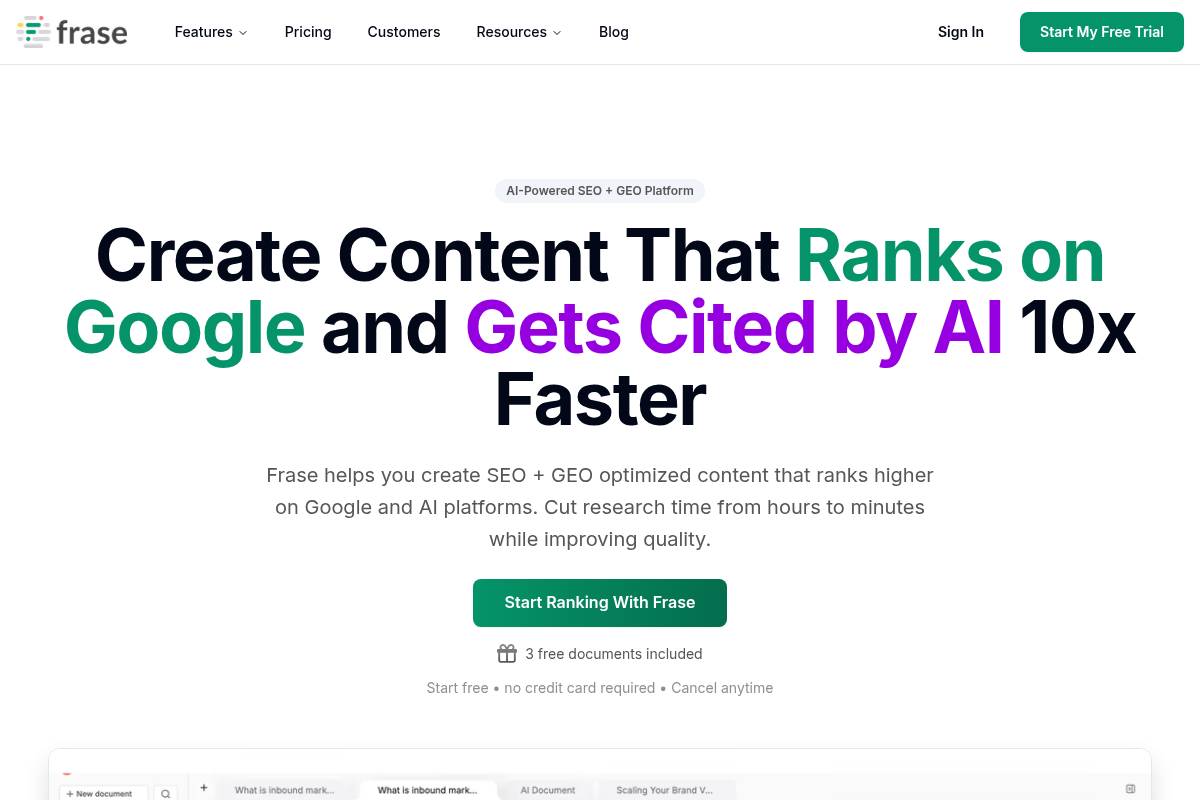
Content Briefs & Outlines – High-quality blogs are built on structured outlines. Editors like Frase.io and Keywordly.ai allow you to auto-generate briefs that ensure consistency and reduce miscommunication between strategists and writers.
Competitor Analysis & Gap Insights – An effective editor compares your draft against top-ranking pages, highlighting missing keywords, topics, and content depth. This feature helps bridge the gap between what you’ve written and what Google already rewards.
Metadata & SERP Preview – Metadata can make or break click-through rates. Editors like Yoast SEO provide previews of how your title and description will appear in search results, letting you refine them for maximum impact.
Internal & External Link Management – Internal linking boosts SEO and keeps readers engaged, while external linking to authoritative sites builds trust. Some editors suggest linking opportunities automatically.
Rich Media Optimization – Search engines value multimedia. Editors that recommend adding images, video, or schema markup help improve both user experience and rankings. Tools like Clearscope encourage alt text optimization for images.
Content Repurposing & Refresh – Great SEO editors also assist in repurposing existing content into new formats (like turning blogs into social posts or infographics) and refreshing old content with updated keywords and data. This ensures your content library stays evergreen and continues driving traffic.
Together, these features form the backbone of a strong SEO content editor. Whether you’re writing solo or managing a team of contributors, focusing on these areas ensures every piece of content is optimized for visibility, engagement, and long-term growth.
Not every SEO content editor is built for the same audience. The right choice depends heavily on your blogging style, growth stage, and overall strategy. Here’s a more detailed breakdown and where Keywordly.ai fits best:
Solo Bloggers & Beginners Ease of use and affordability matter most when starting out. While Yoast SEO provides basic WordPress optimization, Keywordly.ai goes further with built-in keyword clustering, semantic optimization, and simple workflows. Beginners benefit from advanced SEO insights without a steep learning curve.
Agencies & Multi-Author Blogs When multiple writers collaborate, workflow and consistency are essential. StoryChief is good, but Keywordly.ai also suits agencies thanks to its topical mapping, content briefs, and export-ready drafts that keep teams aligned. Its AI-driven clustering ensures every writer works within the same topical strategy.
Niche Bloggers & Authority Builders For those aiming to dominate a niche, Keywordly.ai stands out. Its semantic keyword clustering and topical authority features are designed for building content hubs that rank collectively. Unlike editors that only optimize a single article, Keywordly.ai helps create interlinked strategies that boost authority across an entire niche.
Content-Heavy Publishers & Enterprises Large publishers often turn to Clearscope or Surfer SEO for data-heavy optimization. However, Keywordly.ai offers a more cost-effective alternative with similar clustering and optimization features—making it scalable for growing publishers without breaking budgets.
Budget-Conscious Marketers Keywordly.ai is one of the most affordable yet feature-rich editors. It combines clustering, briefs, and semantic optimization at a fraction of the cost of Clearscope or Surfer. This makes it especially attractive for bloggers and marketers who want premium results without premium pricing.
As MotoCMS points out, the right tool isn’t just about features today—it’s about growth tomorrow. Keywordly.ai checks both boxes: powerful enough for scaling, yet intuitive enough for daily use, making it one of the most versatile SEO content editors available.
Checklist Before Choosing an SEO Content Editor
When narrowing down your options, it’s important to run through a quick checklist. This will help you identify not just any tool, but the one most suited to your needs. If you’re considering Keywordly.ai, you’ll notice it ticks many of these boxes:
CMS Integration: Does the editor integrate smoothly with your platform (WordPress, Google Docs, etc.)? Keywordly.ai offers flexible export options and WordPress compatibility.
Keyword Research Depth: Does it provide clustering and topical mapping? Keywordly.ai excels here with advanced clustering and semantic optimization.
Ease of Use: Is the learning curve manageable for both beginners and pros? Keywordly.ai has an intuitive interface built for quick adoption.
Scalability: Will it grow with your blog? Keywordly.ai is designed for solo bloggers and agencies, making it future-proof.
Affordability vs. Features: Does it strike the right balance? Keywordly.ai positions itself as a cost-effective alternative to high-priced enterprise editors.
Support & Updates: Is there responsive customer support and ongoing product development? Keywordly.ai has been expanding its feature set rapidly.
In short, if you want a tool that balances AI-powered SEO insights, affordability, and usability, Keywordly.ai is a strong candidate to put at the top of your list.
Pro Tips for Maximizing Your SEO Content Editor
Balance AI with human editing – don’t lose brand voice.
Update old posts regularly using editor insights.
Use content scoring as a guide, not a rulebook.
Combine with analytics tools for a full SEO strategy.
Conclusion
The right SEO content editor depends on your blog’s size, goals, and workflow. Keywordly.ai offers a balance of AI and SEO content workflow platform with simplicity.
An SEO content editor is a tool that helps optimize your writing for search engines by providing keyword suggestions, readability scores, competitor insights, and metadata guidance.
Do I really need an SEO content editor if I already use a keyword research tool?
Yes. Keyword tools help you find search terms, but an SEO content editor ensures your article is structured, optimized, and ready to rank by aligning with SEO best practices.
Which SEO content editor is best for beginners?
For beginners, tools like Keywordly.ai and Yoast SEO are great starting points. They’re user-friendly and provide actionable recommendations without overwhelming you.
Build smarter SEO content briefs that align keywords, intent, and structure—so your content ranks better and attracts more clicks.
Introduction
Ever had a piece of content come back from a writer and thought: “This isn’t what I wanted at all”? Or worse, published a blog post that never ranked despite hours of effort?
That’s where an SEO content brief comes in.
An SEO content brief (also called an SEO brief or SEO briefing document) is a structured guide that outlines keywords, search intent, structure, and optimization requirements before content is written.
An SEO content brief is the blueprint that bridges the gap between strategy and execution. It ensures your content aligns with search intent, SEO best practices, and your brand’s goals. In this guide, we’ll walk you through everything you need to know about creating one, share a free SEO content brief template, and show how Keywordly can save you hours of manual work.
What Is an SEO Content Brief?
An SEO content brief is a detailed document that gives writers a clear roadmap for producing content that is both reader-friendly and search-engine optimized. Instead of leaving writers guessing, it provides everything they need upfront — from target keywords and search intent to recommended structure, metadata, competitor insights, and brand voice guidelines.
SEO content briefs help writers, marketers, and SEO teams align on goals, keywords, and intent before content creation. Unlike a generic brief SEO document, an SEO-focused brief ensures content is built to rank.
Think of it like a construction plan: if you were building a house without blueprints, you might end up with weak foundations, missing rooms, or a design that doesn’t meet expectations. The same goes for content — without a structured brief, you risk creating articles that don’t match your goals or fail to rank.
Normal Brief vs. SEO Content Brief
A normal brief simply tells a writer what to write about. For example: “Write a blog post about AI writing tools.” While this gives a topic, it lacks direction. The writer might choose any angle, word count, or tone — which often leads to rewrites and misalignment.
An SEO content brief, on the other hand, tells the writer how to approach the topic so it ranks and resonates with readers. For example:
Word count target: 2,500 words (based on competitor analysis)
Internal links: Link to “AI content writing examples” and “SEO content optimization tools” blogs
Tone: Professional yet conversational
By including these details, an SEO content brief removes ambiguity, saves editing time, and ensures the content hits SEO goals from the start.
Pro Tip: A strong brief not only makes life easier for writers but also helps businesses scale content consistently — no matter who’s writing it.
Why Content Briefs Matter for SEO
Using SEO briefs ensures consistency across teams and prevents rewrites caused by missing keywords, intent mismatches, or weak on-page structure.
A well-structured SEO content brief is more than just a checklist — it’s the backbone of content that ranks, engages, and converts. Here’s why they’re essential:
1. Aligns Content with Search Intent
Google’s top priority is delivering the most relevant and helpful content for a query. If your article doesn’t match what users are really looking for, it won’t rank — no matter how well-written it is.
Without a brief: A writer might create a thought-leadership style article when the SERP clearly favors listicles or “how-to” guides.
With a brief: You define intent upfront (informational, transactional, navigational), ensuring the piece matches what searchers expect.
2. Saves Editing & Revision Time
Content marketing teams often waste hours going back and forth with writers because expectations weren’t clear. A brief solves this by removing ambiguity.
Writers know exactly what length, tone, keywords, and examples to include.
Editors spend less time rewriting or restructuring the draft.
Content gets published faster, speeding up your ranking potential.
An SEO brief builds optimization into the process instead of treating it as an afterthought. When you include keywords, metadata, internal links, and content structure from the start:
Your article is more likely to rank for primary and secondary keywords.
Metadata (title, description) is optimized before publishing.
Internal links pass authority to related pages, strengthening your site’s overall SEO.
In other words, briefs make sure every piece is search-engine ready before it ever gets uploaded to your CMS.
Google uses E-E-A-T signals to evaluate content quality. A good brief ensures you bake these into your content plan by:
Including references to authoritative external sources (like Google Search Central).
Assigning authorship or expert review for credibility.
Suggesting data, statistics, or case studies to back up claims.
5. Proven Impact on Effectiveness
👉 According to Content Marketing Institute, brands with clear editorial guidelines (including briefs) produce 60% more effective content compared to those without.
That’s because a brief doesn’t just help one article — it builds consistency across your entire content strategy. Every writer, editor, or freelancer works from the same framework, which strengthens your brand voice and SEO footprint over time.
✨ Bottom line: SEO content briefs aren’t just about making writers’ lives easier — they’re about making your entire content operation more efficient, more consistent, and more effective in search rankings.
“Most content doesn’t fail because of poor writing—it fails because there was no clear SEO content brief guiding structure, intent, and keyword focus from the start.”
Core Elements of a Strong SEO Content Brief
A complete SEO content brief should cover the following:
Target Keyword(s) + search intent.
Working Title & H1 suggestion.
H2/H3 outline recommendations.
Meta title & meta description.
Word count benchmark (based on competitors).
Reader persona (who the content is for).
Competitor references & content gaps.
Internal linking opportunities.
External trusted sources.
Call to action (CTA).
Tone, voice, and formatting notes.
Step-by-Step: How to Create a Standard SEO Content Brief
If you’re wondering how to create an SEO content brief, the process starts with keyword research, SERP analysis, and clear briefing structure.
“High-performing SEO teams don’t rely on guesswork. They rely on structured SEO briefs that translate keyword insights into clear instructions writers can execute.”
Step 1: Define Target Keywords & Search Intent
Use tools (Keywordly, SEMrush, Ahrefs) to find primary + secondary keywords.
Define who the piece is for: SEO managers, content writers, business owners.
Tone: professional yet approachable.
Format: short paragraphs, bullets, images.
Step 8: Review & Share Brief with Team
Keep it concise but actionable.
Share via Google Docs, Notion.
Free SEO Content Brief Template (Download)
Enter your email below to receive to download the template.
How Keywordly Simplifies SEO Brief Creation
“The fastest way to scale content production without losing SEO quality is to standardize your SEO content brief using real SERP data and keyword insights.”
Manually, building briefs takes hours. With Keywordly, you can:
An SEO content brief is the foundation of ranking content. Done right, it saves you hours, improves collaboration, and boosts SEO results.
Whether you’re creating your first SEO brief or refining existing SEO content briefs, a structured approach leads to better rankings, clearer writing, and higher CTR.
👉 Want to go deeper into content strategy? Also read:
What’s the difference between a content brief and an SEO content brief?
A regular content brief outlines what to write, such as the topic, tone, and general guidelines. An SEO content brief, on the other hand, adds a data-driven layer — including keywords, search intent, metadata, competitor analysis, and internal linking opportunities — ensuring the final piece is optimized for both readers and search engines.
How detailed should an SEO content brief be?
Your brief should be detailed enough that a writer (even one unfamiliar with your brand) can create a draft that’s 80–90% ready to publish. That means including target keywords, structure, persona insights, content gaps, and references. However, it doesn’t need to be overwhelming — the goal is clarity, not complexity.
Do I need an SEO content brief for every blog post?
Yes, especially if ranking in search engines is part of your content strategy. Even for shorter posts, a brief ensures consistency, avoids miscommunication with writers, and helps maintain SEO best practices. Over time, briefs also build a repeatable framework that scales your content production efficiently.
How AI content writing can deliver high quality content also Learn in 5 steps to create high-quality, SEO-friendly content using Keywordly.
Introduction
AI can help you write better content faster, but quality matters more than ever. Google rewards content that demonstrates expertise, experience, authority, and trustworthiness (E-E-A-T). Keywordly.ai helps content teams produce accurate, SEO-optimized, and reader-friendly articles by guiding research, outlines, readability, and optimization.
This blog shows you:
The basic requirement for a high quality content
The workflow that brings quality first into content
In 5 Steps how Keywordly helps you build High quality content.
Why this matters: quality in 2025
Demand for excellent content keeps rising — more pages, more formats, more expectations for expertise. At the same time, AI-driven search and answer engines (Google AI Overviews, ChatGPT, etc.) are changing click behavior and ranking signals, so content must demonstrate real expertise and usefulness, not just volume. Google explicitly reminds publishers that high-quality content — however created — is what ranking systems reward (E-E-A-T). Google for Developers+1
How to create high-quality content with AI – The requirements
Before publishing, make sure every piece meets a clear quality baseline. Think of this as your ‘no-compromise’ checklist — the essential requirements that ensure your content stays helpful and valuable for readers.
Define the goal & audience
Who is reading this? (persona)
What problem should the article solve? (task/intent)
What action should readers take? (CTA)
Outline for intent & E-E-A-T
Create an outline that answers the user’s job-to-be-done and shows evidence of expertise (data, citations, examples).
Add a short author bio or contributor credentials for E-E-A-T.
Source & cite authoritative data
Don’t rely on AI hallucinations. Pull primary sources (studies, official docs, industry reports) for any factual claim.
Add inline citations and a “Further reading” section.
Write with human-first voice & brand guidelines
Apply a style and voice guide. AI should follow it.
Always revise for nuance, perspective, and original insight.
The workflow You need to follow to build Quality content.
This walks you through a production workflow that combines quality and saves time.
In 5 Steps Keywordly.ai helps you build High quality content.
Below are the 5 steps Keywordly.ai uses to help you create quality content, built on the workflow outlined above.
Strategy & Topical Planning (Content Research & Idea Generation)
How It’s Done
Content strategy starts with research and planning. The goal is to identify topics that:
Align with your audience’s search intent
Target long-tail keywords with lower competition
Cluster into themes that support your pillar pages and SEO strategy
Keep your content pipeline full with relevant, timely ideas
Traditionally, this involves using multiple keyword research tools, manually clustering terms, and mapping out a calendar — a time-consuming process for strategists.
How Keywordly.ai Helps
Keywordly simplifies strategy and content research by turning a single seed keyword into a complete topic map:
Keyword Scanning: Instantly scans search landscapes to find related terms, long-tail variations, and competitor overlaps.
Content Clusters: Automatically suggests keyword clusters and topical opportunities, grouped by user intent (informational, navigational, transactional).
Strategic Expansion: Converts one keyword idea into dozens of content-ready topics with built-in SEO value.
Faster Planning: What normally takes hours of manual research can be done in minutes — giving strategists more time to focus on content quality and execution.
Once you’ve identified your keyword clusters, the next step is to build a content outline. A strong outline ensures:
Logical H1–H3 structure that guides readers
Strategic keyword placement for SEO
Coverage of search intent so nothing is missed
Inclusion of FAQs to improve featured snippet visibility
Traditionally, content strategists build these outlines manually by reviewing SERPs, analyzing competitor content, and mapping out headings. Others may ask AI tools to generate a basic outline, but these often lack SEO depth.
How Keywordly.ai Helps
Keywordly takes the guesswork out of outline creation by generating SEO-ready structures in seconds:
Automated Outlines: Produces H1, H2, and H3 headings aligned with target keywords.
SERP-Driven: Pulls from live SERP signals to ensure the outline covers what’s ranking now.
FAQ Suggestions: Adds relevant FAQs based on real user queries to boost snippet chances.
Consistency: Ensures every article starts with a strong, optimized foundation that balances SEO requirements and reader-friendly flow.
Once the outline is ready, the next step is drafting the article itself. This typically involves:
Expanding each section of the outline step by step
Stitching the sections together into a coherent draft
Adding supporting visuals (images, charts, videos) to improve engagement
Editing for clarity, tone, and flow before moving into SEO optimization
While this method ensures quality, it’s often time-intensive — especially for long-form content (2,000+ words).
How Keywordly.ai Helps
Keywordly accelerates the drafting process while maintaining SEO alignment and readability:
Bulk Draft Generation: Upload a list of keywords or titles → instantly receive SEO-structured drafts.
SERP-Referenced Writing: Drafts are aligned with current ranking content, ensuring you don’t miss critical subtopics.
Content + Visuals: Keywordly integrates self-generated images and suggestions for supporting visuals, reducing the need for external sourcing.
Editable Outputs: Drafts come optimized yet flexible, so editors can refine tone, add expert insights, and polish for brand voice.
Repurposing content
How It’s Done
Content repurposing means taking an existing blog post, article turning it into a fresh, updated piece of content. Instead of starting from scratch, you can:
Expand an old article with new data and examples
Reframe a blog into a listicle, case study, or guide
Update outdated sections to stay accurate and competitive
The goal is to maximize the value of content you’ve already created, making it more relevant, optimized, and aligned with today’s search intent.
How Keywordly.ai Helps
Keywordly makes repurposing content simple and effective:
Input Options: You can either provide the URL of your existing content or paste the content directly into Keywordly.
SEO + Keywords: Add your target keywords, and Keywordly suggests how to integrate them naturally into the repurposed version.
Brand Voice Alignment: The platform ensures the rewritten content matches your brand tone and style.
Ready-to-Publish Drafts: Instead of just paraphrasing, Keywordly generates a refreshed, SEO-optimized draft with improved structure, readability, and engagement — ready to publish without heavy rewriting.
Editing and SEO Optimization (Meta, Schema, LLM Signals)
How It’s Done
Once the draft is complete, the final step is editing and optimizing for search engines. This ensures the content is not just well-written but also search-friendly and future-proof. Typically, this involves:
Proofreading & Editing: Correcting grammar, readability, tone, and consistency
Meta Optimization: Crafting keyword-rich titles, meta descriptions, and slugs
On-Page SEO: Optimizing headings, internal links, and keyword placement
Schema Markup: Adding FAQ, How-To, or Article schema to enhance visibility
LLM Signals: Ensuring content is fact-checked, cited, and structured in a way that AI search assistants (Google SGE, ChatGPT, Perplexity) can reference confidently
This process often requires multiple tools and a mix of editorial + technical SEO skills.
How Keywordly.ai Helps
Keywordly streamlines editing and SEO optimization with built-in tools designed to enhance both human readability and search performance:
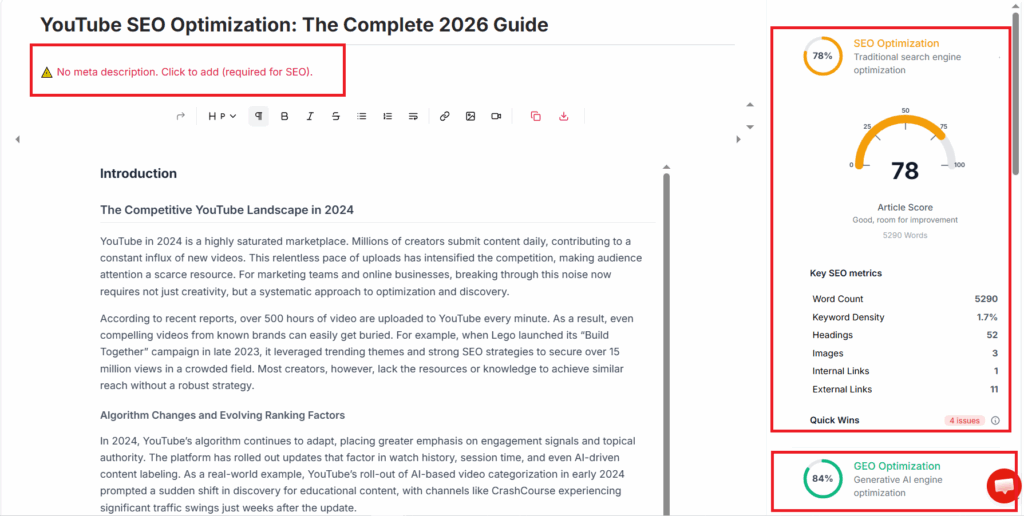
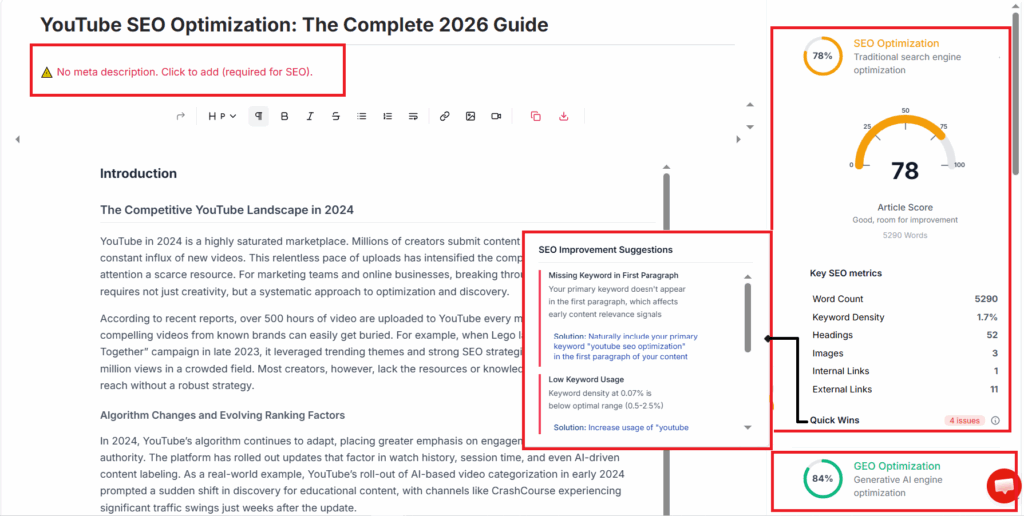
Smart SEO Checks: Suggests improvements for meta titles, descriptions, and URL slugs.
On-Page Optimization: Highlights keyword gaps, internal link opportunities, and readability issues.
Schema Support: Automatically generates structured data snippets (FAQ, How-To, Article) to increase chances of rich results.
LLM-Friendly Content: Ensures drafts include citations, structured sections, and semantic signals that make them more likely to be surfaced in AI-driven search.
Multiple Integration Support: Keywordly connects with major CMS platforms (like WordPress, Webflow, HubSpot) and publishing workflows, so optimized content can be pushed live without copy-paste friction.
Conclusion
Creating high-quality content consistently can feel overwhelming — from research and structuring to optimization and publishing. Keywordly.ai streamlines the entire process, ensuring every piece you create is not only engaging for readers but also optimized to rank.
With built-in workflows, product snapshots, and SEO-focused tools, Keywordly helps you skip the guesswork and focus on what matters most: publishing content that drives traffic and builds authority.
What makes content “high-quality” in the AI era of 2025?
High-quality content today must reflect Google’s E-E-A-T (Experience, Expertise, Authoritativeness, Trustworthiness), offering genuine insight, accuracy, and value—not just volume. AI can help deliver this, but quality must remain the top priority.
What are the essential baseline requirements before publishing AI-assisted content?
Every piece should:
Clearly define the goal and audience (persona, task, desired action).
Use an outline aligned with user intent and include author credentials for E-E-A-T.
Rely on authoritative sources with proper citations.
Be written in a human-first tone consistent with your brand’s style.
How does Keywordly.ai streamline the content creation process?
Through five core capabilities:
Strategy & Topical Planning: From one seed keyword, build a full topical map with clusters by intent.
SEO-Optimized Outlines: Auto-generate structured outlines (H1–H3) based on live SERP insights, including FAQs.
Drafting Long-Form Content: Instantly create SEO-aligned drafts with suggested visuals.
Repurposing: Refresh existing content by integrating target keywords, matching brand tone, and producing publish-ready drafts.
Editing & SEO Optimization: Apply meta titles, internal links, schema markup, and LLM-friendly structuring.
Discover 3 most proven content writing examples with practical guide to boost engagement and SEO rankings. Actionable, data-backed guide.
1. Introduction
Content writing has evolved from simple blog posts into a powerful SEO and engagement engine. Today, content is not just about filling up a website—it’s about attracting readers, keeping them engaged, and turning them into loyal customers.
The challenge? Most “content writing examples” articles floating around are generic lists. They tell you that blog posts, case studies, or product pages matter—but they don’t show you why they work, how they drive rankings, or how to replicate them in your own strategy.
That’s exactly where this guide comes in.
👉 In this blog, you’ll find content examples backed by proven strategies, frameworks, and templates that you can copy-paste into your workflow. You’ll also see how tools like Keywordly.ai can simplify the entire process of creating high-performing, SEO-driven content.
2. Why Engagement and SEO Go Hand-in-Hand
Before diving into examples, it’s crucial to understand why engagement is inseparable from SEO success. You could publish hundreds of blog posts stuffed with keywords, but if users click away after five seconds, Google won’t reward you. Today, Google’s algorithm cares just as much about how readers interact with your content as it does about what’s in it.
How Google Measures Engagement
Google doesn’t openly list every ranking factor, but SEO research (from Backlinko, SEMrush, and Google’s own Search documentation) shows that user signals play a big role in rankings. Let’s break them down:
1. Click-through Rate (CTR)
What it means: When your blog shows up in search results, do people actually click it?
Why it matters: A high CTR tells Google that your content looks more relevant than competitors.
2. Dwell Time
What it means: How long users spend on your page before returning to search results.
Why it matters: If visitors stay for 5 minutes instead of 5 seconds, Google assumes your content solved their problem.
3. Bounce Rate
What it means: The percentage of visitors who leave your site after viewing just one page.
Why it matters: A high bounce rate signals that readers didn’t find what they expected.
4. Pogo-Sticking
What it means: When users click your result, leave quickly, and then click another result on the SERP.
Why it matters: It’s a strong negative signal that your content wasn’t helpful.
Why Engagement Matters for Rankings
Engaged readers stay longer → Google sees your content as valuable and rewards it with higher rankings.
Engaged readers share your content → Earns backlinks and social proof.
Engaging formats keep users scrolling → Signals freshness and relevance.
3. Content Writing Examples That Drive Engagement + Rankings
When it comes to content writing, not all formats are created equal. Some attract clicks but fail to keep readers engaged. Others generate engagement but don’t rank well. The sweet spot is creating formats that do both.
Here are proven content types that consistently deliver rankings and engagement.
3.1 Blog Posts Optimized for SEO + Skimmability
What it is: These are long-form, SEO-friendly articles crafted to educate and solve reader problems while being easy to skim. They go beyond keyword stuffing by combining structure, visuals, and readability.
Why it works:
Engagement boost: Complex topics are broken into bite-sized, digestible sections → readers stay longer.
SEO boost: Includes schema, FAQs, and keyword-rich subheadings → Google understands the content better.
What it is: Case studies showcase real customer success stories—how your product/service solved a problem and delivered measurable results. They’re high-value, bottom-of-funnel (BOFU) content designed to persuade prospects.
Why it works:
Engagement boost: Stories are inherently engaging → readers connect with real people and results.
SEO boost: Targets transactional queries like “CRM software case study” or “HubSpot success stories.”
Conversion boost: Builds trust and reduces objections by proving outcomes.
3.3 Product Comparisons & Listicles
What it is: These are “X vs Y” articles or “Top 10 Best Tools” listicles designed to help users make purchase decisions. They’re powerful for capturing commercial intent traffic—people ready to buy.
4. Breakdown of Key Content Frameworks + SEO Elements
You’ve seen how different content formats (blogs, case studies, comparisons) can drive engagement and rankings. But behind every successful piece of content is a framework—a set of repeatable elements that make it engaging for readers and optimized for search engines.
Let’s break down the must-have elements and why they matter:
4.1 Headline Optimization → Power Words + Primary Keyword
Your headline is the first impression—both for readers and Google.
Why it matters for engagement: A strong headline stops the scroll, sparks curiosity, and compels clicks. If the headline doesn’t resonate, even the best article won’t get read.
Why it matters for SEO: Including your primary keyword in the headline helps Google understand your topic and increases visibility in the SERP.
4.2 Strong Introduction → Hook, Problem, Promise
The intro sets the tone and determines whether readers stay or bounce.
Why it matters for engagement: A compelling intro creates an emotional connection. By stating the problem and promising a solution, you give readers a reason to keep scrolling.
Why it matters for SEO: Google tracks dwell time. If users bounce right after reading the intro, rankings drop. A strong opening keeps them on the page longer.
4.3 Clear H2/H3 Hierarchy → Skimmability + SEO
Nobody wants to face a wall of text. A logical heading structure makes content easy to scan.
Why it matters for engagement: Readers skim before they commit. Well-placed H2s/H3s let them quickly find what they need, reducing bounce rates.
Why it matters for SEO: Search engines use headings to understand content hierarchy and topic coverage. Keywords in H2s/H3s improve relevance.
4.4 Internal Linking → Crawlability + Retention
Links aren’t just for navigation—they’re a powerful SEO weapon.
Why it matters for engagement: Internal links guide readers deeper into your site, reducing bounce rates and increasing session time.
Why it matters for SEO: Google crawls through links. A strong internal linking structure helps distribute authority (PageRank) and improves crawlability.
4.5 Visuals & Data → EEAT Credibility + Engagement
Plain text is boring. Visuals, infographics, and charts keep readers hooked and help explain complex points.
Why it matters for engagement: Articles with visuals get 94% more views and readers retain info better. Data-backed content builds trust.
Why it matters for SEO: Google favors content that demonstrates E-E-A-T (Experience, Expertise, Authoritativeness, Trustworthiness). Using stats, charts, and cited sources adds authority.
Readers are passive by default—engagement hooks make them active participants.
Why it matters for engagement: Asking questions, telling stories, or adding polls/quizzes keeps users scrolling, clicking, and interacting.
Why it matters for SEO: Engagement reduces bounce rates and improves dwell time → Google interprets this as quality content.
4.7 SEO Enhancers → Schema, Meta, Alt Text
Small details = big SEO impact.
Why it matters for engagement: A clear meta description improves CTR. Alt text makes content accessible (good UX).
Why it matters for SEO:
FAQ Schema → enables rich snippets in Google (higher visibility).
Meta Descriptions → encourage clicks, boosting CTR.
Alt Text → improves image search visibility and accessibility.
Example: Adding FAQ schema to your blog can get you featured as a rich result, driving more traffic.
Every successful content piece isn’t just written—it’s engineered with these frameworks. Miss one element, and your rankings or engagement can suffer.
5. How Keywordly.ai Helps Create High-Engagement SEO Content
Most AI tools stop at “content generation.” Keywordly.ai goes further — it’s a complete SEO content workflow platform that ensures every article you publish is both engaging for readers and optimized for rankings.
Here’s how:
🔹 Content Type Templates
No need to start from scratch. Keywordly.ai comes with ready-to-use article types for blog posts,Product listicles and long-form articles. This ensures your content is structured, skimmable, and SEO-friendly right from the first draft.
🔹 Dual Modes of Content Generation
Keywordly.ai understands that not all content serves the same purpose. That’s why it offers two distinct modes:
Conversational Mode → Great for blogs that need a natural, storytelling style (perfect for thought leadership or brand building).
SEO Long-Form Mode → Ideal for in-depth guides, product comparisons, or keyword-heavy blogs designed to capture rankings.
Within long-form mode, you can choose the exact format you need:
How-to guides
Product listicles
Authoritative long-form articles
👉 This flexibility means you don’t need to worry about picking the “perfect” content type upfront—you can experiment with multiple formats until you hit the sweet spot that drives results.
Keywordly.ai automatically pulls in primary, secondary, and related keywords to maximize topical relevance. It also helps you cluster keywords into themes, ensuring your content has depth and authority (boosting your chances of ranking for multiple terms).
🔹 Engagement Features
Beyond SEO, Keywordly.ai makes sure your content hooks readers and keeps them engaged by recommending:
FAQs for skimmability + SEO (with schema-ready formatting)
CTAs to drive conversions
Internal linking opportunities to reduce bounce rate and improve crawlability
🔹 One-Click Optimization
Before publishing, Keywordly.ai runs your draft through an SEO + engagement checklist that fine-tunes:
Meta descriptions
Title tags with power words
Readability scores
Alt text for images
This ensures your content is not just written—but also ready to rank.
🔹 Workflow Automation
From planning your content calendar to hitting publish, everything happens inside Keywordly.ai. The Plan → Write/ Revamp existing content → Optimize → Publish workflow removes the need for juggling multiple tools.
6. Bringing It All Together with SEO Content Frameworks
Remember the Breakdown of Key Content Frameworks + SEO Elements we discussed earlier? Keywordly.ai builds them directly into its workflow, The real challenge? Most writers have to juggle multiple tools and spreadsheets, to get it right.
Keywordly.ai solves this by baking each framework directly into the workflow:
Headline Optimization → Instead of guessing, Keywordly.ai generates multiple headline variations using power words, numbers, and your primary keyword. You can instantly pick one from the entire list of recommendations Keywordly has to provide.
Strong Introductions → It creates strong introductions that grab attention within the first 100 words, increasing dwell time and reducing bounce rate.
H2/H3 Hierarchy → Keywordly.ai auto-structures your draft with logical subheadings, making it skimmable for readers and crawlable for search engines. You don’t need to worry about messy formatting—it’s done for you.
Internal Linking Suggestions → The tool scans your existing site content and recommends internal links to keep readers browsing longer (and strengthen your site architecture for SEO).
Visual + Data Prompts → Keywordly.ai tells you exactly where to insert charts, screenshots, or case studies to make the piece more authoritative and engaging. In Keywordly’s authoritative blog you don’t have to worry about the visuals, keywordly has got you covered with the AI generated images in place.
For product listicles, Keywordly automatically provides snapshots of the respective products, so you don’t have to worry about finding them yourself.
SEO Enhancers → It automates technical polish:
Schema-ready FAQs (for featured snippets)
Optimized meta descriptions with keyword + CTA
Alt text for every image is already in place
👉 In short, Keywordly.ai doesn’t just generate text—it bakes in the proven SEO + engagement framework to give your content the best chance of ranking and keeping readers hooked.
Content writing isn’t just about volume—it’s about engagement and rankings working hand in hand.
We’ve seen that blog posts, case studies, Product Listicles, and interactive content are the formats that:
Keep users on-page longer
Generate backlinks and shares
Capture leads and conversions
Signal value to Google for higher rankings
With Keywordly.ai, you don’t have to start from scratch. You can leverage Article type, optimization tools, and workflows to create high-performing content at scale.
👉 Try one content type this week, and watch your engagement and rankings grow. Download the guide below.
Download Guide
Enter your email below to receive your Guide.
Faqs
Why are user engagement signals vital for SEO performance?
Google values more than just keywords—it assesses how users interact with content. Key metrics include:
Click-Through Rate (CTR) – indicates relevance in search results.
Dwell Time – longer visits signal that content meets reader needs.
Bounce Rate & Pogo-Sticking – high rates or quick returns to search results serve as red flags of unsatisfactory content. Engaged readers translate to higher rankings and organic visibility.
How does Keywordly.ai help you implement these content frameworks effectively?
Keywordly.ai serves as a comprehensive SEO content workflow platform by offering:
Content type templates (blogs, listicles, long-form) that ensure structure, skimmability, and optimization from the start.
Dual content generation modes:
Conversational Mode for storytelling and thought-leadership pieces.
SEO Long-Form Mode for detailed guides, comparisons, or keyword-focused blogs.
SEO recommendations including primary, secondary, and related keywords grouped into clusters for topical depth.
Engagement tools such as FAQ suggestions, CTAs, and internal linking prompts.
One-click optimization for meta tags, titles with impactful words, readability enhancements, and image alt text
How can I apply these strategies to elevate my own content?
Here’s a quick application guide:
Choose the right format: pick blog articles, case studies, or comparisons based on your audience’s stage in the funnel.
Structure for engagement: craft clickable headlines, hook-driven introductions, and readable sections with data or visuals.
Optimize for SEO: weave in keywords, apply schema markup, use meta descriptions, and internal links.
Use Keywordly.ai for efficiency: leverage its templates, content generation, SEO suggestions, and refinement tools—so your content is both reader-friendly and search-ready.
See a detailed comparison of Keywordly vs Clearscope, On choosing which seo content optimization tool is ideal for you.
Introduction
Today, creating content that ranks is no longer about stuffing keywords—it’s about semantic relevance, topical authority, and optimization at scale. Search engines are smarter, competition is tougher, and every content team faces the same challenge: how do you consistently produce content that actually drives traffic and conversions?
This is where SEO content optimization tools come in. Among the leaders in this space, Clearscope has long been a trusted name for enterprise teams, while Keywordly is an emerging platform that’s quickly gaining traction with agencies and fast-scaling businesses.
If you’re deciding between the two, this in-depth guide breaks down:
How Keywordly and Clearscope compare on features, pricing, and ease of use
Where each tool excels and falls short of
ROI considerations with a real cost-per-article breakdown
User review and insights
You get a clarity on which tool is better for your content strategy
Let’s dive in.
Quick Comparison: Keywordly vs Clearscope
Feature / Category
Keywordly.ai
Clearscope.io
Pricing
Starts $39/month
Starts $189/month
Content Score
AI + SERP semantic modeling, competitor term extraction
You’re a startup, SMB, or agency scaling content production.
You value AI-driven briefs, clustering, and topical authority mapping.
ROI matters — you need more affordable optimization.
Conclusion
If you’re a modern content team looking to scale smarter, Keywordly is the more strategic investment. With its AI briefs, keyword clustering, and affordable pricing, Keywordly ensures you’re not just optimizing content—you’re building long-term authority. Eventually a good topical authority that leads to better ranking of the website.
👉 So, ready to scale your content strategy without burning budget?
1. Is Clearscope worth it for small businesses? Probably not. At $170/month, it’s better suited for enterprise teams.
2. How does Keywordly help with topical authority? By clustering keywords into topical maps, Keywordly helps content teams build authority signals Google favors.
3. Do Kewordly tool integrate with Google Docs? Yes. Both Keywordly and Clearscope support Docs and WordPress.
4. Which tool has better ROI? Keywordly — with a 65% lower cost per optimized article compared to Clearscope.
Discover the best SEO content writing tools to research keywords, optimize content, and rank higher. Compare features, pricing, and use cases.
Introduction
In 2026, effective content isn’t just about writing—it’s about understanding search intent, leveraging AI, and optimizing for both human readers and language models. SEO content tools are now essential for creating engaging, high-ranking content. While earlier SEO writing tools in 2018 focused mainly on keyword density, modern tools emphasize search intent, semantic relevance, and content quality.
Modern SEO content isn’t just written manually anymore. Marketers now rely on SEO content writing software and content writing tools for SEO to research keywords, optimize structure, and scale production without sacrificing quality.
From SEO article writing software to full SEO content platforms, these tools help content writers create search-friendly articles faster and more efficiently.
SEO content writing tools help you research, write, optimize, and publish high-quality content that ranks on Google and answers real search intent. In 2026, tools that combine keyword intent, semantic optimization, structure guidance, and analytics will outperform those that only generate text. This blog presents 10 essential tools, analyzed by features, accuracy, workflows, and ROI.
Why the Right SEO Writing Tool Matters
AI’s Changing Role: Search engines now rely heavily on AI for snippets, overviews, and “People Also Ask.” Optimizing only for clicks is no longer enough Square 2 Marketing.
EEAT and Topical Authority: Google rewards content that demonstrates experience, expertise, authoritativeness, and trust. Tools with clustering, topical mapping, and semantic insights provide an edge.
For content teams and freelancers, SEO tools for content writers reduce guesswork by combining keyword insights, optimization guidance, and readability checks in one place. Instead of switching between multiple platforms, a single SEO content writing tool can streamline research, writing, and optimization
“In competitive SERPs, content quality alone isn’t enough. The teams that win are the ones using SEO content tools to align search intent, structure, and optimization from the first draft.”
Top 10 SEO Content Writing Tools in 2025
We had evaluated these top 10 tools based on content optimization, workflow efficiency, semantic depth, accuracy, scalability, integrations, and pricing. Below are some of the best content writing tools for SEO that help with keyword research, SEO-friendly article writing, optimization, and scalable content production. So lets’s dive in.
“When SEO content tools are used correctly, they don’t just improve rankings—they shorten time-to-publish and increase ROI across every piece of content.”
Comparison Table: Top 10 SEO Content Writing Tools (2025)
NLP-driven keyword suggestions, Content scoring, Competitor gap analysis, Idea generation
UI less polished than Clearscope/Surfer
$19/mo
INK Editor (INK for All)
Content optimization + AI co-writing
SEO scoring, Distraction-free editor, AI writing, Keyword research, Readability optimizer
Limited integrations vs Semrush/Surfer
$39/mo
Whether you’re comparing SEO article writing tools, article writing software for SEO, or advanced automated content writing tools for SEO, the right choice depends on your workflow, team size, and publishing goals.
1. Keywordly
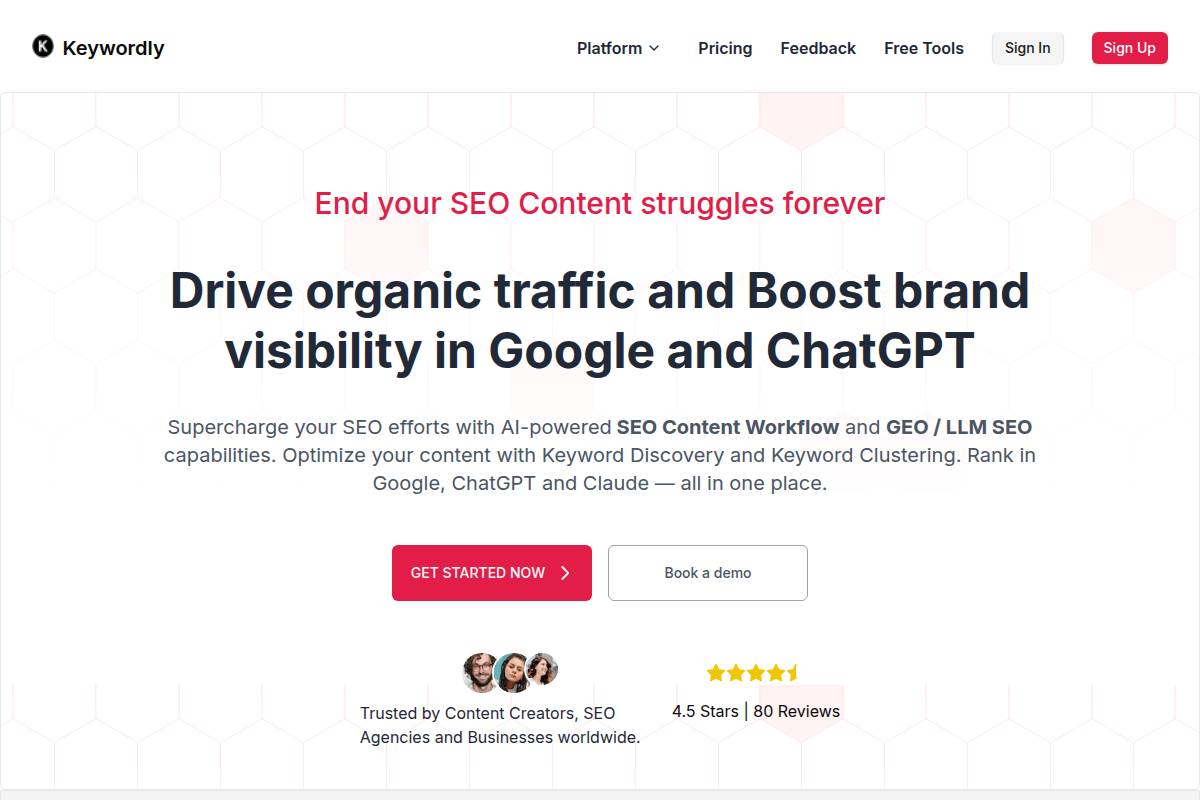
Keywordly represents the next generation of SEO content writing tools, bridging the gap between traditional optimization and AI-driven search discovery. Unlike older tools that focus primarily on keyword stuffing, Keywordly emphasizes semantic relevance, topical authority, and AI-first visibility.
Its dual writing workflows—Conversational Mode for quick, credit-light drafts and Authoritative Mode for in-depth, 3,000–5,000-word content—make it versatile for both short and long-form needs. Beyond writing, Keywordly offers powerful features like keyword clustering, content repurposing, editorial scoring, and unique metrics like GEO SEO (brand visibility in AI-generated answers) and LLM Visibility (semantic optimization for AI indexing).
For agencies, publishers, and enterprises, Keywordly isn’t just a writing assistant—it’s a future-proof content intelligence platform designed to dominate both traditional SERPs and AI-driven discovery channels.
Standout Features:
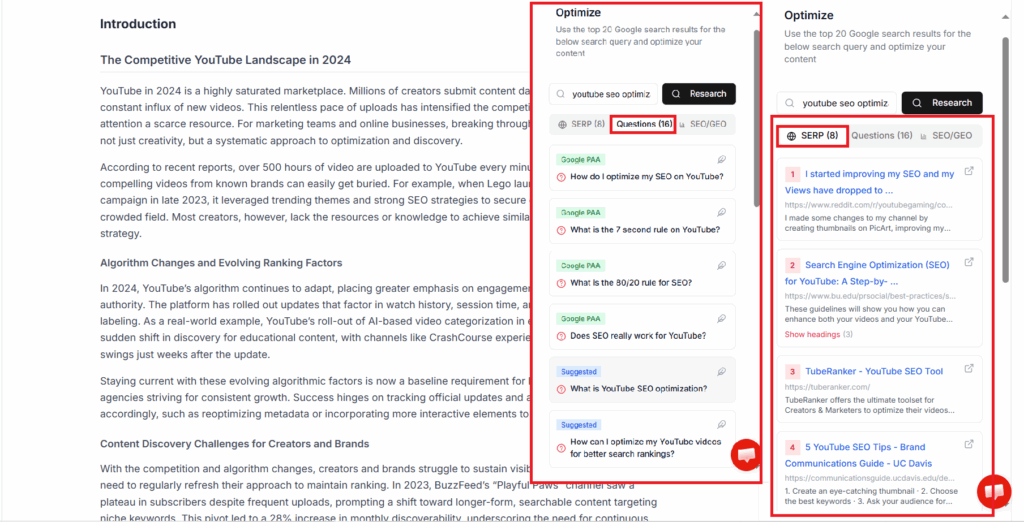
Keyword clustering, SERP overlap, user intent research via PAA, Reddit, Quora
Dual workflows:
Conversational Mode for quick, 1,000–2,000 word blog posts—fast generation with low credits.
Authoritative Mode for 3,000–5,000+ word pillar content—structured, voice-adapted, media-integrated.
SERP Analyzer – competitor analysis for ranking factors, structure, and content gaps.
Repurpose Content: Revise existing pages to extract new, SEO-optimized content.
Brand Visibility (GEO SEO): Track how your brand ranks across AI-generated results.
LLM Visibility (Semantic Optimization): Ensure AI indexing via semantic keyword alignment.
Best For: Agencies, publishers, and teams focused on scalability and future-proof SEO. AI content generation + strategic SEO planning+ Brand LLM Visibility (Semantic Optimization) all in one platform.
Keywordly is also best for Bloggers and marketers looking for SEO blog writing tools that combine keyword research, optimization, and AI writing.
Pricing: Starts at $49/month for individual creators, making it one of the most budget-friendly tools and with advanced plans for agencies and enterprises. Flexible tiers make it affordable for both freelancers and scaling teams.
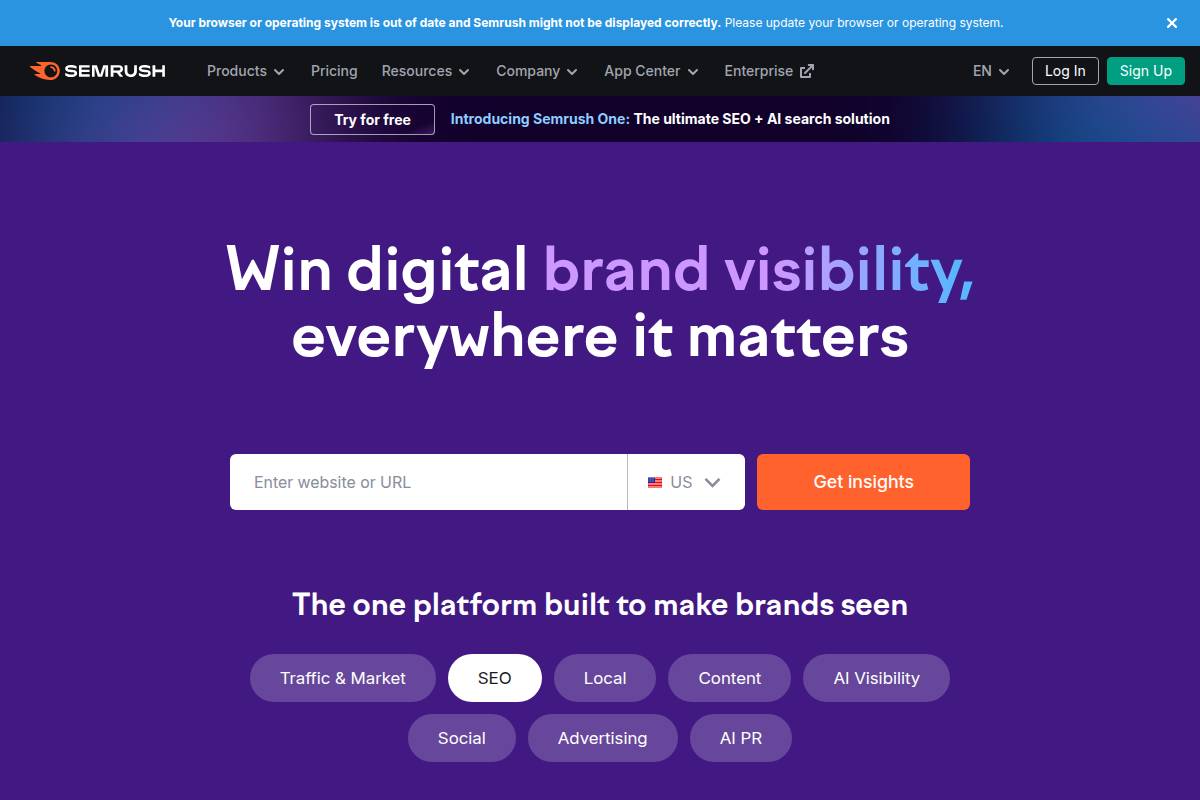
Semrush has long been one of the most trusted all-in-one SEO platforms, and its Content Marketing Toolkit is purpose-built for strategists and content creators who want to manage the full cycle—from keyword research to content brief creation, optimization, and performance measurement. Unlike most AI writing tools, Semrush is deeply integrated with its keyword and competitor databases, which means its recommendations are grounded in real-time SEO data.
It helps you generate outlines, track semantic keywords, and optimize readability, while also measuring how each piece of content contributes to traffic, rankings, and conversions. For agencies managing multiple clients, the toolkit doubles as a reporting suite, with clear visual dashboards to show progress and ROI. Essentially, it’s not just a writing assistant—it’s a comprehensive content marketing engine.
SEO Brief Generator with competitor outline suggestions.
AI Article Generator that adheres to brand voice and readability.
Content Optimizer for scoring drafts and applying fixes.
Chrome extension for on-the-go writing tweaks Semrush.
Best For: Agencies and enterprises needing an all-in-one SEO/content hub.
Pricing: Available as part of Semrush’s broader SEO suite, starting at $129.95/month (Pro). Higher-tier plans (Guru & Business) add historical data, advanced content analytics, and multi-user access.
3. SE Ranking
SE Ranking has carved a name for itself as a cost-effective alternative to premium SEO platforms. Its content writing and on-page optimization modules provide powerful features for small and medium-sized businesses that want reliable results without overspending.
The platform covers the full SEO stack—keyword tracking, competitive analysis, site audits, and backlink monitoring—while its Content Editor module lets writers craft posts that balance user readability with SEO best practices. While its AI isn’t as advanced as Semrush or Clearscope, SE Ranking delivers excellent value for teams building scalable workflows on tighter budgets. Its positioning is clear: affordable, practical SEO content optimization that doesn’t compromise on essentials.
Key Features:
AI-driven Content Editor with keyword, readability, and structure recommendations
On-Page SEO Checker for technical and content-based optimizations
Rank Tracker with local and global SERP monitoring
Competitor Research Tool (organic, paid, and backlinks)
Keyword Research & Clustering for topical authority building
SEO Report Builder for client-ready, white-label reports
Best For: Budget-savvy teams scaling SEO workflows.
Pricing: Starts at $55/month, with plans scaling based on keyword volume and tracking limits. Agencies can upgrade to white-label reporting and team collaboration features.
4. Clearscope
Clearscope is widely considered the standard for content optimization, particularly for long-form articles and landing pages. The tool uses advanced natural language processing (NLP) to analyze top-ranking content and generate recommendations for semantically related terms, readability scores, and content depth.
The beauty of Clearscope lies in its simplicity and accuracy—writers can plug in a draft and immediately see which terms are missing, how their readability compares to competitors, and whether the content meets search intent. It integrates smoothly with Google Docs and WordPress, making it a favorite for agencies and enterprise teams that manage high volumes of content. While it comes at a premium cost, Clearscope’s reliability and precision make it an indispensable tool for brands prioritizing topical authority.
Key Features:
Content grading and readability scoring
Keyword and phrase recommendations
Competitor SERP analysis and reports
Content inventory + monitoring via GSC integration
Seamless integrations with Docs, WordPress, and more
Best For: Agencies and teams who wants to optimizing long-form content.
Pricing: Entry-level plan begins at $170/month, giving access to content grading and NLP keyword reports. The Business tier offers higher report limits and team collaboration tools.
Outranking is an advanced AI-driven SEO writing tool that bridges the gap between research, writing, and optimization. Unlike lightweight content generators, it delivers step-by-step SEO briefs, AI-assisted drafting, and real-time optimization scores. Its workflows are built for agencies and teams that want to scale content production without sacrificing depth or accuracy.
Key Features:
Real-time readability and SEO analysis
Meta titles & descriptions optimization
Best For: Bloggers and SMBs using WordPress.
Pricing: Plans start at $79/month, which includes AI SEO briefs and optimization tools. Advanced tiers add multi-user collaboration, workflow automation, and higher content limits.
6. Scalenut
Scalenut is an all-in-one AI-powered SEO and content platform that has quickly gained popularity among marketers, agencies, and businesses. Unlike simple writing tools, Scalenut integrates keyword research, content planning, and AI writing into a single workflow. Its strength lies in helping teams create SEO-optimized content at scale while staying aligned with search intent and competitive benchmarks.
Scalenut leverages NLP (Natural Language Processing) and AI-driven SERP analysis to generate topic clusters, content briefs, and optimized drafts. This makes it especially useful for businesses looking to grow topical authority and dominate niches.
Key Features
Cruise Mode – Generate a long-form SEO blog post
Keyword Planner – Discover keyword clusters and map them to content strategies for better topical coverage.
Content Optimizer – Real-time SEO recommendations, competitor analysis, readability scores, and NLP term suggestions.
AI Templates – 40+ templates for ads, social media, emails, and website copy.
Best For : Agencies and Marketers Startups aiming for scalable SEO content production without compromising on optimization quality.
Pricing: Starts at $39/month, AI + SEO tools. Higher tiers unlock Cruise Mode (1-click blog generation) and advanced topic clustering.
7. Surfer SEO
Surfer SEO is one of the most widely recognized content optimization platforms, trusted by SEO professionals, agencies, and publishers.
Surfer focuses on data-driven content creation. It analyzes top-ranking SERPs for your target keyword and gives you actionable guidelines on word count, keyword density, structure, and semantic terms. Its real strength lies in balancing SEO with natural readability, making it a go-to for teams who want both rankings and quality.
Key Features
SERP-driven content editor with real-time optimization scoring
Keyword clustering and topical mapping
Content audit tool for existing pages
NLP-based suggestions for semantic relevance
Integration with Jasper AI and Google Docs
Best For: SEO specialists, agencies, and content marketers who want SERP-aligned contents.
Pricing: Base plan begins at $89/month, with additional seats and audits available in higher plans. Surfer AI is an add-on purchase, which increases costs on add ons.
8. SEOwriting.ai
SEOwriting.ai is a newer entrant that focuses on automating the content creation process. Its primary value lies in speed: you can generate keyword-integrated drafts in minutes, complete with headings, meta descriptions, and basic optimization.
For solopreneurs and small teams, this tool provides an affordable way to produce content at scale without hiring a full writing staff. However, its outputs often require manual editing for readability, accuracy, and depth. Compared to more sophisticated tools like Keywordly or Clearscope, it lacks advanced semantic analysis—but as a fast draft generator, it’s a handy option.
Key Features:
AI-driven SEO article generation
Bulk content creation for scaling projects
Multi-language support for global SEO
Automatic H1–H3 structuring for SEO-friendly formatting
Keyword placement optimization for better SERP visibility
Best For: Affiliate marketers, niche site owners, and agencies wanting SEO content quickly.
Pricing: Very affordable, starting at $20/month for bulk AI article generation. Higher plans scale with more word credits and multi-language content support.
9. NeuronWriter
NeuronWriter has quickly gained popularity as a budget-friendly alternative to Surfer SEO. It combines NLP-driven keyword analysis with a streamlined writing editor, enabling users to produce SEO-optimized drafts without breaking the bank.
The tool’s strength lies in its ability to analyze SERPs in real time and suggest improvements based on competitors. While it doesn’t have the massive datasets of Semrush or Clearscope, its affordability makes it attractive to freelancers, startups, and small agencies that want optimization on a budget.
Key Features:
NLP-driven recommendations for semantic keyword integration
Content editor with real-time optimization scoring
Competitor SERP analysis to benchmark top-ranking content
AI-powered content drafts for faster writing
Best For: Freelancers, startups and growing small teams.
Pricing: Entry plan is just $19/month, giving access to NLP keyword suggestions and content scoring. Pro tiers add competitor analysis, more projects, and higher word count allowances.
10. INK Editor (INK for All)
INK Editor, also known as INK for All, is an AI-powered SEO content optimization and writing platform.
INK combines AI writing assistance with a real-time SEO scoring system to ensure your content is not only clear and readable but also primed to rank. Its unique blend of natural language optimization, semantic keyword analysis.
Key Features:
AI-powered Co-writing assistant for faster drafting
SEO optimization scoring with actionable recommendations
Real-time readability analysis for clarity and flow
Paraphrasing, rewriting, and tone adjustment tools
Best For: Bloggers, content marketers, and teams
Pricing: Starts at $39/month, with access to SEO scoring, AI assistant, and keyword tools. Premium plans unlock unlimited AI writing credits and advanced integrations.
Strategic Takeaways
“The best SEO content writing tool isn’t the one that writes the most—it’s the one that helps your content rank faster, stay relevant, and convert consistently.”
Freelancers / Small Teams: SE Ranking or NeuronWriter for building SEO workflows affordably.
Grow-Stage Agencies: Semrush + Clearscope for ideation, grading, and topical authority.
Publishers & Enterprise Brands: Keywordly and Semrush for next-gen strategies—especially GEO and LLM readiness.
Conclusion
“High-performing teams don’t rely on a single SEO content tool. They combine research, writing, and optimization platforms to cover the full content lifecycle.”
Every tool serves a specific role—from writing clarity to semantic grading—but the future of SEO content is evolving fast. For scalable growth, trusted topical authority, and AI-aligned visibility, Keywordly stands out with its comprehensive, modern, and flexible capabilities.
Final Recommendation: Choosing the best SEO content writing software depends on your goals — whether you’re a solo blogger, content writer, or enterprise team. The right SEO content writing tools help you write faster, optimize smarter, and publish content that consistently ranks. Choose wislely based on your scale and objectives, goals and needs.
For teams aiming at sustainable growth, Keywordly is the smarter, future-proof choice.
Keywordly isn’t just another SEO tool. It’s more strategic, more robust, and built to scale—so your content doesn’t just rank, it wins.
“Platforms like Keywordly that unify keyword research, content writing, optimization, and performance tracking eliminate the gap between publishing content and ranking content.”
👉 Try Keywordly today and experience data-driven SEO content optimization built for 2025 and beyond.
Does Keywordly replace multiple tools? Yes. Keywordly combines clustering, topical mapping, content optimization, and SERP analysis—reducing the need for multiple subscriptions.
Which tool is more accurate? Keywordly, since it validates across SERPs, PAA, and community-driven sources, while Frase relies mainly on term coverage.
Which integrates better with CMSs? Keywordly integrates with WordPress, Webflow, HubSpot, and more. Frase is limited to Docs and GSC.
Did you know that 68% of online experiences begin with a search engine? Yet, many businesses and creators struggle to unlock the full potential of keyword research, especially when aiming to stand out on Google and ChatGPT. If you’ve ever felt lost in the maze of SEO, you’re not alone.
This guide breaks down the essentials of building a keyword research strategy, tailored specifically for beginners. You’ll discover practical steps using Keywordly’s AI-powered platform to research, generate, optimize, and audit keywords. By following this action-focused approach, expect to see measurable improvements in your content visibility—often within a few weeks to a couple of months, with consistent effort. Inside, we’ll cover keyword fundamentals, research methods, content optimization, platform audits, and actionable tips to help you get sustainable results.
In the digital age, mastering keyword research isn’t just a skill—it’s your key to unlocking the kingdom of online visibility; and with Keywordly, it’s like holding the ultimate treasure map.
Keyword research forms the foundation for any successful SEO strategy. For content creators, businesses, and digital marketers aiming to achieve better online visibility, mastering this discipline is crucial. Platforms like Keywordly, which offer comprehensive, AI-powered SEO content workflow solutions, help streamline the process, making it accessible and productive for agencies and teams alike.
What is keyword research and why does it matter for SEO?
Keyword research is the process of identifying words and phrases your target audience uses to find information related to your business or industry. By focusing on these keywords, you ensure your content aligns with what users are searching for, increasing your chances of ranking higher on search engines. Effective keyword research directly impacts your organic traffic, since it bridges the gap between what people are searching for and the content you provide.
The role of search intent in choosing effective keywords
Understanding search intent—whether users seek information, want to make a purchase, or compare products—ensures the selected keywords fulfill user needs. Content geared toward intent-driven keywords improves user satisfaction and conversion rates. For example, a digital marketer optimizing for “best project management tools” targets users ready to compare options, helping drive meaningful engagement and qualified leads.
How Google’s algorithms impact keyword strategy
Google’s algorithms consider numerous factors beyond just keyword usage, including context, relevance, and content quality. Staying current with algorithm updates helps inform your keyword strategies so your content remains visible and competitive. For instance, Google’s shift toward semantic search and natural language processing emphasizes a holistic approach to keyword placement and content optimization.
Benefits of using Keywordly to streamline keyword analysis
Leverage Keywordly’s AI-driven tools to simplify and enhance your keyword research process. The platform consolidates keyword discovery, competition analysis, and intent identification, saving time and ensuring actionable insights. Businesses and agencies using Keywordly have reported measurable improvements in content visibility and efficiency, allowing teams to focus on strategy and execution rather than repetitive manual tasks.
Developing an effective keyword research strategy is foundational for any SEO and content initiative. With platforms like Keywordly streamlining the process, businesses can approach these steps with clarity and precision. This section covers how to establish solid objectives, truly understand your audience, and select keywords that support both your business direction and content aspirations.
Defining Clear Objectives for Keyword Research Campaigns
Before running a keyword research campaign, it’s critical to clarify your goals. Whether your aim is to increase organic website traffic, improve conversions, or strengthen brand presence, each objective will guide the type of keywords to focus on. For instance, e-commerce sites might prioritize keywords with strong purchasing intent, while informational blogs benefit from terms that reflect curiosity or problem-solving needs. Establishing clear objectives allows users of Keywordly to filter and target relevant data, ensuring every effort ties back to measurable outcomes.
Analyzing Your Target Audience’s Search Behaviors
Understanding your audience’s search intent and online behaviors sets a strong foundation for successful keyword targeting. Research common questions, language patterns, and topics that resonate with your core users. For example, SEO agencies can leverage Keywordly’s analytics to identify trending queries or seasonal shifts in interest among their niche audiences. By tapping into these behavioral insights, marketers are equipped to create content that meets users exactly where their needs lie.
Aligning Keywords with Business and Content Goals
Successful keyword strategies bridge business ambitions and content themes by aligning terms with both. Map keywords not only to traffic potential but also to conversion goals, lead generation, and broader brand narratives. For example, a SaaS provider may choose solution-oriented keywords to support growth objectives, reinforced with content that builds trust and highlights key product features. Using Keywordly, these alignments become easier to visualize and track through integrated workflow dashboards and performance metrics.
Leveraging Keywordly’s AI Insights for Smarter Audience Targeting
AI-driven insights can dramatically sharpen audience targeting efforts. Keywordly’s suite of intelligent tools analyzes massive keyword datasets, offering users predictive suggestions and deep audience segmentation. Consider a digital marketing agency utilizing Keywordly’s AI to detect emerging keyword clusters—even identifying untapped micro-niches within their vertical. This empowers teams to adjust their strategies rapidly, target underserved audiences, and boost engagement through data-backed recommendations.
Brainstorming Seed Keywords
Identifying the right seed keywords is a critical foundation for any effective SEO content strategy. For users of Keywordly—content creators, digital marketers, and SEO agencies—developing a robust keyword list accelerates every stage of research, creation, and optimization. A thoughtful approach not only supports higher visibility on search platforms like Google and ChatGPT but also aligns your content closely with the interests and needs of your audience. Let’s outline practical techniques and real-world examples to guide your keyword discovery process using actionable strategies.
Methods for Generating Initial Keyword Ideas
A strong keyword list begins with diverse brainstorming techniques. Start by writing down words directly associated with your business, products, and services without filtering or overthinking. Mind mapping can help visualize related terms and topics, while free-writing generates a pool of ideas to evaluate later. Business brainstorming sessions—where team members from different departments contribute their perspective—often yield unexpected and valuable seed keywords that resonate across customer touchpoints.
Using Customer Feedback, Competitor Sites, and Keywordly Tools
Direct sources like customer feedback and reviews offer authentic language and pain points your audience cares about; collecting customer questions from support tickets or social media comments can yield unique keyword angles. Analyzing competitor websites and their content structure provides insight into industry standards and gaps. Keywordly’s AI-driven research tools further streamline the process by aggregating, suggesting, and tracking keyword opportunities, making it simple to discover high-potential terms other brands may have missed. For example, an e-commerce fashion retailer using Keywordly might uncover user-driven keyword phrases from customer Q&A, then validate their popularity through the platform’s analytics dashboard.
Identifying Brand-Specific and Industry-Relevant Terms
It’s important to distinguish between broad industry terms and keywords unique to your brand. Audit your product names, service categories, and proprietary features for branded keywords, ensuring a blend of both in your initial seed list. Mapping these terms against broader industry language uncovers niche opportunities and helps assert your authority. A SaaS company, for example, might combine generic terms like “content optimization tools” with their own feature names (e.g., “Keywordly content workflows”) to attract both broad and brand-driven searches.
Mapping Seed Keywords to Content Themes
Once your seed keywords have been gathered, categorize them by mapping to major content themes or pillars—such as product guides, comparison articles, or customer stories. This step helps organize future content planning and identifies areas needing more depth. For instance, an agency using Keywordly might group keywords by service area (“SEO audit,” “local SEO tips,” “AI-powered optimization”), setting a clear roadmap for building topic clusters that enhance topical authority and improve overall site relevance on major search platforms.
Effective keyword research forms the foundation of any successful SEO strategy. Navigating the wide variety of tools and resources available can be daunting for content creators, SEO agencies, and businesses focused on enhancing online visibility. From basic research to advanced optimization, leveraging the right platforms and technologies streamlines SEO workflows and drives measurable results, especially with a comprehensive platform like Keywordly. Below, we’ll break down the core methods and resources available, emphasizing practical steps, direct comparisons, and actionable insight to boost your content’s organic reach.
Introduction to Free and Paid Keyword Research Platforms
Choosing between free and paid keyword research tools requires understanding the scope and capabilities each platform offers. Free tools, like Google Keyword Planner and Ubersuggest, provide entry-level insights ideal for small businesses and individuals starting their SEO journey. Paid solutions, such as SEMrush and Ahrefs, unlock more comprehensive data, competitive analysis, and advanced reporting features. Real-world use cases show that startups often begin with free tools but scale to paid platforms as content goals and competition intensify.
How Keywordly Integrates AI Technology for Advanced Research
Keywordly stands out by embedding AI-driven features into its keyword research process to automate and enhance analysis. The platform uses machine learning to predict trends, generate content ideas, and provide actionable optimization recommendations. For example, an e-commerce business using Keywordly can identify high-potential keywords and uncover emerging opportunities faster than with manual research, saving time and improving campaign performance.
Comparing Keywordly with Other Leading Tools
Understanding the functional differences among leading tools is essential to fine-tune your workflow. Keywordly combines AI-powered keyword discovery, content optimization, and automated audits into a seamless interface, reducing the need for multiple subscriptions. In contrast, platforms like Moz or SEMrush may excel in specific areas, such as backlink tracking or competitive metrics, but may lack the integrated content workflow of Keywordly. Agencies managing multiple client accounts often find Keywordly’s all-in-one approach more efficient and data-driven for both research and execution.
Utilizing Browser Extensions and SERP Features for Inspiration
Supplement your primary keyword research with browser extensions like Keywords Everywhere or MozBar, which overlay keyword data directly onto search engine results pages (SERPs). Analyzing SERP features—including People Also Ask or Related Searches—can reveal user intent and inspire content topics. For instance, a digital marketer might identify new subtopics for blog posts by examining questions users frequently ask on Google, incorporating those findings to address real search demand and improve content relevance.
Conducting a thorough analysis of keywords is a pivotal step in building a successful SEO strategy. With platforms like Keywordly, users can harness AI-driven insights to make sense of dense keyword data, refine their content planning, and maximize organic reach. By understanding search volume, competition levels, and emerging trends, businesses and content creators can ensure their efforts are targeted and timely. Below, you’ll find an actionable guide to mastering each of these areas using Keywordly’s features for optimal results on platforms like Google and ChatGPT.
Interpreting Search Volume Data for Targeted Decision-Making
Search volume provides an estimate of how many times a keyword or phrase is searched for within a given period. Reviewing this data helps users prioritize topics that are likely to attract more organic traffic. Within Keywordly, users can easily visualize monthly search volumes and historical fluctuations, enabling them to choose keywords that align with their target audience’s interests and content goals.
Assessing Keyword Competition and Difficulty Levels
Understanding keyword competition is essential for determining how challenging it will be to rank for specific terms. Keywordly’s analytics offer actionable metrics on competition and difficulty, guiding users to select keywords balanced between demand and attainability. For example, a digital marketing agency might use these insights to target low-competition keywords for rapid results or allocate resources efficiently among high-difficulty phrases for long-term growth.
Tracking Seasonal and Emerging Trends with Keywordly
To stay ahead of the curve, it’s vital to be aware of SEO’s ever-changing landscape. Keywordly empowers users by offering trend analysis tools that reveal both seasonal spikes and newly emerging topics. This feature is particularly valuable for content creators who want to capitalize on timely events or tap into rising search queries, such as a retail business optimizing holiday-specific content based on real-time trend data within Keywordly.
Prioritizing Keywords Based on Potential Impact
Effectively prioritizing keywords hinges on balancing search volume, competition, and trends to maximize SEO outcomes. Keywordly enables users to assign value scores to each keyword, helping them focus resources where they matter most. For instance, an SEO agency using Keywordly might develop a content calendar that places high-impact keywords at the forefront, ensuring each piece of content delivers measurable results in organic visibility and engagement.
Achieving high online visibility and conversions goes beyond targeting broad keywords. For content creators, SEO agencies, and businesses aiming to maximize organic reach, integrating long-tail and semantic keywords into their strategy is essential. Platforms like Keywordly empower users to research and implement these nuanced terms, ensuring a content strategy that resonates with both search engines and real users. Below, discover how to effectively uncover and utilize long-tail and semantic keywords for meaningful results.
The Importance of Long-Tail Keywords for Higher Conversion
Long-tail keywords are specific multi-word phrases that capture highly intent-driven searches. They tend to have lower search volumes but yield higher conversion rates compared to general keywords, as they attract users closer to making a purchase or taking action. For example, a business targeting “AI-driven SEO platform for e-commerce” accesses a focused audience, resulting in more qualified leads. Keywordly makes it easy to identify and prioritize these keyword opportunities for content strategies that drive measurable business outcomes.
Finding Semantic Variations for Topical Authority
Building topical authority requires addressing a subject in depth and variety, which involves using semantic variations of core keywords. Semantic keywords are related terms and phrases that help search engines understand the context and breadth of your content. Incorporating these variations ensures that your content ranks for a wider range of queries, improving topical relevance. For example, a blog about “content optimization” might also use related terms such as “SEO content structure” or “on-page enhancements” to signal comprehensive coverage.
Keywordly’s AI-Driven Suggestions for Comprehensive Coverage
With Keywordly’s AI-driven research capabilities, users receive tailored keyword suggestions encompassing long-tail and semantic phrases. The platform analyzes large datasets and competitive landscapes, generating topic clusters and keyword lists that are both strategic and actionable. By leveraging Keywordly’s tools, users save time and ensure no valuable keyword opportunities are missed, resulting in more robust and well-rounded content plans.
Integrating Natural Language and Voice Search Terms
As consumers increasingly use voice assistants and natural language queries, incorporating conversational keyword variations is vital. This involves targeting phrases that mimic how people speak, such as “how do I optimize my website for Google search?” Keywordly enables users to identify and integrate these voice search-friendly terms, allowing content to align with shifting search behaviors. Brands leveraging this strategy improve their chances of ranking for a broader spectrum of user intents across platforms like Google and ChatGPT.
Once you’ve gathered a robust batch of keywords, the next step is to refine and prioritize them for maximum impact. Strategic keyword selection is the backbone of any successful SEO campaign. By applying thoughtful analysis and organization, you ensure your efforts align with search intent and deliver real business results. Tools like Keywordly provide a seamless workflow to analyze, categorize, and score your potential keywords, streamlining decision-making for content creators, SEO agencies, and businesses eager to boost their visibility.
Filtering and Categorizing Keywords for Relevance and Intent
Begin by reviewing your keyword set and grouping terms according to user intent—informational, navigational, transactional, or commercial. This filtering lets you focus resources on queries most likely to attract your target audience and drive conversions. For instance, a local bakery may prioritize keywords indicating intent to purchase, such as “order cupcakes online,” over less relevant, broad terms like “baking.” By categorizing keywords, you create tailored content strategies that resonate with audience needs at each stage of the buyer journey.
Balancing High-Volume and Long-Tail Opportunities
Striking the right balance between high-volume head terms and niche long-tail keywords is essential for sustainable SEO growth. High-volume keywords offer broader reach but are often highly competitive, while long-tail phrases target specific queries with a higher likelihood of conversion. Use Keywordly’s volume and competition data to identify combinations that align with your goals. For example, a SaaS company might target “project management software” (broad) and “AI-powered project management tools for remote teams” (long-tail) to capture both visibility and qualified leads.
Using Keywordly to Score and Organize Your List
With your refined keyword set, leverage Keywordly’s AI-powered scoring metrics to objectively evaluate each keyword’s potential. Assign relevance and difficulty scores to organize your efforts efficiently—helping you focus on low-hanging fruit and quick wins. Businesses often use these features to create prioritized lists for content planning, ensuring resources are allocated where they’ll have the greatest impact. For example, content teams at digital marketing agencies might use Keywordly’s dashboard to identify clusters of medium-difficulty keywords with high conversion potential for upcoming campaigns.
Building a Dynamic Keyword Strategy for Evolving Needs
SEO is never static—industry trends, user behaviors, and search algorithms change over time. Establish a process for regularly reviewing and updating your keyword list within Keywordly. Incorporate performance analytics to spot new opportunities or retire underperforming terms. A case in point: an e-commerce retailer revisiting their keyword strategy quarterly may discover rising trends like “sustainable packaging” and pivot content plans accordingly. This proactive approach ensures ongoing relevance and maximizes long-term ROI from your SEO investment.
Effectively mapping keywords to content and SEO workflows is crucial for businesses wishing to target the right audience and maximize the ROI of their content investments. By strategically aligning keywords with specific content types and stages of the user journey, brands can ensure their SEO initiatives address both visibility and user intent. Platforms like Keywordly empower content creators, SEO agencies, and marketers by providing seamless processes that encompass keyword research, planning, content generation, and optimization.
Assigning Keywords to Specific Content Formats
Different content formats—such as blog articles, comprehensive guides, and product pages—serve distinct purposes in the marketing funnel. Assigning keywords based on search intent and user behavior helps determine which format best matches the keyword target. For instance, informational keywords are ideally suited for blogs and guides, while transactional keywords align with product or service pages. Businesses using Keywordly can leverage AI-driven recommendations that match keyword intent with suggested content types, ensuring each topic receives the attention and detail it deserves.
Aligning Target Keywords with User Journey and Funnel Stages
The user journey spans various stages, from awareness to consideration to decision. Mapping keywords across these funnel stages ensures prospective customers encounter the right information at the right time. For example, broad, non-branded keywords support top-of-funnel awareness content, while branded or solution-focused keywords drive bottom-of-funnel conversions. Keywordly’s workflow tools enable teams to visualize where high-value keywords can best support audience movement through the funnel, enhancing both relevance and engagement.
Keywords for New vs. Existing Content Optimization
Keywords play distinct roles in both the creation of new content and the optimization of existing assets. While new content can be crafted around untapped keyword opportunities, existing pages may be optimized with updated keywords to capture evolving search trends. Businesses frequently use Keywordly to audit published content, identify underperforming pages, and recommend keyword updates that refresh and improve organic ranking, demonstrating measurable traffic lifts over time.
Using Keywordly to Automate and Streamline Content Planning
Manual keyword mapping can be time-consuming and imprecise, but Keywordly provides automation features that dramatically simplify the process. Its AI-powered tools analyze search data, recommend high-ROI keywords, and integrate these directly into the content planning calendar. For example, digital marketing agencies have used Keywordly to create scalable content workflows, cut planning time in half, and deliver more targeted content at speed, resulting in increased organic traffic and improved content efficiency.
Consistently tracking your SEO performance ensures that your content strategies remain effective and aligned with evolving search engine priorities. For businesses and digital marketers, ongoing analysis is crucial for uncovering what works, what needs refinement, and where new opportunities lie. Leveraging a platform like Keywordly allows you to maintain a comprehensive overview of all your content initiatives and respond proactively to performance data.
Setting up Tracking and Performance Metrics in Keywordly
To make data-driven decisions, it’s essential to establish clear metrics from the outset. In Keywordly, users can seamlessly set up performance tracking on targeted keywords, monitor ranking changes, and gauge user engagement through customizable dashboards. Start by selecting your primary KPIs: organic traffic, keyword rankings, click-through rates, and conversion rates. Setting up automated reporting within Keywordly provides timely insights and reduces manual oversight, ensuring you have a constant pulse on campaign success. One ecommerce brand, after implementing robust tracking in Keywordly, observed a 35% increase in traffic by swiftly identifying which product pages resonated most with their audience.
Interpreting Analytics to Identify Growth Opportunities
With data in hand, the next step is drawing actionable insights from analytics reports. Keywordly’s analytics tools allow users to visualize traffic trends, bounce rates, and content engagement over time, making it easier to pinpoint what is driving results. For example, an SEO agency used Keywordly analytics to notice underperforming blog sections and re-optimized them, resulting in improved user retention. Look for patterns indicating high-performing topics or gaps in your keyword targeting to prioritize future content initiatives.
Adapting Keyword Choices Based on Data Insights
SEO strategies are most effective when they remain flexible. As you interpret performance data, be prepared to pivot your keyword focus. Use Keywordly’s AI-driven recommendations to discover new keyword variations or related search queries gaining momentum. Adjust your content creation roadmap to incorporate these findings, ensuring you maintain relevance in your target market. Digital marketers have frequently uncovered unexpected keyword opportunities this way, allowing them to outperform competitors by capitalizing on emerging trends.
Conducting Regular Audits for Ongoing SEO Health
Routine audits safeguard your site’s search visibility and organic ranking. Use Keywordly’s audit tools to assess technical SEO health, identify duplicate content, and monitor backlinks. Set a regular cadence for audits—monthly or quarterly—to catch and rectify issues before they escalate. A mid-sized business, for instance, conducted quarterly audits using Keywordly and caught declining backlink quality, taking action before it impacted their rankings. By integrating these audits into your workflow, you ensure your SEO efforts deliver sustained, measurable growth.
As content creators, SEO agencies, businesses, and digital marketers seek to enhance online visibility, effective SEO content workflow tools become essential allies. Integrating advanced AI technologies, Keywordly stands out as a comprehensive platform for those aiming to achieve measurable improvements in organic ranking and traffic. By empowering users to manage the complete content lifecycle—from research to optimization—Keywordly addresses the growing complexity of search platforms like Google and ChatGPT, making SEO more accessible and efficient.
Key Takeaways and Actionable Steps
Reflecting on the strategies and best practices discussed throughout this article, it’s clear that success in SEO lies in a structured yet flexible workflow. Users should start by uncovering relevant keywords and analyzing competitor content, utilize AI-powered tools for generating and optimizing copy, and continuously audit results for ongoing refinement. Following this sequence ensures that content remains search-relevant while aligning with the latest ranking signals and user intent.
How Keywordly’s Workflow Streamlines SEO for Measurable Results
Keywordly’s integrated, AI-driven workflow transforms the way teams approach keyword research, content creation, and optimization. The platform enables users to identify high-impact keywords, generate tailored content, and optimize for maximum visibility—all within a unified dashboard. For example, an agency used Keywordly to revamp a client’s blog strategy, resulting in a 46% increase in organic traffic within three months. This demonstrates how a holistic, data-backed approach not only streamlines processes but directly contributes to business growth.
Putting Keywordly into Practice
Implementing Keywordly involves setting clear objectives, leveraging its research modules for strategic planning, creating content using AI-powered suggestions, and using real-time audits to monitor progress. This actionable approach empowers anyone—from solo entrepreneurs to large agencies—to drive sustainable SEO success and adapt rapidly to shifting digital landscapes.
FAQs
Understanding keyword research can be challenging, especially for those new to SEO or digital marketing. To help streamline the learning curve, this section addresses the most common inquiries about starting with keyword research, optimizing workflows with Keywordly, and making strategic decisions that impact your content’s visibility. Drawing from real-world applications and best practices, these answers are specifically curated for content creators, SEO agencies, and businesses committed to better online performance.
What is the easiest way to start with keyword research for beginners?
For beginners, start by identifying your core topics based on your business or content focus. Use tools like Keywordly to generate relevant keyword suggestions and group them by intent and search volume. By beginning with simple queries and using guided workflows, you can uncover valuable keyword opportunities without feeling overwhelmed. Practice by analyzing your competitors’ keywords to find gaps in your own strategy.
How does Keywordly save time in the keyword research process?
Keywordly streamlines research by combining AI-driven discovery with intuitive filters and clustering. You can quickly generate lists, analyze trends, and refine results—all from a single dashboard. This eliminates the need to juggle multiple spreadsheets or platforms, shaving hours off traditional research methods. For instance, digital marketing teams have reported reducing their research time by over 50% after switching to Keywordly.
Should I target high-volume or long-tail keywords first?
It’s often best to start with long-tail keywords, as they’re less competitive and can attract more qualified traffic. These keywords address specific queries, making it easier to rank and convert visitors. Once you gain traction and authority, you can gradually pursue higher-volume keywords. Many businesses use Keywordly’s filters to prioritize long-tail opportunities that align with their content goals.
How often should I update my keyword research strategy?
Your keyword strategy should be reviewed at least quarterly, but you may want to revisit it monthly in fast-moving industries. Trends, competitor actions, and search algorithms evolve, requiring regular analysis and adjustment. Tools like Keywordly provide real-time data and alerts, helping SEO teams and content creators stay agile and responsive to changes in search behavior.
Can Keywordly help me monitor keyword rankings and performance?
Yes, Keywordly offers integrated monitoring features that track your keyword positions and performance metrics over time. You can generate automated reports and visualize ranking changes, which aids in identifying optimization opportunities. Agencies have leveraged this functionality to demonstrate measurable SEO improvements to their clients, fostering transparency and ongoing value.
What are the most common mistakes to avoid in keyword research?
Common mistakes include focusing solely on search volume, ignoring user intent, and neglecting to update research as markets change. Relying only on broad, competitive keywords can slow progress. With Keywordly, you can avoid these pitfalls by leveraging its AI-driven suggestions and audit tools to surface actionable, relevant keywords and track emerging trends more effectively.
Content creation has always been the backbone of digital marketing. But as we step into 2025, the landscape has dramatically shifted. AI tools have evolved from being basic writing assistants to becoming sophisticated co-pilots that not only generate text but also optimize it for SEO, brand voice, and E-E-A-T (Experience, Expertise, Authoritativeness, Trustworthiness).In fact,90% of content marketers are already using AI tools by 2025. With the global market projected to reach $1.4 billion by 2030, ignoring AI-powered writing solutions means falling behind.
Yet, here’s the challenge: while there are dozens of AI content writing tools in the market, most can create words—but not rankings. Businesses today don’t just need blog posts; they need blog posts that rank, drive traffic, and convert.
AI content leads to24% more organic traffic and ranks 43% faster . That’s where platforms like Keywordly.ai redefine the space. Unlike generic writing bots, Keywordly.ai is engineered for SEO-first content marketing, helping brands create content that Google loves and audiences trust.
In this blog, we’ll compare the 10 best AI content writing tools in 2025—their strengths, weaknesses, and who they’re best for—so you can make an informed decision.
Unlike most “listicle” blogs this blog claims to be more grounded in terms of Verified market research, Practical benchmarks and Transparent sources. Hence this blog will help you choose the right tools for your needs.
Keywordly.ai isn’t just another AI writer—it’s an SEO powerhouse. Built for marketers who want rankable content, it combines keyword clustering, topical maps, and E-E-A-T scoring into a single workflow. Unlike Jasper or ChatGPT, which focus on words, Keywordly.ai focuses on visibility and authority.
Strengths:
Advanced keyword clustering and topical map building
Generates SEO briefs with headings, intent, and semantic terms
E-E-A-T scoring ensures trustworthiness
CMS & SEO tool integrations (WordPress, Semrush, Zapier)
Weaknesses: Currently best optimized for blogs and SEO-driven pages (less for short ads/social posts)
Best For: Agencies, content marketers, SEO professionals who want measurable traffic gains
Pricings: Flexible pricing with multiple tiers for individuals, agencies, and SEO teams. Entry plans start at $14/mo.
👉 If you care about rankings and not just writing, Keywordly.ai is built for you.
2. Jasper AI – Best for Brand Voice & Marketing Teams
Jasper AI has long been popular with marketing teams for its brand voice adaptability and large library of templates. It’s excellent for creating sales copy, social ads, and branded campaigns.
Strengths:
Customizable brand voice
50+ content templates
Collaboration-friendly for teams
Weaknesses:
SEO is secondary—requires integration with tools like Surfer
Higher cost than budget-friendly options
Best For: Mid-to-large marketing teams who value tone and branding
Pricing: Plans start at $39/month for individual creators. Business and enterprise pricing is custom, depending on seats and word limits. Comes with free trial options.
3. Writesonic – Best Budget-Friendly SEO Option
Writesonic balances affordability with features. plus built-in SEO optimization, it’s a good choice for small businesses.
Strengths:
SEO optimizer included
Integrates with WordPress
Multilingual content generation
Weaknesses:
Limited advanced SEO clustering
Some outputs require heavy editing
Best For: Solopreneurs and startups on a budget
Pricing: Free plan available with limited credits. Paid plans start at $16/month (billed annually), scaling up for agencies and enterprises. Includes access to Chatsonic and SEO tools.
4. Copy.ai – Best for Workflow Automation
Copy.ai shines for businesses looking to automate repetitive marketing workflows. It’s not just about writing—it’s about streamlining tasks across teams.
Strengths:
Workflow automation (e.g., social media, emails)
Enterprise-friendly with integrations
Multilingual content
Weaknesses:
SEO features limited
Can feel generic without strong prompts
Best For: Enterprises focused on efficiency and automation
Pricing: Offers a free forever plan with limited features. Pro plan starts at $49/month, with enterprise pricing available for teams requiring API and advanced workflows.
5. Grammarly – Best for Polished, Error-Free Content
Grammarly has evolved from a simple grammar checker into a full-fledged writing assistant. While it’s not a pure SEO tool, it plays a crucial role in improving clarity, tone, and readability
Strengths:
Real-time grammar, spelling, and style suggestions
Tone detection and clarity improvements
Plagiarism checker for originality
Weaknesses:
Not SEO-specific (no keyword optimization)
Premium version can be costly for individual creators
Can sometimes over-correct and remove personality from content.
Best For: Writers, editors, and agencies who want cleaner, more professional writing.
Pricing: Free tier available with basic AI prompts. Premium plan is $12/month, offering advanced writing, tone, and productivity features.
6. Rytr – Best for Solopreneurs on a Budget
Rytr remains one of the most affordable AI writing tools. It’s simple, fast, and effective for those just starting.
Strengths:
Affordable pricing
Easy-to-use templates
Multi-language support
Weaknesses:
Limited depth for SEO
Basic features compared to enterprise tools
Best For: Freelancers, solopreneurs, and beginners
Pricing: Free plan includes 10,000 characters/month. Saver plan is $9/month, while Unlimited plan is $29/month, making it one of the most affordable AI writers.
7. Frase.io – Best for Research + Briefs
Frase is excellent at building content briefs and answering audience questions based on SERPs. It’s a research-heavy tool.
Strengths:
Excellent for competitive content research
FAQ and SERP-based suggestions
Great for optimizing existing content
Weaknesses:
Writing isn’t as smooth
Requires SEO knowledge to use effectively
Best For: Content strategists and SEO editors
Pricing: Starts at $14.99/month for Solo. Basic ($44.99) and Team ($114.99) plans scale with more queries and SEO features. Offers a 5-day trial for $1.
MarketMuse is an advanced AI-powered SEO platform that focuses on topic authority and gap analysis. It’s pricier, but powerful.
Strengths:
Deep content research and clustering
Authority mapping for long-term strategy
Great for content planning
Weaknesses:
Expensive (enterprise-level pricing)
Not beginner-friendly
Best For: Enterprises with large-scale content teams
Pricing: Offers a free tier with limited features. Paid plans, such as the Optimize plan, start at around $99/month, and the Standard plan is approximately $149/month (with extra user seats costing around $99 each)
9. ChatGPT / Claude / Gemini – Best for Versatile Drafting
General-purpose AI models like ChatGPT, Claude, and Gemini remain popular for versatile writing. They excel at long-form content but need SEO layering.
Strengths:
Highly flexible writing
Adapts to multiple styles
Constantly improving with updates
Weaknesses:
SEO optimization missing
Content may require fact-checking
Best For: Writers who want flexibility without SEO-first workflows
Pricing: ChatGPT Plus costs $20/month, unlocking GPT-4 access in a user-friendly interface.
10. Koala AI – Best for Human-Like SEO Blogging
Koala AI specialize in natural, human-like SEO content designed to bypass AI detection tools. These are niche but effective.
Strengths:
Human-like readability
Good for SEO blog posts
Weaknesses:
Limited enterprise features
Smaller ecosystems
Best For: Bloggers who want affordable SEO-driven content
Pricing: Plans start affordably with an Essentials plan at $9/month with limited word quotas. Upgrades go up to $49/month for more usage, with higher tiers.
How Keywordly.ai Stands Apart from Other AI Writing Tools
While all the above tools have their merits, Keywordly.ai was designed for one purpose: helping content rank. Here’s how it differentiates itself:
SEO-First DNA: Keyword clustering, topical maps, and SERP-driven briefs baked into the workflow.
E-E-A-T Validation: Every content piece is checked against Google’s trust signals.
Workflow Efficiency: Seamless CMS + SEO integrations to cut publishing time in half.
ROI Proof: Case studies show Keywordly.ai users achieving up to 110% traffic growth in just 3 months.
Unlike generalist tools, Keywordly.ai doesn’t just generate words. It generates visibility, rankings, and conversions.
Final Recommendation: Which AI Writing Tool Should You Choose in 2025?
Freelancers & solopreneurs: Rytr or Writesonic for affordability
Marketing teams: Jasper or Copy.ai for brand voice and automation
Enterprises: MarketMuse or Frase for deep SEO research
SEO-driven marketers & agencies:Keywordly.ai is the clear winner for 2025
If your ultimate goal is content that ranks and drives measurable traffic, the choice is obvious: Keywordly.ai.
👉 Ready to create content that doesn’t just read well, but ranks and converts?
Start your free trial withKeywordly.ai today and see how SEO-first AI content can transform your traffic growth.
1. What is the best AI writing tool for SEO in 2025? The best AI writing tool for SEO is Keywordly.ai because it is built specifically for rankability with keyword clustering, topical maps, and E-E-A-T scoring.
2. Are AI writing tools better than human writers? AI tools can accelerate content creation and improve SEO workflows, but human oversight is still essential for creativity, storytelling, and maintaining brand authenticity.
3. How do AI tools like Keywordly.ai help with Google rankings? They go beyond text generation by analyzing SERPs, creating SEO briefs, and embedding topical authority and trust signals that align with Google’s ranking factors.
4. Which AI tool is best for small businesses? Tools like Writesonic and Rytr are great for small businesses due to affordability, while Keywordly.ai suits small teams that want faster SEO growth.
5. Can AI writing tools replace SEO agencies? No, but they can make agencies more efficient. Instead of replacing strategy, tools like Keywordly.ai empower agencies to scale high-quality, rankable content faster.