Author: admin

  • 10 Proven Ways to Create a Content Strategy Plan That Delivers Results 

    10 Proven Ways to Create a Content Strategy Plan That Delivers Results 

    Discover 10 proven ways to create a content strategy plan that drives real results. Learn how to set goals, build content pillars, automate workflows with Keywordly.ai, and measure results for consistent growth

    Introduction

    Every brand today is creating content—but only a fraction of them see measurable results. In fact, according to the 2024 benchmark report, only 40% of B2B marketers have a documented content strategy, and those who do are far more likely to report strong ROI. The problem isn’t that businesses aren’t producing enough content—it’s that they’re doing so without a clear strategy, measurable goals, and the right tools.

    That’s where a content strategy plan comes in. Unlike ad hoc publishing or “just blogging,” a content strategy plan ensures every piece of content is aligned with your brand goals, your audience needs, and your sales funnel. When executed properly, it transforms content from a cost center into a profit-driving growth engine.

    But here’s the catch: most traditional guides on content planning stop at basic steps—like setting goals or creating an editorial calendar. What they miss are the modern essentials:

    • How to integrate AI-powered research and tools like Keywordly.ai to save hours in content creation.
    • How to factor in budgeting, workflows, and automation so the plan is scalable.
    • How to connect content performance directly to leads, conversions, and revenue—not just vanity metrics like page views.

    In this blog, we’ll walk through 10 proven, actionable ways to build a content strategy plan that doesn’t just look good on paper, but actually delivers results. Along the way, you’ll find:

    • Step-by-step frameworks used by leading marketers.
    • Practical tips on how to leverage Keywordly.ai to Create a content strategy plan and automate your workflow.

    👉 By the end, you’ll have everything you need to design a content strategy plan that doesn’t just generate traffic—it drives conversion and measurable ROI.

    Define Clear Goals & KPIs (The Foundation of Your Content Strategy Plan)

    Before creating a single blog post, video, or infographic, you need to know why you’re producing it. Too many businesses start publishing content without measurable objectives—leading to wasted resources and frustration when ROI isn’t clear.

    A strong content strategy plan starts with well-defined goals and KPIs (Key Performance Indicators). These goals should be directly tied to your larger business objectives—whether that’s increasing brand awareness, generating leads, or driving sales.

    Why Goals Matter

    According to Harvard Business Review, teams that set specific, measurable goals are significantly more likely to achieve them. In content marketing, this means moving away from vague goals like “get more traffic” and instead focusing on SMART goals:

    • Specific – “Increase organic blog traffic from 10,000 to 15,000 monthly visitors.”
    • Measurable – Trackable through Google Analytics, HubSpot, or Keywordly.ai’s content performance dashboard.
    • Achievable – Realistic based on resources.
    • Relevant – Tied to marketing or sales outcomes.
    • Time-bound – Within a clear deadline (e.g., “within 6 months”).

    Here are the common Content Marketing Goals
    brand-and-target-audience

    Your strategy should align with one or more of these core business drivers:

    1. Brand Awareness – Increasing visibility in search engines and social media.
    2. Lead Generation – Capturing emails or demo requests through gated content.
    3. Sales Enablement – Creating case studies, product comparisons, and bottom-funnel assets.
    4. Customer Retention – Producing educational content that reduces churn.

    Understand Your Audience & Map the Buyer Journey

    Even the most well-crafted content will fail if it doesn’t speak to the right people, at the right time, in the right way. That’s why understanding your audience—and aligning content with their buyer journey—is a critical pillar of a content strategy plan.

    Why Audience Research Matters

    Content isn’t about what you want to say—it’s about what your audience wants to hear. According to a Report, 76% of B2B buyers expect content tailored to their specific needs at each stage of their journey. If your content feels generic or mistimed, they’ll move on to competitors.

    Mapping the Buyer Journey

    Your content must guide potential customers from problem awareness to solution adoption. The buyer journey typically looks like this:

    1. Awareness Stage (TOFU)
      • Problem-focused content: “Why is my website traffic stagnant?”
      • Content types: Blogs, guides, infographics.
    2. Consideration Stage (MOFU)
      • Solution-focused content: “Top tools to help your business grow.”
      • Content types: Case studies, whitepapers, webinars.
    3. Decision Stage (BOFU)
      • Product-focused content: Comparison of Competitor – Which drives better ROI?
      • Content types: Product comparisons, free trials, demos.

    How Keywordly.ai Helps Here

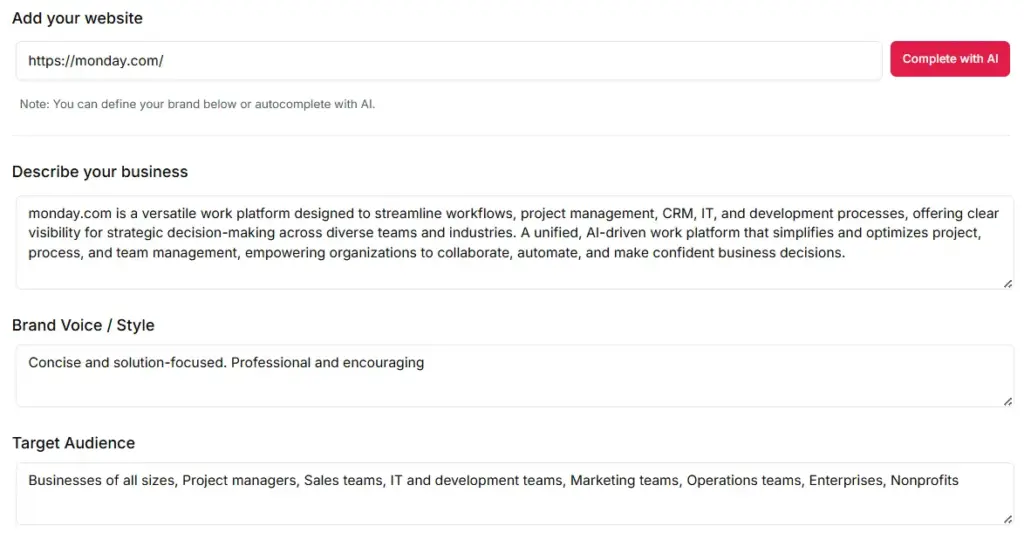
    article objective keywordly.ai

    Goal Alignments with the Buyer Journey With keywordly.ai, you can map each piece of content to funnel stages (TOFU, MOFU, BOFU). This is where Keywordly.ai gives you a competitive edge.

    Run a Comprehensive Content Audit

    Before you plan new content, you need to know what you already have, what’s working, and what’s failing. A content audit helps you analyze all existing assets—blogs, videos, landing pages, emails, and guides—to identify opportunities, eliminate underperformers, and double down on proven winners.

    Why Content Audits Are Crucial

    According to Semrush’s Content Marketing Report, companies that audit their content at least twice a year see up to 30% better performance in search rankings and engagement compared to those that don’t. Without an audit, you risk:

    • Duplicating topics that don’t bring results.
    • Leaving high-performing assets under-optimized.
    • Wasting resources on content that no longer serves your audience.

    Choose Your Core Content Pillars & Topics
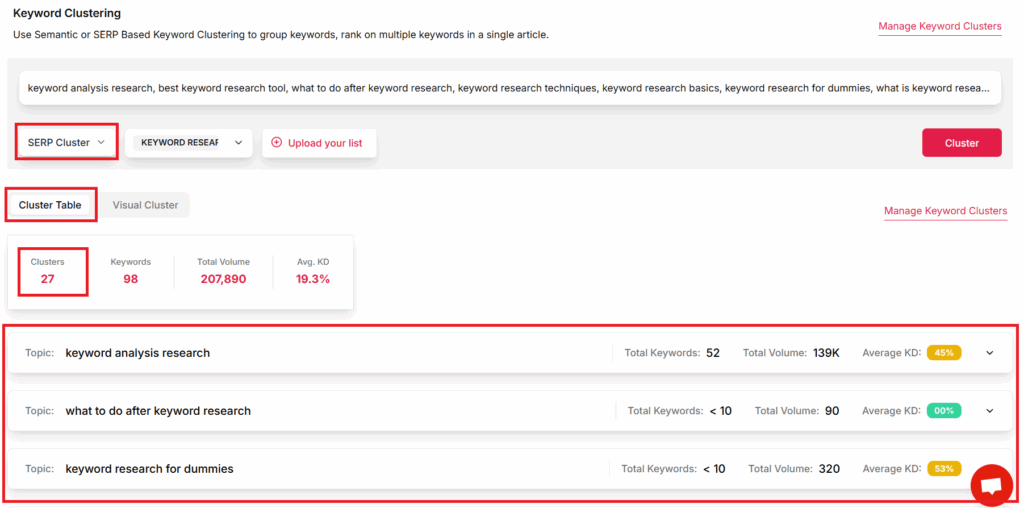
    cluster mapping 2

    Once you’ve audited existing assets, the next step is to build the foundation of your content strategy plan: your content pillars and supporting topics. Without these, your content risks becoming scattered and inconsistent, which makes it harder to rank on Google or move prospects through the funnel.

    What Are Content Pillars?

    Content pillars are the central themes that define your brand’s expertise. Each pillar is supported by a cluster of related topics that reinforce your authority in that area.

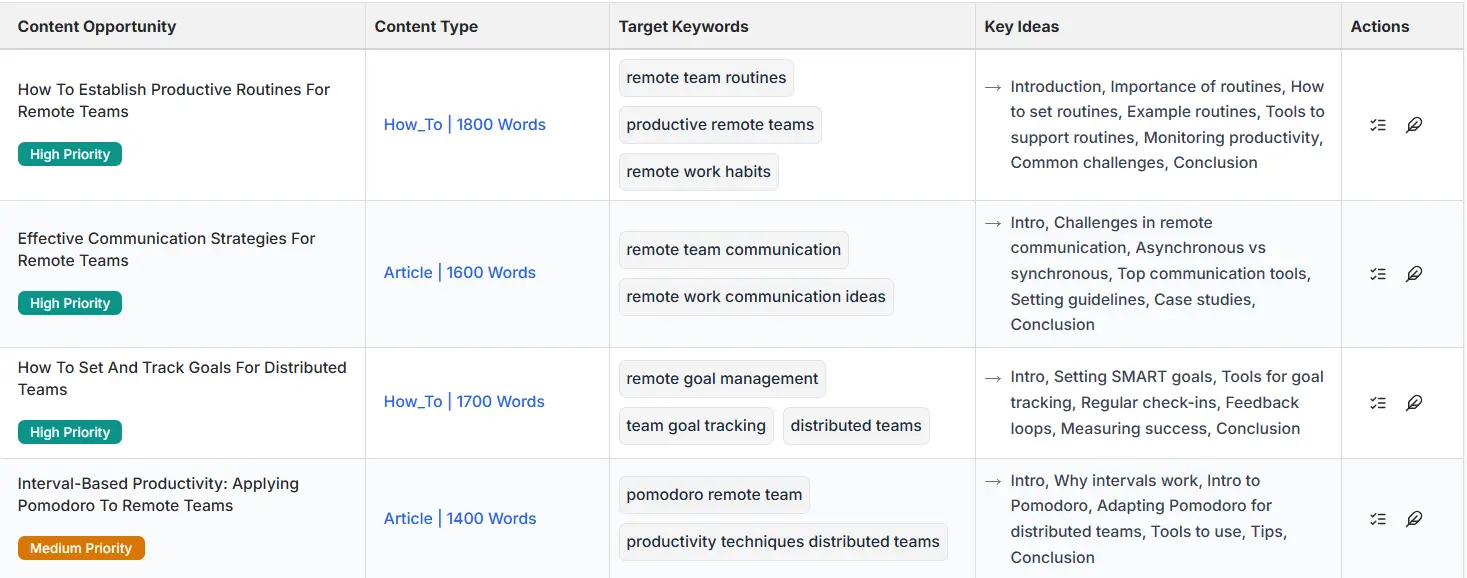
    For example, if your company is in the SaaS-based project management platform, a key content pillar might be: “Remote Team Productivity.”

    Supporting cluster topics could include:

    • 10 Remote Work Challenges and How to Solve Them
    • The Ultimate Guide to Scaling Remote Teams Efficiently
    • Future of Remote Collaboration: AI & Automation in Project Management

    This pillar + cluster approach is exactly what Google rewards when ranking for topical authority.

    Why Pillars Are Crucial

    • They improve SEO by signaling expertise in a domain.
    • They streamline production since all content ladders up to clear themes.
    • They guide users through the buyer journey, from awareness to decision.

    Instead of random posts, you’re building a knowledge hub that both humans and search engines trust.

    Steps to Defining Your Content Pillars

    1. Identify Business Priorities
      • Align content themes with revenue goals (e.g., SaaS growth, lead generation).
    2. Conduct Keyword Research
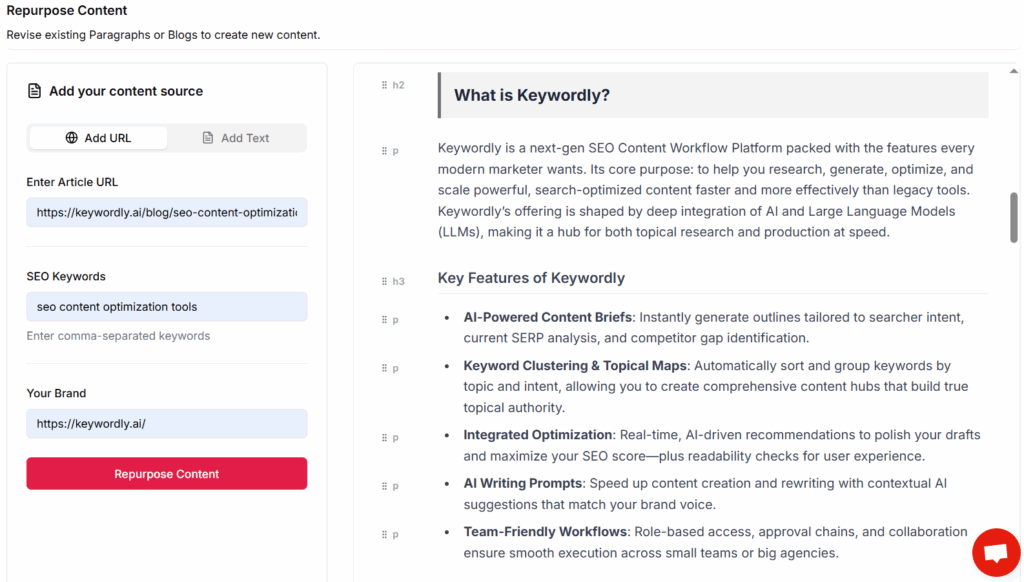
      • Use Keywordly.ai to find high-value, high-intent keywords within your niche.
      • Example: “Remote Team Productivity” → long-tail variations: “Remote Team Challenges” ,“Remote Teams Efficiency.”
    3. Analyze Competitors
      • See which pillars competitors dominate.
      • Spot content gaps where you can differentiate.
    4. Build Pillar-Cluster Maps
      • Core pillar: Remote Team Productivity
      • Clusters: Best practices for remote team productivity, Remote team productivity tools and software, Remote team management and Leadership.

    How Keywordly.ai Supercharges Pillar Development

    • Keyword Opportunity Finder – Surfaces untapped, high-converting keywords to form new clusters.
    • SERP Competitor Analysis – Shows what authority sites rank for and where gaps exist.
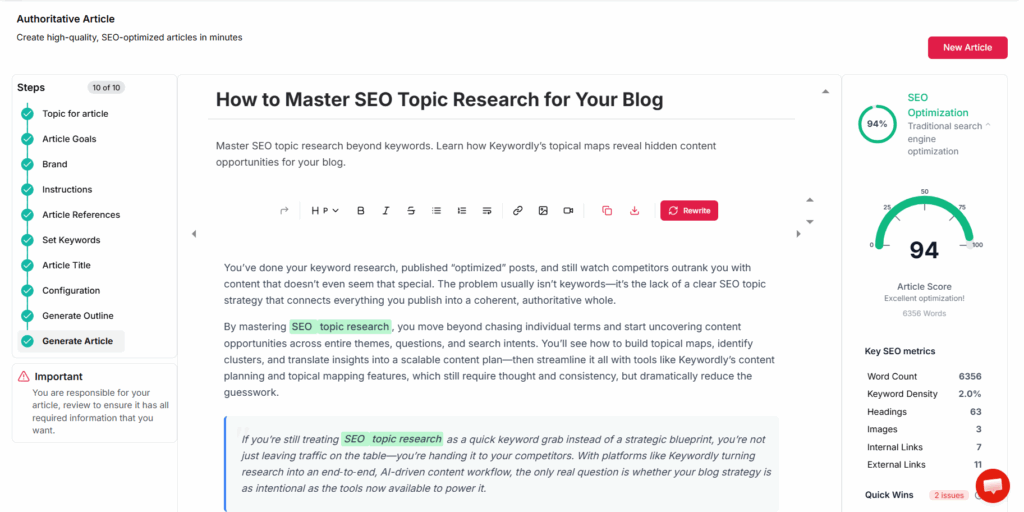
    • Cluster Visualization – Generates visual topic maps so your team can see how all pieces of content connect.
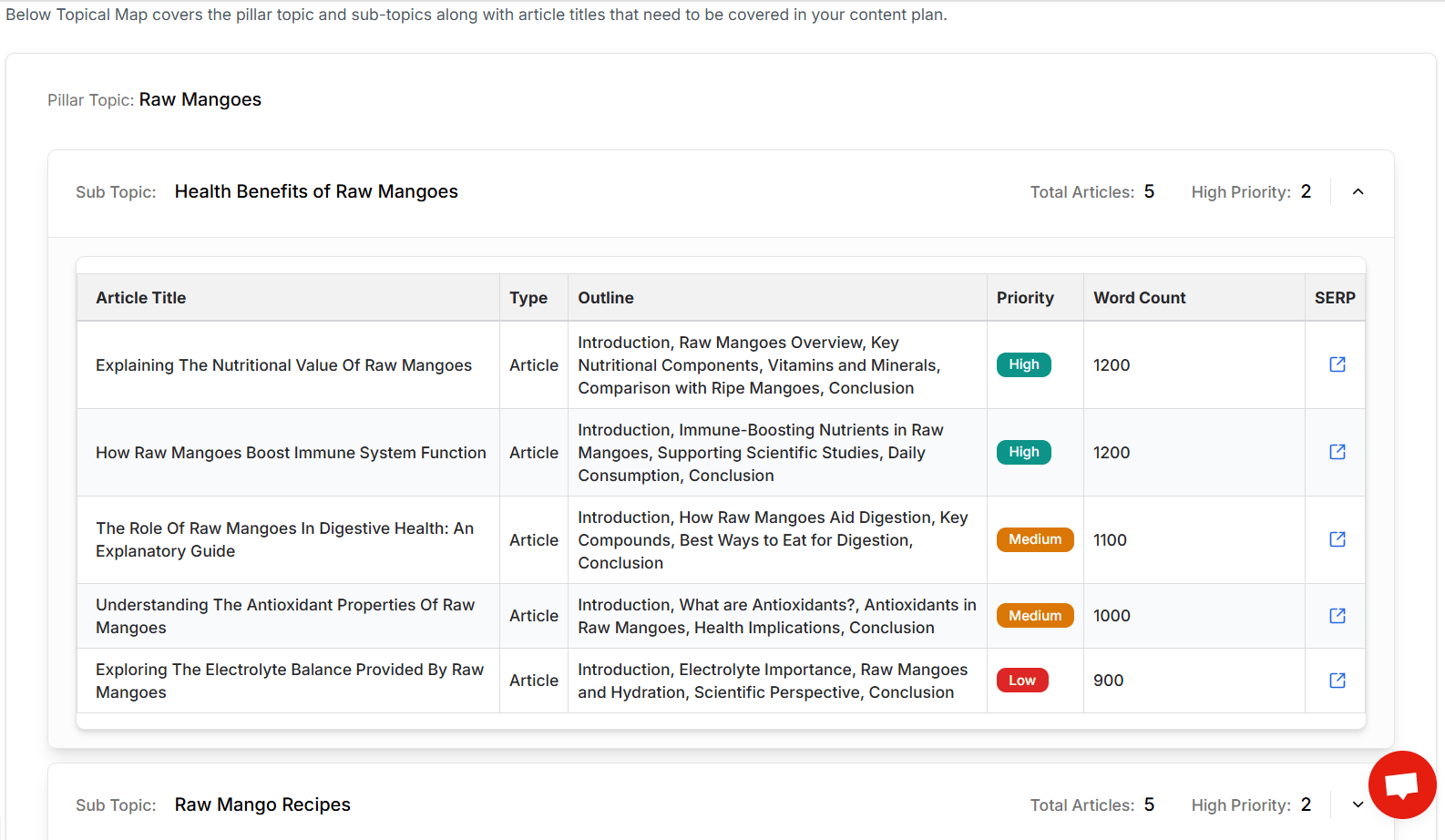
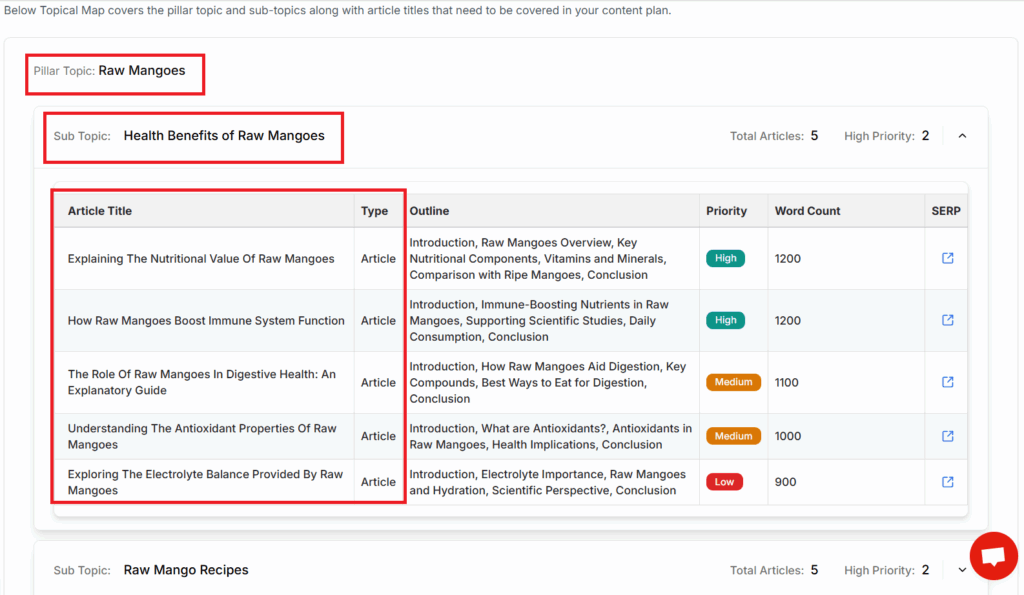
    • Content Oppturnity – Keywordly.ai generates the content oppturnity or content topics that that your content pillar need to cover.

    This ensures you’re not just creating “content for content’s sake,” but building a strategic library aligned with ROI.

    Decide on Content Formats & Channels

    Once you’ve defined your pillars and topics, the next step is to decide what formats to create and where to distribute them. Choosing the right format-channel mix ensures your content not only reaches your audience but also engages them in the way they prefer to consume information.

    Why This Step Matters

    According to Statista, consumers spend over 7 hours per day consuming digital content across multiple platforms. If you publish only blogs but your audience prefers videos, podcasts, or social snippets, you’ll miss engagement opportunities.

    The goal isn’t to be everywhere—it’s to be strategic about format + channel alignment so that each piece of content supports your funnel goals.

    Build an Editorial Calendar & Workflow

    Once you’ve chosen your content formats and channels, the next step is to organize production and publishing. This is where an editorial calendar and a clear workflow come in. Without them, content projects slip through the cracks, deadlines are missed, and team accountability breaks down.

    Why Editorial Calendars Matter

    According to CoSchedule, marketers who document their content schedules are 60% more likely to be successful. A well-structured editorial calendar ensures:

    • Content aligns with strategic goals (not random posting).
    • Teams know who’s responsible for what.
    • Publishing stays consistent across formats and channels.

    How Keywordly.ai Streamlines Editorial Planning
    content brief
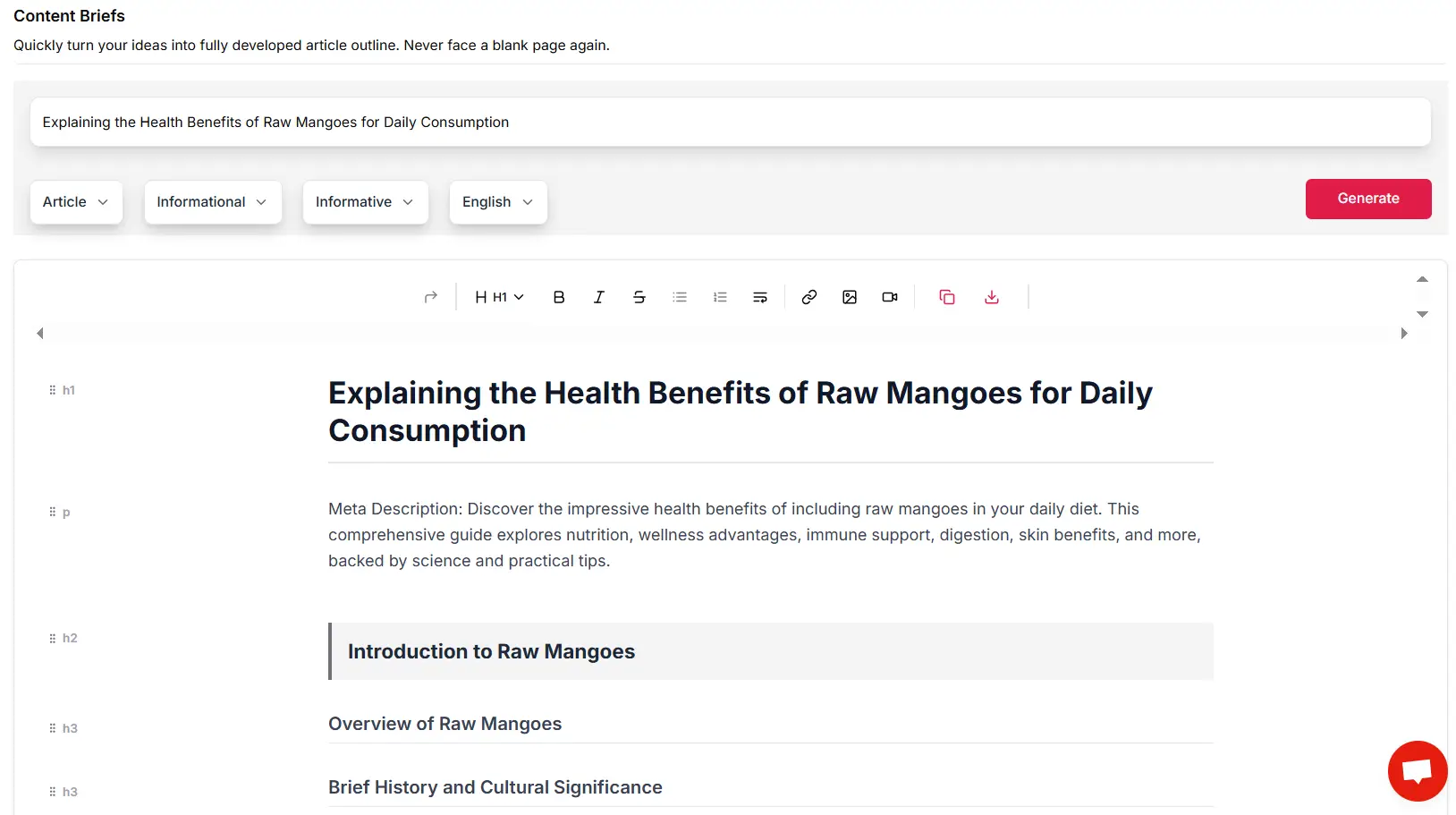
    • AI-Powered Briefs – Generates keyword-rich content briefs with suggested headings, FAQs, and search intent insights, reducing research time by 70%.
    • Topical & Sub-Topical Clustering – Builds advanced topical maps so your editorial calendar isn’t just a list of posts, but a structured strategy that strengthens authority and rankings.
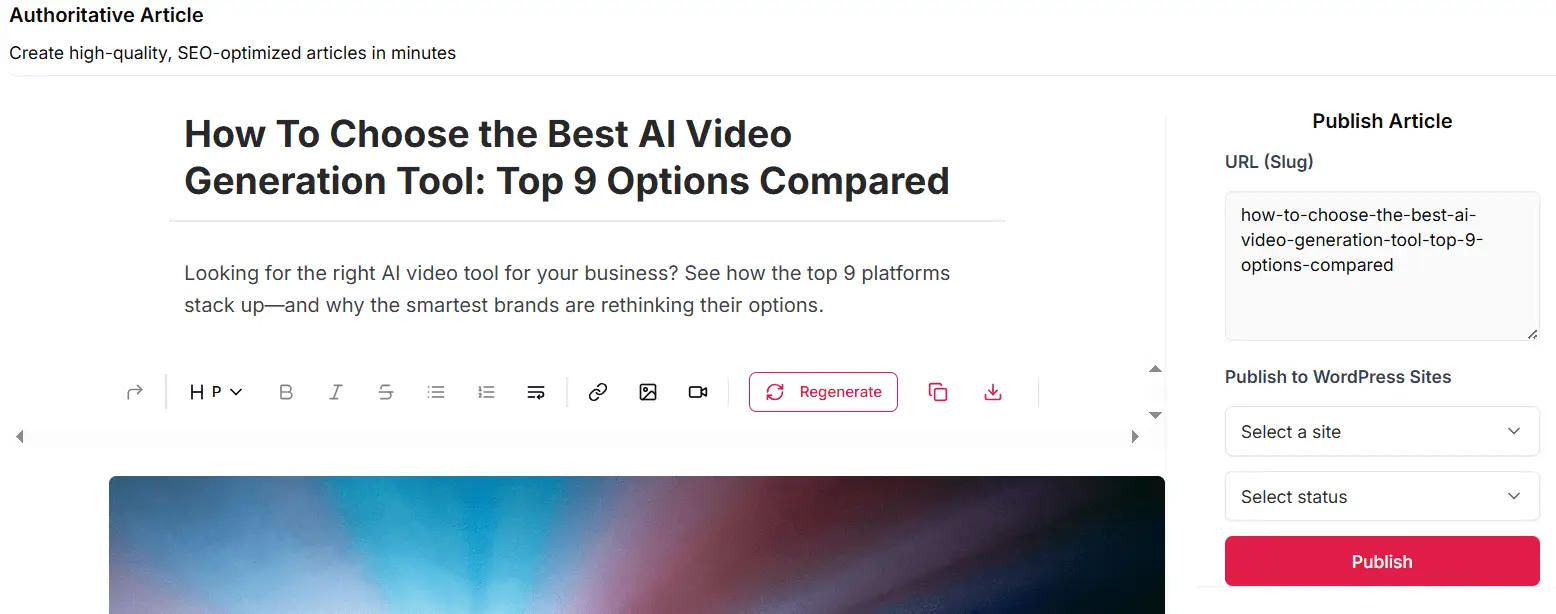
    • Seamless Content Generation Workflow – From research → brief → draft → optimization, Keywordly.ai creates a smooth end-to-end flow, eliminating bottlenecks and saving hours of manual coordination.
    • CMS Publishing & Integration – Directly integrates with popular CMS platforms (WordPress, Webflow, HubSpot, etc.), so your team can push optimized drafts live without messy copy-paste or formatting errors.

    Instead of a static spreadsheet, your editorial plan becomes a dynamic, ROI-focused system.

    article generation workflow keywordly.ai

    Budget, Resources & Tools Planning (Often Ignored but Essential)

    Even the best content strategy plan can collapse without the right budget allocation, team resources, and supporting tools. Many businesses fail here because they underestimate the time, money, and skills required to produce content that actually delivers ROI.

    Why Budgeting Matters

    According to the Content Marketing Institute, 42% of marketers say they don’t have enough budget to execute their strategy effectively. Without clear planning, teams either:

    • Spread resources too thin across channels.
    • Invest in the wrong tools.
    • Miss out on opportunities to scale.

    A well-defined budget ensures you’re investing in content that directly supports business goals, not just adding noise.

    Leverage AI & Automation for Efficiency

    The content landscape is becoming more competitive every day. Publishing random blogs or posting occasionally on social media no longer works — you need to scale without sacrificing quality. This is where AI and automation transform a content strategy plan from “manual and reactive” to efficient, predictive, and ROI-driven.

    Why Automation is Non-Negotiable

    According to a Gartner report, by 2025, 80% of marketing leaders will rely on content automation tools to stay competitive. Manual content operations simply cannot:

    • Keep up with increasing content demand.
    • Optimize for ever-changing search algorithms.
    • Deliver personalized, multi-channel experiences at scale.

    Automate Repetitive Content Tasks

    AI and automation save your team hours each week by handling:

    • Keyword Research – Identifying high-opportunity keywords faster than manual methods.
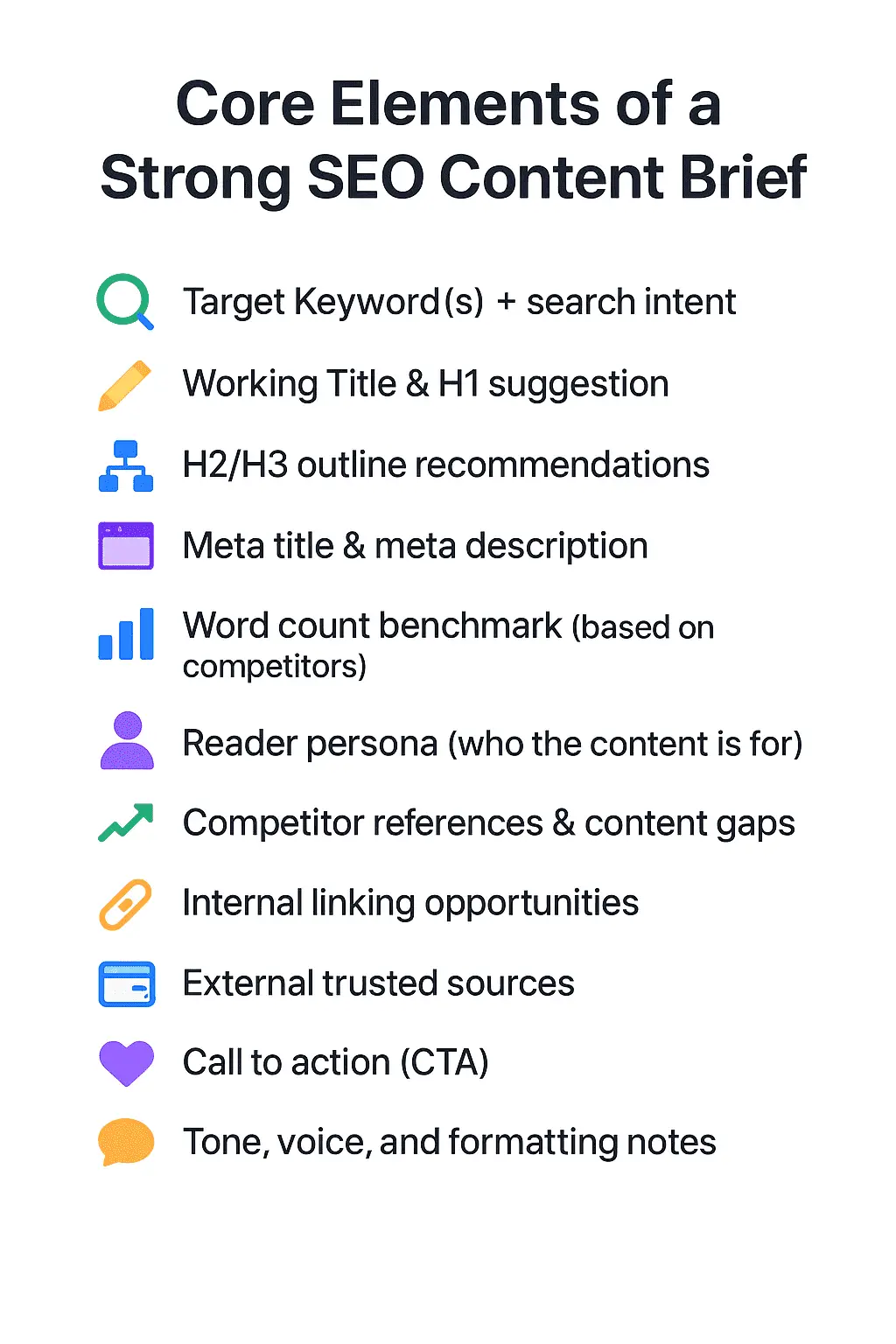
    • Content Briefs – Auto-generating outlines with search intent, suggested headings, and competitor insights.
    • Editorial Scheduling – Auto-updating calendars based on deadlines and performance.
    • Content Repurposing – Turning blogs into videos, infographics, and social posts.
    • Optimization Suggestions – Real-time recommendations for word count, readability, and keyword density.

    Integrate AI into Your Workflow – Read this article


    How Keywordly.ai Differentiates Itself

    Unlike generic AI writing tools, Keywordly.ai is built for end-to-end content strategy management:

    • SEO-first briefs → No guesswork in targeting keywords.
    • Content pillar mapping → Ensures alignment with your long-term strategy.
    • Workflow automation → Replaces multiple disconnected tools (saving time and budget).
    • This makes it not just an AI assistant, but your content strategy engine.

    Measure, Analyze & Continuously Improve

    A content strategy plan isn’t “set and forget.” It’s a living framework that must evolve with audience behavior, algorithm updates, and business priorities. The brands that win are not those who publish the most, but those who learn the fastest from performance data and adapt in real time.

    Why Continuous Measurement Matters

    According to HubSpot, 75% of marketers measure their content’s performance only by traffic. That’s a mistake. Traffic is a vanity metric unless it leads to conversions.

    Instead, focus on actionable KPIs such as:

    • Engagement Metrics → Avg. time on page, scroll depth, bounce rate.
    • SEO Metrics → Keyword rankings, organic traffic growth.
    • Conversion Metrics → Demo requests, downloads, signups.
    • Revenue Attribution → Sales pipeline contribution and customer acquisition cost (CAC).

    Case Study Example

    A SaaS company using Keywordly.ai reduced content production time by 40% and improved lead conversion by 25% by automating keyword research, brief creation, and content scoring. This allowed the team to focus more on creative storytelling and distribution strategy, while the platform handled repetitive, data-heavy tasks.

    Conclusion

    Creating a content strategy plan is no longer optional — it’s the backbone of sustainable growth in today’s competitive digital landscape. From defining clear goals and building strong content pillars to setting up workflows, budgeting wisely, and leveraging AI, the difference between brands that publish content and brands that win with content lies in how well they can execute, adapt, and scale.

    The challenge? Doing all of this manually takes too much time, too many tools, and too many disconnected processes. That’s where Keywordly.ai comes in.

    • It helps you research smarter with AI-powered keyword and topical clustering.
    • It helps you plan better with topical cluster maps tied to editorial calendars.
    • It helps you create faster with optimized content briefs and seamless workflows.
    • It helps you publish easier with CMS integrations.

    With Keywordly.ai, your content strategy isn’t just a document — it becomes a living, automated system that continuously drives measurable business results.

    Don’t just plan your content strategy. Put it into motion.
    Try Keywordly.ai today and see how it can transform your content plan into a revenue engine.

    👉Start your free trial of Keywordly.ai today and turn your strategy into ROI.

    FAQs

    What is the difference between a content strategy and a content strategy plan?

    A content strategy defines the why and what behind your content (goals, audience, messaging), while a content strategy plan focuses on the how — the step-by-step roadmap for execution, workflows, publishing, and measurement.

    How long does it take to see results from a content strategy plan?

    Typically, you’ll see initial SEO and engagement results within 3–6 months, depending on your industry and competition. With AI tools like Keywordly.ai, you can accelerate research, planning, and optimization, shortening the time to measurable ROI.

    What are the key elements of a successful content strategy plan?

    The most important elements include: setting SMART goals, identifying buyer personas, choosing content pillars, building an editorial calendar, budgeting resources, leveraging AI automation, and continuously measuring and optimizing.

    How can AI improve my content strategy plan?

    AI can automate keyword research, create SEO-rich content briefs, suggest topic clusters, streamline workflows, and track ROI. Platforms like Keywordly.ai also integrate with CMSs, making publishing and performance analysis seamless.

  • Competitor Keyword Analysis: A Complete Step-by-Step Guide

    Competitor Keyword Analysis: A Complete Step-by-Step Guide

    Did you know that 89% of marketers believe that competitor keyword research is essential for growing online visibility? If you’ve ever wondered how rival brands manage to outrank you on search engines, you’re not alone—cracking their keyword strategy can seem complex.

    Whether you’re a business owner or a digital marketer, uncovering your competitors’ best keywords is your ticket to crafting more effective content and attracting the right audience. This step-by-step guide walks you through smart ways to find, analyze, and leverage your competitors’ top-performing keywords. You’ll discover methods for identifying your real competitors, using powerful research tools, and integrating high-impact keywords into your own content strategy. Expect to spend a couple of hours gathering and analyzing data to boost your site’s targeted traffic and stay ahead in your industry.

    In the digital battleground of business, knowing your competitor’s keywords is like discovering the secret map to buried treasure — the art lies in being the first to decode it.

    Identify Your Top Competitors

    Competitor keyword analysis helps you find out what keywords competitors are using, what keywords they’re ranking for, and where your site can realistically compete. Instead of guessing, you can check competitor keywords, uncover keywords used by competitors, and align your SEO strategy with proven demand.

    Knowing who your competitors are is a foundational step in developing a strong digital strategy. By understanding the competitive landscape in your industry, you can pinpoint opportunities for differentiation and better serve your audience’s needs. Whether you’re a startup or an established company, a thorough competitor analysis informs every other aspect of your marketing plan.

    Research Direct and Indirect Competitors in Your Niche

    Begin by mapping out businesses that operate within your space, including those offering similar products or services (direct competitors) and those serving the same customer needs in different ways (indirect competitors). For instance, if you run a meal delivery service, direct competitors include other meal kits, while indirect competitors may be local restaurants with take-out options. This broader approach ensures you’re not caught off guard by alternative solutions your customers might consider.

    Use Online Tools to Validate Competitors

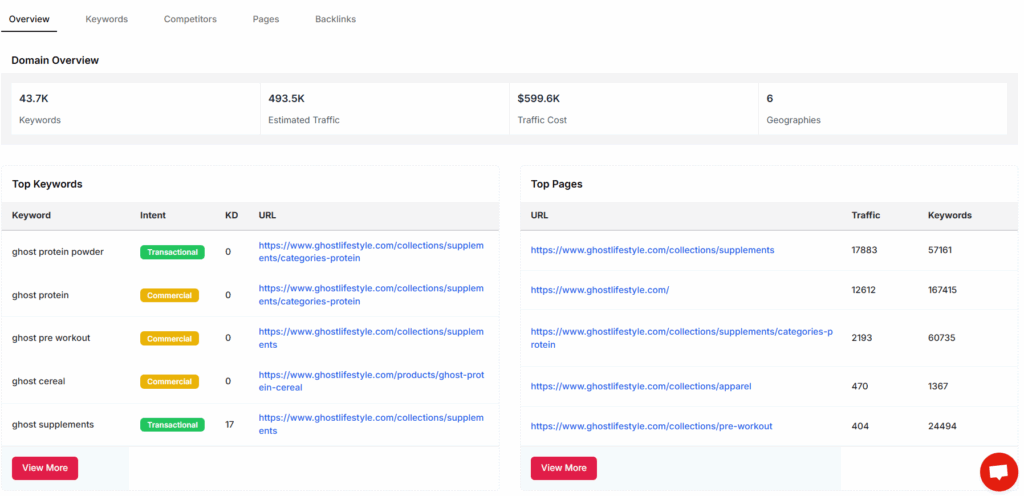
    competitor keyword research
    Keywordly’s Competitor/ Organic Research

    Leverage tools like Keywordly, Ahrefs, or SimilarWeb to verify your initial competitor list. These platforms allow you to analyze domain traffic, keyword rankings, and referral sources to confirm which brands are vying for your audience’s attention online. For example, a case study from a SaaS company showed that using these tools led to the discovery of emerging competitors they weren’t previously tracking.

    Analyze Market Positioning and Brand Presence

    Keywordly competitor analysis overview
    Keywordly’s Competitor/ Organic Research – Competitor Overview

    Dive into how each competitor presents themselves across web, social, and offline channels. Assess their messaging, customer reviews, and brand voice to determine their unique selling points. This helps identify gaps in their approach—such as a lack of personalized customer service—that your business can capitalize on to stand out.

    Prioritize Competitors Based on Digital Footprint

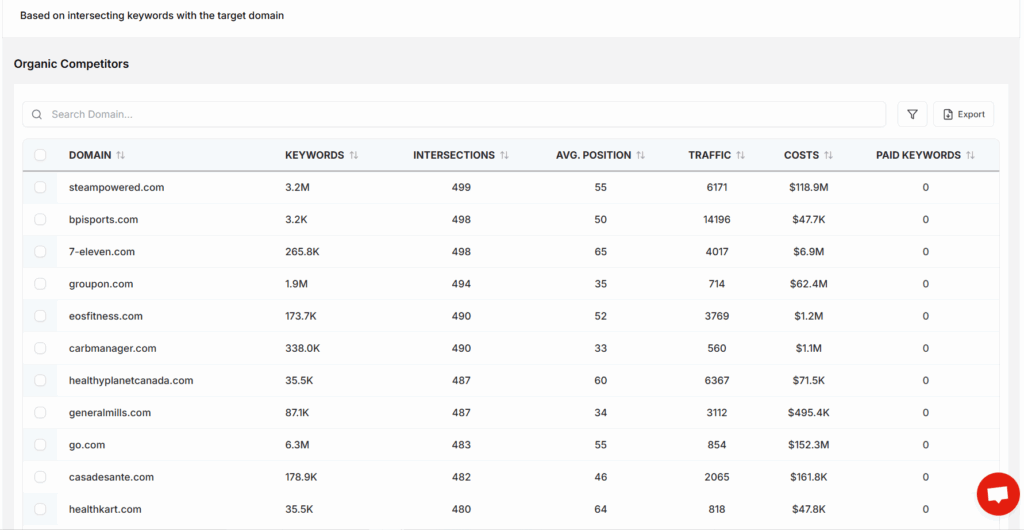
    keywordly competitor analysis- organic competiors
    Keywordly’s Competitor/ Organic Research – Orgainc Competitors

    Start by listing 3–5 domains you compete with in search. These are the sites you’ll check competitor keywords against to understand your competitors keywords and ranking patterns.

    Organize your competitor list by those with the most substantial digital footprint—large followings, high traffic volumes, or significant media mentions. Focusing on competitors with a strong online presence ensures you’re benchmarking against brands your audience is actually engaging with. For instance, a retail brand might prioritize large e-commerce sites over local boutiques with minimal online activity.

    Why Competitor Keyword Analysis Moves the Needle for Your SEO

    When you analyze competitor website keywords, you’re not just collecting data — you’re understanding real search intent. By seeing what keywords your competitors are ranking for, you can spot content gaps, identify missed long-tail opportunities, and prioritize keywords with proven traffic potential.

    For example, if your competitors keywords include transactional or comparison terms you’re not targeting, that’s a clear signal to create or optimize content. This approach helps you find competitor keywords that already convert, instead of chasing keywords blindly.

    “Competitor keyword analysis works best when it’s used to understand why pages rank — not just which keywords they rank for. The real opportunity lies in uncovering intent gaps, not copying keyword lists.”

    Read this Article: Best AI Keyword Research Tools for SEO in 2026

    Find Keywords Your Competitors Are Using

    Gather Competitor Keyword Data
    Gather Competitor Keyword Data

    How to Find Keywords Your Competitors Are Using

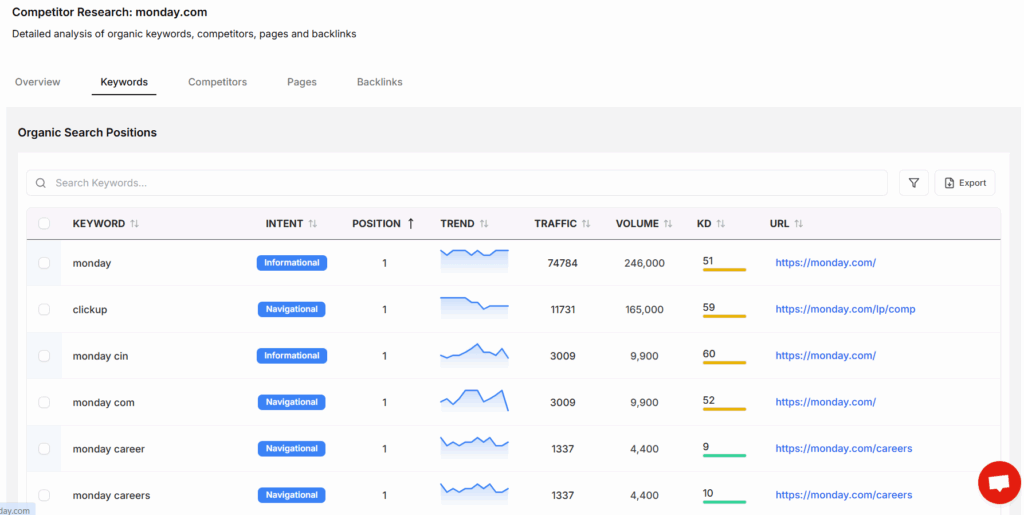
    To find keywords competitors are using, plug a competitor domain into Keywordly’s Organic research tools . The tool allow you to see competitors keywords, get competitors keywords, and analyze what keywords do my competitors rank for across pages.

    Understanding what keywords your competitors are targeting is essential for building a robust SEO and SEM strategy. By analyzing their keyword footprints, you can discover gaps, identify emerging trends, and capitalize on proven search terms. This not only fine-tunes your own campaigns but provides fresh insight into your market and audience preferences.

    “SEO tools reveal what keywords competitors rank for, but value comes from filtering those keywords by intent, competition, and content depth. Without this step, competitor research stays purely observational.”

    Check Competitor Website Keywords Page-Wise

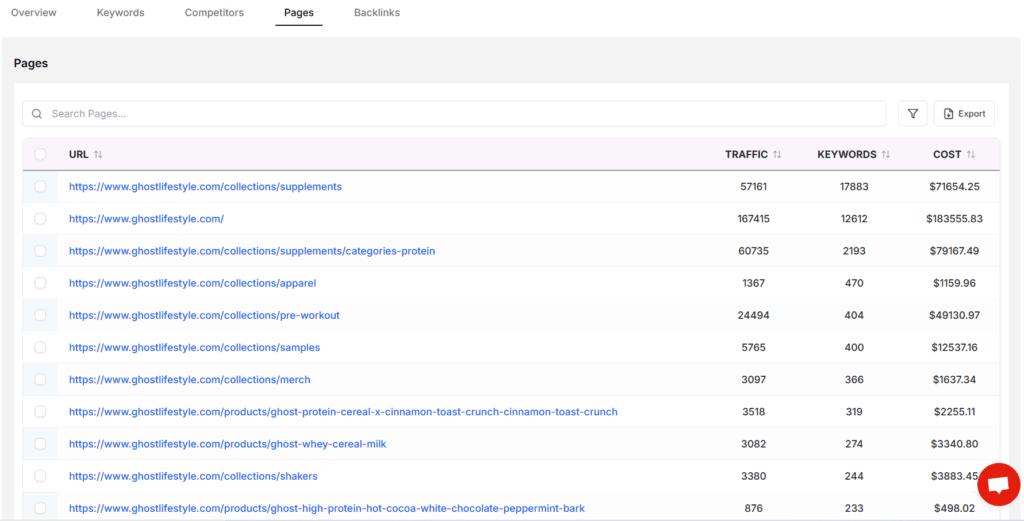
    Keywordly competior analysis - pages
    Keywordly’s Competitor/ Organic Research – Competior Pages

    Reviewing individual pages helps you check competitor website keywords and understand how competitors structure content. This is one of the fastest ways to find out what keywords competitors are using on high-performing URLs.

    Start by choosing the main competitor domains within your industry or niche. Use SEO tools like SEMrush, Ahrefs, or Moz to input these domains and review the full spectrum of terms they rank for. This high-level overview helps you gauge the scope of their organic reach and spot areas where your content is lacking. For example, a local boutique may find that a regional chain consistently outperforms on certain product keywords, guiding them to adjust their content strategy accordingly.

    Extract Organic and Paid Keyword Lists from Competitor Websites

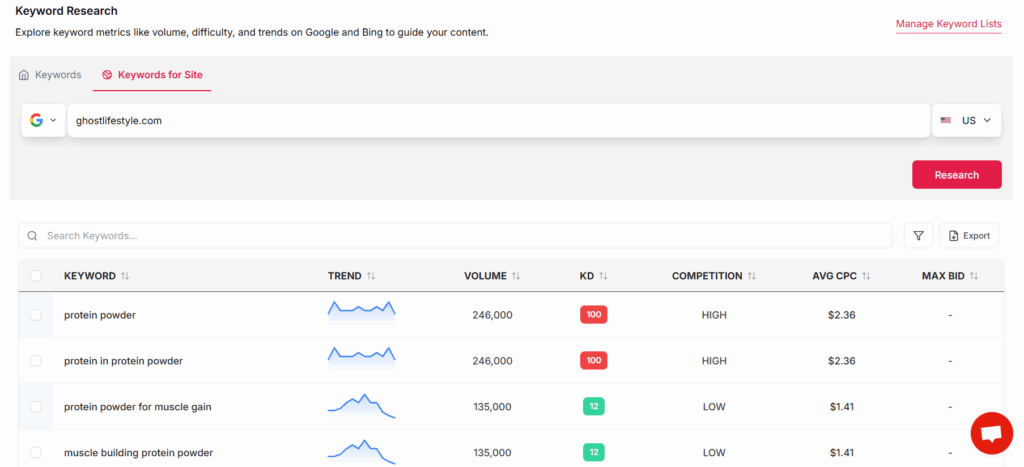
    keywords from website
    Keywordly’s Keyword Research – Extract Keywords from Website

    Dive deeper by segmenting the keywords driving traffic for your competitors. With digital marketing platforms, you can separate organic search terms from paid keyword campaigns, revealing where their ad budget is focused and which organic terms bring consistent traffic. Many businesses, especially e-commerce stores, use this analysis to identify profitable keywords they might be missing in their current campaigns.

    Export Keyword Data for Deeper Analysis

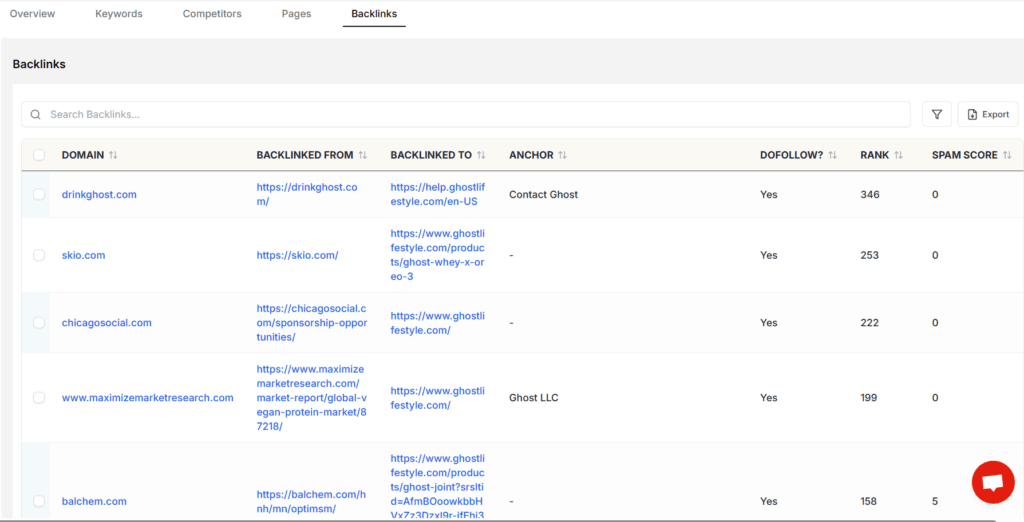
    Keywordly competitor analysis backlinks
    Keywordly’s Competitor/ Organic Research – Competitor Backlinks

    Once you’ve compiled comprehensive keyword lists, export the data for further examination. Spreadsheets allow for advanced sorting, filtering, and comparison across multiple competitors or time periods. Marketing teams often use this exported data to map content gaps, track keyword difficulty, and prioritize optimization efforts efficiently.

    Monitor Ongoing Keyword Updates and Trends

    Keyword popularity is always changing, especially with seasonal trends or new industry developments. Set up alerts with your chosen tools to monitor shifts in competitor rankings and keyword usage. For instance, if a rival suddenly gains traction on a trending keyword, your business can quickly adapt its strategy to remain visible and competitive in search results.

    Read this Article: Find Competitor’s PPC Keywords and Exploit Gaps

    Analyze Your Competitors’ Top Ranking Keywords

    [youtube=https://www.youtube.com/watch?v=JMcDQeJKbY4]

    Analyze Your Competitors’ Top Ranking Keywords

    Knowing what keywords drive traffic and conversions for your competitors is essential for creating a strong content and SEO strategy. By dissecting your rivals’ best-performing keywords, you can unlock opportunities to refine your targeting and better position your business in search results. Here’s how you can systematically analyze these high-value keywords to improve your competitive edge.

    Identify High-Traffic and High-Conversion Keywords

    Start by using keyword research tools to uncover keywords bringing significant traffic to your competitors’ websites. Focus not just on volume but also on those terms with proven conversion rates. For example, an ecommerce retailer might notice that a competitor ranks highly for “buy standing desk online,” a phrase with strong purchase intent. Prioritizing these types of keywords helps ensure your efforts target search terms that can lead to tangible business results.

    Filter by Intent & Opportunity

    • Filter results to find keywords used by competitors with informational or commercial intent
    • Prioritize keywords where you can realistically outrank competitors with better content depth

    After identifying potential keywords, assess the intent behind them—are searchers looking to buy, learn, or compare? Make sure the keywords align with your offerings and resonate with your target audience. For instance, a SaaS company may differentiate between informational intent (like “how to use project management tools”) and transactional intent (“project management software pricing”) to tailor content accordingly.

    Evaluate Keyword Difficulty and Ranking Potential

    Examine how challenging it would be to rank for each keyword based on authority, content quality, and backlink profiles. Use tools to analyze keyword difficulty scores and estimate how much effort and resources you’ll need to compete. For a mid-sized business, targeting moderately competitive keywords might yield faster results compared to chasing heavily contested phrases owned by big industry players.

    Group Keywords by Searcher Intent and Funnel Stage

    Finally, organize your list of keywords based on user intent and where they fit in the buyer’s journey. Grouping keywords into categories—for awareness, consideration, or decision—helps you develop content that meets users’ needs at every stage. A B2B services firm, for example, could separate educational queries from those showing purchase intent, allowing for more personalized content and optimized conversion paths.

    Spot Keyword Gaps and Opportunities

    Spot Keyword Gaps and Opportunities
    Spot Keyword Gaps and Opportunities

    Uncovering keyword gaps and new opportunities is a crucial part of refining your SEO strategy. By analyzing which terms your competitors rank for—but you do not—you can discover hidden content opportunities that directly support your business’s value proposition. Keyword gap analysis helps you zero in on potential traffic sources you may have overlooked, ensuring your business stays competitive in search rankings and continues to appeal to your target audience.

    Compare Your Keyword Profile with Competitors’

    Begin by conducting a side-by-side comparison of your keyword rankings against those of your main competitors. Use tools like SEMrush or Ahrefs to pull up both profiles and identify where competitors are gaining organic traffic that you are missing. For example, an e-commerce brand might notice rival stores ranking for trending product terms or seasonal keywords not yet adopted within their content. This comparison allows you to pinpoint the precise SERP positions and search intents where your site could gain traction.

    Use Gap Analysis Tools to Isolate Missing Keywords

    Gap analysis tools automate the process of isolating keywords you have yet to target. They scan both your and your competitors’ domains, surfacing queries that drive traffic to others but are absent from your site. Creating content around these keywords—especially if they are closely tied to your product or service—can provide quick SEO wins. For instance, a SaaS company can quickly adjust its content plan after discovering a competitor ranking for software integration terms it hasn’t pursued yet.

    Find Long-Tail and Niche Keyword Opportunities

    While broad keywords are often saturated, there’s immense value in finding long-tail and niche keyword phrases that align with your core offerings. Long-tail keywords generally have less competition and can attract more qualified leads. Use keyword research tools to dig beneath the surface, looking for less-obvious queries that reflect specific customer needs. Businesses that focus on these terms often see higher engagement and better conversion rates, as the traffic is more closely aligned with their unique value.

    Map Keyword Gaps to Your Business Value Propositions

    Effective keyword targeting should always be rooted in your brand’s unique selling points. After identifying your gaps, map them against your business’s key value propositions. Prioritize keywords that reflect your primary benefits and differentiators. For example, if your company prides itself on rapid customer support, focus on content that targets searchers looking for fast, reliable service in your space. This method ensures that your SEO strategy directly reinforces your brand and attracts the ideal customers.

    How to Turn Competitor Insights into your Traffic & Rankings

    [youtube=https://www.youtube.com/watch?v=NadiT0HYt4Y]

    Apply Competitor Keywords to Your Strategy

    Once you research competitors keywords, the real value comes from execution:

    • Page optimization: Update existing pages using competitor keywords you’re missing
    • New content clusters: Create supporting articles around find competitors keywords insights
    • Long-tail wins: Target variations competitors rank for but haven’t fully optimized

    Understanding which keywords drive traffic for your competitors provides actionable insight for your SEO efforts. By intelligently applying competitor keyword data, businesses can not only boost their search visibility but also capture qualified leads more efficiently. Here’s how you can strategically implement these keywords to refine your content marketing plan and see measurable results.

    “The goal of competitor keyword research isn’t visibility into their strategy — it’s translating those insights into better pages, clearer content structure, and stronger topical authority.”

    Integrate Winning Keywords into Your Content Planning

    Start by identifying the high-performing keywords your competitors rank for but you currently do not. Map these keywords to relevant stages of your customer journey and content funnel. For example, a B2B software provider used competitor keyword analysis to discover new long-tail phrases. By integrating these keywords into their editorial calendar, they filled crucial content gaps and reached prospects during research and evaluation phases.

    Optimize Existing Content with New Keyword Insights

    Updating your current articles and landing pages with competitive keywords helps you reclaim lost ranking opportunities. Analyze competitor use of these keywords—notice placement in headings and meta descriptions—and thoughtfully incorporate them into your content. A fitness blog re-optimized its best-performing posts after this analysis and achieved a 25% traffic uptick within three months.

    Develop Targeted Landing Pages and Blog Posts

    Targeting high-value competitor keywords with dedicated content can position your brand as an authority. Craft landing pages and blog posts around specific keywords where competitors currently outrank you. For example, a local real estate agency developed new neighborhood pages optimized for competitor keywords; this strategy resulted in increased inquiries and stronger organic presence.

    Monitor and Iterate Your Keyword Strategy Regularly

    Competitor landscapes and search trends are dynamic. Schedule routine reviews to assess the effectiveness of your adopted keywords and adjust your content accordingly. Many growing e-commerce brands use quarterly keyword audits to refine their strategy, allowing them to sustain rankings and respond quickly to shifting customer interests.

    Track Performance and Adjust Your Approach

    Track Performance and Adjust Your Approach
    Track Performance and Adjust Your Approach

    After implementing keyword strategies and optimizing your content, it’s crucial to consistently monitor your progress and pivot as needed. By systematically tracking and analyzing key data, you can ensure your SEO efforts continue to drive meaningful results for your business and audience. Below are actionable steps to help you stay on top of your SEO performance and make informed adjustments.

    Set Up Keyword Performance Tracking in Analytics Tools

    The first step is to equip yourself with reliable analytics tools that can monitor keyword performance effectively. Platforms like Google Analytics and SEMrush allow you to set up keyword tracking, giving you access to insights such as search visibility and top-performing keywords. For example, a regional real estate business can track which neighborhood-specific keywords are attracting prospective buyers.

    Measure Changes in Rankings, Traffic, and Engagement

    Once your keywords are set up for tracking, closely measure changes in key metrics such as search rankings, website traffic, and on-page engagement (like bounce rates and session duration). This step uncovers direct connections between your SEO tactics and user behavior. For instance, if an adjusted product page sees more organic visits and longer stays, it may signal that your tweaks resonate with your target audience.

    Review Competitor Activity Periodically

    Understanding the competitive landscape is vital for refining your SEO approach. Regularly review what keywords competitors are ranking for and any new content strategies they’ve adopted. One practical approach is to set monthly reminders to compare your rankings versus competitors, which can reveal untapped opportunities or highlight areas that require attention.

    Refine Keyword Targeting and SEO Tactics Over Time

    SEO is an iterative process that benefits from ongoing review and adjustment. Use insights from your analytics to refine your keyword targeting—focus on phrases delivering results and experiment with new ones to reach different segments. Consider the example of a local coffee shop: after noticing increased visits from a blog post on “artisan coffee blends,” adjusting your strategy to publish similar content can boost visibility and engagement further.

    Conclusion

    Thoroughly researching competitor keywords is one of the most effective ways to shape a successful SEO strategy. By understanding the keywords that drive the most traffic and conversions for your competitors, you can identify opportunities to enhance your own content and increase visibility. This process not only helps in benchmarking your brand’s performance but also provides actionable insights for ongoing content optimization. When done correctly, competitor keyword analysis removes guesswork. You’re no longer asking “what should I rank for ” — you already know what keywords my competitors are ranking for, and how to outperform them.

    Applying Competitor Keyword Research for Business Growth

    By following this step-by-step guide to finding your competitors’ best keywords, your brand can gain deep insights, uncover valuable content opportunities, and stay ahead in the SEO game. Begin by identifying your direct competitors and analyzing their top-performing pages using SEO tools like Ahrefs, SEMrush, or Moz. Next, filter the discovered keywords by search volume and relevance, and assess where your content gaps exist compared to theirs. For example, a SaaS company might discover high-converting keywords their main competitors rank for but they do not, enabling them to craft targeted landing pages or blog posts that fill these strategic gaps.

    Continuous Optimization and Real-World Applications

    Regularly analyzing and adapting your strategy ensures ongoing growth, more effective targeting, and a stronger online presence. By setting a quarterly review schedule, businesses can monitor shifts in competitor rankings or emerging keyword trends. For instance, an e-commerce retailer might notice competitors gaining traction with seasonal keywords, prompting the brand to update product listings or create timely content for similar terms. Through consistent evaluation, brands not only maintain but also strengthen their position in search results, translating insights into actionable improvements and measurable ROI.

    “Marketers who revisit competitor keyword analysis regularly outperform those who treat it as a one-time task. Search behavior changes — and so should your keyword priorities.”

    Read this Article: 15 Best Keyword Research Tools for 2026

    Read this Article: What Is Keyword Research? Basics and Step-by-Step Process

    FAQs

    Understanding competitor keyword strategies can play a pivotal role in shaping your own SEO approach. Many business owners and marketers have common questions about how competitor keyword research works, the tools needed, and how to leverage these insights effectively. Here, we address some of the most frequently asked questions about competitor keyword analysis, offering practical tips and examples to guide your strategy.

    How do I find out what keywords my competitors are using?

    Use SEO tool like Keywordly to analyze competitor domains and extract keywords competitors are ranking for based on traffic, intent, and position.

    How can I see what keywords my competitors are using?

    By running competitor URLs through keywordly’s Orgainc research tools, you can see what keywords competitors are using across pages.

    What are competitor keywords, and why are they important?

    Competitor keywords are search terms your rivals rank for in search engine results. Identifying these keywords gives you direct insight into the topics and terms that drive traffic to your competitors’ websites. By understanding which keywords are working for others in your industry, you can spot content gaps and opportunities to attract similar or underserved audiences.

    Which tools are best for competitor keyword research?

    There are several reliable tools for discovering competitor keywords, including SEMrush, Ahrefs, and Moz. These platforms allow you to enter a competitor’s domain to instantly see high-performing keywords, traffic volumes, and ranking positions. Using such tools, a retail business owner could identify keywords used by larger brands, and tailor their content accordingly to compete in the same market.

    How frequently should I audit my competitors’ keywords?

    Regular competitor keyword audits help you stay ahead of market trends and respond to shifts in your industry. Most experts recommend reviewing competitor keywords quarterly or bi-annually, but more competitive industries may require monthly audits. For instance, digital marketing agencies often check competitors monthly to maintain their edge in fast-evolving sectors.

    Can small businesses benefit from competitor keyword analysis?

    Absolutely. Small businesses can level the playing field by identifying keywords that established competitors rank for, then optimizing their content to target those terms. A local boutique, for example, might find niche keywords overlooked by larger retailers and focus content efforts there for better visibility.

    What’s the difference between organic and paid competitor keywords?

    Organic competitor keywords are those your competitors rank for via natural search results, while paid keywords are those targeted through ads (like Google Ads). Both offer valuable insights: organic keywords reveal long-term content strategies, while paid keywords highlight what competitors are investing in for immediate results.

    How do I ensure my content stands out using similar keywords?

    The key is to provide unique value, perspectives, or resources around the same keywords competitors use. Consider creating comprehensive guides, incorporating real customer stories, or using richer media formats. A software company, for example, may outrank competitors by offering in-depth tutorials or actionable checklists others don’t provide.

  • SEO Content Writing: A Beginner’s Guide to Ranking Pages

    SEO Content Writing: A Beginner’s Guide to Ranking Pages

    Learn the beginner-friendly step-by-step process of SEO content writing that ranks — from keyword research and intent to on-page structure, featured snippet tactics and a printable checklist.

    Introduction

    If you’re writing blog posts, guides, or landing pages and wondering why they don’t get traffic — this guide is for you. SEO content writing is the craft of creating content that gives people useful answers and tells search engines clearly what your page is about. Done well, it brings consistent organic traffic over time — often the single most cost-effective channel for long-term growth. According to industry data, search still powers a large share of online discovery — making SEO a core skill for any content creator.

    In this guide you’ll get a step-by-step process, checklist and simple tactics to target featured snippets and improve click-throughs.

    “SEO content writing isn’t about stuffing keywords — it’s about creating content that answers real user questions in a way search engines can clearly understand.”

    What is SEO content writing?

    SEO content writing = writing content for humans that’s intentionally structured and optimized so search engines can understand, surface, and match it to the right queries.

    Key idea: write for people first — then scaffold the page so search engines can find and rank it. Google itself emphasizes “people-first” content as the main path to long-term success.

    Why SEO content writing still matters 

    • A large fraction of online experiences still begin with a search engine — search remains a major discovery channel.
    • Ranking #1 in Google typically captures a disproportionately large share of clicks compared to positions below it — so small improvements in ranking often lead to big traffic gains. (CTR curves remain steep.)
    • Patience is required: industry studies and practitioner data show that meaningful organic gains often take months; some pages that rank at the top are years old, meaning topical authority and updates matter. Expect initial ranking improvements in 3–6 months, while top positions for highly competitive terms can take longer.
    • SEO writing pays off over time — but you must plan for quality, topical coverage, and a regular update/promotion process.
    “If your content helps users solve a problem better than competitors, rankings become a byproduct — not the goal.”

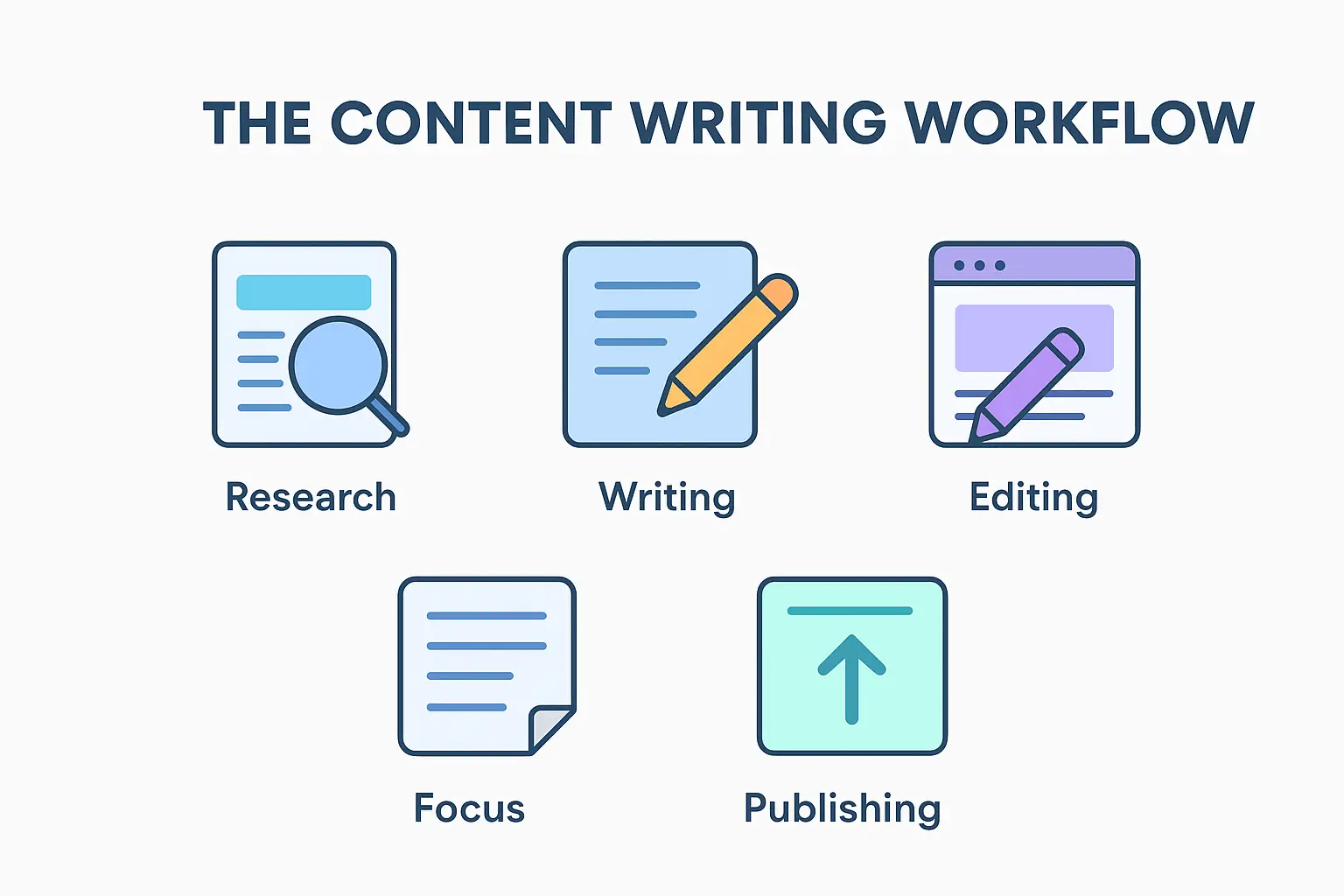
    The beginner’s 8-step SEO writing workflow

    content writing step by step keywordly.ai

    This workflow is the scaffold you’ll follow for every post.

    Step 1 — Keyword research (find the right topic)

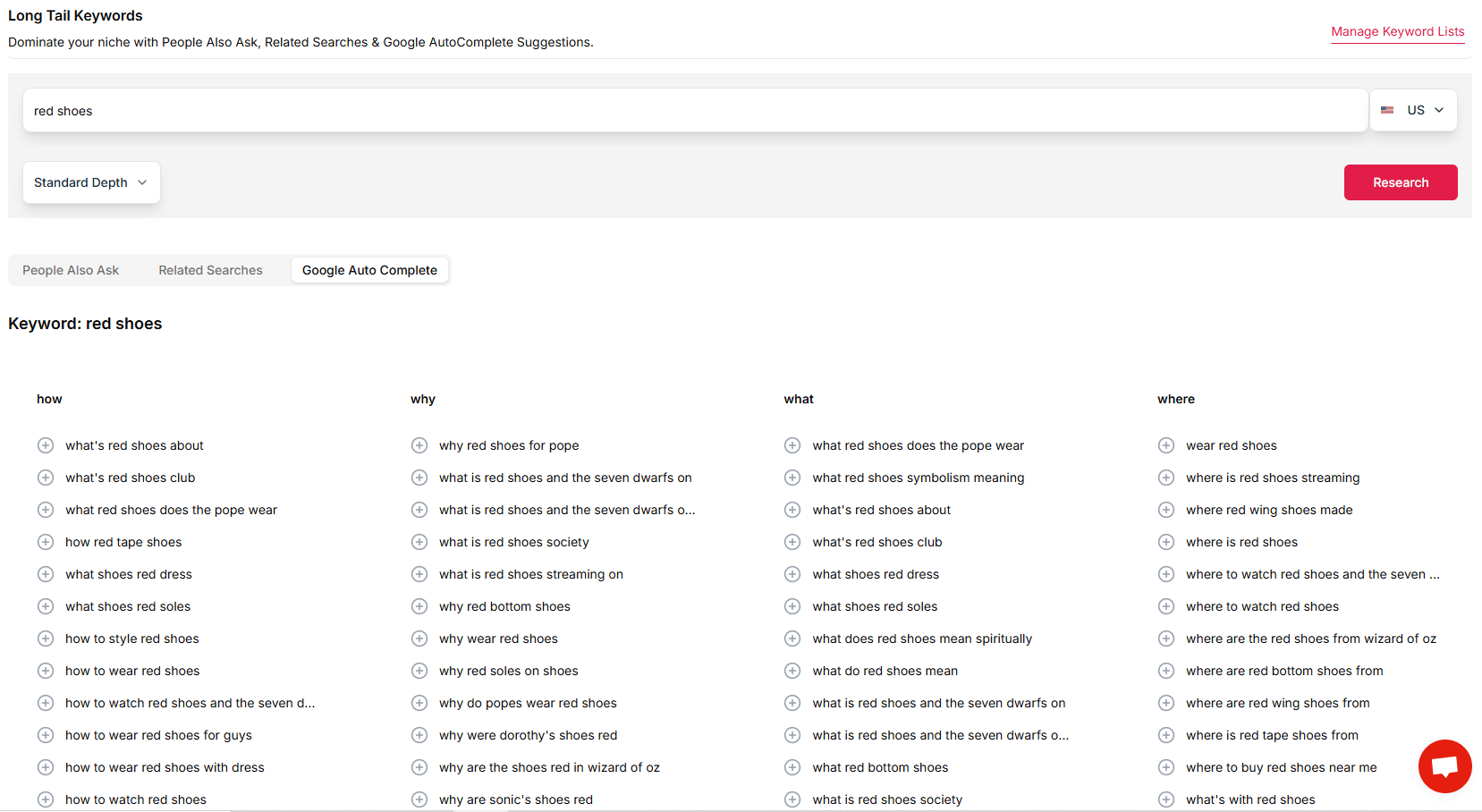
    • Start with a primary keyword phrase (seed) that describes the main idea. Use tools or free sources (Google Autocomplete, People Also Ask, AnswerThePublic) to expand into related queries.
    • Pick keywords based on intent — are people looking to buy, learn, compare, or find a quick answer? Match your content to that intent.
    Pro tip: Long-tail keywords often convert better and are easier to rank for when you’re starting.

    “Great SEO content starts before writing — it begins with understanding what your audience is already searching for.”

    Step 2 — Determine search intent

    • Informational (how-to, guides) → write clear, thorough answers and include examples.
    • Navigational (brand/website) → optimize title and meta for clicks.
    • Transactional (buy/compare) → add product info, benefits, and strong CTAs.

    Step 3 — Create an outline (H1 → H2 → H3)

    • H1: your primary headline with the main keyword (keep it natural). Example : [Primary keyword + benefit]
    • H2s: cover the main subtopics searchers expect. Use People Also Ask and top competitors to see common H2 phrasing. Example : What is [primary keyword]? Why it matters
    • H3s: examples, step lists, and FAQ answers.

    Step 4 — Write for humans, optimize for search engines

    • Use short paragraphs (1–3 sentences).
    • Add bulleted lists and numbered steps for scannability.
    • Place the primary keyword in the title, first paragraph, at least one H2, and naturally elsewhere. Avoid stuffing. Google prioritizes helpfulness; be useful first.

    Step 5 — On-page optimization essentials

    • Title tag: include primary keyword and a hook (under ~60 chars).
    • Meta description: 120–155 chars; compelling summary with call to action.
    • URL slug: short, includes main keyword.
    • Headings: clear hierarchy (H1 → H2 → H3).
    • Images: descriptive filenames + alt text (see image section below).
    • Internal links: link to relevant existing pages — helps crawlability and user flow.

    “Clear structure isn’t just for search engines — it helps readers find answers faster and stay longer.”

    Step 6 — Add structured data (FAQ / Article schema)

    • Use JSON-LD for FAQ schema for the short Q&A you include. This helps the page be eligible for rich results (and increases CTR).
    • Don’t overdo it — only mark up content that is actually Q&A.

    Step 7 — Publish & promote

    • Share in your newsletter and social.
    • Email people you referenced or who might link.
    • Repurpose sections as social posts to drive initial clicks and engagement.

    Step 8 — Monitor & update

    “Optimization doesn’t mean rewriting everything — small improvements in clarity, structure, and intent alignment often make the biggest impact.”

    Read this Article : Top SEO Content Writing Tools to in 2026: Software to Write, Optimize and Scale Content

    Read this Article : How to Choose the Right SEO Content Editor for Your Blog

    How long should your SEO content be?

    There’s no one-size-fits-all. Instead, match length to intent:

    • Short answers / quick how-tos: 600–900 words.
    • Standard blog posts / tutorials: 1,200–2,000 words.
    • Comprehensive guides / pillar pages: 2,500–5,000+ words.

    If the SERP is dominated by long, comprehensive guides, you’ll likely need a longer, more authoritative piece. Conversely, for “quick answer” queries, a short, crisp answers where you can win featured snippets.

    Practical rule: analyze the top 3 pages’ lengths for your keyword and target similar or more in-depth content.

    Snippet & featured snippet tactics

    Featured snippets are prime real estate. Here’s how to target them:

    • Put a concise answer (1–3 sentences) directly under an H2 titled with the question. Keep it ≤ 45 words to increase the chances of being used.
    • For “list” snippets, use ordered or unordered lists immediately under the H2.
    • For “table” snippets, format data into an HTML table.
    • Use direct, clear phrasing; avoid fluff.

    On-page checklist

    This is a copyable and printable checklist, to optimize the onpage content.

    • Primary keyword in title (naturally)
    • Primary keyword in first 100 words
    • 1–2 secondary keywords included in H2s or H3s
    • Short, helpful intro (≤45 words for snippet chance)
    • One clear CTA (subscribe, download, contact)
    • Meta title & description written and previewed
    • Images with alt text and optimized filenames
    • Internal link to 2–3 related pages
    • External links to authoritative sources (Google, research, industry)
    • FAQ block with short answers (for schema)
    • Publish date and author bio (E-E-A-T signal)
    • Schedule a 6–12 week update check

    Common mistakes beginners make and how to fix them

    1. Keyword stuffing — symptom: unnatural repeating of the target term.
      Fix: Use synonyms and entity terms; focus on helpfulness.
    2. Ignoring intent — symptom: writing a long guide for a query that needs a short answer.
      Fix: Check People Also Ask / top pages for expected format.
    3. No internal links — symptom: page doesn’t pass link equity or help users navigate.
      Fix: Link to related posts and topically relevant pages.
    4. Neglecting promotion — symptom: publish, then wait for traffic.
      Fix: Share in channels, ask for links, and repurpose snippets.
    5. No update cadence — symptom: content goes stale while competitors refresh.
      Fix: Log updates and set reminders to refresh (6–12 weeks initially).

    Using AI responsibly to speed up SEO writing

    AI can help with outlines, research notes, and first drafts — but it can also hallucinate and copy. Use this safe workflow:

    • Use AI for: draft outlines, idea expansion, meta suggestions, and creating variations of headings.
    • Don’t use AI for: final factual claims, data points, or anything you can’t verify.
    • Always: fact-check, edit for tone, and add original examples or screenshots.

    A Quick example you can follow

    A small marketing blog republished a 1,200-word guide and followed these steps: updated the title and H2s to match search intent, added a FAQ block, improved meta description, and promoted the update in an email to 2,000 subscribers.

    Result: In 10 weeks, clicks increased by ~40% for the target keyword and the page moved from position 12 to position 6 on Google. (Timing and results will vary — but targeted updates plus promotion often yield measurable gains within a few months). Industry consensus suggests meaningful traffic gains often appear in 3–6 months.

    How to measure success (KPIs beginners should track)

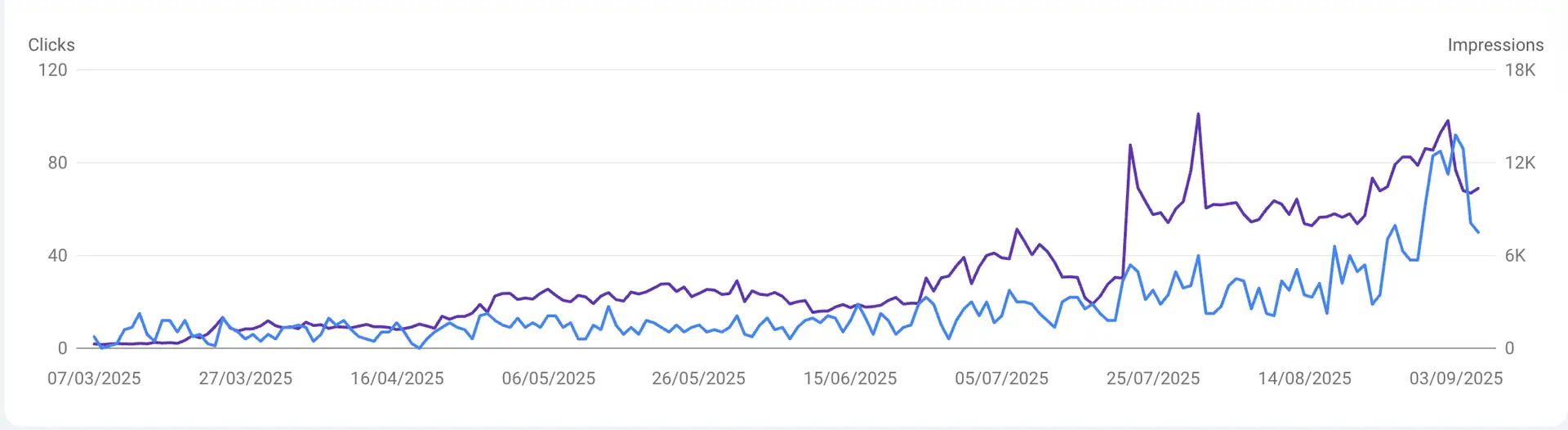
    • Impressions & clicks (Google Search Console) — are people seeing & clicking your listing?
    • Average position — are you moving up over time?
    • CTR — improves with better titles & meta descriptions. Use CTR benchmarks for context.
    • Organic sessions — users arriving from search who engage with the content.
    • Dwell time / bounce rate — proxy for user satisfaction (but interpret with care).

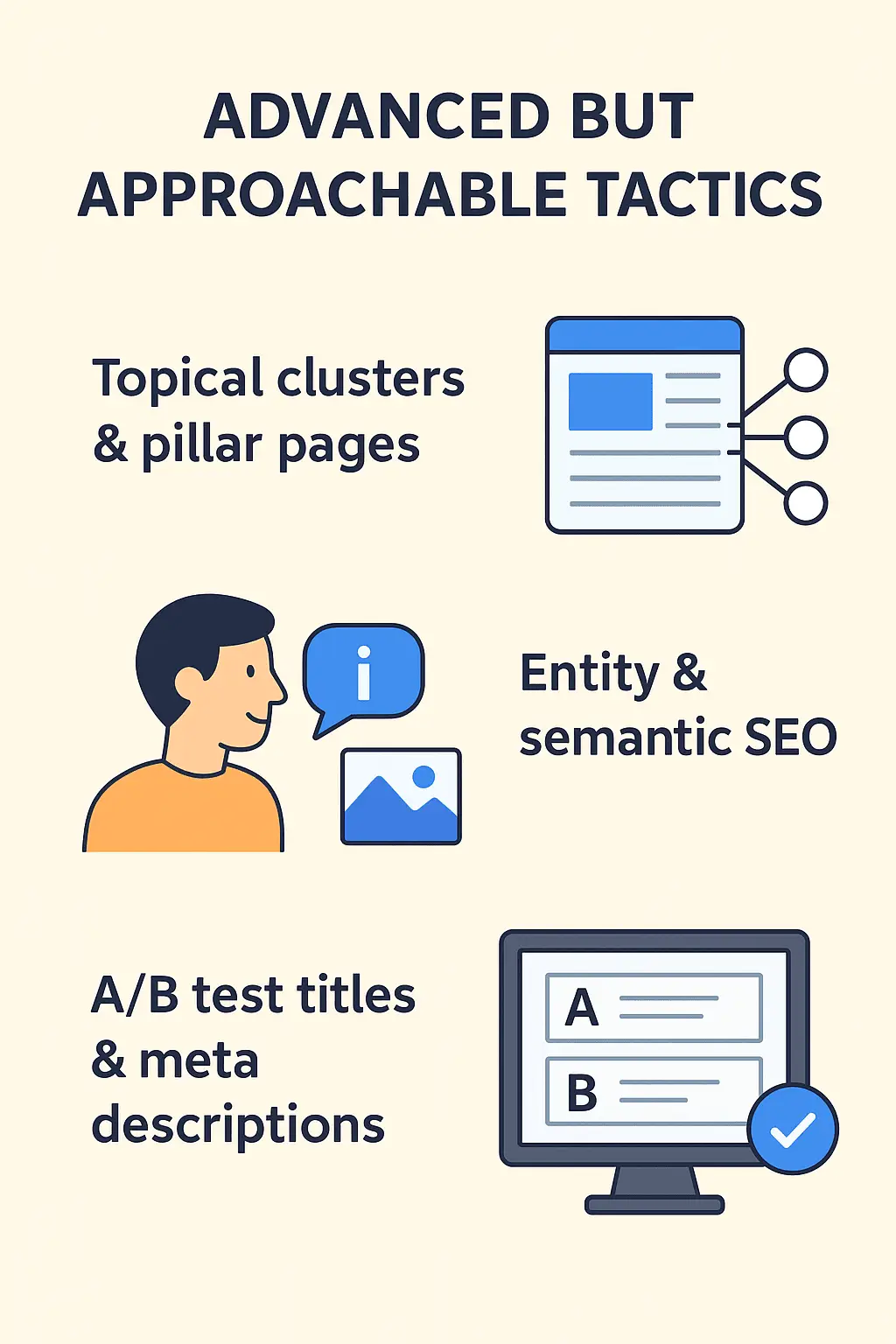
    Advanced but approachable tactics to consider for SEO content writing

    advanced approchable tactics keywordly.ai
    • Topical clusters & pillar pages — group related posts and use a pillar to build topical authority.
    • Entity & semantic SEO — include related entities and people/brand names where relevant.
    • A/B test titles/meta descriptions — small wording changes can boost CTR.
    • Schema beyond FAQ: HowTo, Article, and Product schemas (if relevant).

    Conclusion

    Start small. Publish a helpful post that answers a clear question, make it scannable, add a few authoritative external links, and promote it. Track the data and update the content after a couple of months. SEO content writing is a repeating process — the first few posts teach you the patterns; the next set will bring compounding organic gains.

    Reads This Article : AI Content Writing: 5 Proven Steps to Create High-Quality Content

    Reads This Article : Content Writing Examples that Boost Engagement and Rankings

    Reads This Article : How to Create an SEO Content Brief That Improves Rankings And CTR (Step-by-Step)

    “You don’t need to be an SEO expert to start — you just need a clear process and consistent improvement.”

    FAQs

    Frequently Asked Questions

    How many keywords should I target per post?

    Focus on one primary keyword and 2–4 related secondary keywords and long-tail variants. Keep the page focused and useful.

    Can short posts rank?

    Yes — for quick answer queries and simple informational queries, concise posts can win. Match the SERP.

    How long before I see traffic?

    Expect measurable movement in 3–6 months for most posts; some may rank sooner if competition is low.

    Do I need paid tools to start?

    No — many free tools are free to start (Keywordly.ai, Google Keyword Planner, People Also Ask) are enough to start. Paid tools accelerate research.

  • Content Writing Tips to Boost Quality and Reader Engagement

    Content Writing Tips to Boost Quality and Reader Engagement

    Explore content writing tips and techniques to improve clarity, increase dwell time, and boost reader engagement. Practical steps to help your content connect and convert.

    Introduction — Why quality and engagement matter now

    Great content used to mean “well-written.” Today, it means well-written and meaningful — content that captures attention, answers user needs, and keeps readers on the page long enough to act. With users swiping faster and choices multiplying, attention is the new currency for creators. Recent research suggests the modern online attention span is short (often reported around ~8 seconds), which means your opening seconds — headline, hero image, first paragraph — must work harder than ever to hook readers.

    At the same time, search engines and platforms prioritize “people-first” content: pages created to help users, not merely to manipulate rankings. Google’s guidance on creating helpful, people-first content makes this explicit — prioritize the reader, demonstrate experience and trust, and design content that solves real needs.

    This guide shows how to craft content that balances clarity, persuasion, and the metrics that matter: dwell time, shares, and conversions. You’ll get a repeatable process, creative techniques, editing checklists, tools, case ideas, and recommended image placements for a visually engaging page.

    1. Start with the reader — not the keyword

    Before typing a word, answer: who is the reader and what problem are they trying to solve right now? Are they looking for a quick how-to, a step-by-step tutorial, or proof that a solution works? Match your tone and depth to their intent.

    • Beginner: simple language, clear steps, definitions.
    • Practitioner: examples, data, short-cuts, templates.
    • Decision-maker: business impact, case studies, ROI.
    • Use this persona to shape your headline, intro, and the examples you include.

    2. Nail the headline and opening hook (first 8 seconds)

    Your headline is often the only chance to get a click. The intro is the only chance to keep the reader. With attention measured in seconds, your opening should either promise a solution, deliver an unexpected stat, or tell a compelling micro-story. Most readers leave within seconds — but a single narrative pivot in the first 30 words can double the time they stay.

    • Formula examples:
      • How to [desired outcome] in X steps
      • Why [common belief] is wrong — and what to do instead
      • [Number] proven ways to [solve problem]
    • Hook types you can rotate: stat, provocative question, micro-story, surprising comparison, common mistake.

    3. Structure for content scannable, skimmability and flow

    Web readers scan. Structure your content so scanning,that leads naturally to reading.There’s difference between tension between skimmability and depth. The way to satisfy both is layered content: give scanners the answer in short form, and offer depth below the fold for readers who stay. This layered approach also increases dwell time because readers who land for a quick answer often stay for the example or case study they find below.

    Recommended on-page hierarchy

    • H1: Clear promise (same theme as title tag).
    • H2s: Major steps or sections (problem, process, examples, tools, mistakes).
    • H3s: Sub-steps, checklists, micro-tips.
    • Intro paragraph: 1–3 lines max.
    • Lead sentence for each H2: 1-sentence summary so scanners can understand the section from the header alone.

    Formatting rules

    • Short paragraphs (1–3 sentences).
    • Bulleted lists for steps and benefits.
    • Bold the key takeaway sentence in longer sections.
    • Use ample white space, images, and captioned screenshots.

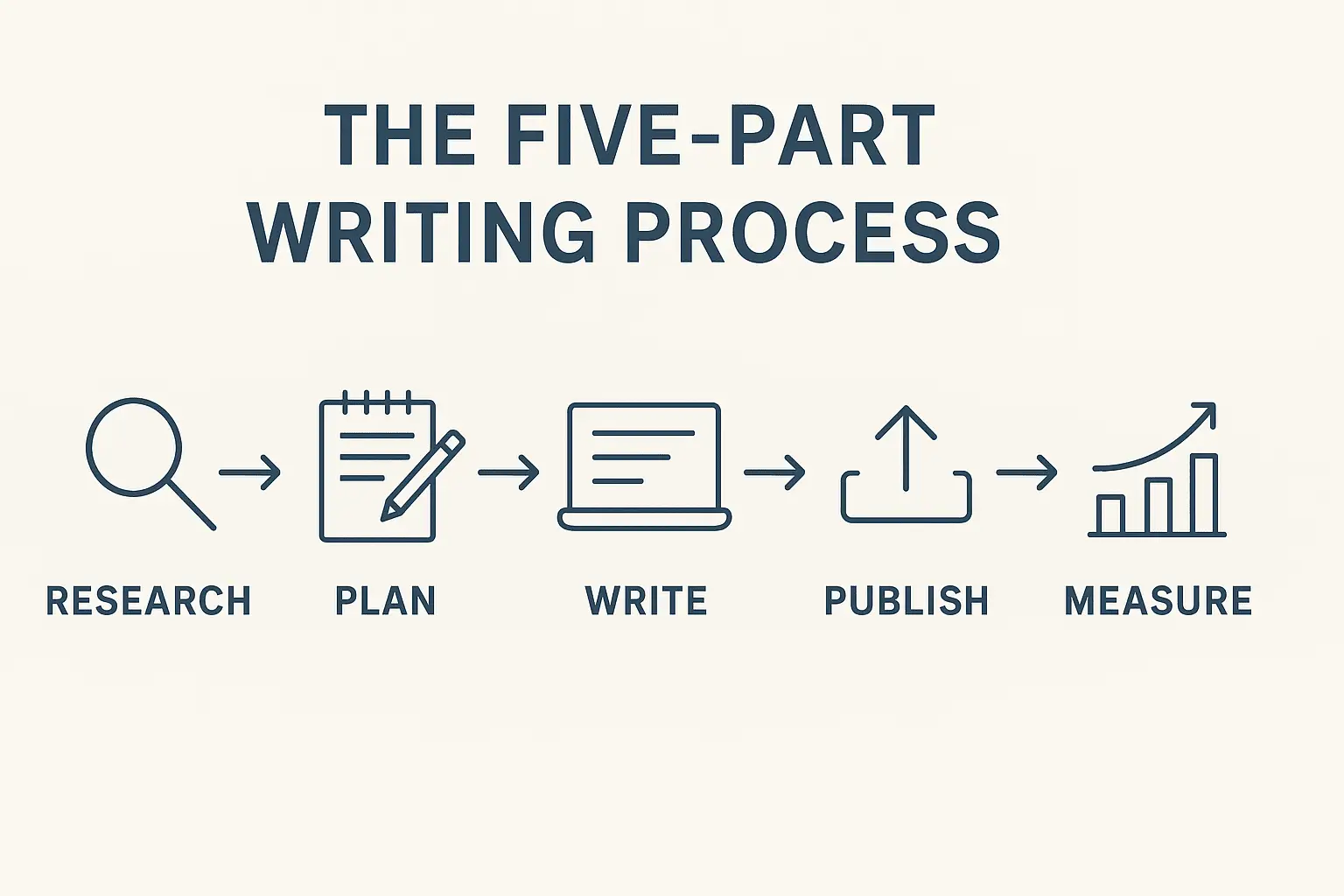
    4. The five-part writing process (research → publish → measure)

    writing process keywordly.ai

    Think of content writing as a mini-project. Use this five-part flow to maintain quality and improve engagement over time.

    Research & idea validation

    • Validate interest with keyword/intent checks and social listening (use tools like Keywordly.ai , BuzzSumo).
    • Check competitor content length, H2 structure, and social traction for similar topics.

    Outline and angle selection

    • Decide your unique angle (counterintuitive approach, deeper data, niche audience application).
    • Outline H2/H3s first — this reduces writer’s block and supports structured flow.

    Drafting for the reader

    • Write fast, then edit. Use the “write-as-you-speak” rule to keep tone conversational.
    • Add short real examples or micro-case studies to make points tangible.

    Revision & optimization

    • Edit ruthlessly for clarity, remove fluff, and check readability.
    • Optimize accessibility (alt text for images, descriptive link text).
    • Add internal links to relevant content on your site.

    Publish and iterate

    • Publish with schema (Article / HowTo where applicable).
    • Measure: dwell time, scroll depth, social shares, comments, and conversions. Use this data to refresh and improve content.

    5. Use storytelling and micro-examples to increase emotional engagement

    Data informs. Story sells.

    • Start sections with a 1–2 sentence micro-story (a user, a problem, and an action).
    • Use named characters when possible (“Sam needed to reduce churn…”).
    • Translate abstract advice into concrete mini case studies or user quotes.

    Storytelling helps readers empathize and imagine applying the advice—this increases the chance of sharing and conversion.

    6. Visuals and multimedia — how to use them strategically

    Visuals aren’t decoration; they are engagement levers.

    Type of visuals that move the needle

    • Infographics that summarize instructions.
    • Screenshots with annotated changes (before/after).
    • Short embedded videos (2–3 minutes) showing step-by-step use of a tool.

    Research shows enriched visual content increases on-page engagement and time-on-page, especially when visuals compress complex ideas into digestible formats.

    7. Writing techniques that directly improve engagement and dwell time

    “Front-load” the payoff

    Tell readers quickly why they should keep reading. If the value is clear in the first 30–60 words, they are likely to stay.

    Use tension and resolution

    Introduce a tension (problem) early and promise a resolution. Then deliver the resolution with examples and actionable takeaways.

    Chunk content with micro-headlines

    Readers skim; micro-headlines (one-line summaries) let them instantly find the part that answers their need.

    Sprinkle interactive elements

    Quizzes, polls, and calculators are powerful engagement drivers. Even a simple inline quiz (“Is your heading strong?”) invites clicks and increases time on page.

    Optimize the first contentful paint

    Slow-loading pages hurt engagement. Compress visuals, use lazy-loading, and ensure your hero image loads fast.

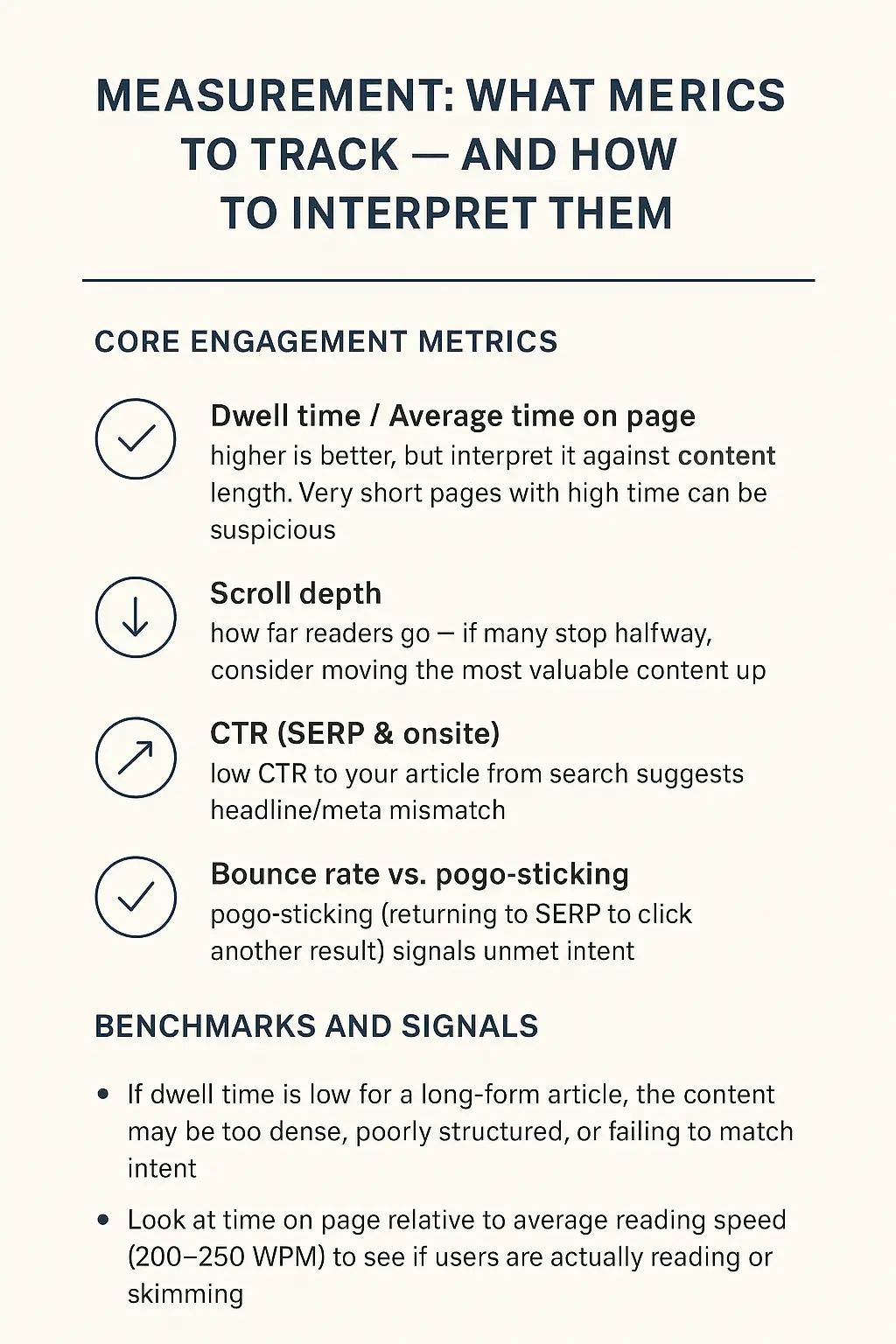
    8. Measurement: what metrics to track — and how to interpret them

    METRICS TO TRACK KEYWORDLY.AI

    Metrics matter — but interpretation matters more.

    Core engagement metrics

    • Dwell time / Average time on page: higher is better, but interpret it against content length. Very short pages with high time can be suspicious. Shopify+1
    • Scroll depth: how far readers go — if many stop halfway, consider moving the most valuable content up.
    • CTR (SERP & onsite): low CTR to your article from search suggests headline/meta mismatch.
    • Bounce rate vs. pogo-sticking: pogo-sticking (returning to SERP to click another result) signals unmet intent.
    • Social shares & comments: qualitative indicators of resonance.

    Benchmarks and signals

    • If dwell time is low for a long-form article, the content may be too dense, poorly structured, or failing to match intent.
    • Look at time on page relative to average reading speed (200–250 WPM) to see if users are actually reading or skimming.

    9. Quick editing checklist (use this before publish)

    • Does the headline promise a clear benefit?
    • Is the intro a hook + promise? (≤ 30–50 words)
    • Is there a TL;DR summary box above the fold?
    • Are H2s scannable and descriptive?
    • Are paragraphs short (≤ 3 sentences)?
    • Are visuals captioned and optimized (alt text + compressed)?
    • Is there at least one real example/case study?
    • Are internal links added to relevant pillar pages?
    • Is schema applied (Article / HowTo / FAQ where applicable)?
    • Have you run readability and grammar checks? (Hemingway / Grammarly)
    • Did you set a clear CTA (download, subscribe, contact)?

    Tools that help you speed up quality writing

    Conclusion — Make quality and engagement your north star

    The best content is not the longest or the most keyword-dense — it is the content that connects quickly, answers well, and leaves the reader better off. Prioritize the reader: test headlines, structure for skimming and reading, add visuals that explain, and measure the signals that show genuine engagement. With repeated testing and a people-first approach, your articles will not only keep readers longer — they’ll convert them into fans and customers.

    👉 Next Reads:

    FAQs

    What are the most important content writing tips for beginners?

    For beginners, focus on clarity, readability, and understanding your audience’s needs. Start by writing compelling headlines, breaking content into sections with H2s/H3s, and keeping paragraphs short.

    How can I make my content more engaging for readers?

    Engagement comes from storytelling, conversational tone, and interactive elements. Include visuals, examples, or statistics, ask questions, and end sections with key takeaways. A mix of text + visuals + real-world stories ensures readers stay hooked.

    What are common mistakes that reduce content quality?

    Common mistakes include keyword stuffing, long unbroken paragraphs, lack of clear structure, and failing to address user intent. Avoid fluff, and instead focus on delivering value backed by examples, data, and actionable insights.

  • What is copywriting vs content writing

    What is copywriting vs content writing

    What’s the difference between copywriting and content writing? Learn how each works, where they’re used, and why both matter in digital marketing.

    Introduction

    “Copywriting is words that sell; content writing is words that educate.”
    — Widely used marketing principle

    Have you ever found yourself confused between copywriting and content writing? You’re not alone. These two terms are often used interchangeably, but in reality, they serve different purposes within marketing, branding, and communication. While copywriting focuses on persuading readers to take immediate action, content writing aims to educate, inform, and engage readers over time.

    This article will walk you through the key differences, similarities, and future trends of copywriting and content writing. We’ll also look at real-world examples, career paths, and how businesses can leverage both to achieve success.

    If you’re a business owner, marketer, or aspiring writer, knowing these distinctions can help you allocate resources wisely, sharpen your writing skills, and build a long-term strategy that drives results.

    Content writing focuses on clear, informative, and engaging content that educates or adds value for readers — a principle reinforced by official plain language standards used in U.S. government communication.
    Copywriting is the art of persuasive, action-focused text that drives conversions — a skill taught in university curricula like copywriting courses at accredited institutions.

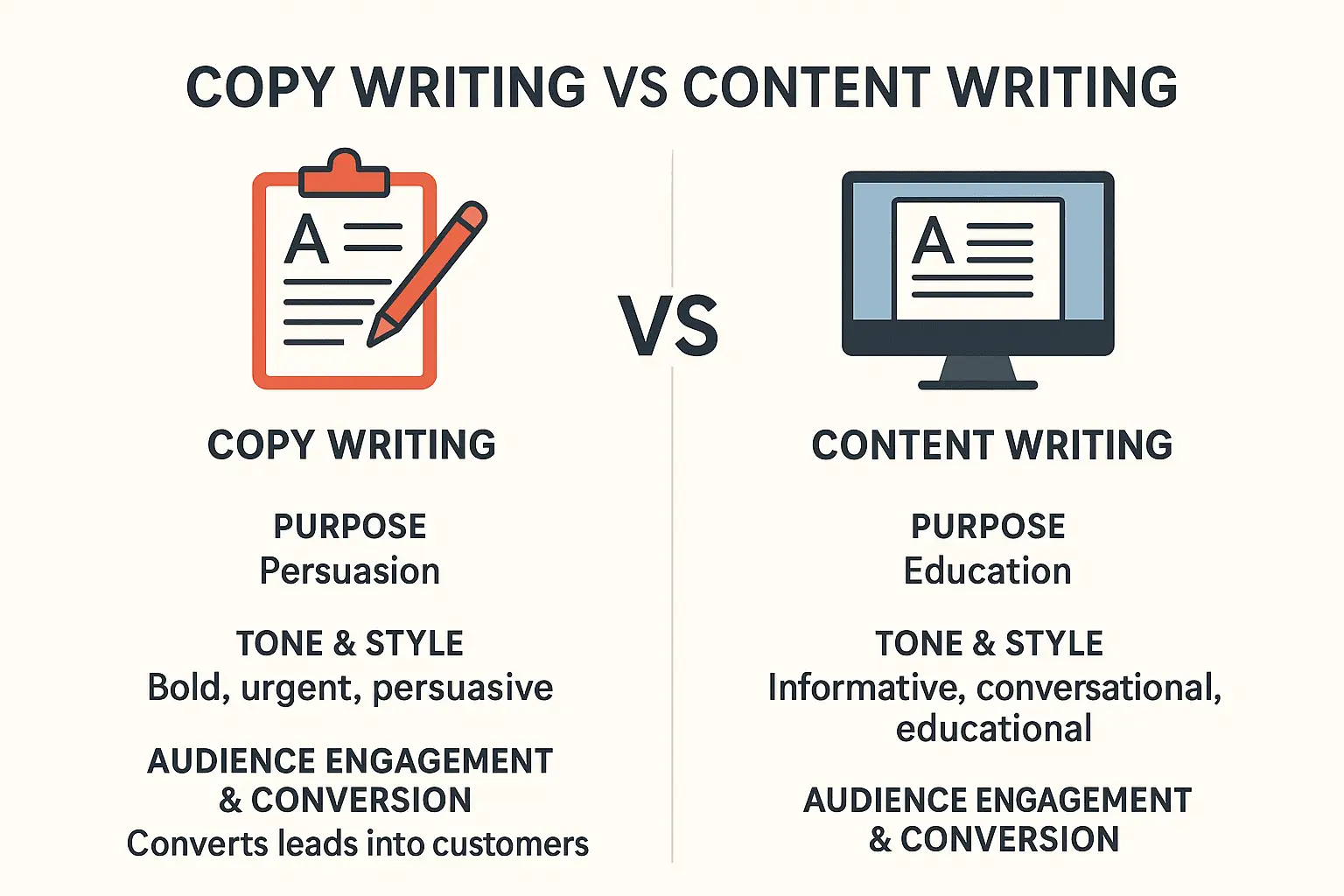
    what is the difference between copy writing and content writing

    “Content builds relationships. Copy builds revenue.”
    — Marketing industry insight

    Here’s a side-by-side comparison table:

    FactorCopywritingContent Writing
    PurposeDrive action (sales, sign-ups, conversions)Educate, inform, and engage
    Tone & StylePersuasive, urgent, emotionalInformative, storytelling, authoritative
    FormatAds, landing pages, emails, product pagesBlogs, guides, case studies, ebooks
    SEO RoleSecondaryPrimary (keyword-rich, evergreen content)
    LengthShort-form (50–500 words)Long-form (500–3000+ words)
    KPIsConversion rate, CTR, revenueOrganic traffic, dwell time, backlinks

    “Great content informs, but great copy persuades—and modern marketing needs both working together.”
    — Digital marketing best practice

    What is Copywriting?

    Copywriting is the art of persuasive writing that drives readers to take a specific action. This could be clicking a button, signing up for a newsletter, or buying a product.

    Core Purpose

    The main goal of copywriting is conversion. Unlike content writing, copywriting is not primarily about informing—it’s about selling, persuading, and converting.

    Copywriting Examples

    • Sales pages
    • Product descriptions
    • Landing pages
    • Ads (Google, Facebook, LinkedIn)
    • Email campaigns
    • Direct response letters

    Skills Required

    • Consumer psychology
    • Crafting compelling CTAs (calls to action)
    • Brevity and clarity
    • A/B testing and optimization
    • Understanding emotional triggers

    Example

    Copywriting Example (Facebook Ad):

    “Stop wasting hours on spreadsheets. Try Our Tool today—save 10+ hours a week. Sign up free!”

    This is short, action-oriented, and persuasive.

    What is Content Writing?

    Content writing is the practice of creating educational, engaging, and value-driven content designed to inform readers and build long-term trust.

    “Content marketing earns attention; copywriting converts attention into action.”
    — Content strategy principle

    Core Purpose

    The main goal of content writing is to educate, entertain, and engage audiences, often as part of a long-term SEO or brand-building strategy.

    Content Writing Example

    • Blog posts
    • Articles
    • Case studies
    • Whitepapers
    • Newsletters
    • Ebooks
    • Website resources (FAQs, help pages)

    Read this article on 3 most  proven content writing examples that boost engagment and improve ranking

    Skills Required

    • Research & analysis
    • SEO optimization
    • Storytelling
    • Clarity and readability
    • Long-form writing structure

    Example

    Content Writing Example (Blog Intro):

    “In today’s digital world, businesses face a common challenge: generating organic traffic. One of the most effective solutions is leveraging SEO tools. In this article, we’ll explore the top 10 SEO tools every marketer should use.”

    This example educates, informs, and sets up an engaging piece of long-form content.

    How Copywriting and Content Writing Work Together

    copy writing vs content writing keywordly.ai

    The best marketing strategies combine both. Content attracts and nurtures audiences, while copy drives them through the conversion funnel.

    1. Top of Funnel (Content): Blog posts, guides, and infographics that attract organic traffic. Example – Blog on “Best Productivity Tools for Teams.”

    2. Middle of Funnel (Content + Copy): Case studies, whitepapers, and newsletters that build trust. Example –  Newsletter recommending tool or service name.
    3. Bottom of Funnel (Copy): Sales pages, CTAs, and email campaigns that push conversions. Example – Landing page with persuasive CTAs to sign up.

    copywriter vs content writer

    copywriter vs content writer salary

    • Copywriters focus on sales, advertising, and direct conversions. They are in high demand in industries like e-commerce, SaaS, advertising, and startups. In the U.S., average salaries range between $55,000 – $75,000/year (Glassdoor, 2024). Career growth can lead to roles such as Conversion Specialists or Creative Directors, with hybrid opportunities like Content + Conversion Writer also on the rise.

    Content Writer

    • Content writers focus on education, SEO, and long-term engagement. They are highly sought after in agencies, SaaS, publishers, and SEO-driven companies. In the U.S., average salaries range between $50,000 – $65,000/year (Indeed, 2024). With experience, content writers can transition into roles like Content Strategists or SEO Managers, while hybrid roles allow them to combine persuasive copy with educational content.

    “Persuasive writing relies on clarity, relevance, and audience awareness.”
    — Academic writing & communication principle

    Future of Copywriting and Content Writing

    A growing trend is the blurring of lines between both roles.

    Blurred Roles

    • Businesses increasingly expect writers to write content that sells and copy that educates.

    AI’s Impact

    • AI tools can generate drafts but need human expertise for voice, brand, and conversion strategy.
    • Writers must adapt by becoming editors, strategists, and hybrid specialists.

    Predicted Trends (Next 5 Years)

    1. Demand for hybrid “SEO Copywriters.”
    2. More emphasis on storytelling + persuasion in long-form content.
    3. AI-assisted content planning, human-led execution.

    Real-World Examples: content writing/copywriting

    Example 1: SaaS

    • Copywriting: Landing page headline — “Automate 90% of your reporting in minutes.”
    • Content Writing: Blog post — “Top 10 Reporting Tools for 2025.”

    Example 2: E-commerce

    • Copywriting: Product description — “Get the perfect fit—50% off today only!”
    • Content Writing: Buying guide — “How to Choose the Best Running Shoes for Beginners.”

    Example 3: B2B

    • Copywriting: LinkedIn ad copy — “Scale your business with our CRM in 30 days—Free Demo.”
    • Content Writing: Case study — “How a Company Increased Conversions by 45% with Our CRM.”

    Conclusion

    Copywriting and content writing are not the same—but they are complementary. Copy focuses on persuasion and conversions, while content builds long-term trust and authority. The smartest businesses (and writers) know how to use both effectively.

    If you’re deciding between the two for your career, consider your strengths. Do you enjoy persuasive, short-form writing? Copywriting may suit you. Prefer research-driven, long-form content? Content writing could be your path. Or, you can evolve into a hybrid writer with the best of both worlds.

    👉 Next Reads:

    FAQs

    1. Is copywriting harder than content writing?
    Not necessarily. Copywriting requires persuasion in fewer words, while content writing demands depth and SEO research. Both need different skill sets.

    2. Can one person be both a copywriter and content writer?
    Yes. Many professionals today work in hybrid roles, writing persuasive copy and informative content.

    3. Which has more career growth: copywriting or content writing?
    Both fields are growing. Copywriting often leads to higher pay, while content writing offers more stable opportunities in SEO-driven industries.

    4. How do businesses decide when to use copy vs content?
    Use content to build awareness and trust; use copy to convert readers into customers.

    5. Do AI tools replace copywriters or content writers?
    AI can assist but not replace. Human creativity, empathy, and strategy remain irreplaceable.

  • What Is Content Writing? Definition, Meaning & Everything You Need to Know

    What Is Content Writing? Definition, Meaning & Everything You Need to Know

    Learn what content writing is, why it matters for SEO, and the different types and best practices with real examples. Perfect for beginners and marketers.

    Introduction

    Content writing is the process of creating written material for digital platforms such as websites, blogs, emails, and social media. If you’re wondering what is content writing all about, it simply means writing content that informs, educates, or engages a specific audience online.


    Content writing has become one of the most important skills for businesses and creators in the digital age. It goes far beyond just “writing articles.” Done well, content writing shapes how a brand communicates, attracts search traffic, generates leads, and engages customers across different platforms.

    In fact, the global content marketing industry is expected to exceed US$107 billion by 2026 . For B2B marketers, 83% say content marketing builds brand awareness, while 77% say it generates demand and leads. That shows the true power of well-structured content writing.

    This guide explains everything you need to know about content writing in 2025—from what it is, why it matters, how to do it step-by-step, the skills you need, how AI fits in, and how to measure ROI.

    “Content writing is the foundation of how brands communicate, educate, and build trust online.”

    What Is Content Writing?

    “At its core, content writing is about delivering the right message, to the right audience, in the right format.”

    To define content writing, it is the practice of planning, writing, and editing content with a clear purpose — whether that’s educating readers, building trust, or supporting business goals. In simple terms, content writing means delivering valuable information in written form for online audiences.

    Unlike casual writing, content writing is goal-oriented. It must serve one or more purposes:

    • Educate the audience (blogs, whitepapers, guides)
    • Attract organic search traffic (SEO articles)
    • Persuade readers (landing pages, sales copy)
    • Engage communities (social posts, newsletters)
    • Support customer journeys (product descriptions, FAQs)

    “You don’t need to be a professional writer to understand content writing — clarity and purpose matter more than perfect words.”

    Read this Article : Top 10 AI SEO Writing Tools to Boost Your Ranking

    Content Writing vs. Copywriting

    While traditional writing focuses on expression or storytelling, content writing is purpose-driven. It blends creativity with structure, audience intent, and clarity — making content or writing a strategic skill in digital marketing.

    • Content writing is broader—long-form, educational, and SEO-driven.
    • Copywriting is conversion-focused—ads, CTAs, landing page copy.

    Read this Article : What is copywriting vs content writing

    What Are the Different Types of Content Writing? (With Examples)

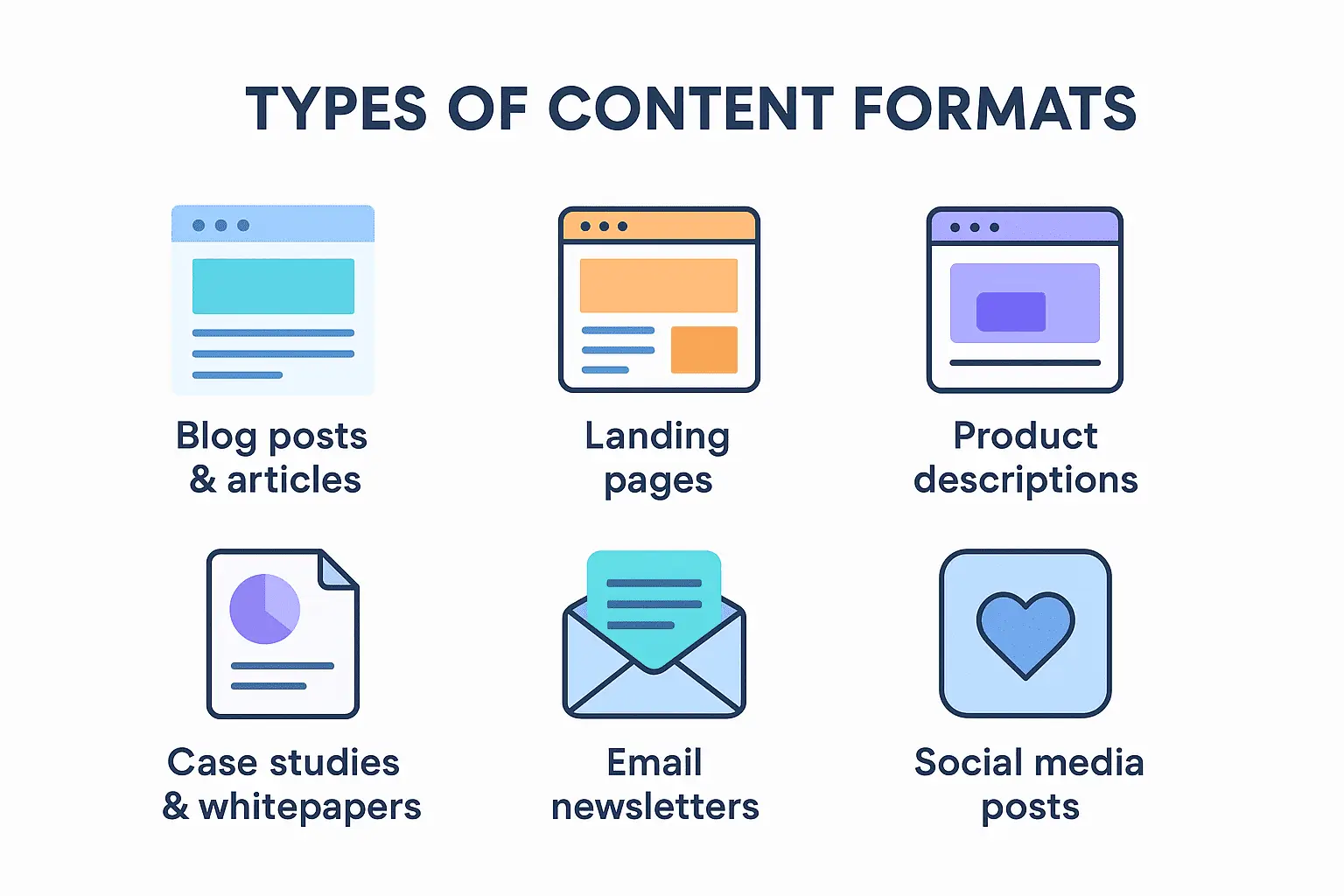
    content format types keywordly.ai

    Content writing includes many formats, and understanding what content writing involves helps you choose the right type based on your goals.

    • Blog posts & articles
      The backbone of most content strategies, blogs educate and inform while attracting organic search traffic. Long-form articles also help build topical authority and showcase expertise.
    • Landing pages
      Conversion-focused pages designed to persuade visitors to take a specific action—sign up, download, or buy. Strong headlines, benefits, and CTAs drive results.
    • Product descriptions
      Concise yet persuasive content highlighting product features, benefits, and use cases. Optimized descriptions boost both SEO visibility and conversions.
    • Case studies & whitepapers
      In-depth, research-backed formats that demonstrate expertise and proof of results. They’re powerful tools for B2B lead generation and trust-building.
    • Email newsletters
      Regular updates sent to subscribers to nurture relationships, share insights, and drive engagement. They often blend educational value with subtle promotional CTAs.
    • Video scripts & podcast scripts
      Pre-written dialogues or outlines that structure engaging audio-visual content. They help ensure clarity, consistency, and storytelling across multimedia formats.
    • Social media posts
      Short, engaging content tailored to platforms like LinkedIn, X (Twitter), or Instagram. Effective for community engagement, brand awareness, and quick call-to-actions.

    “Content writing isn’t one single activity — it takes many forms depending on the platform and purpose.”

    Why Content Writing Matters in 2026

    When we talk about content writing, we’re referring to how written content helps brands communicate, educate users, and build long-term visibility online.

    Content is still king—but quality content is what rules.

    And content budgets keep growing—46% of B2B marketers plan to increase their budgets to keep up with the demand.

    “Every blog, website page, or online guide you read exists because of content writing.”

    The Content Writing Workflow (Step by Step)

    One major gap in competitor blogs is that they don’t show the end-to-end workflow. Here’s the full process:

    content writing step by step keywordly.ai

    1. Research & Planning

    • Identify target keywords (use Google keyword planner, keywordly.ai)
    • Map search intent: informational, commercial, transactional.
    • Analyze competitors’ SERP content.
    • Collect entities and FAQs to include.

    2. Create a Content Brief

    • Include: keywords, H1/H2/H3 outline, meta title/description, target audience, internal links, target word count.

    Read this article : How to Create an SEO Content Brief That Improves Rankings And CTR (Step-by-Step)

    3. Outline & Structure

    • Build a skeleton with H2s and H3s.
    • Ensure scannability (lists, bullet points, bold).

    4. Drafting

    • Write in brand voice.
    • Keep sentences short.
    • Use data and examples.
    • Prioritize readability (Flesch 60+).
    • Add accessibility (alt text, headings).

    5. On-Page SEO

    • Optimize H1, meta title (60 chars), meta description (155 chars).
    • Add schema (FAQ, HowTo, Article).
    • Include OG tags for social sharing.

    6. Review & Edit

    • Proofread grammar.
    • Fact-check.
    • Add sources for E-E-A-T.

    7. Publish & Distribute

    8. Measure & Refresh

    • GA4 events: scroll depth, CTA clicks, conversions.
    • Refresh content every 6–12 months.

    Core Skills Every Content Writer Needs

    • Research & analysis
    • SEO fundamentals
    • Storytelling & voice
    • Grammar & clarity
    • Adaptability across formats
    • AI literacy for writing assistance

    Content Writing Best Practices

    1. Write for humans, optimize for search.
    2. Keep paragraphs short (2–3 lines).
    3. Use credible sources (link to authority sites).
    4. Add visuals + descriptive alt text.
    5. Use clear CTAs.
    6. Ensure accessibility compliance (contrast, headings).

    The Role of AI in Content Writing (2026 & Beyond)

    • Recent data shows that AI has become a mainstream tool in content writing, but its usage varies by stage of the workflow. Around 50% of B2B marketers now use AI for brainstorming, helping them quickly generate content ideas, angles, and headlines without starting from scratch.
    • Roughly 45% rely on AI for draft writing, allowing them to speed up the first-draft stage and focus more on refining the content for quality. Interestingly, only 20–23% currently use AI for proofreading and outlining , suggesting that while AI is strong in ideation and drafting, most writers still trust manual editing and strategic outlining for accuracy, creativity, and maintaining brand voice.
    • This shows AI is a tool, not a replacement.

    Where AI Helps

    • Topic ideation
      AI tools can analyze trends, search data, and audience behavior to suggest fresh, relevant topics. This saves time and ensures content ideas align with what readers are actively searching for.
    • Draft generation
      Instead of starting from a blank page, AI can create structured first drafts based on prompts or briefs. Writers can then refine these drafts to match brand voice, accuracy, and originality.
    • Repurposing into new formats
      AI makes it easier to transform a blog post into social captions, email sequences, or even video scripts. This helps scale distribution while keeping messaging consistent across platforms.

    Measuring Content Writing Success (ROI Framework)

    How do you know if your content is truly bringing value? It’s not just about publishing consistently—it’s about understanding how your content performs against business goals. By tracking the right ROI-focused metrics, you can see whether your writing is driving awareness, engagement, and conversions. These insights help refine strategy, prove value to stakeholders, and ensure your efforts contribute directly to growth.

    Metrics to Track

    73% of marketers use these metrics

    • Conversions
      The ultimate measure of content effectiveness—whether it’s sign-ups, downloads, or purchases. Tracking conversions shows how well your content drives tangible business results.
    • Email engagement
      Metrics like open rates, click-through rates, and replies reveal how effectively your email content nurtures relationships and keeps subscribers interested.
    • Website traffic & engagement
      Analyzing page views, dwell time, and bounce rate helps determine if your content attracts the right audience and keeps them engaged. High engagement signals authority to search engines.
    • Social analytics
      Likes, shares, comments, and reach show how well your content resonates on social platforms. Social performance also indicates content’s shareability and potential for brand amplification.

    Examples of Great Content Writing

    • Blog Example: HubSpot’s “What Is Content Writing?” blog (well-structured, SEO-friendly).
    • Landing Page Example: Apple product pages (benefit-driven, minimal but persuasive).
    • Product Page Example: Amazon listings (SEO + conversion-driven).

    Future of Content Writing

    • AI + human co-creation
      The future of content isn’t AI replacing writers—it’s collaboration. AI will handle repetitive tasks like drafting and repurposing, while humans ensure originality, creativity, and emotional depth.
    • Multilingual & localized content
      As brands go global, writing will need to adapt to multiple languages and local cultures. Localized storytelling builds trust and connects with audiences more authentically than generic, one-size-fits-all content.
    • Voice search optimization
      With the rise of smart speakers and voice assistants, content must be structured for conversational queries. Short, direct, and natural-sounding answers will help capture voice search traffic.
    • Interactive formats (shorts, carousels, AI chatbots)
      Static blogs won’t be enough. The future lies in interactive formats—short-form videos, swipeable carousels, and AI-powered chatbots—that make content engaging, personalized, and easy to consume across platforms.

    Conclusion

    Content writing in 2025 isn’t just about “putting words together.” It’s about research + creativity + SEO + workflow + distribution + measurement.

    The data proves: content remains one of the highest-ROI marketing investments, but only when it’s strategic, measurable, and high-quality.

    👉 Want to get started today?
    Try our free Content Brief & Content Writing Generator to plan, draft, and publish professional content from day one.

    “Understanding content writing is the first step toward creating content that informs, engages, and adds value online.”

    Know more about Content writing tools to consider for AI content writing.

    FAQs

    What is content writing?

    It is the process of creating useful, engaging written content for websites, blogs, and online platforms.

    What is a content writing role?

    Content writing role involves researching topics, writing clear content, and tailoring it for a specific audience.

    What does a content writer do?

    A content writer researches, plans, drafts, and optimizes content for different formats (blogs, landing pages, newsletters) to attract and engage audiences.

    How is content writing different from copywriting?

    Copywriting is conversion-focused (ads, CTAs), while content writing is broader (educational, SEO, storytelling).

    Do I need SEO skills to be a content writer?

    Yes, SEO basics are essential—keyword research, meta tags, internal links, and readability.

    Can AI replace content writers?

    No. AI helps with brainstorming and drafting, but writers ensure originality, brand voice, and accuracy.

  • AI Content Creation: A Practical Guide to Generate Better Content Faster

    AI Content Creation: A Practical Guide to Generate Better Content Faster

    Boost traffic with AI content creation for SEO. Learn how Keywordly increased organic traffic by 110% with end-to-end AI workflows.

    Introduction

    Publishing more content isn’t the bottleneck anymore—ranking is. If you’re shipping blog posts, landing pages, and guides but organic traffic keeps flatlining, you don’t have a writing problem. You have a search intent + optimization problem.

    That’s exactly where AI content creation for SEO comes in. Over the last quarter we rebuilt our publishing workflow around Keywordly—from keyword discovery and clustering to SEO-first briefs, AI-assisted drafting, optimization scoring, and rank tracking. The result: +110% organic traffic in 90 days, with fewer hours per article and a tighter feedback loop.

    This blog shows you precisely how we did it, where most “AI writers” fall short for SEO, and the exact checklist you can use to reproduce our results. 

    “Teams that systemize AI content creation don’t just publish faster — they compound organic growth month after month.”

    What is “AI Content Creation for SEO”?

    Most AI writers are great at text generation but stop short of what actually drives rankings: choosing the right topics, structuring around search intent, covering entities and subtopics comprehensively, optimizing on-page signals, and iterating based on performance.

    When we say AI content creation for SEO, we don’t mean pressing a button and letting an AI spit out a blog post. True SEO-focused AI writing is an end-to-end workflow that blends machine efficiency with search engine strategy.

    Here’s how the process actually works:

    • Research: Expand seed keywords into topical clusters; map intent and difficulty. Clustering helps you cover a topic comprehensively, improve internal linking, and signal authority—key for both classic SEO and GEO.
    • Plan: Turn SERP analysis into briefs with required H2s/H3s, entities, and internal links. Google’s core systems reward helpfulness and depth. Briefs anchor the draft to what real searchers expect to find. Google for Developers
    • Draft: Generate copy aligned to the brief—not generic “thought leadership.”
    • Optimize: Score against competitors; tighten meta, headings, internal links, and schema. Average winning blog posts are longer and more structured than they were a decade ago; process—not just prose—wins
    • Publish & Iterate: Track rankings and rewrite with data.

    It’s not “let the model write an article.” It’s AI-assisted SEO operations. And in 2025, this approach isn’t optional; most marketing teams already use AI in their roles, with adoption continuing to climb.

    “A structured AI workflow reduces content production time by up to 50% — without sacrificing SEO performance.”

    Why AI Now? The Search Landscape Changed

    The Gap Most “AI Writers” Don’t Solve

    Plenty of tools generate copy. Far fewer help you rank:

    • Keyword discovery is shallow. Many tools ideate titles but don’t build clusters or map intent.
    • Briefs are optional. Without SERP-driven outlines, drafts miss subtopics and query refinements that Google (and AI answer engines) expect.
    • No competitive optimization loop. If you’re not scoring against the live SERP and iterating, you’ll trail whoever is.
    • Zero governance. Brand voice, compliance, and factual checks still need a controlled workflow.

    Keywordly closes this gap by combining research → briefs → AI drafting → optimization scoring → publish/track in one flow. That end-to-end design is what turned our content team into a proper revenue function.

    “Content creation drives traffic — but optimized AI workflows drive predictable growth.”

    Read this Article : 5 Proven AI Content Writing Steps to Create High-Quality Content

    Case Study: How We Increased Organic Traffic by 110% in 90 Days with Keywordly

    Context: We were publishing 6–8 posts/month. Average position hovered in the 20s–30s. Impressions were fine; clicks lagged. Our goals:

    1. Win more transactional and high-intent informational queries;
    2. Reduce hours per article;
    3. Build topical authority in 3 sub-niches.

    Step 1 — Seed to Clusters (Research)

    SERP cluster table
    Keywordly SERP Keyword Clustering
    • Started with 8 seed topics tied to product value props.
    • In Keywordly, we expanded each seed into topic clusters with long-tails, questions, and related entities.
    • We filtered keywords by SERP intent (informational vs. commercial), difficulty, and opportunity score (gaps vs. competitors).
    • Output: 42 prioritized keywords grouped into 10 clusters, each with a pillar + 2–4 support articles.

    Step 2 — SERP-Backed Briefs

    content brief generation
    Keywordly Content Brief Genration
    • For every target keyword, Keywordly generated a brief with H2/H3 recommendations mapped to the top 10 results, entities to include, and People Also Ask coverage.
    • We added internal link targets (pillar ↔ cluster) and calls-to-action tailored to BOFU (free trial, demo, checklist).

    Step 3 — AI-Assisted Drafting

    brand voice keywordly.ai
    Keywordly Brand voice & Target Audience workflow
    • Writers used Keywordly’s guided drafting to fill sections against the brief.
    • We enforced a brand voice block (tone, banned phrases), facts to include, and data placeholders (we add citations manually).
    • Every draft passed a factual spot-check and originality pass before optimization.

    Time saved: ~45–60% vs. writing from scratch, mostly in outline creation and first-draft generation.

    Step 4 — On-Page Optimization 

    keywordly - seo optimization
    Keywordly On page SEO/ GEO Optimization
    • Keywordly’s optimizer flagged missing entities, weak sections, and thin H2s relative to the live SERP.
    • We tightened title tags, meta descriptions, H1/H2 semantics, internal links, and added FAQ schema when appropriate.
    • Editorial checklist ensured:
      • Answer snippet-worthy subqueries early
      • Cite 4–5 credible external sources per article
      • Include comparison blocks and tables for BOFU posts

    “Most brands fail with AI not because of the tools — but because they lack a structured optimization system.”

    Read this Article : 10 Best AI Content Writing Tools in 2026

    Step 5 — Publish, Interlink, and Iterate

    • We published in clusters (pillar + 2–3 supports/week) to consolidate signals.
    • After 14–21 days, we pulled GSC data, found underperforming sections, and ran content relaunches (tighten intros, add missing subtopics, refresh stats). This “relaunch” pattern is a proven traffic lever.

    Results (90 Days)

    • Organic traffic: +110% (sitewide)
    • Average position: 32 → 12 (median across new/updated URLs)
    • Impressions: +150%

    When NOT to Use AI for SEO

    • You don’t have a point of view or subject-matter input.
    • Your industry is heavily regulated and requires legal review on every line.
    • You publish news where freshness + original reporting beats depth.
    • You can’t commit to iteration (publish → measure → relaunch).

    AI won’t save a weak process. It accelerates whatever process you already run.

    “The smartest teams don’t automate everything — they automate strategically.”

    Conclusion

    CTA

    “AI content creation becomes a competitive advantage when paired with performance tracking, optimization insights, and repeatable systems.”

    AI has changed the game for marketers, but the real breakthrough comes when you use it strategically for SEO. It’s not just about producing more words — it’s about creating optimized, search-ready content that ranks, attracts the right audience, and drives measurable business growth.

    By following an end-to-end workflow — from keyword research and SERP-driven briefs to SEO scoring, optimization, and iteration — AI enables you to scale content while maintaining quality. Our own experience with Keywordly proves the impact: a 110% traffic increase in just 90 days by replacing guesswork with a structured, AI-driven content engine.

    If your content is struggling to rank, now is the time to adopt AI tools that are built for SEO performance, not just writing convenience.

    “If your team is still treating AI as a drafting tool instead of a growth engine, you’re leaving visibility on the table.”

    Read this Article : What Is AI-Generated Content?A Beginners Guide to Ai Content Creation

    Read this Article : Proven SEO Content Writing Examples That Boost Engagement and Rankings

    FAQs

    Is AI-generated content safe for SEO?
    Yes—quality and helpfulness matter more than the method. Google’s core update targets low-quality, unoriginal content, not “AI content” per se. Align with intent, cite sources, and add original value (examples, data, frameworks).

    How many words should we aim for?
    There’s no magic number, but successful posts tend to be longer than a decade ago because they cover more subtopics. Focus on coverage, not padding. 

    Do we still need human editors?
    Absolutely. Use editors for fact-checking, brand voice, and claims. AI assists; humans ensure accuracy, nuance, and trust

  • How to Choose the Right SEO Content Editor for Your Blog

    How to Choose the Right SEO Content Editor for Your Blog

    Learn how to choose the right SEO content editor with key features and tips to boost rankings and engagement.

    Introduction

    Publishing a blog post is no longer just about writing well—it’s about optimizing every aspect so it ranks, drives traffic, and engages readers. That’s where an SEO content editor comes in. A content editor designed for SEO goes beyond spelling and grammar checks. It integrates keyword data, readability guidance, competitor analysis, metadata optimization, and more, ensuring that every piece of content is search-engine ready.

    In this guide, we’ll explore why SEO content editors are essential, what features you should look for, comparisons of popular tools, and a checklist to help you choose the right one. We’ll also provide external sources so you can dive deeper into expert reviews and industry insights.

    Why You Need an SEO Content Editor for Blogging

    Bloggers often face challenges such as keyword stuffing, poor readability, or content that doesn’t align with user intent. Without proper optimization, even a well-written post can get buried in search results.

    An SEO content editor helps by:

    • Providing real-time SEO feedback (keywords, structure, readability).
    • Aligning content with user search intent to improve rankings.
    • Streamlining workflow with keyword suggestions, briefs, and metadata tools.
    • Boosting engagement by optimizing headings, internal links, and visuals.

    Key Features to Look For in an SEO Content Editor

    Choosing the right SEO content editor means carefully evaluating its core capabilities. Here’s a deeper look at the features that matter most, with practical explanations and examples:

    1. Keyword Research & Clustering – Beyond simply identifying target keywords, clustering groups related terms together to help you build topical authority. Tools like Keywordly.ai shine here by generating semantic keyword maps that guide entire content strategies.
    2. Content Briefs & Outlines – High-quality blogs are built on structured outlines. Editors like Frase.io and Keywordly.ai allow you to auto-generate briefs that ensure consistency and reduce miscommunication between strategists and writers.
    3. Competitor Analysis & Gap Insights – An effective editor compares your draft against top-ranking pages, highlighting missing keywords, topics, and content depth. This feature helps bridge the gap between what you’ve written and what Google already rewards.
    4. Metadata & SERP Preview – Metadata can make or break click-through rates. Editors like Yoast SEO provide previews of how your title and description will appear in search results, letting you refine them for maximum impact.
    5. Internal & External Link Management – Internal linking boosts SEO and keeps readers engaged, while external linking to authoritative sites builds trust. Some editors suggest linking opportunities automatically.
    6. Rich Media Optimization – Search engines value multimedia. Editors that recommend adding images, video, or schema markup help improve both user experience and rankings. Tools like Clearscope encourage alt text optimization for images.
    7. Content Repurposing & Refresh – Great SEO editors also assist in repurposing existing content into new formats (like turning blogs into social posts or infographics) and refreshing old content with updated keywords and data. This ensures your content library stays evergreen and continues driving traffic.

    Together, these features form the backbone of a strong SEO content editor. Whether you’re writing solo or managing a team of contributors, focusing on these areas ensures every piece of content is optimized for visibility, engagement, and long-term growth.

    How to Match the Right Tool to Your Blog’s Needs

    Not every SEO content editor is built for the same audience. The right choice depends heavily on your blogging style, growth stage, and overall strategy. Here’s a more detailed breakdown and where Keywordly.ai fits best:

    • Solo Bloggers & Beginners
      Ease of use and affordability matter most when starting out. While Yoast SEO provides basic WordPress optimization, Keywordly.ai goes further with built-in keyword clustering, semantic optimization, and simple workflows. Beginners benefit from advanced SEO insights without a steep learning curve.
    • Agencies & Multi-Author Blogs
      When multiple writers collaborate, workflow and consistency are essential. StoryChief is good, but Keywordly.ai also suits agencies thanks to its topical mapping, content briefs, and export-ready drafts that keep teams aligned. Its AI-driven clustering ensures every writer works within the same topical strategy.
    • Niche Bloggers & Authority Builders
      For those aiming to dominate a niche, Keywordly.ai stands out. Its semantic keyword clustering and topical authority features are designed for building content hubs that rank collectively. Unlike editors that only optimize a single article, Keywordly.ai helps create interlinked strategies that boost authority across an entire niche.
    • Content-Heavy Publishers & Enterprises
      Large publishers often turn to Clearscope or Surfer SEO for data-heavy optimization. However, Keywordly.ai offers a more cost-effective alternative with similar clustering and optimization features—making it scalable for growing publishers without breaking budgets.
    • Budget-Conscious Marketers
      Keywordly.ai is one of the most affordable yet feature-rich editors. It combines clustering, briefs, and semantic optimization at a fraction of the cost of Clearscope or Surfer. This makes it especially attractive for bloggers and marketers who want premium results without premium pricing.

    As MotoCMS points out, the right tool isn’t just about features today—it’s about growth tomorrow. Keywordly.ai checks both boxes: powerful enough for scaling, yet intuitive enough for daily use, making it one of the most versatile SEO content editors available.

    Checklist Before Choosing an SEO Content Editor

    checklist for seo content brief - keywordly.ai

    When narrowing down your options, it’s important to run through a quick checklist. This will help you identify not just any tool, but the one most suited to your needs. If you’re considering Keywordly.ai, you’ll notice it ticks many of these boxes:

    • CMS Integration: Does the editor integrate smoothly with your platform (WordPress, Google Docs, etc.)? Keywordly.ai offers flexible export options and WordPress compatibility.
    • Keyword Research Depth: Does it provide clustering and topical mapping? Keywordly.ai excels here with advanced clustering and semantic optimization.
    • Ease of Use: Is the learning curve manageable for both beginners and pros? Keywordly.ai has an intuitive interface built for quick adoption.
    • Scalability: Will it grow with your blog? Keywordly.ai is designed for solo bloggers and agencies, making it future-proof.
    • Affordability vs. Features: Does it strike the right balance? Keywordly.ai positions itself as a cost-effective alternative to high-priced enterprise editors.
    • Support & Updates: Is there responsive customer support and ongoing product development? Keywordly.ai has been expanding its feature set rapidly.

    In short, if you want a tool that balances AI-powered SEO insights, affordability, and usability, Keywordly.ai is a strong candidate to put at the top of your list.

    Pro Tips for Maximizing Your SEO Content Editor

    • Balance AI with human editing – don’t lose brand voice.
    • Update old posts regularly using editor insights.
    • Use content scoring as a guide, not a rulebook.
    • Combine with analytics tools for a full SEO strategy.

    Conclusion

    CTA

    The right SEO content editor depends on your blog’s size, goals, and workflow. Keywordly.ai offers a balance of AI and SEO content workflow platform with simplicity.

    Want to sharpen your SEO writing further? Check out our guide: AI Content Writing: 5 Proven Steps to Create High-Quality Content. and How to Create an SEO Content Brief: Step-by-Step Guide (with Free Template)

    FAQs

    What is an SEO content editor?

    An SEO content editor is a tool that helps optimize your writing for search engines by providing keyword suggestions, readability scores, competitor insights, and metadata guidance.

    Do I really need an SEO content editor if I already use a keyword research tool?

    Yes. Keyword tools help you find search terms, but an SEO content editor ensures your article is structured, optimized, and ready to rank by aligning with SEO best practices.

    Which SEO content editor is best for beginners?

    For beginners, tools like Keywordly.ai and Yoast SEO are great starting points. They’re user-friendly and provide actionable recommendations without overwhelming you.

  • How to Create an SEO Content Brief That Improves Rankings And CTR (Step-by-Step)

    How to Create an SEO Content Brief That Improves Rankings And CTR (Step-by-Step)

    Build smarter SEO content briefs that align keywords, intent, and structure—so your content ranks better and attracts more clicks.

    Introduction

    Ever had a piece of content come back from a writer and thought: “This isn’t what I wanted at all”? Or worse, published a blog post that never ranked despite hours of effort?

    That’s where an SEO content brief comes in.

    An SEO content brief (also called an SEO brief or SEO briefing document) is a structured guide that outlines keywords, search intent, structure, and optimization requirements before content is written.

    An SEO content brief is the blueprint that bridges the gap between strategy and execution. It ensures your content aligns with search intent, SEO best practices, and your brand’s goals. In this guide, we’ll walk you through everything you need to know about creating one, share a free SEO content brief template, and show how Keywordly can save you hours of manual work.

    What Is an SEO Content Brief?

    An SEO content brief is a detailed document that gives writers a clear roadmap for producing content that is both reader-friendly and search-engine optimized. Instead of leaving writers guessing, it provides everything they need upfront — from target keywords and search intent to recommended structure, metadata, competitor insights, and brand voice guidelines.

    SEO content briefs help writers, marketers, and SEO teams align on goals, keywords, and intent before content creation. Unlike a generic brief SEO document, an SEO-focused brief ensures content is built to rank.

    Think of it like a construction plan: if you were building a house without blueprints, you might end up with weak foundations, missing rooms, or a design that doesn’t meet expectations. The same goes for content — without a structured brief, you risk creating articles that don’t match your goals or fail to rank.

    Normal Brief vs. SEO Content Brief

    • A normal brief simply tells a writer what to write about. For example: “Write a blog post about AI writing tools.” While this gives a topic, it lacks direction. The writer might choose any angle, word count, or tone — which often leads to rewrites and misalignment.
    • An SEO content brief, on the other hand, tells the writer how to approach the topic so it ranks and resonates with readers. For example:
      • Primary keyword: “best AI writing tools”
      • Search intent: Informational / Comparison
      • Recommended structure: Introduction, Benefits, Top 10 Tools (with features, pricing, pros/cons), FAQs
      • Word count target: 2,500 words (based on competitor analysis)
      • Internal links: Link to “AI content writing examples” and “SEO content optimization tools” blogs
      • Tone: Professional yet conversational

    By including these details, an SEO content brief removes ambiguity, saves editing time, and ensures the content hits SEO goals from the start.

    Pro Tip: A strong brief not only makes life easier for writers but also helps businesses scale content consistently — no matter who’s writing it.

    Why Content Briefs Matter for SEO

    Using SEO briefs ensures consistency across teams and prevents rewrites caused by missing keywords, intent mismatches, or weak on-page structure.

    A well-structured SEO content brief is more than just a checklist — it’s the backbone of content that ranks, engages, and converts. Here’s why they’re essential:

    1. Aligns Content with Search Intent

    Google’s top priority is delivering the most relevant and helpful content for a query. If your article doesn’t match what users are really looking for, it won’t rank — no matter how well-written it is.

    • Without a brief: A writer might create a thought-leadership style article when the SERP clearly favors listicles or “how-to” guides.
    • With a brief: You define intent upfront (informational, transactional, navigational), ensuring the piece matches what searchers expect.

    2. Saves Editing & Revision Time

    Content marketing teams often waste hours going back and forth with writers because expectations weren’t clear. A brief solves this by removing ambiguity.

    • Writers know exactly what length, tone, keywords, and examples to include.
    • Editors spend less time rewriting or restructuring the draft.
    • Content gets published faster, speeding up your ranking potential.

    👉 According to ClearVoice, briefs reduce revisions by up to 50%, freeing up time for strategy instead of endless edits.

    3. Improves SEO Performance

    An SEO brief builds optimization into the process instead of treating it as an afterthought. When you include keywords, metadata, internal links, and content structure from the start:

    • Your article is more likely to rank for primary and secondary keywords.
    • Metadata (title, description) is optimized before publishing.
    • Internal links pass authority to related pages, strengthening your site’s overall SEO.

    In other words, briefs make sure every piece is search-engine ready before it ever gets uploaded to your CMS.

    4. Strengthens E-E-A-T (Experience, Expertise, Authoritativeness, Trustworthiness)

    Google uses E-E-A-T signals to evaluate content quality. A good brief ensures you bake these into your content plan by:

    • Including references to authoritative external sources (like Google Search Central).
    • Assigning authorship or expert review for credibility.
    • Suggesting data, statistics, or case studies to back up claims.

    5. Proven Impact on Effectiveness

    👉 According to Content Marketing Institute, brands with clear editorial guidelines (including briefs) produce 60% more effective content compared to those without.

    That’s because a brief doesn’t just help one article — it builds consistency across your entire content strategy. Every writer, editor, or freelancer works from the same framework, which strengthens your brand voice and SEO footprint over time.

    Bottom line: SEO content briefs aren’t just about making writers’ lives easier — they’re about making your entire content operation more efficient, more consistent, and more effective in search rankings.

    “Most content doesn’t fail because of poor writing—it fails because there was no clear SEO content brief guiding structure, intent, and keyword focus from the start.”

    Core Elements of a Strong SEO Content Brief

    Keywordly.ai core elements of content brief

    A complete SEO content brief should cover the following:

    1. Target Keyword(s) + search intent.
    2. Working Title & H1 suggestion.
    3. H2/H3 outline recommendations.
    4. Meta title & meta description.
    5. Word count benchmark (based on competitors).
    6. Reader persona (who the content is for).
    7. Competitor references & content gaps.
    8. Internal linking opportunities.
    9. External trusted sources.
    10. Call to action (CTA).
    11. Tone, voice, and formatting notes.

    Step-by-Step: How to Create a Standard SEO Content Brief

    If you’re wondering how to create an SEO content brief, the process starts with keyword research, SERP analysis, and clear briefing structure.

    “High-performing SEO teams don’t rely on guesswork. They rely on structured SEO briefs that translate keyword insights into clear instructions writers can execute.”

    Step 1: Define Target Keywords & Search Intent

    Keywordly longtail research
    • Use tools (Keywordly, SEMrush, Ahrefs) to find primary + secondary keywords.
    • Determine intent: informational, transactional, navigational.
    • Example: Keyword = “RAW MANGOES” → Informational intent.

    Step 2: Analyze Competitors

    • Review top 3–5 ranking articles for your keyword.
    • Note their word count, headings, tone, and FAQs.

    Step 3: Map Content Structure (H2/H3 Outline)

    • Draft logical sections based on user needs.
    • Add FAQ-style H3s (use Google’s “People Also Ask” for inspiration).
    • This stage is often referred to as SEO brief preparation, where headings, internal links, and content depth are finalized.

    Step 4: Decide Word Count & Depth

    • Benchmark: check average word count of top 5 SERP results.
    • Example: If competitors average 2,000 words → aim for ~2,300 words.

    Step 5: Add Metadata & On-Page Elements

    • Meta title (under 60 chars) + meta description (under 160 chars).
    • Optimize slug (short, keyword-rich).

    Step 6: Internal & External Linking

    Step 7: Add Reader Persona & Guidelines

    • Define who the piece is for: SEO managers, content writers, business owners.
    • Tone: professional yet approachable.
    • Format: short paragraphs, bullets, images.

    Step 8: Review & Share Brief with Team

    • Keep it concise but actionable.
    • Share via Google Docs, Notion.

    Free SEO Content Brief Template (Download)

    Enter your email below to receive to download the template.

    How Keywordly Simplifies SEO Brief Creation

    “The fastest way to scale content production without losing SEO quality is to standardize your SEO content brief using real SERP data and keyword insights.”

    Keywordly content brief

    Manually, building briefs takes hours. With Keywordly, you can:

    • Keywordly suggests keywords, variations automatically.
    • Provides competitor analysis with content gap detection.
    • Generate briefs in minutes (from keyword to outline).
    • Get automatic competitor analysis & content gap detection.
    • Receive AI-powered metadata & title suggestions.
    •  Suggests brand tone adjustments.

    Common Mistakes to Avoid

    • Overloading briefs with too many keywords.
    • Ignoring search intent.
    • Missing internal link opportunities.
    • Forgetting metadata.
    • Not updating briefs after publishing.

    Conclusion

    An SEO content brief is the foundation of ranking content. Done right, it saves you hours, improves collaboration, and boosts SEO results.

    Whether you’re creating your first SEO brief or refining existing SEO content briefs, a structured approach leads to better rankings, clearer writing, and higher CTR.

    👉 Want to go deeper into content strategy? Also read:

    ✅ Download the free SEO content brief template.
    ✅ Try Keywordly to generate briefs in minutes instead of hour

    Want to build SEO content briefs faster using real keyword data and SERP insights? Try a structured workflow that removes manual guesswork.

    Faqs

    What’s the difference between a content brief and an SEO content brief?

    A regular content brief outlines what to write, such as the topic, tone, and general guidelines. An SEO content brief, on the other hand, adds a data-driven layer — including keywords, search intent, metadata, competitor analysis, and internal linking opportunities — ensuring the final piece is optimized for both readers and search engines.

    How detailed should an SEO content brief be?

    Your brief should be detailed enough that a writer (even one unfamiliar with your brand) can create a draft that’s 80–90% ready to publish. That means including target keywords, structure, persona insights, content gaps, and references. However, it doesn’t need to be overwhelming — the goal is clarity, not complexity.

    Do I need an SEO content brief for every blog post?

    Yes, especially if ranking in search engines is part of your content strategy. Even for shorter posts, a brief ensures consistency, avoids miscommunication with writers, and helps maintain SEO best practices. Over time, briefs also build a repeatable framework that scales your content production efficiently.

  • 5 Proven AI Content Writing Steps to Create High-Quality Content

    5 Proven AI Content Writing Steps to Create High-Quality Content

    Learn 5 proven AI content writing steps to create high-quality, SEO-friendly content that ranks higher, drives traffic, and boosts engagement consistently.

    Introduction 

    AI can help you write better content faster, but quality matters more than ever. Google rewards content that demonstrates expertise, experience, authority, and trustworthiness (E-E-A-T). Keywordly.ai helps content teams produce accurate, SEO-optimized, and reader-friendly articles by guiding research, outlines, readability, and optimization.

    This blog explains AI content writing steps to help you create high-quality content with Keywordly.

    • The basic requirement for a high quality content 
    • The workflow that brings quality first into content 
    • In 5 Steps how Keywordly helps you build High quality content.

    Why this matters: quality in 2025

    Demand for excellent content keeps rising — more pages, more formats, more expectations for expertise. At the same time, AI-driven search and answer engines (Google AI Overviews, ChatGPT, etc.) are changing click behavior and ranking signals, so content must demonstrate real expertise and usefulness, not just volume. Google explicitly reminds publishers that high-quality content — however created — is what ranking systems reward (E-E-A-T). Google for Developers+1

    AI Content Writing Steps That Work – The requirements

    Before publishing, make sure every piece meets a clear quality baseline. Think of this as your ‘no-compromise’ checklist — the essential requirements that ensure your content stays helpful and valuable for readers.

    Define the goal & audience

    • Who is reading this? (persona)
    • What problem should the article solve? (task/intent)
    • What action should readers take? (CTA)

    Outline for intent & E-E-A-T

    • Create an outline that answers the user’s job-to-be-done and shows evidence of expertise (data, citations, examples).
    • Add a short author bio or contributor credentials for E-E-A-T.

    Source & cite authoritative data

    • Don’t rely on AI hallucinations. Pull primary sources (studies, official docs, industry reports) for any factual claim.
    • Add inline citations and a “Further reading” section.

    Write with human-first voice & brand guidelines

    • Apply a style and voice guide. AI should follow it.
    • Always revise for nuance, perspective, and original insight.

    AI Content Writing The workflow You need to follow to build Quality content.

    This walks you through a production workflow that combines quality and saves time.

    1. Strategy & topical planning (seed keywords → clusters)
    2. Content Outline & intent mapping (H1/H2/H3 + FAQs)
    3. Drafting (AI-assisted long-form)
    4. Quality enrichment (facts, data, examples, primary sources)
    5. SEO optimization (meta, schema, LLM-friendly signals)
    6. Repurposing of existing content (maximize the value of content)
    7. Publish & Integration (automation + continuous workflow)

    5 AI Content Writing Steps with Keywordly.ai that helps you build High quality content.

    Below are the 5 steps Keywordly.ai uses to help you create quality content, built on the workflow outlined above.

    Content Strategy & Topical Planning (Content Research & Idea Generation)

    How It’s Done

    Content strategy starts with research and planning. The goal is to identify topics that:

    • Align with your audience’s search intent
    • Target long-tail keywords with lower competition
    • Cluster into themes that support your pillar pages and SEO strategy
    • Keep your content pipeline full with relevant, timely ideas

    Traditionally, this involves using multiple keyword research tools, manually clustering terms, and mapping out a calendar — a time-consuming process for strategists.

    How Keywordly.ai Helps

    tropical map
    Keywordly – Topical Map

    Keywordly simplifies strategy and content research by turning a single seed keyword into a complete topic map:

    • Keyword Scanning: Instantly scans search landscapes to find related terms, long-tail variations, and competitor overlaps.
    • Content Clusters: Automatically suggests keyword clusters and topical opportunities, grouped by user intent (informational, navigational, transactional).
    • Strategic Expansion: Converts one keyword idea into dozens of content-ready topics with built-in SEO value.
    • Faster Planning: What normally takes hours of manual research can be done in minutes — giving strategists more time to focus on content quality and execution.

    Read this Article : 10 Best AI Content Writing Tools in 2026

    Read this Article : What Is AI-Generated Content?A Beginners Guide to Ai Content Creation

    Generating SEO-Optimized Outlines in Seconds

    How It’s Done

    Once you’ve identified your keyword clusters, the next step is to build a content outline. A strong outline ensures:

    • Logical H1–H3 structure that guides readers
    • Strategic keyword placement for SEO
    • Coverage of search intent so nothing is missed
    • Inclusion of FAQs to improve featured snippet visibility

    Traditionally, content strategists build these outlines manually by reviewing SERPs, analyzing competitor content, and mapping out headings. Others may ask AI tools to generate a basic outline, but these often lack SEO depth.

    How Keywordly.ai Helps

    content brief generation
    Keywordly Content Brief

    Keywordly takes the guesswork out of outline creation by generating SEO-ready structures in seconds:

    • Automated Outlines: Produces H1, H2, and H3 headings aligned with target keywords.
    • SERP-Driven: Pulls from live SERP signals to ensure the outline covers what’s ranking now.
    • FAQ Suggestions: Adds relevant FAQs based on real user queries to boost snippet chances.
    • Consistency: Ensures every article starts with a strong, optimized foundation that balances SEO requirements and reader-friendly flow.

    Drafting Long-Form Articles

    How It’s Done

    Once the outline is ready, the next step is drafting the article itself. This typically involves:

    • Expanding each section of the outline step by step
    • Stitching the sections together into a coherent draft
    • Adding supporting visuals (images, charts, videos) to improve engagement
    • Editing for clarity, tone, and flow before moving into SEO optimization

    While this method ensures quality, it’s often time-intensive — especially for long-form content (2,000+ words).

    How Keywordly.ai Helps

    CONTENT GENERATION
    Keywordly Content Writing

    Keywordly accelerates the drafting process while maintaining SEO alignment and readability:

    • Bulk Draft Generation: Upload a list of keywords or titles → instantly receive SEO-structured drafts.
    • SERP-Referenced Writing: Drafts are aligned with current ranking content, ensuring you don’t miss critical subtopics.
    • Content + Visuals: Keywordly integrates self-generated images and suggestions for supporting visuals, reducing the need for external sourcing.
    • Editable Outputs: Drafts come optimized yet flexible, so editors can refine tone, add expert insights, and polish for brand voice.

    Repurposing content 


    How It’s Done

    Content repurposing means taking an existing blog post, article turning it into a fresh, updated piece of content. Instead of starting from scratch, you can:

    • Expand an old article with new data and examples
    • Reframe a blog into a listicle, case study, or guide
    • Update outdated sections to stay accurate and competitive

    The goal is to maximize the value of content you’ve already created, making it more relevant, optimized, and aligned with today’s search intent.

    How Keywordly.ai Helps

    repourpose content
    Keywordly Content Repurpose

    Keywordly makes repurposing content simple and effective:

    • Input Options: You can either provide the URL of your existing content or paste the content directly into Keywordly.
    • SEO + Keywords: Add your target keywords, and Keywordly suggests how to integrate them naturally into the repurposed version.
    • Brand Voice Alignment: The platform ensures the rewritten content matches your brand tone and style.
    • Ready-to-Publish Drafts: Instead of just paraphrasing, Keywordly generates a refreshed, SEO-optimized draft with improved structure, readability, and engagement — ready to publish without heavy rewriting.

    Editing and SEO Optimization (Meta, Schema, LLM Signals)

    How It’s Done

    Once the draft is complete, the final step is editing and optimizing for search engines. This ensures the content is not just well-written but also search-friendly and future-proof. Typically, this involves:

    • Proofreading & Editing: Correcting grammar, readability, tone, and consistency
    • Meta Optimization: Crafting keyword-rich titles, meta descriptions, and slugs
    • On-Page SEO: Optimizing headings, internal links, and keyword placement
    • Schema Markup: Adding FAQ, How-To, or Article schema to enhance visibility
    • LLM Signals: Ensuring content is fact-checked, cited, and structured in a way that AI search assistants (Google SGE, ChatGPT, Perplexity) can reference confidently

    This process often requires multiple tools and a mix of editorial + technical SEO skills.

    How Keywordly.ai Helps

    keywordly - seo optimization
    Keywordly – SEO / GEO Optimization

    Keywordly streamlines editing and SEO optimization with built-in tools designed to enhance both human readability and search performance:

    • Smart SEO Checks: Suggests improvements for meta titles, descriptions, and URL slugs.
    • On-Page Optimization: Highlights keyword gaps, internal link opportunities, and readability issues.
    • Schema Support: Automatically generates structured data snippets (FAQ, How-To, Article) to increase chances of rich results.
    • LLM-Friendly Content: Ensures drafts include citations, structured sections, and semantic signals that make them more likely to be surfaced in AI-driven search.
    • Multiple Integration Support: Keywordly connects with major CMS platforms (like WordPress, Webflow, HubSpot) and publishing workflows, so optimized content can be pushed live without copy-paste friction.

    Conclusion

    Creating high-quality content consistently can feel overwhelming — from research and structuring to optimization and publishing. Keywordly.ai streamlines the entire process, ensuring every piece you create is not only engaging for readers but also optimized to rank.

    With built-in workflows, product snapshots, and SEO-focused tools, Keywordly helps you skip the guesswork and focus on what matters most: publishing content that drives traffic and builds authority.

    👉 For more inspiration, read this blog: Proven Content Writing Examples That Boost Engagement and Rankings — a practical guide to writing content that engages and drives results.

    Ready to simplify your content creation and scale your results? Try Keywordly.ai today and start creating content that truly performs.

    Read this Article : AI Content Creation for SEO: How to Increase Traffic by 110% Using Keywordly

    Read this Article : Proven Content Writing Examples That Boost Engagement and Rankings

    Faqs

    What makes content “high-quality” in the AI era of 2025?

    High-quality content today must reflect Google’s E-E-A-T (Experience, Expertise, Authoritativeness, Trustworthiness), offering genuine insight, accuracy, and value—not just volume. AI can help deliver this, but quality must remain the top priority.

    What are the essential baseline requirements before publishing AI-assisted content?

    Every piece should:

    • Clearly define the goal and audience (persona, task, desired action).
    • Use an outline aligned with user intent and include author credentials for E-E-A-T.
    • Rely on authoritative sources with proper citations.
    • Be written in a human-first tone consistent with your brand’s style.

    How does Keywordly.ai streamline the content creation process?

    Through five core capabilities:

    1. Strategy & Topical Planning: From one seed keyword, build a full topical map with clusters by intent.
    2. SEO-Optimized Outlines: Auto-generate structured outlines (H1–H3) based on live SERP insights, including FAQs.
    3. Drafting Long-Form Content: Instantly create SEO-aligned drafts with suggested visuals.
    4. Repurposing: Refresh existing content by integrating target keywords, matching brand tone, and producing publish-ready drafts.
    5. Editing & SEO Optimization: Apply meta titles, internal links, schema markup, and LLM-friendly structuring.